
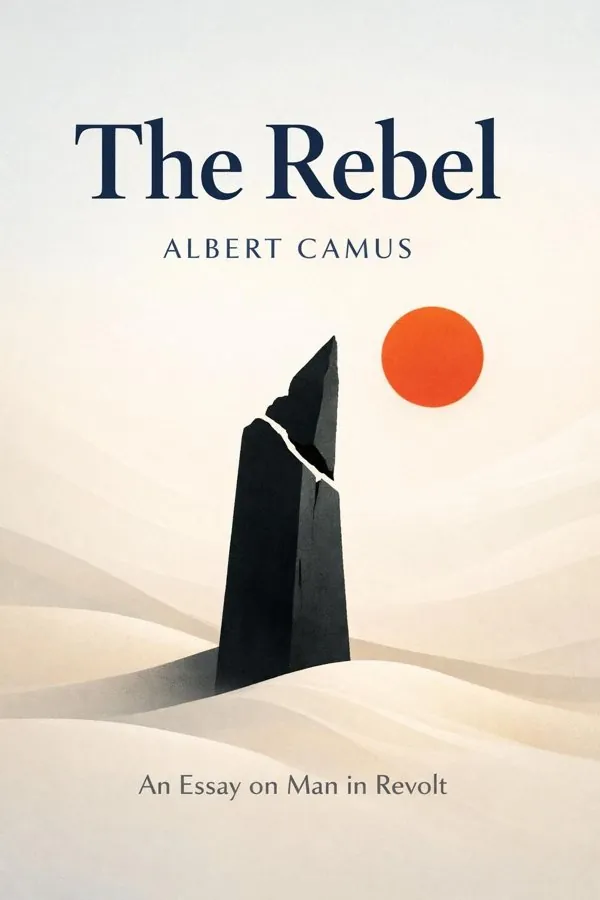
The Rebel: An Essay on Man in Revolt: Summary & Key Insights
by Albert Camus
 10 min9 chaptersAudio available
Key Takeaways from The Rebel: An Essay on Man in Revolt
Every true rebellion starts with a boundary.
When human beings can no longer accept divine explanations for suffering, rebellion expands from protest into worldview.
A rebellion changes character the moment it becomes historical.
Ideas become dangerous when they claim history is on their side.
When rebellion loses its connection to shared human value, it collapses into nihilism.
What Is The Rebel: An Essay on Man in Revolt About?
The Rebel: An Essay on Man in Revolt by Albert Camus is a western_phil book spanning 8 pages. First published in 1951, The Rebel is Albert Camus’s sweeping philosophical inquiry into why human beings revolt—and what happens when that revolt loses its moral limits. Beginning with the individual’s refusal to accept humiliation, suffering, or meaningless injustice, Camus traces rebellion from its intimate, existential origins to its political and historical consequences. He asks a difficult question that remains urgent today: when we reject oppression, how do we avoid becoming oppressors ourselves? The book matters because it speaks directly to modern crises of ideology, violence, polarization, and moral confusion. Camus examines the path from metaphysical protest against fate and God to revolutionary movements that, in the name of justice, justify terror and murder. Against both passive resignation and destructive absolutism, he argues for an ethic of measure, solidarity, and human limits. Camus writes with unusual authority because he was not only a novelist and philosopher, but also a journalist shaped by war, fascism, resistance, and the political upheavals of the twentieth century. The Rebel is one of his boldest and most enduring works: a defense of freedom that refuses nihilism and a call to rebel without losing one’s humanity.
This FizzRead summary covers all 9 key chapters of The Rebel: An Essay on Man in Revolt in approximately 10 minutes, distilling the most important ideas, arguments, and takeaways from Albert Camus's work. Also available as an audio summary and Key Quotes Podcast.
The Rebel: An Essay on Man in Revolt
First published in 1951, The Rebel is Albert Camus’s sweeping philosophical inquiry into why human beings revolt—and what happens when that revolt loses its moral limits. Beginning with the individual’s refusal to accept humiliation, suffering, or meaningless injustice, Camus traces rebellion from its intimate, existential origins to its political and historical consequences. He asks a difficult question that remains urgent today: when we reject oppression, how do we avoid becoming oppressors ourselves?
The book matters because it speaks directly to modern crises of ideology, violence, polarization, and moral confusion. Camus examines the path from metaphysical protest against fate and God to revolutionary movements that, in the name of justice, justify terror and murder. Against both passive resignation and destructive absolutism, he argues for an ethic of measure, solidarity, and human limits.
Camus writes with unusual authority because he was not only a novelist and philosopher, but also a journalist shaped by war, fascism, resistance, and the political upheavals of the twentieth century. The Rebel is one of his boldest and most enduring works: a defense of freedom that refuses nihilism and a call to rebel without losing one’s humanity.
Who Should Read The Rebel: An Essay on Man in Revolt?
This book is perfect for anyone interested in western_phil and looking to gain actionable insights in a short read. Whether you're a student, professional, or lifelong learner, the key ideas from The Rebel: An Essay on Man in Revolt by Albert Camus will help you think differently.
- ✓Readers who enjoy western_phil and want practical takeaways
- ✓Professionals looking to apply new ideas to their work and life
- ✓Anyone who wants the core insights of The Rebel: An Essay on Man in Revolt in just 10 minutes
Want the full summary?
Get instant access to this book summary and 100K+ more with Fizz Moment.
Get Free SummaryAvailable on App Store • Free to download
Key Chapters
Every true rebellion starts with a boundary. Before rebellion becomes political, organized, or historical, it begins in a deeply personal moment when someone says: this is intolerable. For Camus, this first revolt is metaphysical because it arises not only against a ruler or institution, but against the conditions of existence itself—suffering, injustice, mortality, and the silence of the universe.
The rebel is not simply complaining. He is asserting that there is something in him, and by extension in all human beings, that deserves respect. That is why rebellion contains both a “no” and a hidden “yes.” It rejects humiliation, but it also affirms a value: dignity, justice, or shared humanity. In this sense, rebellion is different from resentment or destruction. It is a protest rooted in an intuition that some line should not be crossed.
This matters because many modern conflicts begin with legitimate outrage yet become confused about what they are defending. An employee who speaks up against exploitation, a citizen who resists censorship, or a student who challenges degrading treatment is not only opposing a condition; each is implicitly claiming that human beings are not objects to be used.
Camus’s insight is practical: if your resistance does not protect any value, it can become pure negativity. If you cannot say what dignity, freedom, or fairness you are defending, your rebellion risks hardening into anger for its own sake.
Actionable takeaway: when you oppose something, name the human value you are trying to preserve. A rebellion with a clear moral center is less likely to turn into mere destruction.
A rebellion changes character the moment it becomes historical. What begins as an individual refusal of humiliation can develop into a collective movement aiming to transform society. Camus follows this transition closely because it marks the point at which revolt gains power—and also becomes vulnerable to corruption.
Personal rebellion is anchored in lived injustice: a worker refuses degradation, a prisoner resists torture, a citizen protests oppression. Collective revolution, however, introduces strategy, institutions, leaders, ideology, and long-term goals. The rebel who once defended concrete human dignity may now justify abstract plans for a future paradise. In that shift, means begin to matter less than ends.
Camus does not reject political struggle. He understands that injustice is often structural and cannot be solved by private protest alone. But he insists that revolution becomes dangerous when it forgets its original source in shared human suffering. Once movements begin sacrificing living people for historical destiny, rebellion has betrayed itself.
This is easy to recognize in both history and daily organizations. A reform movement within a company may begin by demanding humane treatment, then evolve into internal purges and ideological loyalty tests. A political cause may start by defending the vulnerable, only to silence dissent in the name of unity. The larger the movement, the stronger the temptation to excuse cruelty as necessary.
For Camus, the test is simple: does the movement still protect the human beings in whose name it arose? If not, it has ceased to be rebellion and become domination under a new banner.
Actionable takeaway: when joining a cause, regularly compare its methods to its original moral purpose. If the movement sacrifices actual people for abstract promises, it is time to question its direction.
Ideas become dangerous when they claim history is on their side. Camus argues that many revolutions begin with a legitimate hunger for justice but drift toward terror once they believe they possess absolute truth. If a movement sees itself as the agent of destiny, then opponents are no longer fellow humans to persuade; they become obstacles to eliminate.
This is the central logic Camus exposes: if the future is sacred, then present suffering can be excused. Murder becomes “necessary.” Lies become “strategic.” Repression becomes “transitional.” In this framework, ethical limits are dismissed as sentimental or counterrevolutionary. The dream of total justice ends by licensing total violence.
Camus is especially sharp in showing how revolutionary thought can become theological in secular form. Instead of salvation after death, it promises redemption through history. Instead of heresy, it punishes dissent. Instead of God, it worships the inevitable triumph of the cause. The structure of fanaticism survives even when religion is rejected.
This pattern appears far beyond formal revolutions. In workplaces, activist communities, or online culture, people often justify harmful tactics because the stakes feel morally absolute. Public shaming, dehumanization, and ideological purges are easier to rationalize when one believes the cause itself guarantees righteousness.
Camus’s response is not passivity but restraint. Justice must remain tied to limits, because once any cause claims permission to do anything, it has already abandoned justice.
Actionable takeaway: distrust any ideology that asks you to suspend ordinary morality for a higher end. If a movement says cruelty is acceptable because history will vindicate it, that is a signal to step back and reexamine everything.
When rebellion loses its connection to shared human value, it collapses into nihilism. Camus defines nihilism not merely as despair, but as the belief that nothing has inherent worth and therefore everything is permitted. At first glance, nihilism may appear radical and liberating: if there is no ultimate meaning, no moral law, no fixed truth, then all limits seem arbitrary. But Camus sees that this freedom quickly becomes empty and violent.
The original rebel says no to humiliation because something matters. The nihilist says no because nothing matters. That difference is decisive. Rebellion aims to defend dignity; nihilism dissolves the grounds for dignity altogether. Once values are denied, murder can appear no more significant than mercy, and power fills the vacuum left by meaning.
Camus explores how this descent occurs in modern thought and politics. A person or movement may begin by rejecting hypocrisy and false ideals, but if that rejection becomes universal, it erases the very standards needed to judge injustice. In personal life, this can look like cynicism disguised as realism: believing all institutions are corrupt, all motives selfish, all morality manipulative. Such thinking often leads not to honesty, but to apathy or cruelty.
A practical example is the manager who insists “everyone is out for themselves,” then uses that belief to justify exploitation. Or the citizen who believes “all politicians lie,” and therefore gives up on civic responsibility entirely. In each case, nihilism becomes a permission slip.
Camus insists that rebellion must resist this temptation. Even in an absurd world, we can affirm limits and solidarity.
Actionable takeaway: when criticism turns into blanket cynicism, pause and identify one value you still refuse to surrender—fairness, honesty, compassion, or human dignity. That refusal is the beginning of meaningful resistance.
Art is one of Camus’s most original answers to the problem of revolt. Where political revolution often seeks to remake the world through force, art rebels by giving shape, coherence, and measure to human experience. The artist does not deny chaos, suffering, or contradiction; instead, he wrestles them into form. In that act, Camus sees a model of rebellion that resists both submission and destruction.
To create is to say that reality, though fractured, is still worth engaging. A novel, painting, poem, or song does not solve injustice directly, but it preserves human meaning against absurdity and erasure. Art refuses the world as it is, yet does not annihilate it. It selects, orders, and transforms. This is why Camus values artistic rebellion: it demonstrates that one can oppose reality without claiming the right to dominate or destroy everything.
This idea has practical force even outside the arts. A teacher crafting a humane classroom culture, a community organizer building rituals of solidarity, or a parent creating stability in a chaotic home is also giving form to disorder. They are not merely protesting what is wrong; they are making something livable.
Camus also warns that art fails when it becomes pure propaganda or pure negation. If it serves only ideology, it loses freedom. If it celebrates only fragmentation, it abandons communication. Great art balances protest with form, freedom with limits.
Actionable takeaway: don’t let resistance remain purely reactive. Create something—a conversation space, a written reflection, a work of art, a better process—that embodies the world you want to defend. Constructive form is a powerful kind of revolt.
The most important word in The Rebel may be limit. Camus believes rebellion is morally meaningful only when it recognizes boundaries it must not cross. The rebel says, “This far and no further,” but that phrase must apply to the rebel as well. Without limits, revolt turns into conquest; with limits, it remains faithful to justice.
Camus opposes the fantasy of total solutions. Human beings are finite, societies are imperfect, and history does not grant us purity. That is why moderation, for him, is not weakness but courage. It takes strength to refuse both submission and excess, to fight injustice without becoming intoxicated by absolute power. Measure protects us from the political and moral disasters produced by all-or-nothing thinking.
In practice, this means resisting the urge to justify dehumanization for a good cause. It means accepting compromise when compromise preserves human lives and freedoms. It means understanding that not every victory is worth its cost. In organizations, leaders who operate with measure build trust: they enforce standards without humiliation, pursue change without scapegoating, and remain accountable even when convinced of their own rightness.
Modern culture often rewards extremity because it looks decisive and pure. Camus reminds us that purity can be murderous when translated into politics. Measured action may look less dramatic, but it is more humane and more durable.
Actionable takeaway: define your non-negotiable ethical limits before conflict escalates. Decide in advance what you will not do—even for a cause you believe in. Limits are easiest to defend before passion and certainty take over.
A rebel discovers that suffering is never purely private. One of Camus’s deepest insights is that revolt reveals a common human condition. When an individual resists injustice, he does not merely assert himself; he recognizes a bond with others who suffer the same degradation. In this sense, rebellion is not the celebration of ego but the birth of solidarity.
This distinguishes Camus from purely individualist philosophies. The rebel says, in effect, “I refuse this treatment because no human being should endure it.” That movement from “I” to “we” is the ethical core of his thought. It is also what keeps revolt from becoming selfish rage. Shared dignity, not private grievance, gives rebellion its legitimacy.
This idea matters in contemporary life because many conflicts become trapped in personal identity, status competition, or symbolic performance. Camus asks us to move beyond self-display toward common cause. A campaign for fair wages, for instance, succeeds when workers recognize one another’s vulnerability, not only their own frustrations. A movement against discrimination becomes stronger when it defends universal dignity rather than merely reversing who gets excluded.
Solidarity also requires humility. You do not need to suffer exactly as others do in order to stand with them. But you do need to listen, to refuse indifference, and to reject systems that divide people into disposable and protected classes.
Actionable takeaway: turn private frustration into shared responsibility. The next time you encounter injustice, ask not only “How does this affect me?” but “Who else is being diminished here, and how can we respond together?”
All Chapters in The Rebel: An Essay on Man in Revolt
About the Author
Albert Camus (1913–1960) was a French-Algerian writer, essayist, novelist, and journalist whose work shaped twentieth-century moral and philosophical thought. Born in Mondovi, Algeria, and raised in poverty, he developed a lifelong sensitivity to injustice, human suffering, and political violence. He became widely known for works such as The Stranger, The Plague, The Myth of Sisyphus, and The Rebel, which explore the absurd, freedom, rebellion, and ethical responsibility. Though often linked to existentialism, Camus followed an independent path, emphasizing clarity, limits, and human dignity over abstraction and ideological certainty. During World War II, he was active in the French Resistance and worked as an editor for the underground newspaper Combat. In 1957, he received the Nobel Prize in Literature for illuminating “the problems of the human conscience.”
Get This Summary in Your Preferred Format
Read or listen to the The Rebel: An Essay on Man in Revolt summary by Albert Camus anytime, anywhere. FizzRead offers multiple formats so you can learn on your terms — all free.
Available formats: App · Audio · PDF · EPUB — All included free with FizzRead
Download The Rebel: An Essay on Man in Revolt PDF and EPUB Summary
Key Quotes from The Rebel: An Essay on Man in Revolt
“Every true rebellion starts with a boundary.”
“When human beings can no longer accept divine explanations for suffering, rebellion expands from protest into worldview.”
“A rebellion changes character the moment it becomes historical.”
“Ideas become dangerous when they claim history is on their side.”
“When rebellion loses its connection to shared human value, it collapses into nihilism.”
Frequently Asked Questions about The Rebel: An Essay on Man in Revolt
The Rebel: An Essay on Man in Revolt by Albert Camus is a western_phil book that explores key ideas across 9 chapters. First published in 1951, The Rebel is Albert Camus’s sweeping philosophical inquiry into why human beings revolt—and what happens when that revolt loses its moral limits. Beginning with the individual’s refusal to accept humiliation, suffering, or meaningless injustice, Camus traces rebellion from its intimate, existential origins to its political and historical consequences. He asks a difficult question that remains urgent today: when we reject oppression, how do we avoid becoming oppressors ourselves? The book matters because it speaks directly to modern crises of ideology, violence, polarization, and moral confusion. Camus examines the path from metaphysical protest against fate and God to revolutionary movements that, in the name of justice, justify terror and murder. Against both passive resignation and destructive absolutism, he argues for an ethic of measure, solidarity, and human limits. Camus writes with unusual authority because he was not only a novelist and philosopher, but also a journalist shaped by war, fascism, resistance, and the political upheavals of the twentieth century. The Rebel is one of his boldest and most enduring works: a defense of freedom that refuses nihilism and a call to rebel without losing one’s humanity.
More by Albert Camus



You Might Also Like
A Little History of Philosophy
Nigel Warburton
10 min
Areopagitica
John Milton
10 min
How To Think Like A Philosopher: Essential Principles For Clear Thinking
Peter Cave
10 min
Language, Truth and Logic
A. J. Ayer
10 min
The Age of Reason
Thomas Paine
10 min
The Essays
Michel De Montaigne
10 minBrowse by Category
Ready to read The Rebel: An Essay on Man in Revolt?
Get the full summary and 100K+ more books with Fizz Moment.