
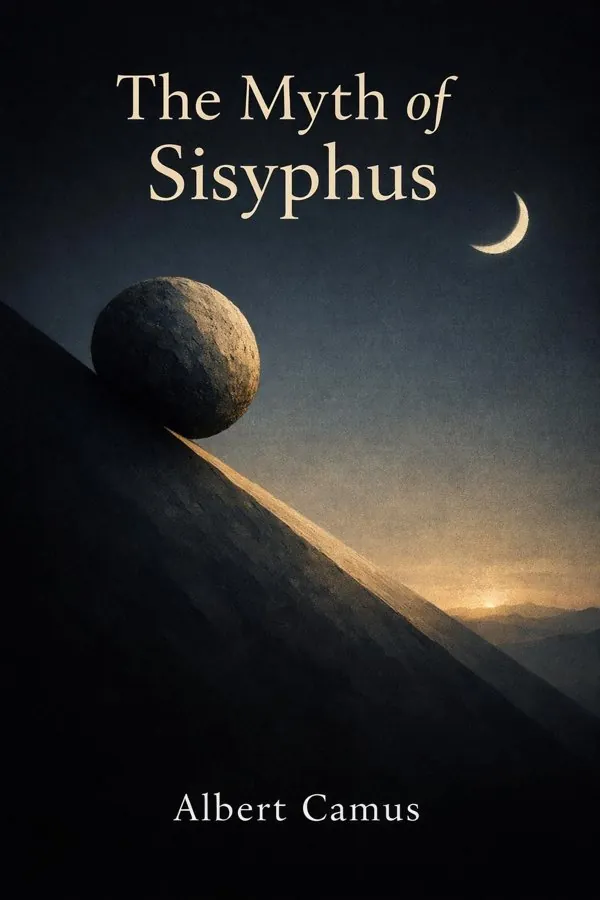
The Myth of Sisyphus: Summary & Key Insights
by Albert Camus
 10 min9 chaptersAudio available
Key Takeaways from The Myth of Sisyphus
The absurd does not arrive as a theory; it arrives as a shock.
A philosophy proves its seriousness by the questions it dares to face.
Some escapes wear the mask of depth.
When ultimate meaning disappears, something unexpected becomes available: freedom.
If the absurd rules out final meaning, what kind of person should we become?
What Is The Myth of Sisyphus About?
The Myth of Sisyphus by Albert Camus is a western_phil book spanning 8 pages. What do you do when life refuses to explain itself? In The Myth of Sisyphus, Albert Camus confronts that question with unusual honesty and courage. First published in 1942, this philosophical essay begins from what Camus calls the only truly serious philosophical problem: whether life is worth living. Rather than turning to religion, idealism, or comforting systems, he examines the tension between our hunger for meaning and the universe’s apparent indifference. That tension, for Camus, is the absurd. The book matters because it speaks directly to modern experience: the feeling of routine, disillusionment, uncertainty, and the collapse of inherited certainties. Yet Camus does not end in despair. He argues that once we recognize the absurd clearly, we can live more freely, intensely, and honestly. Using literary criticism, philosophical debate, and the unforgettable image of Sisyphus endlessly pushing his rock uphill, Camus offers not a solution to life’s mystery, but a way to face it without self-deception. Few books ask such a bleak question and arrive at such a defiant, life-affirming answer.
This FizzRead summary covers all 9 key chapters of The Myth of Sisyphus in approximately 10 minutes, distilling the most important ideas, arguments, and takeaways from Albert Camus's work. Also available as an audio summary and Key Quotes Podcast.
The Myth of Sisyphus
What do you do when life refuses to explain itself? In The Myth of Sisyphus, Albert Camus confronts that question with unusual honesty and courage. First published in 1942, this philosophical essay begins from what Camus calls the only truly serious philosophical problem: whether life is worth living. Rather than turning to religion, idealism, or comforting systems, he examines the tension between our hunger for meaning and the universe’s apparent indifference. That tension, for Camus, is the absurd. The book matters because it speaks directly to modern experience: the feeling of routine, disillusionment, uncertainty, and the collapse of inherited certainties. Yet Camus does not end in despair. He argues that once we recognize the absurd clearly, we can live more freely, intensely, and honestly. Using literary criticism, philosophical debate, and the unforgettable image of Sisyphus endlessly pushing his rock uphill, Camus offers not a solution to life’s mystery, but a way to face it without self-deception. Few books ask such a bleak question and arrive at such a defiant, life-affirming answer.
Who Should Read The Myth of Sisyphus?
This book is perfect for anyone interested in western_phil and looking to gain actionable insights in a short read. Whether you're a student, professional, or lifelong learner, the key ideas from The Myth of Sisyphus by Albert Camus will help you think differently.
- ✓Readers who enjoy western_phil and want practical takeaways
- ✓Professionals looking to apply new ideas to their work and life
- ✓Anyone who wants the core insights of The Myth of Sisyphus in just 10 minutes
Want the full summary?
Get instant access to this book summary and 100K+ more with Fizz Moment.
Get Free SummaryAvailable on App Store • Free to download
Key Chapters
The absurd does not arrive as a theory; it arrives as a shock. Camus says it emerges in those moments when habit breaks down and the world suddenly appears unfamiliar. You wake up, go to work, answer emails, repeat routines, and then one day a question interrupts the machinery: why am I doing any of this? That rupture is not just boredom. It is the clash between the human demand for meaning, order, and explanation and the world’s silence. We want reasons; the universe offers facts. We seek moral architecture; reality gives us contingency, chance, and death.
Camus is careful here. The absurd is not located only in the world, as if reality itself were inherently meaningless. Nor is it only in the mind. It arises in the confrontation between a questioning consciousness and a mute universe. This means the absurd is relational. It lives in the gap between our expectations and what existence can provide.
This insight matters because many people respond to crisis by immediately covering it over. They distract themselves, adopt inherited beliefs without examination, or keep moving fast enough to avoid asking ultimate questions. Camus asks for the opposite: lucid attention. A breakup, a job loss, a diagnosis, or even a quiet Sunday afternoon can expose the absurd. Instead of treating such moments as failures, he treats them as awakenings.
In practical terms, this means noticing where your life runs on automatic. When routine feels empty, don’t rush to numb the feeling. Ask what you are expecting life to guarantee. Your actionable takeaway: identify one recurring activity this week that feels mechanical, and spend ten honest minutes asking what meaning you assume it should provide.
A philosophy proves its seriousness by the questions it dares to face. Camus opens The Myth of Sisyphus with a startling claim: there is only one truly serious philosophical problem, and that is suicide. If life has no ultimate meaning, is it still worth living? He refuses to treat this as a rhetorical flourish. For him, metaphysical ideas matter only if they touch lived experience. A philosophy that explains everything except why one should continue living has avoided the essential issue.
Camus does not romanticize despair. He is not encouraging self-destruction; he is testing whether the recognition of absurdity logically leads to it. His answer is no. Suicide, in his view, is not a resolution of the absurd but an escape from it. It removes one side of the confrontation: the conscious human being. If absurdity is born from the meeting of mind and world, then ending life ends the tension by eliminating the one who experiences it. That is not a victory of truth but a refusal to continue the struggle.
This point remains relevant today, especially in an age of burnout, loneliness, and crisis. Many people quietly ask whether effort is worthwhile when certainty is unavailable. Camus insists that the absence of cosmic meaning does not invalidate living. On the contrary, it calls for a more direct engagement with life as it is.
Practically, this idea invites us to distinguish between a life that lacks final answers and a life that lacks value. They are not the same. You do not need a universal script to justify your next act of courage, kindness, or attention. Your actionable takeaway: when you feel trapped by the question of life’s meaning, replace “What is the point of everything?” with “What is one reason to remain present today?”
Some escapes wear the mask of depth. Camus argues that many philosophers and religious thinkers, after recognizing the absurd, retreat into what he calls philosophical suicide. Instead of staying with the tension between human longing and the world’s silence, they leap toward transcendence, hidden purpose, or divine order. Thinkers such as Kierkegaard, Jaspers, and others, in Camus’s reading, honestly confront the limits of reason but then restore meaning through faith, mystery, or metaphysical hope.
Why call this suicide? Because it sacrifices intellectual honesty. It kills the very lucidity that first discovered the absurd. Camus is not dismissing religion out of arrogance or cynicism. His point is narrower and sharper: if we claim to be examining life without illusion, we cannot then smuggle in a comforting explanation simply because the alternative is difficult to bear. A leap beyond evidence may soothe anxiety, but it abandons the original confrontation.
This critique applies far beyond formal philosophy. People perform philosophical suicide whenever they use grand stories to avoid reality: “Everything happens for a reason,” “Success will finally make my life meaningful,” or “History guarantees justice in the end.” Such beliefs may offer temporary relief, but they can also prevent direct contact with the actual conditions of life.
Camus proposes a discipline of refusal. Refuse easy endings. Refuse the temptation to turn mystery into certainty. Refuse narratives that ask you to deny what you honestly know. In modern life, this might mean resisting productivity myths, ideological certainty, or spiritual slogans that erase grief and ambiguity. Your actionable takeaway: notice one belief you use primarily for comfort, and ask whether it arises from evidence, experience, or fear of uncertainty.
When ultimate meaning disappears, something unexpected becomes available: freedom. Camus argues that once we stop believing life is governed by a fixed higher purpose, we are no longer measured against a cosmic script. That loss can feel terrifying at first. If nothing is guaranteed, if no destiny justifies our choices, then responsibility lands fully on us. Yet this very absence of transcendental command opens a distinct form of liberty.
Absurd freedom does not mean anything goes in a shallow or reckless sense. It means that we are released from the need to conform our lives to some imagined final plan. The person waiting for a divine blueprint, historical necessity, or predetermined identity often postpones living. Camus invites us to stop waiting. Freedom begins when we accept that no final tribunal will explain our existence for us.
This has practical consequences. A professional may leave a prestigious but deadening career not because a larger destiny calls, but because lucidity reveals the cost of continuing. A student may choose a path based on lived conviction rather than inherited expectation. A parent may stop demanding that every sacrifice fit a grand narrative and instead value love as a lived act in the present.
For Camus, freedom becomes deeper when we stop asking life to justify itself in advance. The future remains uncertain, but the present becomes more available. You do not need absolute certainty to make meaningful choices; you need awareness, courage, and ownership.
Your actionable takeaway: identify one decision you have delayed while waiting for perfect certainty or permission. Make the smallest concrete move toward it this week, accepting that clarity often follows action rather than preceding it.
If the absurd rules out final meaning, what kind of person should we become? Camus answers with the figure of the absurd man: someone who lives without appeal, without illusion, and without resignation. This person does not deny death, suffering, or uncertainty. He lives more fully because he no longer expects the world to redeem them. Lucidity becomes a source of vitality.
The absurd man rejects both despair and hope understood as deferred salvation. He does not live for eternity, for moral accounting in another world, or for a final philosophical resolution. Instead, he values multiplicity of experience, clarity of consciousness, and fidelity to the present. To know that life is limited is, for Camus, to become more alert to its texture.
This is not hedonism in the crude sense. Camus is not saying “seek pleasure at all costs.” He is saying that once we stop living for abstractions, we can inhabit our actual days more intensely. The absurd man pays attention. He loves, works, creates, walks, argues, and suffers without pretending these activities add up to an eternal meaning. Their value is lived, not guaranteed.
In everyday terms, this can look like trading performative ambition for direct engagement: reading because it sharpens you, not because it enhances your image; spending time with friends because the encounter matters, not because it serves a life plan. The absurd life is measured by presence, not metaphysical success.
Your actionable takeaway: choose one ordinary experience today, such as a meal, a conversation, or a walk, and give it your full undivided attention without trying to turn it into productivity, self-improvement, or a stepping-stone to something else.
Camus uses literary and symbolic figures to show how absurd living might take shape, and one of the most provocative is Don Juan. Rather than treating him merely as a seducer, Camus reads Don Juan as a man who refuses the illusion of a single ultimate fulfillment. He does not seek one eternal love that redeems all others. He embraces plurality, repetition, and the finite intensity of each encounter.
The deeper point is not about romance alone. Don Juan represents a life that values the richness of moments over the fantasy of final completion. Camus contrasts this with the common human desire for permanence: one perfect career, one final identity, one relationship that settles all restlessness. The absurd perspective suspects such dreams. It asks us to stop burdening finite experiences with infinite expectations.
This idea can be misunderstood as a defense of superficiality. But Camus’s emphasis is not on carelessness; it is on lucidity. To appreciate an experience because it is temporary may be more honest than demanding that it last forever. In work, friendship, travel, art, and love, we often suffer not only because things end, but because we believed they were supposed to complete us.
Applied practically, this means learning to value depth without demanding permanence. A project can matter even if it ends. A season of life can be meaningful without becoming a lifelong identity. A conversation can change you without solving you.
Your actionable takeaway: think of one area where you are demanding permanence or completion from a finite experience. Loosen that expectation and ask instead, “How can I fully value what this gives me now?”
Creation becomes powerful when it stops pretending to deliver ultimate truth. Camus sees art, especially drama and fiction, as privileged expressions of the absurd because they allow us to represent experience without forcing it into final metaphysical conclusions. The artist does not solve the contradiction of existence. The artist gives it form.
For Camus, creation is an act of revolt. The absurd artist knows that reality is fragmented, transient, and resistant to complete explanation. Yet instead of yielding to silence, he shapes worlds, scenes, and characters. This is why Camus is drawn to novelists and dramatists who illuminate contradiction rather than erase it. Art honors the density of life by refusing cheap closure.
This idea matters beyond literature. In any creative act, writing, painting, designing, teaching, even building a business, we are tempted to seek validation through permanence or grand significance. Camus invites a different motive: create because the act itself is a lucid response to existence. Make something clear, beautiful, precise, or moving, not because it defeats mortality, but because it bears witness to consciousness.
In personal life, creation can also mean shaping your days. A parent arranging a ritual for dinner, a manager building a humane team culture, or a person journaling honestly through grief is engaged in form-giving. These acts do not eliminate absurdity; they answer it with style and attention.
Your actionable takeaway: start or return to one creative practice this week, however small, and approach it not as a path to immortality or approval, but as a disciplined way of responding to life with clarity and form.
Camus’s answer to the absurd is not surrender but revolt. Revolt is the ongoing refusal to submit either to despair or to illusion. It is not a one-time declaration; it is a daily stance. To live absurdly is to keep the contradiction alive: to know that life has no final justification and yet to continue engaging it fully.
Conquest, in this context, does not mean domination over others. It means gaining as much consciousness and lived intensity as possible within human limits. Camus wants us to expand life horizontally, through experience, perception, and commitment, not vertically toward transcendence. Since there is no eternal meaning waiting above us, our task is to inhabit what is here more deliberately.
This defiant posture is especially relevant in times of disappointment. When plans collapse, when institutions fail, when private hopes are frustrated, revolt means refusing both cynicism and false hope. You continue to act, care, and create, not because success is guaranteed, but because lucidity itself demands a response.
Examples are everywhere. A person who keeps telling the truth in a culture of spin practices revolt. Someone who continues to love after loss, without pretending loss is good, practices revolt. An employee who resists becoming a machine in a dehumanizing system practices revolt by preserving awareness and dignity.
Camus’s revolt is intensely personal, but it also has moral implications: to be lucid about suffering without glorifying it, to resist degradation without fantasies of final redemption. Your actionable takeaway: choose one recurring situation where you usually become passive or cynical, and decide on one conscious act of resistance that preserves your dignity and attention.
Camus’s most famous line is also his most radical: “One must imagine Sisyphus happy.” In the Greek myth, Sisyphus is condemned by the gods to push a boulder up a mountain forever, only to watch it roll back down each time he nears the summit. At first glance, this seems the perfect image of futility. Camus chooses it because it resembles ordinary human life: repetitive labor, unrealized completion, and the certainty that time undoes what we build.
But the key moment in Camus’s reading is not the climb. It is the descent, when Sisyphus walks back down the mountain fully conscious of his fate. In that interval, he knows the whole truth of his condition. And because he knows it, he is greater than it. The gods can impose the task, but they cannot dictate his inner response. His scorn, lucidity, and persistence transform punishment into a form of victory.
This is the culmination of Camus’s philosophy. Happiness is not naïve optimism or denial of hardship. It is the dignity that arises when we stop demanding that life become something other than what it is. A repetitive job, caregiving, chronic illness, failed ambitions, and daily obligations can all feel Sisyphean. Camus does not trivialize these burdens. He suggests that consciousness and defiance can make even burdened existence a site of freedom.
Your actionable takeaway: identify one burden in your life that you cannot immediately remove. Instead of asking only how to escape it, ask how you might meet it with greater lucidity, ownership, and even a touch of defiant pride.
All Chapters in The Myth of Sisyphus
About the Author
Albert Camus (1913–1960) was a French-Algerian writer, journalist, and philosopher whose work helped define twentieth-century thought. Born in Mondovi, Algeria, he grew up in modest circumstances and developed a lifelong sensitivity to injustice, suffering, and the moral complexity of political life. Though often linked with existentialism, Camus is more accurately known for his philosophy of the absurd, which examines the conflict between the human search for meaning and the world’s indifference. His major works include The Stranger, The Plague, The Rebel, and The Myth of Sisyphus. He also wrote plays, essays, and political journalism shaped by the crises of war, totalitarianism, and colonialism. In 1957, he received the Nobel Prize in Literature for illuminating the human conscience of his age. He died in a car accident in 1960.
Get This Summary in Your Preferred Format
Read or listen to the The Myth of Sisyphus summary by Albert Camus anytime, anywhere. FizzRead offers multiple formats so you can learn on your terms — all free.
Available formats: App · Audio · PDF · EPUB — All included free with FizzRead
Download The Myth of Sisyphus PDF and EPUB Summary
Key Quotes from The Myth of Sisyphus
“The absurd does not arrive as a theory; it arrives as a shock.”
“A philosophy proves its seriousness by the questions it dares to face.”
“Camus argues that many philosophers and religious thinkers, after recognizing the absurd, retreat into what he calls philosophical suicide.”
“When ultimate meaning disappears, something unexpected becomes available: freedom.”
“If the absurd rules out final meaning, what kind of person should we become?”
Frequently Asked Questions about The Myth of Sisyphus
The Myth of Sisyphus by Albert Camus is a western_phil book that explores key ideas across 9 chapters. What do you do when life refuses to explain itself? In The Myth of Sisyphus, Albert Camus confronts that question with unusual honesty and courage. First published in 1942, this philosophical essay begins from what Camus calls the only truly serious philosophical problem: whether life is worth living. Rather than turning to religion, idealism, or comforting systems, he examines the tension between our hunger for meaning and the universe’s apparent indifference. That tension, for Camus, is the absurd. The book matters because it speaks directly to modern experience: the feeling of routine, disillusionment, uncertainty, and the collapse of inherited certainties. Yet Camus does not end in despair. He argues that once we recognize the absurd clearly, we can live more freely, intensely, and honestly. Using literary criticism, philosophical debate, and the unforgettable image of Sisyphus endlessly pushing his rock uphill, Camus offers not a solution to life’s mystery, but a way to face it without self-deception. Few books ask such a bleak question and arrive at such a defiant, life-affirming answer.
More by Albert Camus
You Might Also Like
A Little History of Philosophy
Nigel Warburton
10 min
Areopagitica
John Milton
10 min
How To Think Like A Philosopher: Essential Principles For Clear Thinking
Peter Cave
10 min
Language, Truth and Logic
A. J. Ayer
10 min
The Age of Reason
Thomas Paine
10 min
The Essays
Michel De Montaigne
10 minBrowse by Category
Ready to read The Myth of Sisyphus?
Get the full summary and 100K+ more books with Fizz Moment.