
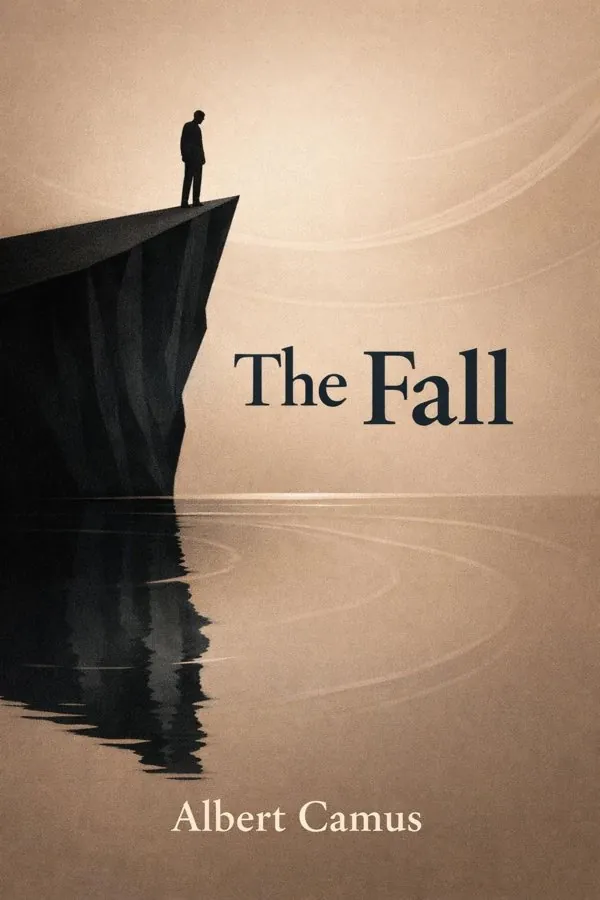
The Fall: Summary & Key Insights
by Albert Camus
 10 min9 chaptersAudio available
Key Takeaways from The Fall
One of the sharpest ideas in The Fall is that confession is not always an act of humility; sometimes it is a strategy for control.
Moral collapse rarely begins with a dramatic scandal; more often, it starts when a flattering image of ourselves stops holding together.
Sometimes a human life changes not through argument, but through a moment that cannot be explained away.
A person may discover their moral truth not in what they do, but in what they fail to do when action is required.
People are often quickest to condemn in the very areas where they feel most vulnerable.
What Is The Fall About?
The Fall by Albert Camus is a classics book spanning 7 pages. Albert Camus’s The Fall is a dark, elegant, and unsettling philosophical novel in which a former Parisian lawyer, Jean-Baptiste Clamence, speaks almost without interruption to a silent stranger in the bars and canals of Amsterdam. What begins as witty conversation slowly turns into confession, accusation, and moral trap. Clamence recounts the life he once admired in himself—successful, generous, admired by others—before exposing the vanity, cowardice, and self-deception beneath that polished surface. As his monologue deepens, the novel becomes less a story about one man’s failure than an inquiry into the hidden guilt shared by nearly everyone. First published in 1956, The Fall remains one of Camus’s most penetrating works because it strips away the comforting stories people tell about their innocence. Camus, Nobel Prize-winning author of The Stranger, The Plague, and The Myth of Sisyphus, brings extraordinary moral clarity to questions of judgment, hypocrisy, freedom, and responsibility. This is a short novel, but it leaves a long echo. It matters because it challenges readers not merely to understand Clamence, but to recognize the ways they too seek innocence while quietly judging others.
This FizzRead summary covers all 9 key chapters of The Fall in approximately 10 minutes, distilling the most important ideas, arguments, and takeaways from Albert Camus's work. Also available as an audio summary and Key Quotes Podcast.
The Fall
Albert Camus’s The Fall is a dark, elegant, and unsettling philosophical novel in which a former Parisian lawyer, Jean-Baptiste Clamence, speaks almost without interruption to a silent stranger in the bars and canals of Amsterdam. What begins as witty conversation slowly turns into confession, accusation, and moral trap. Clamence recounts the life he once admired in himself—successful, generous, admired by others—before exposing the vanity, cowardice, and self-deception beneath that polished surface. As his monologue deepens, the novel becomes less a story about one man’s failure than an inquiry into the hidden guilt shared by nearly everyone.
First published in 1956, The Fall remains one of Camus’s most penetrating works because it strips away the comforting stories people tell about their innocence. Camus, Nobel Prize-winning author of The Stranger, The Plague, and The Myth of Sisyphus, brings extraordinary moral clarity to questions of judgment, hypocrisy, freedom, and responsibility. This is a short novel, but it leaves a long echo. It matters because it challenges readers not merely to understand Clamence, but to recognize the ways they too seek innocence while quietly judging others.
Who Should Read The Fall?
This book is perfect for anyone interested in classics and looking to gain actionable insights in a short read. Whether you're a student, professional, or lifelong learner, the key ideas from The Fall by Albert Camus will help you think differently.
- ✓Readers who enjoy classics and want practical takeaways
- ✓Professionals looking to apply new ideas to their work and life
- ✓Anyone who wants the core insights of The Fall in just 10 minutes
Want the full summary?
Get instant access to this book summary and 100K+ more with Fizz Moment.
Get Free SummaryAvailable on App Store • Free to download
Key Chapters
One of the sharpest ideas in The Fall is that confession is not always an act of humility; sometimes it is a strategy for control. Jean-Baptiste Clamence appears to be exposing himself honestly. He tells the stranger in the Amsterdam bar about his vanity, his moral failures, and the collapse of the noble self-image he once cherished. At first, this seems admirable. We tend to trust people who admit their weaknesses. Yet Camus gradually reveals that Clamence’s confession is deeply manipulative. By accusing himself first, he gains the upper hand. He becomes the one who defines the terms of guilt, innocence, and judgment.
Clamence calls himself a “judge-penitent,” a phrase that captures the paradox at the heart of the book. He presents himself as guilty, but in doing so he also places everyone else under the same indictment. His self-criticism becomes a way of implicating others. If he is corrupt, then so are you. If he is vain, then your virtues may be performance too. The confession is not cleansing; it is contagious.
This insight has clear relevance beyond literature. In public life, people often confess strategically. A leader admits a small fault to avoid deeper accountability. A friend reveals just enough vulnerability to appear trustworthy while still steering the emotional conversation. Even in our own lives, we may “own” our flaws in ways that preserve our superiority: we confess, but we do not truly change.
Camus asks us to examine whether our honesty actually opens us to responsibility or simply helps us manage how others see us. The actionable takeaway: when you confess a mistake, ask yourself whether you are seeking truth, sympathy, or control—and aim for truth before anything else.
Moral collapse rarely begins with a dramatic scandal; more often, it starts when a flattering image of ourselves stops holding together. Before his downfall, Clamence sees himself as exceptionally virtuous. He is successful, charming, generous, and admired. He helps the blind cross the street, gives up his seat, defends the weak, and enjoys being known as a man of conscience. But Camus’s brilliance lies in showing that Clamence’s goodness is mixed with performance. He does not simply do good; he enjoys watching himself do good.
The “fall” of the title is therefore not only a moral event but also a psychological one. Clamence falls from the pedestal of self-approval. His crisis begins when he can no longer ignore the possibility that his virtue depended on applause, even silent applause. Once that realization appears, his whole identity starts to unravel. If his generosity was vanity, if his kindness was theater, then who is he really?
This is an uncomfortable but useful idea. Many people build identities around being competent, ethical, caring, or enlightened. These may be real qualities, but they can become dangerous when they harden into self-congratulation. The problem is not having values. The problem is needing those values to prove our superiority.
A practical example is workplace behavior. Someone may volunteer for difficult tasks and seem indispensable, but privately resent others for not noticing enough. Another person may present as compassionate in relationships while quietly keeping score. The actions may still help others, but the hidden need for admiration makes the identity fragile.
The lesson is not to abandon ideals, but to hold them with less vanity. The actionable takeaway: identify one trait you are proud of, then ask how much of it depends on recognition from others—use that answer to practice a quieter, less performative version of the same virtue.
Sometimes a human life changes not through argument, but through a moment that cannot be explained away. In The Fall, one such turning point comes when Clamence hears laughter behind him on a bridge after an evening in Paris. No one is clearly identified, and the source remains uncertain, but the moment wounds him deeply. Why? Because the laugh seems to expose him. It punctures the dignified image he holds of himself and introduces a new possibility: perhaps he is not admirable at all, perhaps he is ridiculous.
Camus uses this mysterious laugh as a symbol of self-consciousness and judgment. It functions like a sudden awakening. Clamence realizes that identity is never secured from within alone. We imagine ourselves stable, coherent, and justified, but a glance, a reaction, or an unforeseen event can reveal how dependent we are on the approval of others. The laugh is devastating because it sounds like truth arriving from outside the self.
This experience is familiar in ordinary life. A confident speech feels polished until someone smirks and the speaker loses composure. A carefully curated public persona can collapse after one criticism that hits too close to home. Even social media works this way: praise can inflate self-image, but ridicule can expose how fragile that image was all along.
Yet Camus does not simply warn us about embarrassment. He shows that these moments can become invitations to honesty. When certainty cracks, we can either become defensive or grow more aware. Clamence moves toward bitterness and accusation, but the reader can choose differently.
The practical application is simple: when a moment of criticism or humiliation unsettles you, resist the urge to react immediately. Instead, ask what part of your self-image feels threatened and why. The actionable takeaway: treat moments of discomfort not as proof that you are worthless, but as opportunities to discover where your identity depends too heavily on appearances.
A person may discover their moral truth not in what they do, but in what they fail to do when action is required. The defining wound in Clamence’s life occurs when he hears a woman fall into the water from a bridge at night and does nothing to save her. He hears the splash, hears the cries, and walks on. This moment is central to The Fall because it shatters the difference between the man Clamence imagined himself to be and the man he actually was when confronted by urgency, fear, and risk.
Camus does not treat the scene as melodrama. Its power lies in its simplicity. Clamence was once certain of his generosity and courage, but in the decisive instant he fails. Afterward, he cannot return to his old innocence. The event becomes an internal tribunal. His guilt is not abstract philosophy; it is tied to a concrete omission. He did not push someone into the river. He did something more ordinary and, in Camus’s world, more revealing: he remained passive.
This matters because many moral failures in daily life are failures of omission. We stay silent when someone is humiliated. We ignore a friend’s distress because involvement would be inconvenient. We avoid intervening in unfair situations because we fear conflict. These are not dramatic crimes, yet they shape character.
Clamence’s torment shows that conscience often remembers what pride wants to forget. We cannot always act perfectly, but we can become more alert to the moments that test who we are. The right action is often uncomfortable, inconvenient, or unglamorous.
The actionable takeaway: think of one situation in which you usually remain passive—at work, in friendship, or in public—and decide in advance what concrete action you will take the next time responsibility appears.
People are often quickest to condemn in the very areas where they feel most vulnerable. Clamence’s transformation into a “judge-penitent” reveals how judgment can become self-defense. Once he has recognized his own hypocrisy and cowardice, he does not become gentler. Instead, he becomes more universal in his accusation. He concludes that everyone is guilty, everyone is compromised, everyone deserves judgment. This worldview allows him to live with himself. If no one is innocent, then his own failure loses its exceptional sting.
Camus exposes a pattern that remains common. When individuals feel inwardly ashamed, they may seek relief by broadening the circle of blame. In personal relationships, someone who has acted selfishly begins criticizing everyone else’s selfishness. In politics, public outrage can become a way of avoiding self-examination. In moral discourse, people often denounce corruption while remaining uninterested in the subtler forms of corruption inside their own motives.
The disturbing brilliance of Clamence is that he is not entirely wrong. Human beings are compromised. We are inconsistent, mixed in motive, and often less good than we appear. But Camus shows the danger of turning that truth into a system of superiority. Universal guilt can become an excuse for private evasion. If everyone is guilty, then no one needs to repent in any meaningful way.
A healthier response is to let awareness of human weakness produce humility rather than cynical domination. We can recognize that others fail without using that fact to protect our ego. This changes the tone of how we speak, argue, and evaluate.
The actionable takeaway: the next time you feel eager to criticize someone, pause and ask whether the issue touches a flaw you dislike in yourself—then let that recognition make your response more honest, specific, and compassionate.
Places in literature often do more than provide scenery; they reveal the inner shape of a character’s mind. In The Fall, Amsterdam is not just a setting but a moral landscape. Its fog, canals, dampness, and low-lying geography create an atmosphere of descent, enclosure, and unease. Clamence, once a celebrated lawyer in bright, socially vibrant Paris, now lives in a city below sea level, surrounded by water and shadow. The move is symbolic. He has descended from public brilliance into a colder, murkier awareness of himself.
Camus uses this environment to intensify the novel’s themes of guilt and judgment. The canals suggest both drowning and reflection. The city’s flatness and confinement echo Clamence’s mental condition: there is no lofty moral ground left to stand on. Even the bars where he speaks feel like stations of exile, places where the past is retold not to recover innocence but to relive condemnation.
This connection between place and psychology has practical resonance. Our environments influence how we think and feel. Certain spaces invite honesty; others reinforce performance. A quiet walk can expose thoughts that busyness suppresses. A cluttered room can mirror mental confusion. A city, workplace, or social circle can sustain an identity long after it has become false.
Camus encourages readers to notice how external surroundings interact with inner life. If Clamence had remained in the polished world where he was admired, he might never have confronted himself. Amsterdam, bleak as it is, becomes the fitting stage for self-revelation.
The actionable takeaway: examine one environment you inhabit regularly and ask what version of yourself it reinforces—then intentionally create or seek out spaces that support honesty, reflection, and moral clarity rather than image management.
One of Camus’s most unsettling claims in The Fall is that innocence is not a stable possession but a fragile illusion people desperately try to maintain. Clamence once lived as if he were securely on the side of justice. He defended causes, behaved courteously, and enjoyed moral prestige. Yet his crisis reveals that innocence can be less a fact than a narrative—a story we tell to organize our behavior and protect our self-respect.
The novel does not say that goodness is impossible. Rather, it questions whether people can honestly claim purity. Human motives are mixed. Kindness may contain vanity. Love may contain domination. Public virtue may contain hunger for admiration. Even sincere decency can coexist with cowardice. Clamence’s downfall comes when he can no longer ignore this complexity. He loses not just confidence, but the comforting fiction that he was fundamentally exempt from judgment.
This matters in everyday life because many conflicts become more rigid when people insist on seeing themselves as completely right and others as completely wrong. In families, workplaces, and public debates, certainty about one’s own innocence can block learning. It becomes easier to accuse than to reflect.
A more mature moral stance accepts ambiguity without collapsing into nihilism. We can strive to be just while admitting we are never above scrutiny. We can take responsibility without expecting purity. This produces steadier character than the need to feel blameless.
Camus offers no easy absolution, but he does offer clarity: innocence should not be presumed; it should be approached with caution and humility. The actionable takeaway: when evaluating a conflict, describe not only what the other person did wrong but also where your own motives may have been mixed—this practice weakens self-righteousness and strengthens responsibility.
Modern people often celebrate freedom as the ability to act without constraint, but The Fall asks a harder question: what good is freedom if we do not understand the motives that guide it? Clamence once appeared free in every admired sense. He was socially successful, intellectually agile, professionally accomplished, and able to move through life with confidence. Yet his freedom was shallow because it rested on unconscious self-deception. He believed he was choosing nobly, while much of his behavior was shaped by vanity and the desire to dominate morally.
Camus suggests that freedom without self-knowledge easily turns into evasion. We call ourselves independent, but we may simply be avoiding responsibility. We insist on living by our own rules, but those rules may protect comfort rather than truth. Clamence’s life before his crisis demonstrates this dynamic. He enjoyed the pleasures of virtue without paying the cost of genuine moral seriousness.
This theme remains highly relevant. Someone may value personal autonomy yet avoid difficult commitments in relationships. A professional may pursue “freedom” in career choices while secretly chasing status. Even the language of authenticity can conceal laziness if it becomes a justification for refusing discipline or accountability.
True freedom in Camus’s darker moral vision begins when illusion weakens. It is painful because it removes excuses. Once Clamence sees himself more clearly, he is no longer free to enjoy his innocence. He can still choose what to do next, but not in ignorance.
For readers, the practical lesson is that self-examination is not an enemy of freedom; it is what makes freedom honest. The actionable takeaway: before making an important choice, name the motive you publicly defend and the motive you privately suspect—better decisions begin when both are brought into the light.
The greatest trick of The Fall is that it does not leave judgment inside the story; it slowly transfers judgment to the reader. Clamence speaks to an unnamed listener in a bar, but because that listener says almost nothing, readers begin to occupy the role themselves. This is one of Camus’s most brilliant structural decisions. We are not merely observing confession; we are being addressed by it. As Clamence exposes his hypocrisy, he also lays a trap: if we condemn him too confidently, we may reveal our own blindness.
This technique gives the novel its unusual force. Many books present flawed characters and invite analysis from a safe distance. The Fall refuses that safety. Clamence’s monologue creates intimacy, discomfort, and complicity. The reader starts by evaluating him, then gradually senses that the same categories apply to their own life: hidden vanity, selective morality, unacknowledged cowardice, the wish to be seen as good without being fully responsible.
This has practical significance because self-examination often begins only when abstraction becomes personal. It is easy to discuss hypocrisy in general, much harder to ask where it lives in one’s own routines. Camus uses narrative form to create that confrontation. The silence of the listener is especially important: it resembles the silence in which conscience speaks back to us.
A modern application might be any situation where criticism of others becomes a mirror. Reading, therapy, honest friendship, and even conflict can all function this way if we resist defensiveness. The goal is not self-hatred but deeper lucidity.
The actionable takeaway: after finishing a difficult book, argument, or conversation, ask not only “Was that true about them?” but “Where is that true about me?” That single question turns observation into transformation.
All Chapters in The Fall
About the Author
Albert Camus (1913–1960) was a French-Algerian writer, essayist, and journalist whose work helped define twentieth-century literature and philosophy. Born in Mondovi, Algeria, he grew up in modest circumstances and later became known for his lucid prose and profound reflections on absurdity, freedom, suffering, and moral responsibility. His major works include The Stranger, The Plague, The Myth of Sisyphus, and The Fall. Although often associated with existentialism, Camus rejected that label, preferring to explore how human beings might live with dignity in a world without ultimate certainty. In 1957, he received the Nobel Prize in Literature for illuminating the problems of the human conscience with clarity and seriousness. He died in a car accident in 1960, but his work remains deeply influential.
Get This Summary in Your Preferred Format
Read or listen to the The Fall summary by Albert Camus anytime, anywhere. FizzRead offers multiple formats so you can learn on your terms — all free.
Available formats: App · Audio · PDF · EPUB — All included free with FizzRead
Download The Fall PDF and EPUB Summary
Key Quotes from The Fall
“One of the sharpest ideas in The Fall is that confession is not always an act of humility; sometimes it is a strategy for control.”
“Moral collapse rarely begins with a dramatic scandal; more often, it starts when a flattering image of ourselves stops holding together.”
“Sometimes a human life changes not through argument, but through a moment that cannot be explained away.”
“A person may discover their moral truth not in what they do, but in what they fail to do when action is required.”
“People are often quickest to condemn in the very areas where they feel most vulnerable.”
Frequently Asked Questions about The Fall
The Fall by Albert Camus is a classics book that explores key ideas across 9 chapters. Albert Camus’s The Fall is a dark, elegant, and unsettling philosophical novel in which a former Parisian lawyer, Jean-Baptiste Clamence, speaks almost without interruption to a silent stranger in the bars and canals of Amsterdam. What begins as witty conversation slowly turns into confession, accusation, and moral trap. Clamence recounts the life he once admired in himself—successful, generous, admired by others—before exposing the vanity, cowardice, and self-deception beneath that polished surface. As his monologue deepens, the novel becomes less a story about one man’s failure than an inquiry into the hidden guilt shared by nearly everyone. First published in 1956, The Fall remains one of Camus’s most penetrating works because it strips away the comforting stories people tell about their innocence. Camus, Nobel Prize-winning author of The Stranger, The Plague, and The Myth of Sisyphus, brings extraordinary moral clarity to questions of judgment, hypocrisy, freedom, and responsibility. This is a short novel, but it leaves a long echo. It matters because it challenges readers not merely to understand Clamence, but to recognize the ways they too seek innocence while quietly judging others.
More by Albert Camus


You Might Also Like



Browse by Category
Ready to read The Fall?
Get the full summary and 100K+ more books with Fizz Moment.