
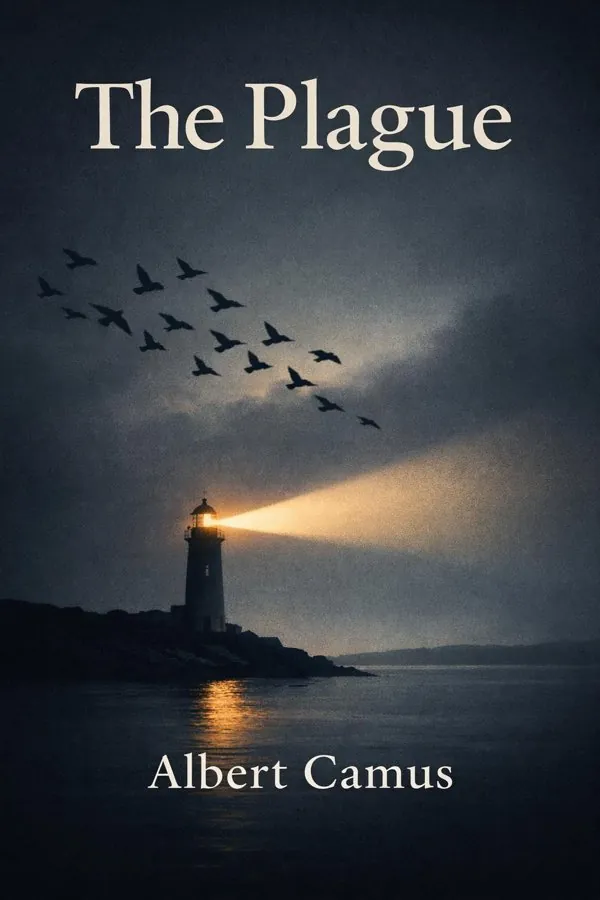
The Plague: Summary & Key Insights
by Albert Camus
 10 min8 chaptersAudio available
Key Takeaways from The Plague
A crisis does not create human truth so much as expose what routine had hidden.
The most important moral acts are often quiet, repetitive, and unglamorous.
When the world stops making sense, human connection becomes a form of meaning.
Some of the deepest suffering in The Plague comes not from disease itself but from separation.
People often reach for explanations not because they are true but because uncertainty is hard to bear.
What Is The Plague About?
The Plague by Albert Camus is a general book. What happens when ordinary life is suddenly sealed off by catastrophe? In The Plague, Albert Camus turns that question into a haunting, deeply human novel about fear, duty, suffering, and solidarity. First published in 1947, the book follows the Algerian city of Oran as it is overtaken by a deadly epidemic. As the disease spreads, familiar routines collapse, families are separated, and the townspeople are forced to confront mortality in ways they had long avoided. Yet Camus is not interested only in disaster. He is interested in what disaster reveals: who people become when comfort disappears, and whether decency can survive in a world that offers no clear justice. Camus, Nobel Prize-winning writer, philosopher, and one of the defining moral voices of the twentieth century, uses the plague both as a literal crisis and as a metaphor for war, fascism, and the persistent presence of human suffering. The result is a novel that feels timeless. It speaks to anyone who has lived through uncertainty and asks the enduring question: how should we live when life is fragile and meaning is not guaranteed?
This FizzRead summary covers all 8 key chapters of The Plague in approximately 10 minutes, distilling the most important ideas, arguments, and takeaways from Albert Camus's work. Also available as an audio summary and Key Quotes Podcast.
The Plague
What happens when ordinary life is suddenly sealed off by catastrophe? In The Plague, Albert Camus turns that question into a haunting, deeply human novel about fear, duty, suffering, and solidarity. First published in 1947, the book follows the Algerian city of Oran as it is overtaken by a deadly epidemic. As the disease spreads, familiar routines collapse, families are separated, and the townspeople are forced to confront mortality in ways they had long avoided. Yet Camus is not interested only in disaster. He is interested in what disaster reveals: who people become when comfort disappears, and whether decency can survive in a world that offers no clear justice. Camus, Nobel Prize-winning writer, philosopher, and one of the defining moral voices of the twentieth century, uses the plague both as a literal crisis and as a metaphor for war, fascism, and the persistent presence of human suffering. The result is a novel that feels timeless. It speaks to anyone who has lived through uncertainty and asks the enduring question: how should we live when life is fragile and meaning is not guaranteed?
Who Should Read The Plague?
This book is perfect for anyone interested in general and looking to gain actionable insights in a short read. Whether you're a student, professional, or lifelong learner, the key ideas from The Plague by Albert Camus will help you think differently.
- ✓Readers who enjoy general and want practical takeaways
- ✓Professionals looking to apply new ideas to their work and life
- ✓Anyone who wants the core insights of The Plague in just 10 minutes
Want the full summary?
Get instant access to this book summary and 100K+ more with Fizz Moment.
Get Free SummaryAvailable on App Store • Free to download
Key Chapters
A crisis does not create human truth so much as expose what routine had hidden. At the beginning of The Plague, Oran is a practical, commercial city devoted to schedules, profit, and habit. People are busy, efficient, and emotionally distracted. They assume tomorrow will resemble today. Camus shows how this confidence is not wisdom but a fragile illusion. When dead rats begin appearing and unexplained fevers spread, the population resists reality. Officials hesitate, citizens rationalize, and many cling to the comforting belief that large-scale tragedy happens somewhere else. This denial is one of the novel’s most recognizable insights: people often mistake normality for permanence.
Camus uses the epidemic to strip away those assumptions. Once the city gates close, the inhabitants discover how dependent their identities were on movement, plans, social roles, and the expectation of control. Separation from loved ones turns vague affection into acute longing. Work loses its meaning. Time changes texture. The illusion that life can be managed through routine disappears. In its place comes a harsher but more honest awareness: human beings are vulnerable, and the future is never guaranteed.
This idea applies far beyond fiction. Economic crashes, illness, layoffs, and political upheaval often reveal how much of modern life rests on unspoken confidence. We postpone difficult conversations, neglect relationships, or assume health and stability will continue indefinitely. Camus challenges that laziness of perception. He asks readers to see fragility before catastrophe forces the lesson upon them.
Actionable takeaway: treat ordinary life as precious rather than permanent by investing attention now in relationships, health, and meaningful work.
The most important moral acts are often quiet, repetitive, and unglamorous. One of Camus’s central insights is that goodness does not usually arrive as grand heroism. Instead, it appears in small acts of persistence: showing up, doing one’s job honestly, easing another person’s pain, and refusing indifference. Dr. Rieux, the novel’s central figure, does not present himself as a saint or philosopher. He simply continues treating patients, recording facts, and helping where he can. His moral clarity comes not from ideology but from action.
Camus deliberately lowers the temperature of moral language. Rather than celebrating extraordinary virtue, he emphasizes “common decency.” This matters because heroism can feel inaccessible. Many people imagine ethics as something dramatic, reserved for exceptional individuals in exceptional circumstances. The Plague rejects that comforting excuse. In a city under siege, everyone has opportunities to contribute or withdraw. The standard is not perfection but participation in the shared struggle.
This idea has powerful practical relevance. In workplaces, families, neighborhoods, or civic life, people often wait for a charismatic leader or a dramatic turning point. Yet institutions and communities are sustained by less visible forms of care: the colleague who follows through, the neighbor who checks in, the nurse who remains patient, the citizen who resists cruelty in conversation and policy. Camus reminds us that moral life is built from such habits.
Actionable takeaway: stop asking whether you can be heroic and ask instead where you can be reliably useful today.
Some of the deepest suffering in The Plague comes not from disease itself but from separation. When Oran is quarantined, loved ones are trapped apart with no clear timeline for reunion. Camus describes this condition as a form of exile. The citizens are exiled from one another, from their former routines, and from the future they expected. This exile is geographical, but it is also psychological. People live suspended between memory and fear, unable to inhabit the present fully.
Camus captures how prolonged crisis distorts emotion. At first, separation feels dramatic and unbearable. Over time, it becomes numbing. Grief turns habitual. Hope shrinks to small rituals: waiting for telegrams, recalling a face, repeating plans that may never happen. The novel shows that human beings can adapt even to misery, but adaptation has a cost. Emotional life becomes flattened, and the inability to share ordinary intimacy becomes its own wound.
This idea resonates strongly in modern life. Exile can take many forms beyond literal quarantine: migration, divorce, long-distance caregiving, burnout, social alienation, or digital overstimulation that leaves people emotionally unavailable. We may remain physically near others while feeling cut off from genuine presence. Camus teaches that such estrangement should not be dismissed simply because it lacks spectacle.
The practical lesson is that connection requires deliberate maintenance, especially under strain. Honest communication, small routines of affection, and preserving memory can help people endure periods of distance without surrendering to emotional erosion. Naming exile is itself clarifying; it helps us see that loneliness is not always a personal failure but sometimes a condition imposed by circumstance.
Actionable takeaway: during periods of distance or disruption, create simple recurring practices of connection that keep relationships emotionally alive.
People often reach for explanations not because they are true but because uncertainty is hard to bear. In The Plague, Camus explores how individuals and institutions respond when reality becomes unbearable. Some minimize the threat. Some rely on bureaucracy. Some turn to grand moral or religious interpretations that try to fit suffering into a tidy framework. Camus does not mock the desire for meaning, but he is suspicious of any explanation that becomes an excuse for passivity, judgment, or self-protection.
This is especially important in the novel’s treatment of language and authority. Officials delay naming the plague because labels carry consequences. Religious and ideological interpretations can also become evasions if they explain suffering too quickly. Camus suggests that when people cling to certainty, they may stop seeing actual human pain. Their need to feel right overpowers their obligation to respond compassionately.
The lesson is relevant in public life and personal relationships. During crises, people often circulate simple narratives: someone is to blame, everything happens for a reason, the problem is exaggerated, the problem is total, the right theory will save us. Such certainty can reduce complexity and relieve anxiety, but it can also harden the heart. It becomes easier to argue than to help.
Camus offers a more disciplined ethic: look clearly, speak honestly, and remain humble before what you do not know. This does not mean abandoning conviction. It means refusing to let explanations replace attention. Wisdom begins with reality, not ideology.
Actionable takeaway: when facing suffering or uncertainty, resist the urge for instant interpretation and begin by observing carefully, listening fully, and responding concretely.
We understand freedom most clearly when it is taken away. Before the outbreak, the citizens of Oran rarely think about liberty because they assume it as background. Once the city is sealed, movement is regulated, choices narrow, and private desires are subordinated to collective necessity. Camus shows that freedom is not merely the ability to choose among options. It also depends on social conditions, public trust, and a stable world in which plans can be carried out.
The novel illustrates the psychological consequences of restriction. People become impatient, resentful, restless, and obsessed with escape. Some seek loopholes or personal advantage. Others internalize the limits and become resigned. The plague reveals how difficult it is to balance individual longing with communal responsibility. A person may sincerely love someone outside the city and still be ethically required to remain inside. Camus does not romanticize this conflict. He presents it as tragic, not easily solvable.
This insight remains deeply relevant. Public emergencies, institutional breakdowns, or family crises often constrain freedom in ways that feel unjust even when they are necessary. The challenge is to recognize that freedom and responsibility are not opposites. In moments of collective danger, freedom without regard for others becomes destructive, while obedience without reflection becomes dehumanizing. Camus asks readers to inhabit the tension maturely.
Practically, this means preparing ourselves to think beyond personal convenience. It also means defending humane values even when restrictions are needed. Rules should serve life, not erase dignity. Collective action should be accompanied by compassion, transparency, and accountability.
Actionable takeaway: measure your choices not only by personal preference but by how they affect the safety and dignity of the wider community.
One of the hardest truths in The Plague is that suffering is not allocated according to merit. The epidemic does not distinguish between the virtuous and the selfish, the devout and the skeptical, the young and the old. Camus refuses sentimental moral arithmetic. Innocent people suffer, and no elegant theory can make that feel just. This refusal is essential to the book’s emotional force. Rather than preserving comforting illusions, Camus insists that ethical life begins when we face undeserved suffering without denial.
The novel’s power lies in how it responds to this unfairness. If suffering is arbitrary, one reaction is nihilism: nothing matters. Another is blame: victims must somehow deserve it. Camus rejects both. He argues, through character and action rather than doctrine, that the absence of cosmic fairness increases rather than diminishes our responsibility to one another. Precisely because pain is not justly distributed, compassion becomes urgent.
This idea applies to illness, unemployment, accidents, and inherited disadvantage. People often search for neat reasons because randomness is frightening. Yet that search can become cruel. It allows observers to protect themselves psychologically by imagining that victims are different, careless, or morally lacking. Camus dismantles that defense. He insists on a more honest humanism: suffering may be absurd, but our response need not be.
For everyday life, this means replacing judgment with presence. It means supporting people without requiring them to justify their pain or perform optimism. It also means building systems that recognize vulnerability as universal, not exceptional.
Actionable takeaway: when confronted with another person’s suffering, lead first with compassion and practical support rather than explanation or blame.
Evil rarely disappears forever; it waits, adapts, and returns. The final lesson of The Plague is deliberately unsettling. Even after the epidemic recedes and celebration begins, Camus warns that the plague bacillus never truly dies. It can remain dormant for years before reappearing. On the literal level, this reflects disease. On the symbolic level, it points to war, authoritarianism, hatred, complacency, and all the recurring forms of human destruction. Victory is real, but it is never final.
This conclusion transforms the novel from a story about one outbreak into a philosophy of vigilance. Camus had lived through fascism and occupation, and the plague can be read as a metaphor for those political evils. But his point is broader. Human beings are always susceptible to indifference, self-interest, and collective forgetting. Once danger passes, people long to resume comfort and declare the lesson finished. Camus resists that desire. He reminds us that moral memory fades quickly unless it is renewed in practice.
In everyday terms, this means that decency is not a one-time achievement. Institutions require maintenance. Democracies require participation. Relationships require care. Personal integrity requires repetition. The same habits that help resist a plague of disease also help resist social and moral corruption: honesty, solidarity, attentiveness, and refusal to normalize harm.
The practical strength of this idea is its realism. Camus does not ask for perfection or permanent triumph. He asks for persistence. To be human is to remain alert to recurring threats and to answer them again and again.
Actionable takeaway: after a crisis passes, preserve its hard-earned lessons by turning awareness, compassion, and civic responsibility into lasting habits.
All Chapters in The Plague
About the Author
Albert Camus was a French-Algerian novelist, essayist, journalist, and playwright born in 1913 in Mondovi, Algeria. Raised in modest circumstances, he became one of the most important literary voices of the twentieth century. His work explores absurdity, rebellion, freedom, justice, and the moral responsibilities of ordinary people. Though often linked to existentialism, Camus defined his own path, emphasizing lucid realism and ethical resistance in the face of suffering. His best-known books include The Stranger, The Myth of Sisyphus, The Plague, and The Rebel. During and after World War II, he gained recognition not only for his fiction but also for his political and journalistic engagement. In 1957, he was awarded the Nobel Prize in Literature for illuminating the human conscience with seriousness and clarity. He died in 1960 in a car accident.
Get This Summary in Your Preferred Format
Read or listen to the The Plague summary by Albert Camus anytime, anywhere. FizzRead offers multiple formats so you can learn on your terms — all free.
Available formats: App · Audio · PDF · EPUB — All included free with FizzRead
Download The Plague PDF and EPUB Summary
Key Quotes from The Plague
“A crisis does not create human truth so much as expose what routine had hidden.”
“The most important moral acts are often quiet, repetitive, and unglamorous.”
“When the world stops making sense, human connection becomes a form of meaning.”
“Some of the deepest suffering in The Plague comes not from disease itself but from separation.”
“People often reach for explanations not because they are true but because uncertainty is hard to bear.”
Frequently Asked Questions about The Plague
The Plague by Albert Camus is a general book that explores key ideas across 8 chapters. What happens when ordinary life is suddenly sealed off by catastrophe? In The Plague, Albert Camus turns that question into a haunting, deeply human novel about fear, duty, suffering, and solidarity. First published in 1947, the book follows the Algerian city of Oran as it is overtaken by a deadly epidemic. As the disease spreads, familiar routines collapse, families are separated, and the townspeople are forced to confront mortality in ways they had long avoided. Yet Camus is not interested only in disaster. He is interested in what disaster reveals: who people become when comfort disappears, and whether decency can survive in a world that offers no clear justice. Camus, Nobel Prize-winning writer, philosopher, and one of the defining moral voices of the twentieth century, uses the plague both as a literal crisis and as a metaphor for war, fascism, and the persistent presence of human suffering. The result is a novel that feels timeless. It speaks to anyone who has lived through uncertainty and asks the enduring question: how should we live when life is fragile and meaning is not guaranteed?
More by Albert Camus

You Might Also Like
Duct Tape Marketing: The World's Most Practical Small Business Marketing Guide
John Jantsch
10 minDusk, Night, Dawn: On Revival and Courage
Anne Lamott
10 minFinish Big: How Great Entrepreneurs Exit Their Companies on Top
Bo Burlingham
10 minFirst As Tragedy, Then As Farce
Slavoj Zizek
10 minFirst Principles: What America's Founders Learned from the Greeks and Romans and How That Shaped Our Country
Thomas E. Ricks
10 minGood Habits, Bad Habits: The Science of Making Positive Changes That Stick
Wendy Wood
10 minBrowse by Category
Ready to read The Plague?
Get the full summary and 100K+ more books with Fizz Moment.