
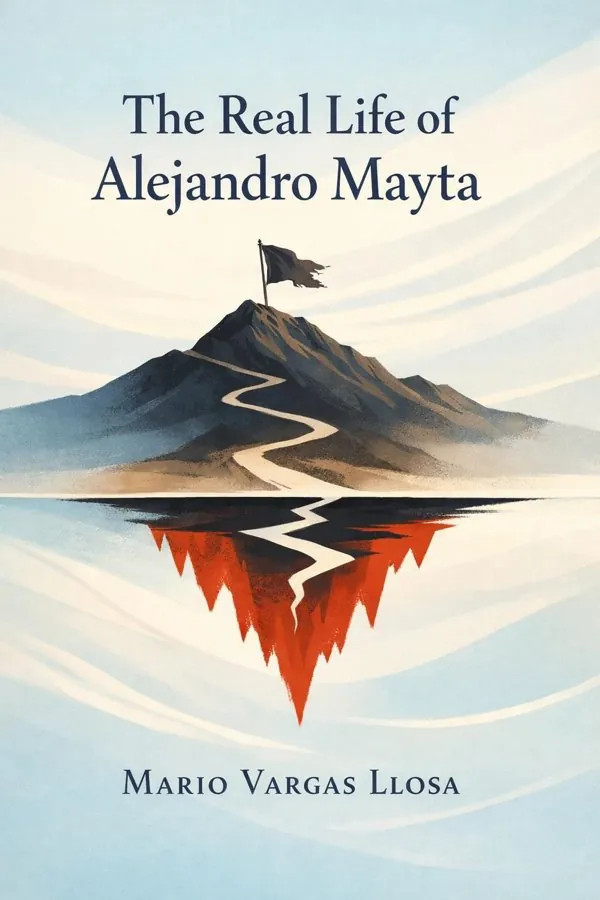
The Real Life of Alejandro Mayta: Summary & Key Insights
 10 min9 chaptersAudio available
Key Takeaways from The Real Life of Alejandro Mayta
The search for one man becomes a lesson in how fragile truth really is.
A failed rebellion can only be understood inside a failed social landscape.
Revolutionaries are rarely born as symbols; they begin as lonely people searching for coherence.
Movements that dream of transforming society often collapse under the weight of their own internal battles.
Grand revolutions often begin with fragile alliances, improvisation, and unrealistic hope.
What Is The Real Life of Alejandro Mayta About?
The Real Life of Alejandro Mayta by Mario Vargas Llosa is a bestsellers book spanning 8 pages. What if the closer you moved toward the truth about a person, the more uncertain that truth became? In The Real Life of Alejandro Mayta, Mario Vargas Llosa turns a failed revolutionary episode into a brilliant investigation of memory, ideology, and storytelling itself. The novel follows a narrator trying to reconstruct the life of Alejandro Mayta, a little-known Peruvian Trotskyist who once helped launch a doomed uprising in the Andes. But each interview, recollection, and testimony complicates rather than clarifies who Mayta really was. This is not simply a political novel about rebellion. It is also a profound meditation on how history gets made, distorted, and weaponized. Vargas Llosa uses Mayta’s life to examine Peru’s fractures—class inequality, racial division, urban-rural distance, and ideological extremism—while also exposing the seductions and failures of revolutionary purity. The result is both intimate and panoramic. Vargas Llosa, one of Latin America’s most important novelists and winner of the Nobel Prize in Literature, brings extraordinary authority to these themes. His deep engagement with politics, journalism, and fiction makes this novel an especially powerful study of how personal conviction collides with historical reality.
This FizzRead summary covers all 9 key chapters of The Real Life of Alejandro Mayta in approximately 10 minutes, distilling the most important ideas, arguments, and takeaways from Mario Vargas Llosa's work. Also available as an audio summary and Key Quotes Podcast.
The Real Life of Alejandro Mayta
What if the closer you moved toward the truth about a person, the more uncertain that truth became? In The Real Life of Alejandro Mayta, Mario Vargas Llosa turns a failed revolutionary episode into a brilliant investigation of memory, ideology, and storytelling itself. The novel follows a narrator trying to reconstruct the life of Alejandro Mayta, a little-known Peruvian Trotskyist who once helped launch a doomed uprising in the Andes. But each interview, recollection, and testimony complicates rather than clarifies who Mayta really was.
This is not simply a political novel about rebellion. It is also a profound meditation on how history gets made, distorted, and weaponized. Vargas Llosa uses Mayta’s life to examine Peru’s fractures—class inequality, racial division, urban-rural distance, and ideological extremism—while also exposing the seductions and failures of revolutionary purity. The result is both intimate and panoramic.
Vargas Llosa, one of Latin America’s most important novelists and winner of the Nobel Prize in Literature, brings extraordinary authority to these themes. His deep engagement with politics, journalism, and fiction makes this novel an especially powerful study of how personal conviction collides with historical reality.
Who Should Read The Real Life of Alejandro Mayta?
This book is perfect for anyone interested in bestsellers and looking to gain actionable insights in a short read. Whether you're a student, professional, or lifelong learner, the key ideas from The Real Life of Alejandro Mayta by Mario Vargas Llosa will help you think differently.
- ✓Readers who enjoy bestsellers and want practical takeaways
- ✓Professionals looking to apply new ideas to their work and life
- ✓Anyone who wants the core insights of The Real Life of Alejandro Mayta in just 10 minutes
Want the full summary?
Get instant access to this book summary and 100K+ more with Fizz Moment.
Get Free SummaryAvailable on App Store • Free to download
Key Chapters
The search for one man becomes a lesson in how fragile truth really is. The novel begins with a narrator setting out to discover the “real” Alejandro Mayta, a former revolutionary whose failed rebellion has faded into rumor, myth, and contradiction. Instead of giving readers a straightforward biography, Vargas Llosa presents an inquiry built from interviews, memories, gossip, and partial records. Every witness offers a different version of Mayta: principled idealist, naïve fanatic, tragic fool, or dangerous subversive. The more the narrator investigates, the less fixed Mayta appears.
This structure matters because it shifts the novel away from the simple question of what happened and toward the more unsettling question of how we decide what counts as reality. Testimony is shaped by fear, ideology, resentment, nostalgia, and self-justification. People revise their pasts to make themselves look wiser, more innocent, or more central than they were. History, then, is not a clean archive but a battleground of stories.
This idea has practical force beyond literature. In daily life, we often assume that gathering more information automatically produces certainty. But in politics, workplaces, families, and media, new evidence can reveal just how biased every perspective is. Think of how public scandals, revolutions, or even office conflicts generate wildly different narratives depending on who tells the story.
Vargas Llosa invites readers to become active interpreters rather than passive consumers of “facts.” The narrator’s quest is compelling precisely because it never fully succeeds. Its value lies in exposing the limits of certainty.
Actionable takeaway: When evaluating any important story—historical, political, or personal—compare multiple accounts and ask what each speaker gains by telling it that way.
A failed rebellion can only be understood inside a failed social landscape. As the narrator reconstructs Mayta’s life, the novel gradually unveils a Peru marked by deep divisions: rich and poor, coastal and Andean, urban and rural, white and Indigenous, secular modernity and old structures of exclusion. Mayta is not merely an eccentric radical acting in isolation. He is a product of a country in which inequality is so entrenched that revolution can seem both absurd and inevitable.
Vargas Llosa portrays Peru as a place where people inhabit different realities while technically sharing the same nation. The privileged can treat politics as abstract debate; the marginalized experience it as hunger, violence, humiliation, and abandonment. This fragmentation helps explain why revolutionary movements attract believers. Ideology offers a total explanation for suffering and a promise—however unrealistic—of moral clarity.
Yet the novel is too sophisticated to romanticize the oppressed or demonize one class alone. Instead, it shows how social breakdown creates desperation, fantasies, and rigid identities. Institutions fail. Dialogue collapses. The country becomes fertile ground for extremes.
Readers can apply this insight broadly. Polarized societies often produce simplistic narratives because complexity feels unbearable under pressure. When public trust erodes, people turn to dogma, conspiracy, or purity politics. The same pattern can be seen in many countries where inequality and alienation are left unresolved.
By embedding Mayta’s story in Peru’s fragmented reality, Vargas Llosa turns one man’s biography into a diagnosis of national crisis. The novel suggests that private idealism and public disorder feed each other.
Actionable takeaway: To understand radical politics, look beyond slogans and examine the social fractures, exclusions, and institutional failures that make extreme visions feel plausible.
Revolutionaries are rarely born as symbols; they begin as lonely people searching for coherence. Mayta’s early life reveals a man driven by moral seriousness, intellectual restlessness, and dissatisfaction with the world around him. He is drawn to politics not because it is glamorous, but because it promises order, justice, and meaning. In a society riddled with hypocrisy and inequality, doctrine offers him a language for outrage.
Vargas Llosa carefully traces how ideological identity forms. Mayta moves through political circles, debates, factions, and doctrinal disputes that may appear comically narrow from the outside but feel existentially important to believers. His commitment is not superficial. He wants consistency between thought and action, and this very integrity makes him vulnerable to extremism. He cannot easily tolerate compromise, ambiguity, or the messy slowness of real democratic change.
This portrait is deeply human. Many people, especially when young, are attracted to systems that explain everything and divide the world into right and wrong. The appeal is emotional as much as intellectual. Strong belief can provide community, status, and a sense of mission. In modern terms, we can see similar patterns in online activism, ideological subcultures, or career environments where identity fuses with doctrine.
The brilliance of the novel lies in showing that Mayta is neither monster nor hero. He is sincere, intelligent, and at times admirable. But sincerity alone does not protect a person from illusion. In fact, it can intensify it.
Vargas Llosa asks us to examine the seductive relationship between ethical seriousness and ideological rigidity. Conviction may begin in compassion, but it can drift toward dogmatism when reality refuses to behave according to theory.
Actionable takeaway: When a worldview feels morally complete, pause and ask whether it still leaves room for doubt, complexity, and correction.
Movements that dream of transforming society often collapse under the weight of their own internal battles. One of the novel’s sharpest insights is that the political left in Mayta’s world is fragmented into rival factions, each claiming to represent the purest version of revolutionary truth. Trotskyists, other Marxists, reformists, doctrinaire activists, and tactical opportunists all compete not only against the state but against one another.
Vargas Llosa presents these disputes with irony and seriousness at once. On one level, the endless arguments over line, doctrine, and historical interpretation can seem absurdly petty. On another, they reveal something profound: revolutionary politics often promises unity while generating division. When ideological purity becomes more important than practical judgment, movements lose touch with the people they claim to represent.
Mayta’s disillusionment grows in this atmosphere. He sees opportunism, vanity, factionalism, and paralysis where he hoped to find disciplined purpose. Yet instead of abandoning the dream entirely, he pushes deeper into it. This is psychologically realistic. People often respond to disappointment not by moderating belief but by embracing more radical versions of it. Failed systems can produce greater extremism because believers blame corruption, not the idea itself.
The pattern extends far beyond revolutionary cells. Nonprofits, political parties, religious communities, and even businesses can become consumed by internal purity contests. Teams stop solving problems and start policing identity. Energy that should go toward outcomes gets redirected into symbolic conflict.
The novel suggests that ideological communities can become closed mirrors, reflecting only themselves. Their language grows more absolute as their contact with reality weakens.
Actionable takeaway: In any group devoted to change, judge it not only by the purity of its ideals but by its ability to cooperate, adapt, and remain connected to real human needs.
Grand revolutions often begin with fragile alliances, improvisation, and unrealistic hope. A crucial phase of the novel centers on Mayta’s partnership with Vallejos, a military man whose grievances and ambitions intersect with Mayta’s ideological fervor. Together they attempt to build an uprising in the Andes, imagining that a small insurrection can ignite a wider revolutionary fire. The plan reflects a familiar political fantasy: that history is waiting for one brave spark.
What makes this section powerful is the contrast between aspiration and material reality. The conspirators must deal with logistics, geography, trust, timing, local support, and the unpredictable behavior of ordinary people. Theory collides with weather, transportation, fear, miscommunication, and the sheer indifference of those who are supposed to rise up. Revolutionary rhetoric sounds dramatic in conversation; it looks painfully brittle when translated into action.
Vargas Llosa also highlights the unstable nature of alliances. Mayta and Vallejos are united by rebellion but not by identical motives. One is driven by ideological conviction, the other by a more practical and military logic. Such coalitions can be tactically useful, but they are vulnerable from the start. Shared enemies do not guarantee shared goals.
This dynamic appears in many real-world efforts at change. Founders, activists, reformers, and executives may unite around a bold mission without honestly assessing whether they agree on methods, risks, or end states. Plans fail not only because they face external resistance but because internal assumptions were never tested.
The buildup to the uprising is therefore about more than a historical episode. It is an anatomy of overconfidence, projection, and the seduction of decisive action.
Actionable takeaway: Before joining any ambitious cause, examine the practical conditions, incentives, and hidden differences among allies—belief alone cannot carry a plan.
Nothing exposes illusion faster than action that cannot sustain itself. The uprising Mayta helps launch is a failure, and the collapse is not heroic in the romantic sense. It is messy, confused, underprepared, and revealing. The rebellion does not trigger mass revolutionary awakening. Instead, it demonstrates the enormous gap between ideological imagination and social reality.
This failure matters because Vargas Llosa refuses to frame it as either noble martyrdom or simple farce. The event is tragic precisely because conviction was real, suffering was real, and yet the political imagination behind the act was disastrously misaligned with circumstances. Mayta and his collaborators believed history could be forced by willpower. The aftermath shows that human beings do not become instruments of theory on demand.
The consequences spread outward. Failed rebellion damages lives, distorts memory, and invites harsher repression or suspicion. For the individuals involved, defeat does not necessarily produce clarity. Some reinterpret the failure as betrayal, bad luck, or premature timing rather than a flaw in the premise itself. This is another key insight: people often preserve identity by rewriting failure.
The lesson applies to smaller-scale situations too. In organizations, personal relationships, and public campaigns, dramatic gestures can feel morally satisfying while making conditions worse. Acting boldly is not always the same as acting effectively. A plan that ignores readiness, context, and likely consequences may satisfy the ego of action while failing the people it intends to help.
Vargas Llosa portrays the failed insurrection as a test that ideology cannot pass. Reality returns with humiliating force, and no slogan can erase that.
Actionable takeaway: When judging a bold plan, ask not only whether its goals are inspiring but whether its strategy matches the actual capacities, timing, and needs of the people involved.
The novel’s deepest provocation is that fiction may reveal reality by openly admitting its distortions. As the narrator reconstructs Mayta’s life, readers become increasingly aware that what they are receiving is not a transparent record but a crafted narrative. Memory is selective, testimony is contaminated, and the narrator himself shapes the material into meaning. Vargas Llosa turns this into a central theme: truth is never encountered in pure form, especially when filtered through language and history.
This does not mean facts are irrelevant. Rather, the novel shows that facts alone do not generate understanding. They must be arranged, interpreted, and narrated. The storyteller chooses beginnings, emphases, omissions, and causal links. In that sense, all histories contain elements of fiction—not because they invent everything, but because they impose form on chaos.
This insight is remarkably contemporary. News media, documentaries, memoirs, podcasts, and social media threads all transform raw events into stories with heroes, villains, motives, and lessons. Even when sincere, they are shaped by narrative necessity. The danger comes when we mistake coherence for certainty. A story that feels complete may simply be well told.
Vargas Llosa is especially interested in the ethics of this process. What right does anyone have to tell another person’s life? Can a writer capture reality without betraying it? The novel never gives a final answer, but it insists that awareness of construction is healthier than naive faith in objectivity.
By blurring the boundaries between investigation and invention, the book trains readers to become more self-conscious interpreters of all narratives, including their own.
Actionable takeaway: Whenever a story about the past feels too neat, ask what has been selected, omitted, or arranged to make it persuasive.
When institutions decay, extreme ideas gain the emotional force of necessity. The broader world surrounding Mayta’s story is one of growing disorder, fear, violence, and authoritarian temptation. Vargas Llosa suggests that ideological extremism does not emerge in a vacuum; it feeds on social collapse. As the public sphere deteriorates, moderate politics can start to look weak, compromised, or irrelevant. In such conditions, people are drawn to voices that promise total explanations and decisive solutions.
The novel therefore works on two levels. It studies one failed revolutionary from the past, while also hinting at a larger national descent into crisis. This connection matters because it prevents readers from dismissing Mayta as a bizarre outlier. His story becomes part of a recurring pattern in societies under strain: exclusion breeds rage, rage seeks doctrine, doctrine invites violence, violence justifies harsher power, and the cycle deepens.
Vargas Llosa is not arguing that all ideology is identical. He is showing that any worldview can become dangerous when it stops engaging with reality and starts treating people as instruments of historical destiny. Revolutionary absolutism and authoritarian reaction may appear opposed, but both thrive on simplification, fear, and moral dehumanization.
This theme remains urgently relevant. In polarized times, citizens can be tempted to believe that only uncompromising force will save a nation. But such thinking often accelerates the breakdown it claims to cure.
The novel warns that disillusionment is politically volatile. People who lose faith in flawed institutions do not automatically become wise democrats. They may instead embrace harsher certainties.
Actionable takeaway: In moments of social crisis, resist narratives that reduce complex problems to a single enemy and promise redemption through absolute power.
The most unsettling aspect of the novel is that Mayta remains recognizably human even when he is wrong. Vargas Llosa does not reduce him to a symbol of failure or a caricature of political fanaticism. Instead, Mayta emerges as a lonely, earnest, wounded, and often contradictory person whose desire for justice becomes entangled with personal frustration, moral vanity, and historical delusion. This complexity is what gives the novel its emotional force.
By refusing easy condemnation, Vargas Llosa asks readers to confront an uncomfortable truth: destructive political commitments are often sustained by admirable traits gone astray—integrity without flexibility, empathy without realism, courage without prudence, idealism without self-suspicion. Mayta’s tragedy is not that he lacks values. It is that he cannot convert values into effective understanding of the world.
This distinction matters in real life. We are often tempted to classify people as either good-hearted idealists or dangerous extremists, but the line between the two can be thin. A person may genuinely want justice and still support disastrous methods. Likewise, mocking failed believers can prevent us from seeing the emotional needs and moral aspirations that gave their beliefs power.
The novel’s compassion does not excuse Mayta. It deepens judgment by making it more precise. Readers are encouraged to recognize how biography, loneliness, identity, and political context shape conviction. Understanding this does not weaken accountability; it makes it more intelligent.
Ultimately, Mayta’s “real life” cannot be captured in one label. He is both agent and victim, dreamer and dupe, morally serious and politically blind.
Actionable takeaway: When assessing people with extreme beliefs, look beyond labels and examine how sincere values, personal wounds, and social conditions interact to produce harmful commitments.
All Chapters in The Real Life of Alejandro Mayta
About the Author
Mario Vargas Llosa is a Peruvian novelist, essayist, journalist, and political thinker whose work has shaped modern literature in Spanish. Born in 1936 in Arequipa, Peru, he emerged as one of the leading figures of the Latin American Boom, alongside writers such as Gabriel García Márquez and Julio Cortázar. His novels frequently explore political violence, authoritarianism, social inequality, individual freedom, and the gap between idealism and reality. Major works include The Time of the Hero, Conversation in the Cathedral, The War of the End of the World, and The Feast of the Goat. In addition to fiction, he has written influential essays on culture and politics and was active in public life, even running for president of Peru in 1990. He received the Nobel Prize in Literature in 2010.
Get This Summary in Your Preferred Format
Read or listen to the The Real Life of Alejandro Mayta summary by Mario Vargas Llosa anytime, anywhere. FizzRead offers multiple formats so you can learn on your terms — all free.
Available formats: App · Audio · PDF · EPUB — All included free with FizzRead
Download The Real Life of Alejandro Mayta PDF and EPUB Summary
Key Quotes from The Real Life of Alejandro Mayta
“The search for one man becomes a lesson in how fragile truth really is.”
“A failed rebellion can only be understood inside a failed social landscape.”
“Revolutionaries are rarely born as symbols; they begin as lonely people searching for coherence.”
“Movements that dream of transforming society often collapse under the weight of their own internal battles.”
“Grand revolutions often begin with fragile alliances, improvisation, and unrealistic hope.”
Frequently Asked Questions about The Real Life of Alejandro Mayta
The Real Life of Alejandro Mayta by Mario Vargas Llosa is a bestsellers book that explores key ideas across 9 chapters. What if the closer you moved toward the truth about a person, the more uncertain that truth became? In The Real Life of Alejandro Mayta, Mario Vargas Llosa turns a failed revolutionary episode into a brilliant investigation of memory, ideology, and storytelling itself. The novel follows a narrator trying to reconstruct the life of Alejandro Mayta, a little-known Peruvian Trotskyist who once helped launch a doomed uprising in the Andes. But each interview, recollection, and testimony complicates rather than clarifies who Mayta really was. This is not simply a political novel about rebellion. It is also a profound meditation on how history gets made, distorted, and weaponized. Vargas Llosa uses Mayta’s life to examine Peru’s fractures—class inequality, racial division, urban-rural distance, and ideological extremism—while also exposing the seductions and failures of revolutionary purity. The result is both intimate and panoramic. Vargas Llosa, one of Latin America’s most important novelists and winner of the Nobel Prize in Literature, brings extraordinary authority to these themes. His deep engagement with politics, journalism, and fiction makes this novel an especially powerful study of how personal conviction collides with historical reality.
More by Mario Vargas Llosa
You Might Also Like
The Godfather
Mario Puzo
10 min
The Handmaid's Tale
Margaret Atwood
10 min
The Hunger Games
Suzanne Collins
10 min
The Nightingale
Kristin Hannah
10 min
The Seven Husbands of Evelyn Hugo
Taylor Jenkins Reid
10 min
Backwater Justice
Fern Michaels
10 minBrowse by Category
Ready to read The Real Life of Alejandro Mayta?
Get the full summary and 100K+ more books with Fizz Moment.