
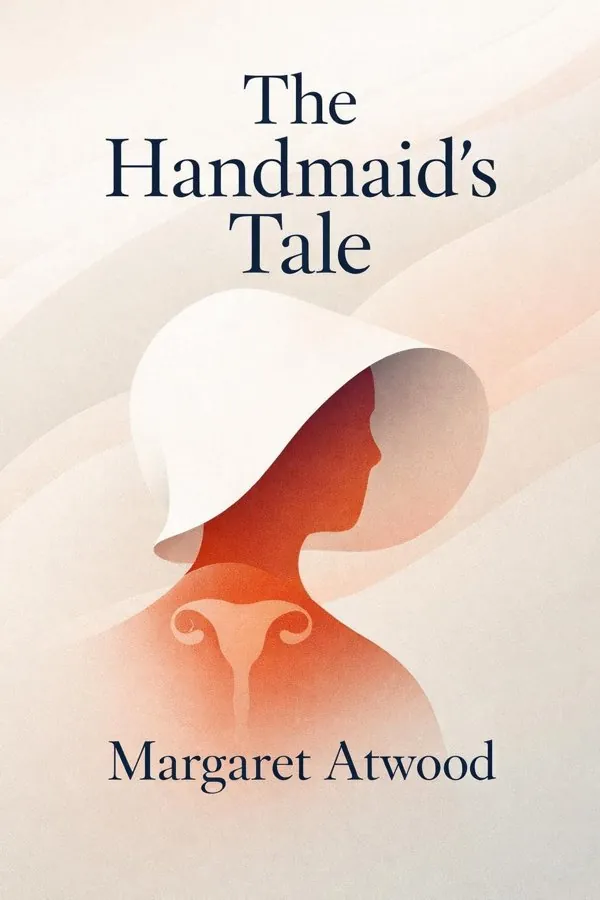
The Handmaid's Tale: Summary & Key Insights
 10 min9 chaptersAudio available
Key Takeaways from The Handmaid's Tale
Tyranny rarely arrives announcing itself as tyranny; it arrives as a solution.
Oppression becomes most powerful when it feels routine.
One of the novel’s deepest truths is that resistance often begins not with ideology but with longing.
History is never only about what happened; it is also about who gets to interpret what happened afterward.
Control the words, and you narrow the world people can imagine.
What Is The Handmaid's Tale About?
The Handmaid's Tale by Margaret Atwood is a bestsellers book published in 1985 spanning 4 pages. Some novels feel invented; The Handmaid’s Tale feels alarmingly assembled from pieces of real history. Margaret Atwood’s 1985 classic imagines the Republic of Gilead, a theocratic regime built on fear, fertility crisis, and the systematic reduction of women into social functions. At the center is Offred, a Handmaid assigned to bear children for powerful men and their wives, while struggling to preserve memory, identity, and the possibility of freedom. What makes the novel so enduring is not only its dystopian setting, but its psychological precision: Atwood shows how tyranny enters everyday life through language, ritual, clothing, law, and the slow normalization of cruelty. The book matters because it turns abstract debates about power, gender, religion, and politics into lived experience. It asks how rights disappear, how people adapt to oppression, and what forms of resistance remain when open rebellion seems impossible. Atwood brings unusual authority to these questions through her sharp historical awareness, literary craft, and refusal to invent atrocities that human societies have not already practiced somewhere. The result is a haunting, intelligent, and urgently relevant novel.
This FizzRead summary covers all 9 key chapters of The Handmaid's Tale in approximately 10 minutes, distilling the most important ideas, arguments, and takeaways from Margaret Atwood's work. Also available as an audio summary and Key Quotes Podcast.
The Handmaid's Tale
Some novels feel invented; The Handmaid’s Tale feels alarmingly assembled from pieces of real history. Margaret Atwood’s 1985 classic imagines the Republic of Gilead, a theocratic regime built on fear, fertility crisis, and the systematic reduction of women into social functions. At the center is Offred, a Handmaid assigned to bear children for powerful men and their wives, while struggling to preserve memory, identity, and the possibility of freedom. What makes the novel so enduring is not only its dystopian setting, but its psychological precision: Atwood shows how tyranny enters everyday life through language, ritual, clothing, law, and the slow normalization of cruelty. The book matters because it turns abstract debates about power, gender, religion, and politics into lived experience. It asks how rights disappear, how people adapt to oppression, and what forms of resistance remain when open rebellion seems impossible. Atwood brings unusual authority to these questions through her sharp historical awareness, literary craft, and refusal to invent atrocities that human societies have not already practiced somewhere. The result is a haunting, intelligent, and urgently relevant novel.
Who Should Read The Handmaid's Tale?
This book is perfect for anyone interested in bestsellers and looking to gain actionable insights in a short read. Whether you're a student, professional, or lifelong learner, the key ideas from The Handmaid's Tale by Margaret Atwood will help you think differently.
- ✓Readers who enjoy bestsellers and want practical takeaways
- ✓Professionals looking to apply new ideas to their work and life
- ✓Anyone who wants the core insights of The Handmaid's Tale in just 10 minutes
Want the full summary?
Get instant access to this book summary and 100K+ more with Fizz Moment.
Get Free SummaryAvailable on App Store • Free to download
Key Chapters
Tyranny rarely arrives announcing itself as tyranny; it arrives as a solution. In The Handmaid’s Tale, the Republic of Gilead rises from the wreckage of environmental damage, declining fertility, political violence, and social panic. These crises create the perfect conditions for authoritarianism: when people are frightened enough, they may accept extreme controls in exchange for promised safety and moral order. Atwood shows that Gilead is not born from pure fantasy but from familiar ingredients—religious fundamentalism, militarization, misogyny, and the manipulation of public fear.
The new regime overthrows the United States and rapidly strips women of legal and economic independence. They lose jobs, access to money, freedom of movement, and control over their own bodies. Importantly, these changes happen fast, but not instantly; the speed itself is part of the shock. Citizens do not fully grasp what is happening until the new system has hardened around them. The novel suggests that democratic collapse is often easier to imagine in retrospect than in the moment.
This idea has practical relevance far beyond fiction. Societies under stress often look for scapegoats, simple moral narratives, and strong leaders. Rights can be reframed as dangers, and inequality can be sold as necessity. The lesson is not merely political; it applies in workplaces, schools, and communities whenever fear is used to justify unchecked control.
Actionable takeaway: pay close attention when leaders use crisis to concentrate power, limit accountability, or define certain groups as expendable for the supposed good of society.
Oppression becomes most powerful when it feels routine. Offred’s daily life as a Handmaid is governed by scripted rituals, restricted speech, prescribed clothing, and constant surveillance. She lives in the Commander’s household, where every relationship is structured by hierarchy: Serena Joy, the Wife, resents her; household servants maintain distance; the Commander holds official authority while violating the rules he helps uphold. Offred’s body is treated as state property, yet the regime masks this violence behind religious language and ceremonial formality.
Atwood’s brilliance lies in showing that control is not maintained by brute force alone. Gilead shapes behavior through repetition, isolation, and the destruction of spontaneity. Even greetings are standardized. Names are reassigned. Desire is policed. The Handmaids are taught to internalize the regime’s logic through indoctrination at the Red Center, where Aunts train women to blame victims, fear one another, and accept subordination as virtue. This is a machinery of control because each piece—dress, ritual, law, language, shame—supports the others.
In everyday life, systems of control often work in similar ways, though less dramatically. An organization may normalize silence through jargon, unequal rules, or the fear of social punishment. People adapt by censoring themselves, performing compliance, and shrinking their sense of possibility.
Actionable takeaway: examine the routines and language around you. When rules consistently reduce one group’s agency, suppress dissent, or disguise exploitation as duty, name the pattern before it becomes normal.
One of the novel’s deepest truths is that resistance often begins not with ideology but with longing. Offred’s acts of disobedience are not grand revolutionary gestures at first; they emerge from desire—for touch, memory, pleasure, language, connection, and selfhood. Her illicit relationship with Nick, her secret meetings with the Commander, and her interior refusal to become fully obedient reveal that freedom survives first as appetite and imagination before it becomes action.
Atwood refuses to romanticize these choices. Offred’s compromises are morally complicated because survival under tyranny is morally complicated. Her meetings with the Commander offer small privileges but also deepen the system’s hypocrisy. Her affair with Nick may be emotional refuge, manipulation, genuine intimacy, or all three at once. The point is that people under oppressive conditions rarely get clean choices. They navigate constrained options, uncertain loyalties, and risks that are both physical and psychological.
This complexity makes the novel especially useful for thinking about real-world courage. We often imagine bravery as dramatic and visible, but much of it is private: preserving a memory, refusing a lie, trusting someone cautiously, or choosing not to surrender one’s inner life. Even imperfect acts of disobedience can keep the self alive.
Actionable takeaway: do not wait for ideal conditions to protect your autonomy. Small acts—questioning, remembering, connecting, and refusing internal surrender—can be the first practical steps toward larger freedom.
History is never only about what happened; it is also about who gets to interpret what happened afterward. The “Historical Notes” at the end of The Handmaid’s Tale transform the entire novel. Offred’s testimony, which felt immediate and intimate, is reframed as an academic artifact discussed at a conference long after Gilead’s decline. This shift is unsettling because it exposes how even suffering can be turned into scholarly distance, irony, or speculation.
The male professor analyzing Offred’s account treats her story with a tone that often feels detached, even amused. He focuses on identifying the Commander and dating the tapes rather than fully confronting the human reality of sexual enslavement and terror. Atwood is not dismissing scholarship; she is warning that institutions can sanitize atrocity by converting lived pain into an intellectual puzzle. Memory can be preserved and diminished at the same time.
This section also raises questions about evidence, voice, and narrative authority. Offred’s account is partial, fragmented, and emotionally shaped—as any testimony from trauma would be. Yet its incompleteness does not make it less true. In fact, the gaps themselves reveal the conditions under which it was created. In modern contexts, we see similar tensions when data, media coverage, or official reports flatten personal experience.
Actionable takeaway: when encountering historical or personal accounts of injustice, ask not only what happened, but who is framing the story, whose voice is centered, and whether analysis is preserving humanity or erasing it.
Control the words, and you narrow the world people can imagine. Gilead understands that language is political infrastructure. Women are denied access to reading and writing, names are reassigned to reflect male ownership, and phrases like “Blessed be the fruit” replace ordinary speech with ideological ritual. These formulas are not harmless expressions; they train people to speak inside the regime’s worldview.
Offred’s very name means “Of Fred,” linking her identity to the Commander she serves. This is domination disguised as grammar. The state also rewrites moral language, calling coercion sacred duty and calling punishment justice. Once words are rearranged, resistance becomes harder because people lose the verbal tools needed to describe what is being done to them. If there is no approved language for violation, then violation can be recast as order, holiness, or necessity.
Atwood also shows why storytelling matters. Offred’s narrative voice—observant, ironic, reflective, and often darkly funny—is itself an act of resistance. By telling her story, even in fragments, she reclaims language from propaganda. In ordinary life, the same principle applies whenever institutions use euphemisms to conceal harm: layoffs become “optimization,” censorship becomes “safety,” discrimination becomes “tradition.” Words can blur accountability.
Actionable takeaway: listen carefully to official language. When terms seem designed to soften cruelty, hide agency, or make injustice sound natural, translate them into plain speech. Clarity is one of the first defenses against manipulation.
Not everyone in a brutal system is equally powerful, but many people help keep it running. One reason The Handmaid’s Tale remains so disturbing is that Gilead is sustained not only by commanders and soldiers, but also by wives, aunts, workers, informants, and frightened ordinary people. Atwood explores complicity without reducing every character to a villain. Many participate because they believe, benefit, fear punishment, or see no alternative.
Serena Joy is a striking example. She is constrained by the regime she once helped legitimize, yet she also inflicts cruelty on Offred. The Aunts train women into obedience while presenting themselves as protectors. Even Offred sometimes judges others harshly or chooses silence where solidarity might matter. These ambiguities make the novel psychologically realistic. Oppressive systems often recruit the oppressed into maintaining the hierarchy, offering them limited status in exchange for cooperation.
This dynamic appears in many settings. In a toxic workplace, people may enforce unfair norms to protect their position. In families or communities, harmful rules survive because members fear exclusion more than they value honesty. Recognizing complicity does not require moral perfection; it requires awareness of how incentives shape behavior.
Actionable takeaway: ask what small benefits, fears, or habits might be tying you to an unfair system. Ethical resistance often begins by noticing the compromises you have learned to excuse and deciding which ones you will no longer accept.
When a society becomes obsessed with reproduction, women’s bodies become political territory. In Gilead, declining fertility justifies a social order in which fertile women are assigned reproductive roles and stripped of personal autonomy. The regime frames this arrangement as sacred necessity, but Atwood makes clear that the real issue is power, not life. Fertility becomes a resource to be managed by the state, and women become categories: Wives, Handmaids, Marthas, Econowives, Unwomen.
This classification system reduces complex human beings to biological and domestic functions. It also reveals how control over reproduction is never only about children; it is about social hierarchy, sexual regulation, and ownership. Men’s roles in infertility are largely ignored, while blame falls heavily on women. Shame and status are distributed through reproductive success, turning intimacy into policy and pregnancy into public value.
The novel remains relevant because debates over bodily autonomy, parenthood, contraception, and reproductive rights continue to shape modern societies. Atwood’s warning is that whenever institutions claim authority over private bodies in the name of morality, tradition, or national survival, freedom becomes dangerously conditional.
On a personal level, the book invites readers to think about how bodies are judged, regulated, and politicized—not only through law, but through culture, medicine, and social pressure.
Actionable takeaway: defend the principle that no government, institution, or ideology should override individual bodily autonomy under the guise of collective virtue.
A person can be imprisoned physically and still resist through memory. Offred survives partly by remembering her former life—her daughter, her husband Luke, her mother, ordinary freedoms, old language, and even banal details from the world before Gilead. These memories are painful because they remind her of what she has lost, yet they are also essential because they prevent the regime from defining reality completely.
Love in the novel is similarly double-edged. It is a source of vulnerability, grief, hope, and rebellion. Offred’s memories of family sharpen her suffering, but they also preserve her sense that she once belonged to a world larger than Gilead’s rules. Emotional attachment becomes political because oppressive systems depend on replacing authentic bonds with state-sanctioned roles. If people remember other ways of loving and living, total control remains incomplete.
This idea matters in daily life whenever institutions pressure people to detach from their histories, values, or communities in order to conform. Memory is not nostalgia here; it is evidence. It tells Offred that what is happening is not natural. In trauma studies, social movements, and personal recovery, remembering can be a crucial part of reclaiming agency.
Actionable takeaway: preserve the stories, relationships, and personal records that remind you who you are outside any role imposed on you. Identity is harder to erase when it is actively remembered and shared.
We like stories where heroes act decisively, but Atwood offers something truer: resistance under oppression is fragmented, uncertain, and often invisible. Offred is not a conventional revolutionary. She hesitates, adapts, fears, and sometimes prioritizes immediate survival over collective action. Yet this does not make her weak. It makes her human. The novel insists that people living under extreme control should not be judged by the standards of those who are free.
Groups like Mayday suggest organized resistance exists, but information is scarce and trust is dangerous. Every decision carries risk because betrayal can mean torture or death. In such a world, even passing a message, hiding a feeling, or observing carefully may count as meaningful resistance. Atwood broadens the definition of courage by locating it in endurance, witness, and the refusal to become spiritually numb.
This is a useful corrective in modern life, where people sometimes dismiss imperfect activism or expect victims of injustice to behave flawlessly. Real resistance is often messy. People are tired, afraid, dependent, uncertain, and constrained by responsibilities. Progress may depend not on purity but on networks of partial, cumulative actions.
Actionable takeaway: value resistance in all its forms, not only the dramatic ones. Support people who are pushing back within difficult conditions, and do not let the demand for heroic perfection become an excuse for inaction.
All Chapters in The Handmaid's Tale
About the Author
Margaret Atwood is a celebrated Canadian author, poet, essayist, and critic whose work has shaped modern literature for decades. Born in Ottawa in 1939, she became known for fiction that combines sharp storytelling with deep insight into gender, power, politics, environmental crisis, and human vulnerability. Her novels often blur the line between speculative fiction and social realism, drawing on real historical patterns to imagine unsettling futures. Among her best-known works are The Handmaid’s Tale, Alias Grace, Oryx and Crake, and The Blind Assassin, the last of which won the Booker Prize. Atwood has received numerous international honors and remains one of the most influential literary voices of her generation. Her authority comes not only from her craft, but from her ability to reveal how private lives are shaped by larger systems of power.
Get This Summary in Your Preferred Format
Read or listen to the The Handmaid's Tale summary by Margaret Atwood anytime, anywhere. FizzRead offers multiple formats so you can learn on your terms — all free.
Available formats: App · Audio · PDF · EPUB — All included free with FizzRead
Download The Handmaid's Tale PDF and EPUB Summary
Key Quotes from The Handmaid's Tale
“Tyranny rarely arrives announcing itself as tyranny; it arrives as a solution.”
“Oppression becomes most powerful when it feels routine.”
“One of the novel’s deepest truths is that resistance often begins not with ideology but with longing.”
“History is never only about what happened; it is also about who gets to interpret what happened afterward.”
“Control the words, and you narrow the world people can imagine.”
Frequently Asked Questions about The Handmaid's Tale
The Handmaid's Tale by Margaret Atwood is a bestsellers book that explores key ideas across 9 chapters. Some novels feel invented; The Handmaid’s Tale feels alarmingly assembled from pieces of real history. Margaret Atwood’s 1985 classic imagines the Republic of Gilead, a theocratic regime built on fear, fertility crisis, and the systematic reduction of women into social functions. At the center is Offred, a Handmaid assigned to bear children for powerful men and their wives, while struggling to preserve memory, identity, and the possibility of freedom. What makes the novel so enduring is not only its dystopian setting, but its psychological precision: Atwood shows how tyranny enters everyday life through language, ritual, clothing, law, and the slow normalization of cruelty. The book matters because it turns abstract debates about power, gender, religion, and politics into lived experience. It asks how rights disappear, how people adapt to oppression, and what forms of resistance remain when open rebellion seems impossible. Atwood brings unusual authority to these questions through her sharp historical awareness, literary craft, and refusal to invent atrocities that human societies have not already practiced somewhere. The result is a haunting, intelligent, and urgently relevant novel.
More by Margaret Atwood
You Might Also Like






Featured In
Browse by Category
Ready to read The Handmaid's Tale?
Get the full summary and 100K+ more books with Fizz Moment.