
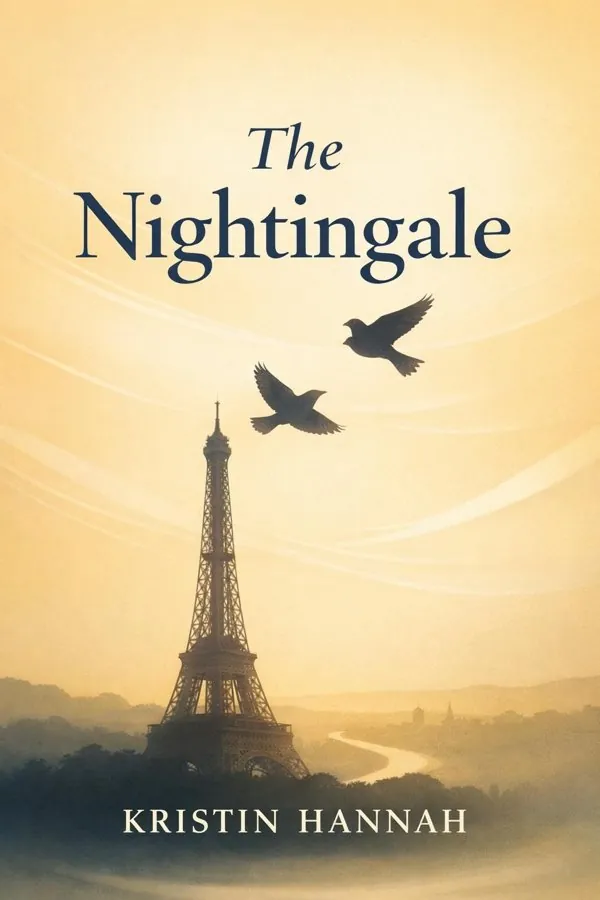
The Nightingale: Summary & Key Insights
 10 min9 chapters
Key Takeaways from The Nightingale
Some of the deepest wars do not end when the gunfire stops.
People often imagine bravery as a single trait, but The Nightingale insists that courage has many forms.
Evil is most terrifying when it enters the home and calls itself normal.
It is easy to admire resistance in retrospect; it is much harder to imagine the fear that makes resistance costly.
History often celebrates those who fought at the front while overlooking those who kept life possible behind it.
What Is The Nightingale About?
The Nightingale by Kristin Hannah is a bestsellers book published in 2015 spanning 5 pages. Set against the devastation of Nazi-occupied France, The Nightingale is Kristin Hannah’s haunting novel about two sisters who face the Second World War in radically different ways. Vianne Mauriac wants only to protect her daughter, preserve her home, and survive each day with dignity. Her younger sister Isabelle Rossignol is impulsive, angry, and unwilling to accept submission, eventually throwing herself into the Resistance. Through their diverging paths, Hannah reveals that courage does not look the same for everyone: sometimes it is loud and defiant, and sometimes it is quiet, domestic, and nearly invisible. The novel matters because it restores attention to the experiences of women whose sacrifices often go unrecorded in official histories. Rather than focusing on battlefields and generals, it examines fear, hunger, betrayal, love, motherhood, and moral compromise under occupation. Kristin Hannah, one of contemporary fiction’s most widely read authors, is known for emotionally rich stories about resilience and family. In The Nightingale, she combines historical research with deeply human storytelling to create a powerful portrait of survival, resistance, and the lasting cost of war.
This FizzRead summary covers all 9 key chapters of The Nightingale in approximately 10 minutes, distilling the most important ideas, arguments, and takeaways from Kristin Hannah's work.
The Nightingale
Set against the devastation of Nazi-occupied France, The Nightingale is Kristin Hannah’s haunting novel about two sisters who face the Second World War in radically different ways. Vianne Mauriac wants only to protect her daughter, preserve her home, and survive each day with dignity. Her younger sister Isabelle Rossignol is impulsive, angry, and unwilling to accept submission, eventually throwing herself into the Resistance. Through their diverging paths, Hannah reveals that courage does not look the same for everyone: sometimes it is loud and defiant, and sometimes it is quiet, domestic, and nearly invisible. The novel matters because it restores attention to the experiences of women whose sacrifices often go unrecorded in official histories. Rather than focusing on battlefields and generals, it examines fear, hunger, betrayal, love, motherhood, and moral compromise under occupation. Kristin Hannah, one of contemporary fiction’s most widely read authors, is known for emotionally rich stories about resilience and family. In The Nightingale, she combines historical research with deeply human storytelling to create a powerful portrait of survival, resistance, and the lasting cost of war.
Who Should Read The Nightingale?
This book is perfect for anyone interested in bestsellers and looking to gain actionable insights in a short read. Whether you're a student, professional, or lifelong learner, the key ideas from The Nightingale by Kristin Hannah will help you think differently.
- ✓Readers who enjoy bestsellers and want practical takeaways
- ✓Professionals looking to apply new ideas to their work and life
- ✓Anyone who wants the core insights of The Nightingale in just 10 minutes
Want the full summary?
Get instant access to this book summary and 100K+ more with Fizz Moment.
Get Free SummaryAvailable on App Store • Free to download
Key Chapters
Some of the deepest wars do not end when the gunfire stops. The Nightingale opens in 1995 with an elderly woman living in Oregon, far from wartime France, yet emotionally tethered to it. This framing device immediately tells us that memory is not a passive archive; it is an active force shaping identity, grief, and silence. The past has weight, and Hannah shows that survival often means carrying what cannot be neatly explained to later generations.
As the narrative moves between the present and the 1940s, memory becomes both burden and testimony. The older narrator has built a life, crossed an ocean, and entered old age, but her recollections remain vivid because trauma does not obey chronology. This structure reminds readers that history is never just a list of events. It lives inside bodies, habits, fears, and unfinished conversations. The novel asks a difficult question: how do people honor painful truth when they have spent decades hiding it just to go on living?
This idea extends beyond wartime fiction. Families often pass down fragments instead of full stories, especially when the truth contains shame, sacrifice, or unbearable loss. A child may know that a grandparent was "changed" by an experience without understanding why. Organizations and nations do something similar, polishing their pasts while leaving out the hardest parts. Hannah argues, through fiction, that remembrance is an ethical act.
In practical terms, the book encourages us to treat private histories with more care. Ask elders thoughtful questions. Preserve letters, names, and details. Accept that people may have survived by staying silent. Actionable takeaway: make space for difficult memories, because what is remembered honestly can become a form of dignity rather than a hidden wound.
People often imagine bravery as a single trait, but The Nightingale insists that courage has many forms. In the summer of 1939, Vianne Mauriac and Isabelle Rossignol stand as emotional opposites. Vianne values stability, home, and family. She wants safety, routine, and the quiet comforts of ordinary life with her husband Antoine and daughter Sophie. Isabelle, in contrast, is restless, rebellious, wounded by abandonment, and hungry for meaning. Their temperaments shape how they respond when France collapses under occupation.
Hannah avoids making one sister morally superior to the other. Vianne’s caution is not weakness; it grows from responsibility. Isabelle’s defiance is not mere recklessness; it grows from conscience and outrage. As war intensifies, both women are forced to act under pressure, but they do so from different instincts. This contrast is one of the novel’s greatest strengths because it refuses simplistic heroism. Some people resist by forging documents, carrying messages, and risking execution. Others resist by feeding a child, sheltering the vulnerable, or enduring humiliation without surrendering their humanity.
This idea has practical resonance in everyday life. In crises, one person organizes, another speaks publicly, another protects family, and another quietly keeps everything functioning. Modern readers often compare themselves unfavorably to dramatic examples of bravery, forgetting that endurance and care are also forms of strength. Leaders, caregivers, activists, and survivors all contribute differently under pressure.
The sisters also illuminate how old family wounds shape adult behavior. Isabelle’s need to prove herself and Vianne’s fear of instability both arise from childhood pain. Actionable takeaway: when judging courage, look beyond dramatic gestures and recognize that steadfast responsibility and visible resistance can both be acts of extraordinary bravery.
Evil is most terrifying when it enters the home and calls itself normal. Under Nazi occupation, Vianne’s world shrinks from a peaceful village life to a constant series of impossible choices. Soldiers requisition homes, food becomes scarce, movement is controlled, and fear saturates every interaction. Hannah demonstrates that occupation is not only political domination; it is the corruption of ordinary life. Every domestic task, from cooking to hosting an unwanted officer, becomes morally charged.
Vianne’s struggle captures the ethics of survival. She must ask herself what can be endured to protect Sophie. If she complies outwardly, is she complicit? If she rebels openly, does she endanger her child? The novel refuses easy answers because occupation destroys the conditions that make moral clarity possible. Hunger, surveillance, and arbitrary violence narrow a person’s freedom until even decency becomes dangerous.
This section of the story is especially powerful because it shows how historical atrocities depend on routine. Bureaucracy, silence, and gradual adaptation make the intolerable seem survivable. Readers can see how people become trapped in systems they never chose. The lesson is not to condemn from a distance but to understand how pressure distorts judgment.
In modern life, moral survival may not involve soldiers in the hallway, but people still face compromised systems: workplaces that normalize abuse, institutions that reward silence, or communities that pressure individuals to look away. Hannah’s novel teaches readers to pay attention to the small concessions that accumulate into larger surrender.
Actionable takeaway: when circumstances pressure you to accept what feels wrong, pause and name the compromise clearly. Moral courage begins by refusing to let injustice become ordinary in your mind.
It is easy to admire resistance in retrospect; it is much harder to imagine the fear that makes resistance costly. Through Isabelle’s journey, The Nightingale strips away the glamour often attached to underground heroism. Isabelle, who eventually becomes involved in the Resistance, acts with bold conviction, but Hannah carefully shows the exhaustion, danger, loneliness, and brutality that accompany such choices. Resistance is not an identity badge. It is repeated risk.
Isabelle’s transformation is rooted in both personal anger and moral awakening. She cannot tolerate passivity while France submits and while Jewish people, downed pilots, and civilians are hunted. Her role in helping Allied airmen escape across the Pyrenees becomes one of the novel’s most gripping storylines. Yet the book never lets readers forget the practical costs: forged documents, coded messages, betrayal, capture, torture, and the ever-present possibility of death. Courage, Hannah suggests, is not fearlessness. It is action taken despite terror.
This matters because stories of heroism are often reduced to symbols. Hannah restores the labor of resistance: logistics, secrecy, trust, and physical suffering. The work is communal and fragile. One mistake or one informer can destroy an entire network. In that sense, resistance resembles many difficult modern efforts, from whistleblowing to organizing against injustice. Real change usually requires persistence, planning, and a willingness to absorb consequences.
For readers, Isabelle’s path offers inspiration without fantasy. Not everyone will be called to dramatic risk, but everyone can ask what values are worth inconvenience, reputation, or safety. Actionable takeaway: identify one principle you would actively defend, then consider what concrete sacrifices that commitment would actually require when tested.
History often celebrates those who fought at the front while overlooking those who kept life possible behind it. One of The Nightingale’s most important contributions is its portrayal of women’s wartime labor as central rather than peripheral. Hannah shifts the focus from battle strategy to bread lines, ration cards, children, pregnancies, hidden identities, and impossible domestic decisions. In doing so, she broadens our understanding of what war really is.
Vianne’s experience, in particular, reveals the physical and emotional labor required to survive occupation. She manages scarcity, protects her daughter, navigates male power, and endures escalating threats while her husband is absent. Her work is repetitive, anxious, and mostly invisible, which is precisely Hannah’s point. Survival itself is labor. Meanwhile, Isabelle’s contributions remind us that women did not merely endure war; they also shaped it through espionage, courier work, sheltering fugitives, and participating directly in resistance networks.
The novel also exposes how women’s suffering can be erased after conflict ends. Societies often prefer clean narratives of victory and honor. Experiences involving sexual violence, coerced intimacy, maternal desperation, and emotional compromise do not fit those narratives comfortably. Hannah restores those realities without reducing women to victims alone. Her characters are complex agents who act under terrible constraints.
This theme remains relevant today. Care work, emotional labor, and crisis management are still undervalued in families, workplaces, and public life. We often notice dramatic intervention more readily than sustained caregiving. The book invites readers to reconsider whose effort gets named, remembered, and rewarded.
Actionable takeaway: practice recognizing invisible labor in your own world. Whether at home, at work, or in your community, acknowledge the people whose steady, uncelebrated effort holds others together.
The people we love are often the reason we endure, and the reason we are most easily broken. Throughout The Nightingale, love is not sentimental decoration; it is the force that drives nearly every major decision. Vianne’s love for Sophie shapes her caution, her compliance, and eventually her acts of protection. Isabelle’s hunger for connection, recognition, and purpose pushes her toward dangerous commitments. Romantic love, parental love, sibling love, and love of country all overlap, complicating what might otherwise look like simple choices.
Hannah is especially effective at showing that love during wartime is inseparable from fear. To love someone under occupation is to know they can be taken, starved, exposed, deported, or used against you. That fear can produce tenderness, but it can also produce secrecy, resentment, and impossible compromise. Vianne and Isabelle both discover that protecting others may require lying to them, leaving them, or risking them indirectly. The novel therefore rejects the fantasy that love always clarifies what to do. Sometimes it does the opposite.
Yet love also creates moral stamina. People continue when they should collapse because someone depends on them. A hidden child, a missing husband, a sister in danger, or the memory of a parent’s failure can become a source of endurance. Readers can apply this insight beyond the novel: values rarely become real until they are attached to specific people and responsibilities.
The story also suggests that mature love is not merely feeling. It is costly action. Feeding someone, hiding someone, forgiving someone, or remembering someone all count as expressions of love in motion. Actionable takeaway: define love in terms of what it asks you to do consistently, especially when comfort, safety, or certainty are no longer available.
War does not only destroy cities; it dismantles the selves people thought they were. Both Vianne and Isabelle begin The Nightingale with relatively fixed ideas about identity. Vianne sees herself as a wife, mother, and guardian of home. Isabelle sees herself as a troublesome outsider, emotionally bruised but fierce, always on the edge of belonging. Occupation tears these assumptions apart, forcing each woman into roles she never imagined.
For Vianne, survival demands adaptation. She becomes more strategic, morally alert, and quietly dangerous than her earlier self would have believed possible. For Isabelle, resistance transforms reckless anger into disciplined purpose, even as it exposes her to extraordinary pain. In both arcs, identity is shown to be dynamic rather than static. Character is not only what a person says they value in peaceful times; it is what emerges under sustained pressure.
This transformation is painful because it often involves loss. The self that existed before war cannot remain untouched. Innocence, certainty, trust, and even the body may be altered permanently. Yet Hannah does not portray this only as devastation. She also shows the emergence of hidden capacities. People may discover courage, ingenuity, or compassion they did not know they possessed.
That insight has broad application. Illness, grief, displacement, caregiving, unemployment, and public crisis all force identity shifts. Many readers will recognize the fear of no longer fitting an old self-image. The novel suggests that such change, though unwelcome, can reveal a deeper core.
Actionable takeaway: when life disrupts who you thought you were, ask not only what has been lost but also what new strength, discipline, or clarity the hardship has uncovered in you.
We often imagine liberation as a clean emotional climax, but Hannah shows that freedom arrives tangled with grief. When the war turns and France moves toward liberation, relief is real, yet it does not erase what has happened. Families remain broken. Bodies remain damaged. The dead do not return simply because the occupiers leave. By extending the story into the aftermath, The Nightingale insists that survival is not the same as restoration.
This is one of the novel’s most mature insights. Public celebration can coexist with private devastation. Communities may wave flags while individuals search for missing loved ones, confront collaboration, or try to speak about experiences for which language feels inadequate. For some survivors, the end of immediate danger creates space for delayed collapse. What was endured in action must now be processed in memory.
The novel also highlights a painful social reality: not all forms of courage are recognized equally after crisis. Some heroes remain unknown. Some sacrifices are misunderstood. Some people return to societies eager for simple narratives, not complicated truths. This helps explain the older narrator’s silence and emotional distance decades later. History may move on; the survivor’s body often does not.
In contemporary terms, this theme applies to any major crisis. Recovery after trauma, burnout, violence, or loss rarely follows public timelines. People are often expected to be grateful and functional long before they are healed. The book encourages patience with the long aftermath of hardship.
Actionable takeaway: do not confuse the end of crisis with the completion of healing. If you or someone else has endured trauma, make room for recovery as a long process rather than a triumphant moment.
Not every act of resistance announces itself dramatically. One of the most affecting lessons in The Nightingale is that ordinary decisions can become profound forms of defiance when made under oppressive conditions. A meal shared, a name protected, a child hidden, a stranger helped, or a humiliating demand quietly refused can carry enormous moral significance. Hannah’s genius lies in showing how the mundane acquires heroic weight when freedom has been stripped away.
This is especially visible in Vianne’s storyline. Her life is not structured around grand speeches or strategic command, yet the choices she makes within the domestic sphere matter deeply. They reveal that resistance often begins with preserving human dignity where a regime wants degradation. Even small gestures can interrupt the machinery of cruelty, especially when multiplied across households and communities.
The idea guards against an all-or-nothing view of courage. Readers sometimes believe that if they are not leading a movement, they are doing nothing meaningful. But systems of oppression rely on millions of tiny permissions. Refusing one permission can matter. Protecting one vulnerable person can matter. Telling the truth in one pressured environment can matter. Moral significance is not measured only by scale.
This perspective is practically useful. In workplaces, schools, families, and civic life, people regularly face moments when they can either normalize harm or quietly resist it. Speaking up for someone excluded, documenting abuse, preserving truthful records, or refusing dehumanizing language are contemporary examples of small but meaningful action.
Actionable takeaway: do not wait for a dramatic opportunity to be brave. Identify one ordinary place in your life where you can choose dignity, honesty, or protection over convenience.
All Chapters in The Nightingale
About the Author
Kristin Hannah is an American novelist celebrated for emotionally rich fiction about family, resilience, love, and survival. Before becoming a full-time writer, she worked as a lawyer, but she eventually built a major literary career with novels that blend accessible storytelling and strong emotional impact. She is the author of numerous bestselling books, including The Nightingale, Firefly Lane, The Great Alone, and The Four Winds. Her work often centers on women facing extraordinary hardship, whether in historical settings or intimate family dramas. Hannah’s novels have been translated widely and have reached a broad international readership. With The Nightingale, she earned particular acclaim for illuminating the overlooked experiences of women in World War II and for creating a story that is both historically evocative and deeply moving.
Get This Summary in Your Preferred Format
Read or listen to the The Nightingale summary by Kristin Hannah anytime, anywhere. FizzRead offers multiple formats so you can learn on your terms — all free.
Available formats: App · Audio · PDF · EPUB — All included free with FizzRead
Download The Nightingale PDF and EPUB Summary
Key Quotes from The Nightingale
“Some of the deepest wars do not end when the gunfire stops.”
“People often imagine bravery as a single trait, but The Nightingale insists that courage has many forms.”
“Evil is most terrifying when it enters the home and calls itself normal.”
“It is easy to admire resistance in retrospect; it is much harder to imagine the fear that makes resistance costly.”
“History often celebrates those who fought at the front while overlooking those who kept life possible behind it.”
Frequently Asked Questions about The Nightingale
The Nightingale by Kristin Hannah is a bestsellers book that explores key ideas across 9 chapters. Set against the devastation of Nazi-occupied France, The Nightingale is Kristin Hannah’s haunting novel about two sisters who face the Second World War in radically different ways. Vianne Mauriac wants only to protect her daughter, preserve her home, and survive each day with dignity. Her younger sister Isabelle Rossignol is impulsive, angry, and unwilling to accept submission, eventually throwing herself into the Resistance. Through their diverging paths, Hannah reveals that courage does not look the same for everyone: sometimes it is loud and defiant, and sometimes it is quiet, domestic, and nearly invisible. The novel matters because it restores attention to the experiences of women whose sacrifices often go unrecorded in official histories. Rather than focusing on battlefields and generals, it examines fear, hunger, betrayal, love, motherhood, and moral compromise under occupation. Kristin Hannah, one of contemporary fiction’s most widely read authors, is known for emotionally rich stories about resilience and family. In The Nightingale, she combines historical research with deeply human storytelling to create a powerful portrait of survival, resistance, and the lasting cost of war.
More by Kristin Hannah

You Might Also Like
Browse by Category
Ready to read The Nightingale?
Get the full summary and 100K+ more books with Fizz Moment.