
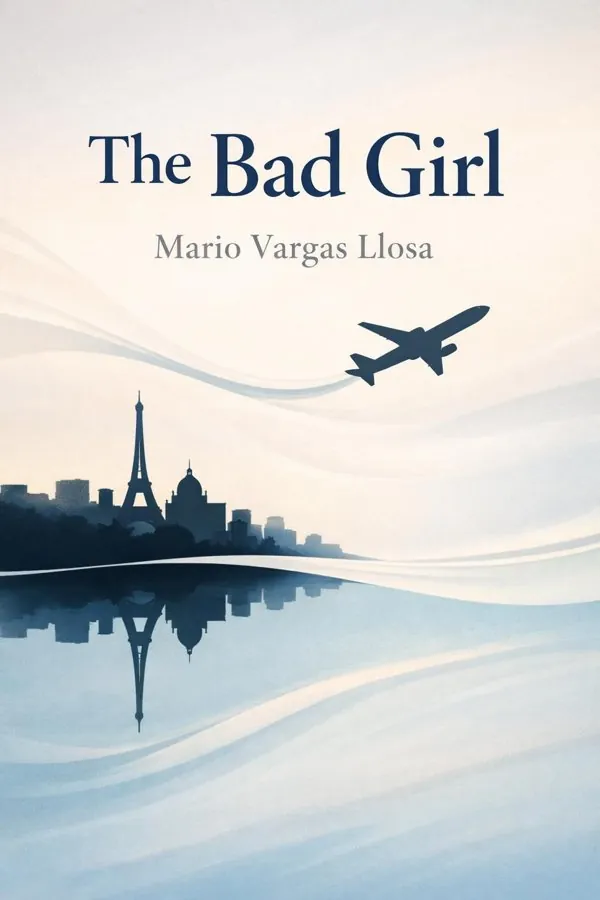
The Bad Girl: Summary & Key Insights
 10 min9 chaptersAudio available
Key Takeaways from The Bad Girl
A life can be shaped as much by a dream as by a decision.
The most dangerous prisons are sometimes the ones we decorate ourselves.
Few things are as seductive as a person who seems able to become anyone.
Behind many love stories lies a quieter story about class.
A new city can refresh the senses, but it cannot automatically cure an old pattern.
What Is The Bad Girl About?
The Bad Girl by Mario Vargas Llosa is a bestsellers book spanning 3 pages. The Bad Girl by Mario Vargas Llosa is a sweeping, emotionally charged novel about the power of desire and the cost of devoting a life to an illusion. At its center is Ricardo Somocurcio, a quiet Peruvian translator whose greatest dream is to live in Paris. Yet the true force shaping his life is not the city he longs for, but a woman he first meets in Lima and then encounters again and again across decades, each time under a different name, social role, and identity. She is seductive, elusive, ambitious, and impossible to possess. Ricardo loves her with a loyalty that borders on self-erasure. Part love story, part psychological portrait, and part international coming-of-age novel, The Bad Girl travels through Lima, Paris, London, Tokyo, and Madrid while tracing changing political and cultural landscapes. Vargas Llosa, one of the most important novelists of the modern era and winner of the Nobel Prize in Literature, brings extraordinary narrative control to a story that is both intimate and expansive. The result is a haunting exploration of obsession, reinvention, class ambition, and the uneasy distance between romantic fantasy and reality.
This FizzRead summary covers all 9 key chapters of The Bad Girl in approximately 10 minutes, distilling the most important ideas, arguments, and takeaways from Mario Vargas Llosa's work. Also available as an audio summary and Key Quotes Podcast.
The Bad Girl
The Bad Girl by Mario Vargas Llosa is a sweeping, emotionally charged novel about the power of desire and the cost of devoting a life to an illusion. At its center is Ricardo Somocurcio, a quiet Peruvian translator whose greatest dream is to live in Paris. Yet the true force shaping his life is not the city he longs for, but a woman he first meets in Lima and then encounters again and again across decades, each time under a different name, social role, and identity. She is seductive, elusive, ambitious, and impossible to possess. Ricardo loves her with a loyalty that borders on self-erasure.
Part love story, part psychological portrait, and part international coming-of-age novel, The Bad Girl travels through Lima, Paris, London, Tokyo, and Madrid while tracing changing political and cultural landscapes. Vargas Llosa, one of the most important novelists of the modern era and winner of the Nobel Prize in Literature, brings extraordinary narrative control to a story that is both intimate and expansive. The result is a haunting exploration of obsession, reinvention, class ambition, and the uneasy distance between romantic fantasy and reality.
Who Should Read The Bad Girl?
This book is perfect for anyone interested in bestsellers and looking to gain actionable insights in a short read. Whether you're a student, professional, or lifelong learner, the key ideas from The Bad Girl by Mario Vargas Llosa will help you think differently.
- ✓Readers who enjoy bestsellers and want practical takeaways
- ✓Professionals looking to apply new ideas to their work and life
- ✓Anyone who wants the core insights of The Bad Girl in just 10 minutes
Want the full summary?
Get instant access to this book summary and 100K+ more with Fizz Moment.
Get Free SummaryAvailable on App Store • Free to download
Key Chapters
A life can be shaped as much by a dream as by a decision. For Ricardo Somocurcio, growing up in Lima means living with a quiet but persistent conviction: his real life will begin only when he reaches Paris. Paris is not merely a destination for him. It is refinement, freedom, culture, and escape from provincial limits. This dream gives structure to his ambitions and makes him willing to endure uncertainty, modest work, and emotional loneliness.
At the same time, Ricardo’s first encounters with the girl who later becomes the great obsession of his life reveal how desire often attaches itself to fantasy. She enters his world as a young Chilean girl, alluring and slightly out of reach, and from the beginning there is a mismatch between what she is and what he needs her to represent. Ricardo wants beauty, excitement, and destiny to arrive together. In her, he believes they have.
Vargas Llosa uses this early stage of the story to show how identity is formed through longing. Ricardo imagines himself as a man of Paris and a man of great love long before experience gives him either. This is deeply human. Many people build careers, relationships, and self-images around an idealized future they have not yet tested.
In practical terms, the novel invites readers to ask whether their aspirations are rooted in reality or in projection. A dream can motivate growth, but it can also make us overlook warning signs when something seems to fit too perfectly. Ricardo’s dream pushes him forward, yet it also leaves him vulnerable to self-deception. Actionable takeaway: honor your ambitions, but regularly examine whether the people and goals you pursue belong to your real life or only to your imagined one.
The most dangerous prisons are sometimes the ones we decorate ourselves. Ricardo’s love for the bad girl is not simply romantic attachment; it becomes a structure of submission that he repeatedly chooses. Even when she lies, disappears, humiliates him, or returns only when she needs money, protection, or tenderness, he remains available. He tells himself that fidelity to feeling is noble. Yet the novel steadily asks whether that fidelity has crossed into self-betrayal.
What makes this dynamic so compelling is that Ricardo is not ignorant. He sees much of what is happening. He understands her opportunism, senses her manipulation, and suffers from her emotional unpredictability. But knowledge alone does not free him. Vargas Llosa captures a truth many readers recognize from real life: insight does not automatically produce change. People often stay trapped in unhealthy relationships not because they cannot see the pattern, but because the pattern has become part of their identity.
The bad girl, for her part, is not a simple villain. She embodies hunger, ambition, and refusal. She wants more than the world has assigned her, and she uses intimacy as one of her means of mobility. Ricardo confuses endurance with devotion, while she treats attachment as situational. Their bond is therefore unequal from the start.
This idea applies beyond romance. People can become captive to jobs, family roles, or dreams that wound them but also make them feel chosen or necessary. The lesson is not to avoid love, but to notice when love consistently erodes dignity, clarity, and peace. Actionable takeaway: if a relationship repeatedly demands your self-respect as proof of your loyalty, pause and ask whether you are loving the person or preserving your own fantasy of love.
Few things are as seductive as a person who seems able to become anyone. One of the novel’s defining features is the bad girl’s repeated metamorphosis. In each city and period, she appears in a new incarnation: socially polished, strategically renamed, emotionally adapted to the world she wants to enter. She becomes what the moment requires, whether that means a diplomat’s wife, a glamorous socialite, or a woman attached to power and money in a new national setting.
These transformations are not simply tricks. They reveal how identity can be both invented and constrained. The bad girl understands that class systems are rigid, men are gatekeepers, and charm can function as currency. She therefore treats identity as an instrument. Where Ricardo seeks authenticity and continuity, she seeks mobility. Her reinventions expose a modern truth: many social worlds reward performance more than sincerity.
Vargas Llosa does not present this shapeshifting as purely admirable or purely corrupt. It is resourceful, often impressive, but also spiritually costly. Every new role requires the suppression of history. The more she reinvents herself, the less stable any core self seems to become. Readers may recognize versions of this in contemporary life, where people curate personas for work, status, romance, or social media, sometimes losing track of who they are without the performance.
The practical question is how much adaptation is healthy. We all adjust to new contexts, but there is a difference between growth and perpetual self-erasure. The bad girl survives by transforming, yet she also becomes unreachable. Actionable takeaway: adapt when necessary, but define a few non-negotiable values and truths about yourself so reinvention does not turn into inner disappearance.
A new city can refresh the senses, but it cannot automatically cure an old pattern. The Bad Girl unfolds across Lima, Paris, London, Tokyo, and Madrid, giving the novel a cosmopolitan sweep. Each location introduces a new social atmosphere, new political currents, and a new stage in Ricardo’s emotional education. Yet for all this movement, one fact remains constant: Ricardo carries his longing with him.
This is one of the novel’s sharpest observations. People often imagine that relocation will transform them. A move to another country, a new job, or a different social world seems like the beginning of a better self. Sometimes it is. But Vargas Llosa reminds us that inner habits, especially emotional ones, travel easily. Ricardo becomes more experienced, more worldly, and more linguistically skilled, but he does not escape the deep script governing his attachment to the bad girl.
The international settings matter because they contrast external change with internal repetition. The world modernizes, ideologies shift, and cultural fashions evolve, yet Ricardo remains trapped in a private cycle of waiting, reunion, hope, and disillusionment. That pattern is familiar to anyone who has sought a fresh start without addressing the emotional logic underneath past choices.
The broader application is simple but important. Travel, success, and novelty can be enriching, but they are not substitutes for self-knowledge. If you consistently recreate the same disappointments in different environments, the issue may not be the setting. Actionable takeaway: when entering a new chapter of life, ask not only what has changed around you, but what recurring belief or wound you may still be carrying into every new place.
Popular culture often celebrates unconditional love, but the novel asks a harder question: when does devotion stop being virtuous? Ricardo sees himself as constant, faithful, and generous. Those traits are admirable in many contexts. Yet in his relationship with the bad girl, devotion frequently requires silence, excuses, and acceptance of repeated emotional injury. What appears noble from one angle looks like self-abandonment from another.
Vargas Llosa refuses easy judgment. Ricardo is not pathetic in a simple sense. He is intelligent, cultured, kind, and capable of deep feeling. His love gives his life intensity and coherence. But the same force that makes him loyal also prevents him from drawing boundaries. He repeatedly accepts terms that diminish him because he believes that persistence proves sincerity. The novel thus distinguishes between loving deeply and loving wisely.
This tension has clear relevance beyond fiction. In families, friendships, and workplaces, people often confuse endurance with goodness. They stay available to those who exploit them because they want to be seen as generous or strong. But dignity requires limits. Without them, devotion can become a permission structure for mistreatment.
The bad girl helps expose this truth because she instinctively tests the elasticity of Ricardo’s loyalty. Since he rarely withdraws access, she rarely has reason to change. Relationships teach people how to treat us. If sacrifice is endless, reciprocity becomes optional.
The lesson is not to harden the heart. It is to recognize that self-respect is not the enemy of love. In fact, it often makes love more honest. Actionable takeaway: measure the health of your commitment not only by how much you can endure, but by whether the relationship allows you to remain fully recognizable to yourself.
What we cannot fully know often holds us most powerfully. Ricardo’s attraction to the bad girl endures partly because she never becomes fully stable, transparent, or available. She appears, vanishes, changes names, hides motives, and returns in altered forms. This instability causes suffering, but it also keeps desire alive. The unknown becomes erotic. Uncertainty becomes meaning.
Vargas Llosa understands that many obsessions feed on incompletion. A person who is always slightly beyond reach can occupy more psychic space than someone who offers consistent love. The imagination fills in the gaps, often with idealization. Ricardo does not merely love the woman before him; he loves the versions of her he invents while waiting, remembering, and hoping. Distance allows fantasy to outperform reality.
This pattern can be seen in many aspects of modern life. People become fixated on unavailable partners, glamorous careers, or imagined futures precisely because ambiguity leaves room for projection. By contrast, what is present and dependable can seem less intoxicating, even if it is healthier. The novel exposes this bias with unusual elegance. Ricardo’s great passion is sustained not only by emotion but by absence.
There is a practical warning here. If your strongest desire intensifies mainly in periods of confusion, separation, or unpredictability, you may be attached less to the person than to the emotional drama surrounding them. Clarity can feel less thrilling, but it is often where trust becomes possible. Actionable takeaway: when you feel irresistibly drawn to someone, ask whether the attraction comes from genuine connection or from the seductive charge of mystery, distance, and uncertainty.
Individual lives unfold inside history, but personal obsessions often ignore historical scale. One of the novel’s quiet achievements is how it places Ricardo’s intimate story against decades of geopolitical and cultural change. Revolutions, social upheavals, shifting class structures, and changing urban worlds form the background of the narrative. Yet Ricardo remains focused on the next reappearance of the bad girl, as if private longing were the true axis of time.
This contrast gives the novel depth. Vargas Llosa shows that people can live through eras of transformation while remaining internally bound to a single unresolved drama. Political events matter, but they do not automatically liberate the heart. Ricardo’s life as an expatriate translator also reinforces this point. He is someone who moves between languages and worlds, observing history from close range, yet his emotional life remains anchored to an old wound and an old desire.
This idea resonates because many readers know what it means to be historically aware and personally stuck at the same time. One can advance professionally, witness social change, and accumulate experience while still circling the same emotional question for years. The novel does not condemn this; it simply renders it truthfully.
The takeaway is that growth requires more than the passage of time or exposure to a wider world. People often assume maturity will arrive automatically through age and experience. But unresolved patterns can persist unless consciously examined. Actionable takeaway: periodically review the major story you are telling yourself about your life, and ask whether it still deserves to organize your present after the world around you has already moved on.
The end of an obsession is rarely a clean awakening; more often, it is a painful mixture of loss, recognition, and lingering tenderness. In the later movements of The Bad Girl, the glamour surrounding the central relationship begins to fray. Time strips away some of the theatrical power of reinvention. Bodies age, opportunities narrow, and the emotional costs of earlier choices become harder to hide. What once seemed thrillingly elusive starts to look fragile and tragic.
This final reckoning is one of the novel’s greatest strengths. Vargas Llosa does not deliver a simplistic moral in which Ricardo finally sees everything clearly and walks away untouched. Instead, he shows that illusions can persist even after they are recognized. Love does not vanish simply because reality has won the argument. Ricardo gains painful knowledge, but he also remains capable of compassion. That complexity gives the novel its emotional seriousness.
For readers, the larger lesson is that growing up often means learning to hold two truths at once: someone may have harmed us, and we may still feel tenderness toward them; a dream may have been false, and it may still have given shape to our life. Maturity is not always about replacing feeling with judgment. Sometimes it is about integrating both.
This idea can help people process endings in their own lives. Not every broken attachment needs to be rewritten as a total mistake. Some relationships wound us and teach us at the same time. Actionable takeaway: when confronting the end of an illusion, resist the urge to simplify it; name both the damage and the meaning so you can leave with clarity rather than bitterness.
All Chapters in The Bad Girl
About the Author
Mario Vargas Llosa was a Peruvian novelist, essayist, journalist, and public intellectual widely regarded as one of the defining writers of modern world literature. Born in Arequipa, Peru, in 1936, he rose to prominence during the Latin American literary boom and built a career marked by formal ambition, political intelligence, and deep psychological insight. His major works include The Time of the Hero, Conversation in the Cathedral, The War of the End of the World, and The Feast of the Goat. In 2010, he received the Nobel Prize in Literature for his cartography of structures of power and his vivid images of individual resistance, revolt, and defeat. Across fiction and nonfiction alike, Vargas Llosa explored politics, history, freedom, class, and desire with exceptional range and authority.
Get This Summary in Your Preferred Format
Read or listen to the The Bad Girl summary by Mario Vargas Llosa anytime, anywhere. FizzRead offers multiple formats so you can learn on your terms — all free.
Available formats: App · Audio · PDF · EPUB — All included free with FizzRead
Download The Bad Girl PDF and EPUB Summary
Key Quotes from The Bad Girl
“A life can be shaped as much by a dream as by a decision.”
“The most dangerous prisons are sometimes the ones we decorate ourselves.”
“Few things are as seductive as a person who seems able to become anyone.”
“Behind many love stories lies a quieter story about class.”
“A new city can refresh the senses, but it cannot automatically cure an old pattern.”
Frequently Asked Questions about The Bad Girl
The Bad Girl by Mario Vargas Llosa is a bestsellers book that explores key ideas across 9 chapters. The Bad Girl by Mario Vargas Llosa is a sweeping, emotionally charged novel about the power of desire and the cost of devoting a life to an illusion. At its center is Ricardo Somocurcio, a quiet Peruvian translator whose greatest dream is to live in Paris. Yet the true force shaping his life is not the city he longs for, but a woman he first meets in Lima and then encounters again and again across decades, each time under a different name, social role, and identity. She is seductive, elusive, ambitious, and impossible to possess. Ricardo loves her with a loyalty that borders on self-erasure. Part love story, part psychological portrait, and part international coming-of-age novel, The Bad Girl travels through Lima, Paris, London, Tokyo, and Madrid while tracing changing political and cultural landscapes. Vargas Llosa, one of the most important novelists of the modern era and winner of the Nobel Prize in Literature, brings extraordinary narrative control to a story that is both intimate and expansive. The result is a haunting exploration of obsession, reinvention, class ambition, and the uneasy distance between romantic fantasy and reality.
More by Mario Vargas Llosa
You Might Also Like
The Godfather
Mario Puzo
10 min
The Handmaid's Tale
Margaret Atwood
10 min
The Hunger Games
Suzanne Collins
10 min
The Nightingale
Kristin Hannah
10 min
The Seven Husbands of Evelyn Hugo
Taylor Jenkins Reid
10 min
Backwater Justice
Fern Michaels
10 minBrowse by Category
Ready to read The Bad Girl?
Get the full summary and 100K+ more books with Fizz Moment.