
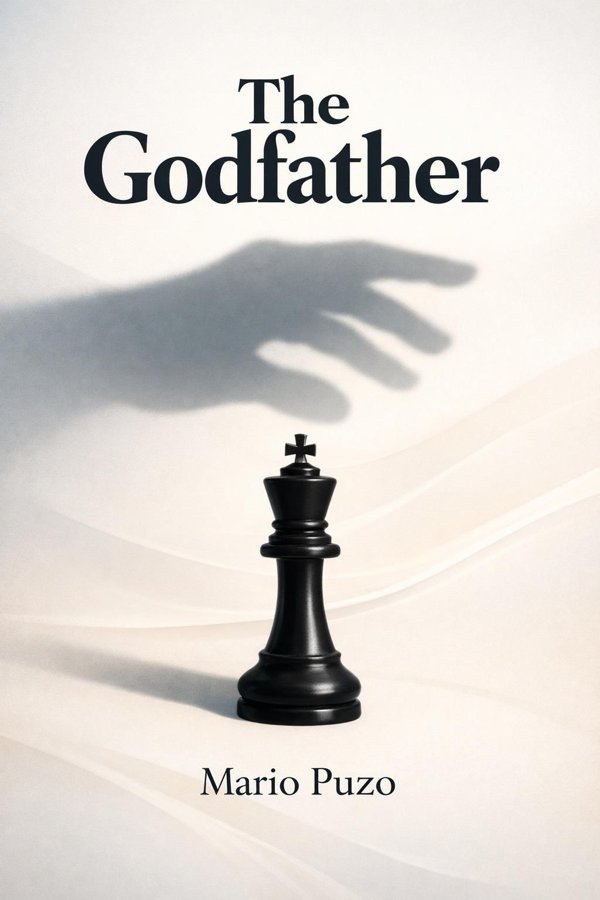
The Godfather: Summary & Key Insights
by Mario Puzo
 10 min9 chapters
Key Takeaways from The Godfather
Real power rarely announces itself loudly; it is felt in the quiet certainty that others will listen.
A celebration can reveal more truth than a confession.
Sometimes the clearest sign of power is the ability to shape events far beyond your own territory.
One moment of crisis can turn a detached observer into a committed participant.
Leaving home does not erase who you are; it often strips away distractions and reveals it more clearly.
What Is The Godfather About?
The Godfather by Mario Puzo is a bestsellers book published in 1969 spanning 8 pages. The Godfather by Mario Puzo is far more than a gangster novel. First published in 1969, it is a sweeping story about family, power, loyalty, ambition, and the hidden systems that govern society when official institutions fail. At its center stands Don Vito Corleone, the head of a powerful Italian American crime family whose influence reaches from neighborhood favors to the highest levels of business and politics. Yet the novel’s deepest drama belongs to his youngest son, Michael Corleone, whose transformation from outsider to ruthless successor gives the book its lasting emotional force. What makes The Godfather endure is not simply its violence or suspense, but its human complexity. Puzo examines how authority is built through obligation, how love and fear become intertwined, and how a family’s code of honor can both protect and destroy it. Puzo wrote with unusual authority about immigrant identity, urban hardship, and the seductions of power, creating a story that feels both intimate and epic. The result is a modern classic that speaks to readers interested in crime, psychology, leadership, and the moral cost of success.
This FizzRead summary covers all 9 key chapters of The Godfather in approximately 10 minutes, distilling the most important ideas, arguments, and takeaways from Mario Puzo's work.
The Godfather
The Godfather by Mario Puzo is far more than a gangster novel. First published in 1969, it is a sweeping story about family, power, loyalty, ambition, and the hidden systems that govern society when official institutions fail. At its center stands Don Vito Corleone, the head of a powerful Italian American crime family whose influence reaches from neighborhood favors to the highest levels of business and politics. Yet the novel’s deepest drama belongs to his youngest son, Michael Corleone, whose transformation from outsider to ruthless successor gives the book its lasting emotional force. What makes The Godfather endure is not simply its violence or suspense, but its human complexity. Puzo examines how authority is built through obligation, how love and fear become intertwined, and how a family’s code of honor can both protect and destroy it. Puzo wrote with unusual authority about immigrant identity, urban hardship, and the seductions of power, creating a story that feels both intimate and epic. The result is a modern classic that speaks to readers interested in crime, psychology, leadership, and the moral cost of success.
Who Should Read The Godfather?
This book is perfect for anyone interested in bestsellers and looking to gain actionable insights in a short read. Whether you're a student, professional, or lifelong learner, the key ideas from The Godfather by Mario Puzo will help you think differently.
- ✓Readers who enjoy bestsellers and want practical takeaways
- ✓Professionals looking to apply new ideas to their work and life
- ✓Anyone who wants the core insights of The Godfather in just 10 minutes
Want the full summary?
Get instant access to this book summary and 100K+ more with Fizz Moment.
Get Free SummaryAvailable on App Store • Free to download
Key Chapters
Real power rarely announces itself loudly; it is felt in the quiet certainty that others will listen. That is the essence of Don Vito Corleone, the novel’s commanding center. Puzo presents him not as a reckless criminal, but as a patient strategist who understands that influence comes from trust, fear, reciprocity, and timing. People come to him because courts, politicians, and employers have failed them. In that vacuum, Don Vito becomes an alternative source of justice. His authority rests not only on violence, but on memory: he remembers every favor granted, every insult delivered, and every alliance worth preserving.
What makes this idea so compelling is that the Don operates like both a patriarch and a statesman. He listens carefully, speaks sparingly, and acts decisively. He understands that leadership is not simply about issuing orders; it is about building a system in which others depend on you. That system can be benevolent, manipulative, or both. Puzo shows that people often accept morally compromised leadership when it provides stability, dignity, or protection.
In practical terms, this idea extends beyond crime fiction. In business, politics, and personal life, those who cultivate reliable relationships often wield more influence than those with official titles alone. A boss may have authority on paper, but the person everyone trusts to solve problems often has the real power. The novel reminds us to ask where influence truly comes from and what price it demands.
Actionable takeaway: Look beyond formal status and identify who actually creates loyalty, solves problems, and controls outcomes in any system you are part of.
A celebration can reveal more truth than a confession. The opening wedding of Connie Corleone is one of the most famous scenes in modern fiction because it introduces the entire moral architecture of the novel. Music, food, tradition, and family warmth create an atmosphere of joy, yet behind the festivities runs a second current: requests, bargains, grievances, and obligations. On the day of his daughter’s wedding, Don Vito cannot refuse a reasonable favor, and people line up to seek his help. This ritual shows that family and business are inseparable in the Corleone world.
Puzo uses the wedding to establish every major theme at once. We see old-world Sicilian customs transplanted into America. We see the Don’s role as protector, judge, and benefactor. We see the contrast between insiders and outsiders, especially through Michael Corleone, who attends with Kay Adams and tries to stand apart from the family business. The scene also demonstrates how power networks function: not through abstract systems, but through personal relationships. Every guest, every request, and every small interaction matters.
This opening offers a practical lesson in how environments reveal hidden structures. In real life, weddings, funerals, conferences, and family gatherings often expose who matters, who owes whom, and how decisions get made. If you pay attention, informal settings can teach you more about an organization or family than formal meetings ever will. The wedding is not filler; it is a complete social map.
Actionable takeaway: When entering any new group or institution, observe its rituals closely. They often reveal the true rules, loyalties, and power relationships beneath the surface.
Sometimes the clearest sign of power is the ability to shape events far beyond your own territory. Johnny Fontane, the famous singer and actor who turns to Don Vito for help, illustrates how the Corleone family’s influence extends into entertainment, labor, and elite institutions. Johnny’s problem appears personal and professional: his career is faltering, and a coveted film role may slip away. But his appeal to the Don reveals a larger truth. In Puzo’s world, there is no clean boundary between legitimate and illegitimate power. Hollywood, politics, unions, and organized crime all operate through pressure, vanity, leverage, and favors.
The Don’s intervention on Johnny’s behalf is important not simply because it works, but because it exposes the methods behind public success. Talent matters, but so do access, alliances, reputation, and the willingness to apply force indirectly. Puzo suggests that many glamorous industries are sustained by hidden negotiations. Johnny is not merely a celebrity; he is a case study in dependence. Even the rich and admired need powerful patrons.
Readers can apply this insight by recognizing that outcomes are often shaped by networks rather than merit alone. This does not mean ethics are irrelevant, but it does mean influence must be understood realistically. People advance because they combine ability with relationships, credibility, and strategic support. The novel warns against naivete while also showing the danger of becoming too comfortable with morally corrupt shortcuts.
Actionable takeaway: Build genuine relationships and professional credibility, but never assume visible success tells the whole story about how decisions are really made.
One moment of crisis can turn a detached observer into a committed participant. Early in The Godfather, Michael Corleone stands apart from his family’s criminal empire. He is a war hero, educated, disciplined, and romantically linked to a life outside Sicilian tradition. He can explain his family to Kay with a mixture of affection and distance: this is my family, he implies, but it is not me. That illusion collapses when Don Vito is nearly assassinated. The attack does more than wound the family patriarch; it destabilizes the entire balance of power and forces Michael to confront who he is when the people he loves are threatened.
Michael’s transformation is one of the novel’s greatest achievements. He does not step into violence impulsively. Puzo shows him thinking, watching, and gradually accepting that the world he hoped to avoid now demands action from him. His decision to protect his father in the hospital and later to murder Sollozzo and Captain McCluskey marks the end of innocence. He discovers not only that he is capable of violence, but that he is extraordinarily suited to strategic, cold-blooded power.
This idea matters because many people discover their real values not during comfort, but during disruption. Crisis reveals whether someone will retreat, adapt, or transform. In leadership, family life, or career, pressure often clarifies identity faster than introspection does. Yet Puzo also shows the cost: once Michael crosses certain moral lines, returning to his former self becomes impossible.
Actionable takeaway: Treat moments of crisis as revealing tests of character, and think carefully before taking actions that may solve an immediate problem but permanently redefine who you become.
Leaving home does not erase who you are; it often strips away distractions and reveals it more clearly. After killing Sollozzo and McCluskey, Michael flees to Sicily, and the novel enters a quieter but deeply important phase. His exile is not a pause in the story but a spiritual and cultural education. In Sicily, Michael encounters the ancestral roots of the values that shaped his father: pride, fatalism, family honor, vendetta, and the intimate connection between beauty and danger. The landscape is romantic, but the social order is severe.
Michael’s time there broadens his understanding of power. In America, the Corleones operate within a complex world of business, law, and ethnic mobility. In Sicily, power feels older and more naked. Custom governs behavior, and violence is woven directly into social memory. Michael’s marriage to Apollonia briefly gives him a vision of tenderness and belonging, yet tragedy destroys that possibility. The loss hardens him further, teaching him that personal happiness is fragile in a life shaped by enemies and inherited obligations.
For readers, this section offers insight into how environments mold identity. We often think decisions come solely from personality, but place, history, and inherited codes exert enormous pressure. Exile, travel, or major transitions can reveal assumptions we did not know we carried. Michael does not simply hide in Sicily; he absorbs its logic.
Actionable takeaway: When life forces you into transition, use the distance to study the values you have inherited, deciding consciously which ones to keep and which ones will cost too much to carry forward.
Strength without discipline can become a weapon against itself. Sonny Corleone, the Don’s eldest son, is brave, passionate, and fiercely loyal, but he lacks the patience that true long-term leadership requires. Where Don Vito calculates, Sonny reacts. Where Michael learns to conceal his intentions, Sonny lets emotion spill into action. After the attack on his father, Sonny assumes control of the family and responds with aggression, escalating tensions with rival families. His instincts are understandable, even admirable in their devotion, but Puzo makes clear that temperament matters as much as courage.
Sonny’s downfall is tragic because it grows from qualities that might seem heroic in another context. He loves his family deeply, defends them without hesitation, and refuses to be intimidated. Yet he cannot master himself. His rage over his sister Connie’s abuse draws him into a deadly trap, showing how enemies exploit predictable emotion. The novel repeatedly suggests that the most dangerous vulnerability is not weakness, but manipulable passion.
This lesson applies widely. In management, negotiation, and conflict, emotional honesty is valuable, but emotional impulsiveness can be disastrous. A leader who cannot control anger reveals a map of pressure points to opponents. The problem is not feeling strongly; it is allowing feelings to dictate strategy. Sonny teaches that intensity wins battles only when paired with restraint.
Actionable takeaway: Notice the situations that reliably provoke you, and develop a pause between feeling and response so others cannot predictably use your emotions against you.
The most chilling forms of power wear the mask of order. The novel’s climax, in which Michael consolidates control through a series of coordinated killings while standing as godfather at a baptism, crystallizes everything Puzo has been building toward. Publicly, Michael appears to be entering respectable adulthood: family man, sponsor of a child, heir to stability. Privately, he is eliminating enemies and securing his position as the new head of the Corleone empire. The contrast is not incidental. It is the point. Power often legitimizes itself through ceremony even while it commits acts of great brutality.
This sequence reveals Michael’s final transformation. He no longer reacts to events; he designs them. He has learned from Don Vito’s patience, but he exceeds him in ruthlessness and in the desire to centralize control. The personal and political merge completely. By the time he lies to Kay and closes the door on her, the emotional consequences of his rise become unmistakable. He has achieved security, but at the cost of honesty, intimacy, and much of his humanity.
For modern readers, the lesson reaches beyond organized crime. Institutions frequently hide harsh realities behind polished narratives, titles, and rituals. Leaders speak of values while protecting power. Individuals rationalize questionable actions by appealing to duty or necessity. The Godfather asks us to notice these contradictions and to ask what kind of success we are really admiring.
Actionable takeaway: When evaluating leaders or institutions, look past their ceremonies and public language to the concrete actions they take and the human cost of maintaining their control.
All Chapters in The Godfather
About the Author
Mario Puzo (1920–1999) was an American author and screenwriter best known for The Godfather, one of the most influential novels of the 20th century. He was born in New York City to Italian immigrant parents and grew up in a working-class environment that deeply shaped his understanding of family, struggle, and ambition. Although he wrote several books, it was The Godfather, published in 1969, that brought him international fame. Puzo had a gift for combining popular storytelling with sharp insight into power, loyalty, and moral compromise. He later co-wrote the screenplays for The Godfather and The Godfather Part II with director Francis Ford Coppola, winning two Academy Awards. His work remains central to modern crime fiction and to the broader cultural imagination surrounding family, power, and the American dream.
Get This Summary in Your Preferred Format
Read or listen to the The Godfather summary by Mario Puzo anytime, anywhere. FizzRead offers multiple formats so you can learn on your terms — all free.
Available formats: App · Audio · PDF · EPUB — All included free with FizzRead
Download The Godfather PDF and EPUB Summary
Key Quotes from The Godfather
“Real power rarely announces itself loudly; it is felt in the quiet certainty that others will listen.”
“A celebration can reveal more truth than a confession.”
“Sometimes the clearest sign of power is the ability to shape events far beyond your own territory.”
“One moment of crisis can turn a detached observer into a committed participant.”
“Leaving home does not erase who you are; it often strips away distractions and reveals it more clearly.”
Frequently Asked Questions about The Godfather
The Godfather by Mario Puzo is a bestsellers book that explores key ideas across 9 chapters. The Godfather by Mario Puzo is far more than a gangster novel. First published in 1969, it is a sweeping story about family, power, loyalty, ambition, and the hidden systems that govern society when official institutions fail. At its center stands Don Vito Corleone, the head of a powerful Italian American crime family whose influence reaches from neighborhood favors to the highest levels of business and politics. Yet the novel’s deepest drama belongs to his youngest son, Michael Corleone, whose transformation from outsider to ruthless successor gives the book its lasting emotional force. What makes The Godfather endure is not simply its violence or suspense, but its human complexity. Puzo examines how authority is built through obligation, how love and fear become intertwined, and how a family’s code of honor can both protect and destroy it. Puzo wrote with unusual authority about immigrant identity, urban hardship, and the seductions of power, creating a story that feels both intimate and epic. The result is a modern classic that speaks to readers interested in crime, psychology, leadership, and the moral cost of success.
You Might Also Like

Browse by Category
Ready to read The Godfather?
Get the full summary and 100K+ more books with Fizz Moment.