
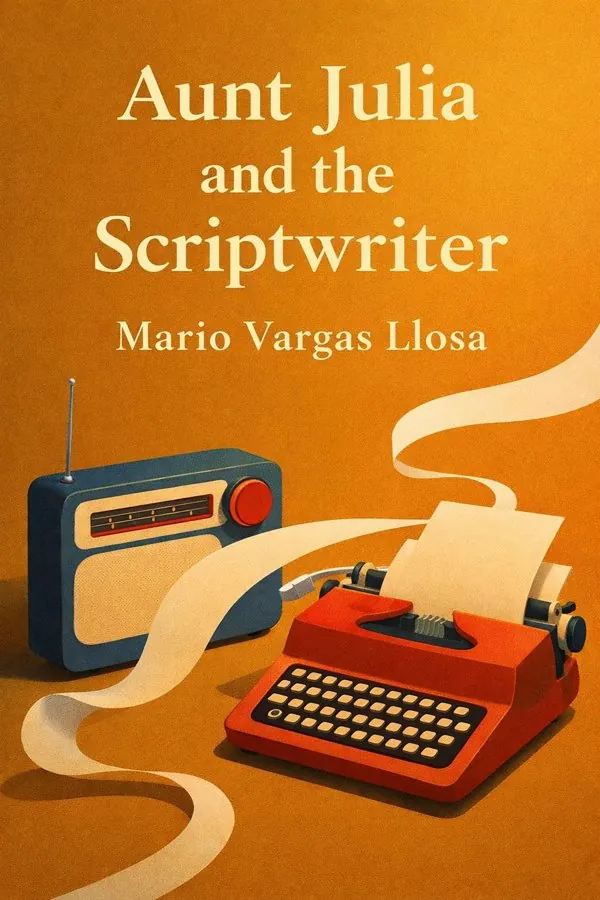
Aunt Julia and the Scriptwriter: Summary & Key Insights
 10 min9 chaptersAudio available
Key Takeaways from Aunt Julia and the Scriptwriter
Love often becomes most visible when society tries hardest to deny it.
Creative brilliance can look heroic from a distance and alarming up close.
Stories do not remain on the page or on the airwaves; they spill into the way people see the world.
Comedy can expose social hypocrisy more effectively than moral preaching.
Becoming a writer, artist, or maker rarely begins with glamour; it begins with persistence in unglamorous conditions.
What Is Aunt Julia and the Scriptwriter About?
Aunt Julia and the Scriptwriter by Mario Vargas Llosa is a bestsellers book spanning 5 pages. Aunt Julia and the Scriptwriter is one of Mario Vargas Llosa’s most delightful and inventive novels: a comic, semi-autobiographical story about ambition, desire, and the dangerous seductions of storytelling. Set in 1950s Lima, the book follows young Mario, an aspiring writer working at a radio station, who falls in love with Julia, his older, recently divorced aunt by marriage. Their romance is already scandalous enough in a rigid, gossip-driven society. But running alongside it is another drama: the rise and unraveling of Pedro Camacho, a wildly productive Bolivian radio scriptwriter whose melodramatic serials captivate listeners even as his own mind begins to fracture. What makes the novel so memorable is the way Vargas Llosa intertwines these two worlds—lived experience and fabricated drama—until they begin to mirror, distort, and invade each other. The result is funny, sharp, and unexpectedly profound. Beneath the farce lies a serious meditation on how writers shape reality, how obsession can fuel and destroy creativity, and how love often requires rebellion. As a Nobel Prize-winning novelist drawing on his own youth, Vargas Llosa writes with authority, wit, and intimate emotional truth.
This FizzRead summary covers all 9 key chapters of Aunt Julia and the Scriptwriter in approximately 10 minutes, distilling the most important ideas, arguments, and takeaways from Mario Vargas Llosa's work. Also available as an audio summary and Key Quotes Podcast.
Aunt Julia and the Scriptwriter
Aunt Julia and the Scriptwriter is one of Mario Vargas Llosa’s most delightful and inventive novels: a comic, semi-autobiographical story about ambition, desire, and the dangerous seductions of storytelling. Set in 1950s Lima, the book follows young Mario, an aspiring writer working at a radio station, who falls in love with Julia, his older, recently divorced aunt by marriage. Their romance is already scandalous enough in a rigid, gossip-driven society. But running alongside it is another drama: the rise and unraveling of Pedro Camacho, a wildly productive Bolivian radio scriptwriter whose melodramatic serials captivate listeners even as his own mind begins to fracture.
What makes the novel so memorable is the way Vargas Llosa intertwines these two worlds—lived experience and fabricated drama—until they begin to mirror, distort, and invade each other. The result is funny, sharp, and unexpectedly profound. Beneath the farce lies a serious meditation on how writers shape reality, how obsession can fuel and destroy creativity, and how love often requires rebellion. As a Nobel Prize-winning novelist drawing on his own youth, Vargas Llosa writes with authority, wit, and intimate emotional truth.
Who Should Read Aunt Julia and the Scriptwriter?
This book is perfect for anyone interested in bestsellers and looking to gain actionable insights in a short read. Whether you're a student, professional, or lifelong learner, the key ideas from Aunt Julia and the Scriptwriter by Mario Vargas Llosa will help you think differently.
- ✓Readers who enjoy bestsellers and want practical takeaways
- ✓Professionals looking to apply new ideas to their work and life
- ✓Anyone who wants the core insights of Aunt Julia and the Scriptwriter in just 10 minutes
Want the full summary?
Get instant access to this book summary and 100K+ more with Fizz Moment.
Get Free SummaryAvailable on App Store • Free to download
Key Chapters
Creative brilliance can look heroic from a distance and alarming up close. Pedro Camacho, the eccentric Bolivian scriptwriter who arrives at Radio Panamericana, embodies this tension perfectly. Small, severe, tireless, and almost monastic in his habits, he produces radio serials at an astonishing pace. He writes endlessly, isolates himself from ordinary life, and treats storytelling not as a profession but as a sacred mission. To listeners, he is a genius. To colleagues, he is a phenomenon. To the reader, he gradually becomes something more troubling: a man whose identity has fused dangerously with his output.
Camacho’s arrival electrifies the station. His melodramas seize the public imagination because they are emotionally excessive, vivid, and relentless. He understands audience appetite intuitively. But his productivity comes at a cost. He strips away sleep, leisure, friendship, and balance in service of invention. Vargas Llosa uses him to dramatize a hard truth about artistic labor: discipline is essential, but when discipline loses all connection to reality, it curdles into obsession.
This idea applies far beyond literature. In modern life, overwork is often mistaken for devotion. A founder who never rests, a student who burns out, an employee who cannot detach from performance metrics—all may look admirable until their effectiveness collapses. Camacho reminds us that output without recovery can become self-defeating.
The novel also shows that audiences often reward intensity without noticing the damage behind it. That is an important caution in a culture that glamorizes hustle. Sustainable creativity requires not only effort but boundaries, reflection, and replenishment.
A practical exercise is to look at your own work habits and ask whether your routines are building mastery or simply feeding compulsion. Protecting time for rest is not laziness; it is part of the craft. The takeaway: obsession can generate brilliance for a while, but only balance makes excellence last.
Stories do not remain on the page or on the airwaves; they spill into the way people see the world. One of the novel’s most original achievements is the interplay between Mario’s real-life courtship and Pedro Camacho’s serialized dramas. Vargas Llosa alternates chapters between the relatively grounded account of Mario’s life and increasingly bizarre episodes from Camacho’s radio universe. At first, the separation seems clear. Then the boundaries begin to blur. Characters recur under different names, plots overlap, continuity breaks down, and reality itself starts to feel infected by melodrama.
This structural choice is more than a clever literary trick. It suggests that fiction shapes perception even when we think we are merely consuming entertainment. The people of Lima are enthralled by radio serials because the dramas intensify emotions that ordinary life only hints at: jealousy, sacrifice, betrayal, redemption. In turn, Mario’s own life begins to look theatrical, almost as if he is living inside a narrative pattern. The novel asks whether we ever encounter life directly, or whether we continually interpret it through stories we have inherited.
This insight remains especially relevant today. Social media, television, political messaging, and personal branding all teach us to narrate ourselves. We borrow scripts about romance, success, conflict, and identity. Sometimes these stories help us make meaning. Sometimes they trap us in exaggeration.
A practical application is to pay attention to the narratives you automatically use. Do you cast yourself as the misunderstood hero, the perpetual victim, the rebel, the savior? Those scripts can distort your judgment. Like Camacho’s increasingly tangled serials, they may simplify reality until it stops making sense.
Try rewriting one story you tell about your life in more precise, less dramatic terms. The takeaway: fiction is powerful not because it escapes reality, but because it quietly teaches us how to interpret it.
Comedy can expose social hypocrisy more effectively than moral preaching. Aunt Julia and the Scriptwriter is a deeply funny novel, but its humor is not ornamental. Vargas Llosa uses wit, irony, exaggeration, and farce to reveal how absurd supposedly respectable society can be. Mario and Julia’s romance becomes a scandal, not because it harms anyone, but because it disrupts the appearances that families work so hard to preserve. Meanwhile, the melodramatic excess of radio serials is treated as entertainment even as everyday life in Lima is full of equally irrational vanity, gossip, and performance.
The novel’s comedy works because it is rooted in observation. Relatives panic, bureaucrats interfere, lovers scheme, and public morality bends according to convenience. Vargas Llosa shows that institutions of respectability—family, work, class expectations, social decorum—are often less stable and less sincere than they claim. People defend norms not always because those norms are moral, but because they are useful for maintaining status.
In practical terms, humor becomes a tool for perspective. When you can laugh at rigid systems, you become less intimidated by them. This does not mean dismissing real consequences. Mario and Julia face genuine difficulties. But the novel suggests that many forms of social pressure lose some of their power when their theatricality is exposed.
This is useful in workplaces, families, and communities where unwritten rules dominate behavior. Often the first step in resisting unhealthy norms is recognizing how arbitrary they are. A little irony can break the spell of false seriousness.
Consider an environment in your life where everyone acts as if certain expectations are sacred. Ask which of those rules serve real human needs and which merely protect image. The takeaway: humor is not an escape from reality; it is a way of seeing through its pretenses.
Becoming a writer, artist, or maker rarely begins with glamour; it begins with persistence in unglamorous conditions. Mario, the young protagonist, works at a radio station doing routine tasks while nurturing a fierce literary ambition. He is not yet the celebrated author he dreams of becoming. He is underpaid, dependent on family structures he does not fully fit into, and constantly pulled between practical responsibilities and imaginative aspiration. This makes him an unusually honest portrait of the artist before success.
What the novel captures so well is the texture of early ambition. Mario reads, observes, drafts, fantasizes, and uses every available environment—newsrooms, broadcasts, conversations, family drama—as material. He is learning that writing is not only inspiration but apprenticeship. Talent matters, but so do endurance, attention, and the willingness to continue before rewards are visible.
Vargas Llosa also complicates the romantic image of artistic destiny by placing Mario beside Pedro Camacho. Mario wants to become a serious writer; Camacho is already a prolific professional. Yet Camacho’s example shows what happens when vocation becomes all-consuming. The contrast implies that ambition needs shape, not just intensity. One must work hard, but also cultivate judgment about what kind of life that work is creating.
The lesson applies to any long-term project: building a business, mastering a craft, earning a degree, or changing careers. Progress often happens in obscurity. The challenge is to keep faith with your larger purpose while doing the ordinary labor required by it.
A practical takeaway is to build a system rather than rely on moods. Set regular time for your craft, use your current job as training instead of seeing it only as an obstacle, and study the people who model both skill and sustainability. The takeaway: ambition becomes real when it survives routine, delay, and discomfort.
The most dangerous sentence a creator can believe is: I am only what I produce. Pedro Camacho’s breakdown is one of the novel’s darkest and most revealing threads. As he continues generating serial after serial, the coherence of his fictional worlds starts to disintegrate. Characters from different programs cross into one another’s plots, names are confused, ages change, and logic frays. What first appears comic gradually becomes tragic. Camacho’s artistic machinery is failing because the human being operating it has exceeded his limits.
Vargas Llosa’s portrayal is sharp because it avoids a simplistic moral. Camacho is not merely a cautionary caricature. He is talented, disciplined, and sincerely devoted to his art. His collapse emerges from a recognizable temptation: to replace ordinary life with productivity. By refusing rest, relationships, and self-distance, he loses the very mental order his craft depends on.
This resonates strongly in achievement-driven cultures. People can become so identified with performance that any pause feels threatening. Professionals treat busyness as identity; students treat grades as self-worth; creators treat visibility as existence. The danger is not only exhaustion but fragmentation. When all value comes from output, the mind loses flexibility and resilience.
A practical response is to diversify your sense of self. You are not only your job title, project, audience, or success metric. Protect forms of life that are not instrumental: friendship, reading for pleasure, walking, family meals, sleep, silence. These do not interrupt meaningful work; they stabilize the person doing it.
If you notice that rest produces guilt rather than recovery, that is an important signal. Build boundaries before breakdown makes the decision for you. The takeaway: your work may express who you are, but when it becomes the whole of who you are, both life and craft begin to unravel.
We like to imagine that our choices are personal, but many of them are filtered through family scripts and class expectations. In the novel, Mario and Julia’s romance unfolds within a social world intensely concerned with propriety, lineage, and appearances. Relatives intervene, speculate, and judge not simply because they care, but because the relationship threatens an entire network of assumptions about what a respectable life should look like. Marriage is not treated as a private matter. It is bound up with status, gender roles, and family honor.
Vargas Llosa captures how social structures operate through intimate relationships. No policeman needs to appear for pressure to be felt. Family conversations, sideways remarks, moral panic, and bureaucratic obstacles do the work. That is why the novel remains so recognizable: even in societies that seem more liberal, many people still experience love and career choices through inherited expectations. Who is considered suitable? What age difference is acceptable? Which profession brings prestige? What choices embarrass the family?
The book’s value lies in showing that these pressures are powerful precisely because they feel normal. Mario and Julia must decide whether to internalize the judgments around them or act on their own understanding of their bond. Their struggle becomes a broader meditation on social conformity.
This applies in everyday decisions well beyond romance. People stay in secure careers they dislike, avoid relationships that might invite criticism, or delay difficult truths because they fear disappointing their social circle. Yet a life built solely around reputation often becomes emotionally hollow.
A practical step is to distinguish between advice grounded in care and pressure grounded in image. Ask: if nobody were watching, what would I choose? Then ask what cost you are paying to avoid disapproval. The takeaway: family and class may shape desire, but they do not have to govern destiny.
Every era has its dominant medium, and in 1950s Lima, radio is not background noise but social infrastructure. Aunt Julia and the Scriptwriter vividly portrays a world in which voices transmitted across the city can organize time, shape emotion, and create shared public fantasies. Radio station life is therefore central to the novel’s meaning. It is where Mario learns about communication, where Camacho builds his fame, and where private imagination becomes mass experience.
Pedro Camacho’s serials matter because they reveal how storytelling works when it becomes industrial and collective. He is not writing for a small literary audience but for listeners who structure their days around his plots. The medium rewards immediacy, cliffhangers, emotional intensity, and constant output. In that sense, Vargas Llosa is not only writing about radio. He is anticipating later media ecosystems built on attention and serial consumption.
The novel invites us to think about how format affects content. Radio pushes stories toward melodrama because voices must quickly create feeling. Today, social platforms encourage compression, outrage, and repetition for similar reasons. The lesson is that media do not simply distribute stories; they shape what kinds of stories flourish.
For readers, this is a practical call to become more conscious consumers. When a medium rewards sensationalism, we should not be surprised when public discourse grows theatrical. The same principle applies in professional communication: presentations, newsletters, podcasts, and posts all have structural biases. Knowing them helps us use them more wisely.
A useful exercise is to ask, of any piece of content, what the platform is rewarding: nuance, speed, emotion, tribal identity, or repetition. That question can protect judgment. The takeaway: storytelling gains enormous influence when tied to mass media, so understanding the medium is part of understanding the message.
One of the novel’s deepest insights is that writing feeds on life, but it cannot substitute for living. Mario is becoming a writer by observing everything around him: the radio station, his family, his city, his own awkward and passionate romance. At the same time, Pedro Camacho represents the extreme opposite—a writer so engulfed by fabrication that reality begins to recede. Between them, Vargas Llosa stages a quiet argument about artistic maturity.
The mature writer is not the one who escapes life most completely, but the one who can metabolize it—turning experience into form without severing the link to the world that nourishes imagination. Mario’s story suggests that love, embarrassment, conflict, labor, and uncertainty are not distractions from creative work. They are part of the material. Camacho’s tragedy suggests that when imagination floats free of lived contact, it risks becoming sterile, repetitive, and unstable.
This applies to many kinds of thinking, not just literature. Strategy without contact with reality becomes abstraction. Analysis without experience becomes brittle. Even self-improvement can become disconnected if one spends more time consuming frameworks than engaging life directly.
A practical way to use this insight is to balance reflection with participation. If you write, create, teach, or lead, do not disappear entirely into plans and concepts. Have conversations. Observe people. Stay embedded in ordinary life. Let your work be informed by reality rather than insulated from it.
The novel ultimately honors storytelling while refusing to worship it. Stories matter because they deepen life, illuminate it, and give it shape. But they must remain connected to human experience. The takeaway: the best art transforms reality by paying close attention to it, not by abandoning it.
All Chapters in Aunt Julia and the Scriptwriter
About the Author
Mario Vargas Llosa was a Peruvian novelist, essayist, journalist, and public intellectual widely regarded as one of the defining writers of the Spanish-speaking world. Born in Arequipa in 1936, he emerged as a major figure in the Latin American Boom with ambitious novels that combined formal experimentation, psychological depth, and political insight. His fiction often explores authority, rebellion, corruption, desire, and the tension between private life and public systems. Among his best-known works are The Time of the Hero, Conversation in the Cathedral, The War of the End of the World, and The Feast of the Goat. In 2010, he was awarded the Nobel Prize in Literature. Aunt Julia and the Scriptwriter is one of his most charmingly personal novels, drawing on his early life in Lima and his first marriage.
Get This Summary in Your Preferred Format
Read or listen to the Aunt Julia and the Scriptwriter summary by Mario Vargas Llosa anytime, anywhere. FizzRead offers multiple formats so you can learn on your terms — all free.
Available formats: App · Audio · PDF · EPUB — All included free with FizzRead
Download Aunt Julia and the Scriptwriter PDF and EPUB Summary
Key Quotes from Aunt Julia and the Scriptwriter
“Love often becomes most visible when society tries hardest to deny it.”
“Creative brilliance can look heroic from a distance and alarming up close.”
“Stories do not remain on the page or on the airwaves; they spill into the way people see the world.”
“Comedy can expose social hypocrisy more effectively than moral preaching.”
“Becoming a writer, artist, or maker rarely begins with glamour; it begins with persistence in unglamorous conditions.”
Frequently Asked Questions about Aunt Julia and the Scriptwriter
Aunt Julia and the Scriptwriter by Mario Vargas Llosa is a bestsellers book that explores key ideas across 9 chapters. Aunt Julia and the Scriptwriter is one of Mario Vargas Llosa’s most delightful and inventive novels: a comic, semi-autobiographical story about ambition, desire, and the dangerous seductions of storytelling. Set in 1950s Lima, the book follows young Mario, an aspiring writer working at a radio station, who falls in love with Julia, his older, recently divorced aunt by marriage. Their romance is already scandalous enough in a rigid, gossip-driven society. But running alongside it is another drama: the rise and unraveling of Pedro Camacho, a wildly productive Bolivian radio scriptwriter whose melodramatic serials captivate listeners even as his own mind begins to fracture. What makes the novel so memorable is the way Vargas Llosa intertwines these two worlds—lived experience and fabricated drama—until they begin to mirror, distort, and invade each other. The result is funny, sharp, and unexpectedly profound. Beneath the farce lies a serious meditation on how writers shape reality, how obsession can fuel and destroy creativity, and how love often requires rebellion. As a Nobel Prize-winning novelist drawing on his own youth, Vargas Llosa writes with authority, wit, and intimate emotional truth.
More by Mario Vargas Llosa
You Might Also Like
The Godfather
Mario Puzo
10 min
The Handmaid's Tale
Margaret Atwood
10 min
The Hunger Games
Suzanne Collins
10 min
The Nightingale
Kristin Hannah
10 min
The Seven Husbands of Evelyn Hugo
Taylor Jenkins Reid
10 min
Backwater Justice
Fern Michaels
10 minBrowse by Category
Ready to read Aunt Julia and the Scriptwriter?
Get the full summary and 100K+ more books with Fizz Moment.