
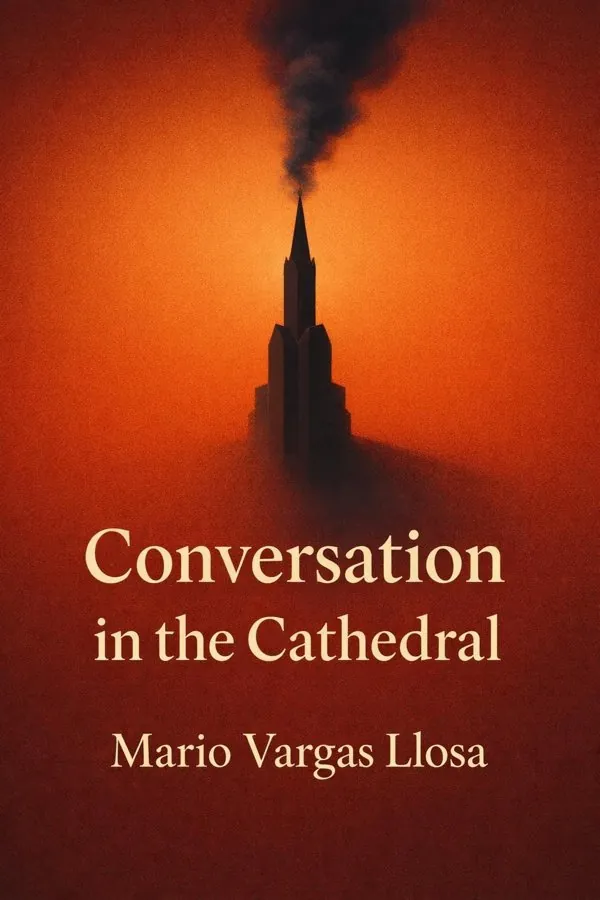
Conversation in the Cathedral: Summary & Key Insights
 10 min9 chaptersAudio available
Key Takeaways from Conversation in the Cathedral
Some places do not merely host conversations; they force truth to surface.
Authoritarianism is most dangerous when it stops looking dramatic.
Remembering is not always liberating; sometimes it is a form of trial.
Personal despair is often treated as private, but Vargas Llosa shows that it can be profoundly political.
People may speak of love, loyalty, or friendship as universal, yet class quietly shapes all three.
What Is Conversation in the Cathedral About?
Conversation in the Cathedral by Mario Vargas Llosa is a classics book spanning 4 pages. Conversation in the Cathedral is one of Mario Vargas Llosa’s most ambitious and penetrating novels, a dark, intricate portrait of Peru under the dictatorship of General Manuel A. Odría. First published in 1969, the book begins with what seems like a chance meeting between Santiago Zavala, a disillusioned journalist from an upper-class family, and Ambrosio, his father’s former chauffeur. Their extended conversation in a grimy bar called La Catedral gradually opens into a vast moral inquiry: at what point did Peru go wrong, and at what point did each individual surrender to corruption, fear, compromise, or silence? Through fragmented memories, shifting voices, and intersecting lives, Vargas Llosa shows how political oppression spreads into family relationships, class divisions, sexuality, ambition, and private conscience. This is not just a political novel but a diagnosis of a society poisoned from within. It matters because it captures how authoritarian systems deform everyday life long before they collapse. Vargas Llosa, a Nobel Prize-winning novelist and one of Latin America’s most influential writers, brings exceptional authority to this theme, combining narrative daring with sharp psychological and political insight.
This FizzRead summary covers all 9 key chapters of Conversation in the Cathedral in approximately 10 minutes, distilling the most important ideas, arguments, and takeaways from Mario Vargas Llosa's work. Also available as an audio summary and Key Quotes Podcast.
Conversation in the Cathedral
Conversation in the Cathedral is one of Mario Vargas Llosa’s most ambitious and penetrating novels, a dark, intricate portrait of Peru under the dictatorship of General Manuel A. Odría. First published in 1969, the book begins with what seems like a chance meeting between Santiago Zavala, a disillusioned journalist from an upper-class family, and Ambrosio, his father’s former chauffeur. Their extended conversation in a grimy bar called La Catedral gradually opens into a vast moral inquiry: at what point did Peru go wrong, and at what point did each individual surrender to corruption, fear, compromise, or silence? Through fragmented memories, shifting voices, and intersecting lives, Vargas Llosa shows how political oppression spreads into family relationships, class divisions, sexuality, ambition, and private conscience. This is not just a political novel but a diagnosis of a society poisoned from within. It matters because it captures how authoritarian systems deform everyday life long before they collapse. Vargas Llosa, a Nobel Prize-winning novelist and one of Latin America’s most influential writers, brings exceptional authority to this theme, combining narrative daring with sharp psychological and political insight.
Who Should Read Conversation in the Cathedral?
This book is perfect for anyone interested in classics and looking to gain actionable insights in a short read. Whether you're a student, professional, or lifelong learner, the key ideas from Conversation in the Cathedral by Mario Vargas Llosa will help you think differently.
- ✓Readers who enjoy classics and want practical takeaways
- ✓Professionals looking to apply new ideas to their work and life
- ✓Anyone who wants the core insights of Conversation in the Cathedral in just 10 minutes
Want the full summary?
Get instant access to this book summary and 100K+ more with Fizz Moment.
Get Free SummaryAvailable on App Store • Free to download
Key Chapters
Some places do not merely host conversations; they force truth to surface. La Catedral, the seedy bar where Santiago Zavala and Ambrosio meet, functions as far more than a setting. It becomes a moral chamber in which buried memories, private shame, and national decay rise together. The bar’s physical gloom mirrors the spiritual exhaustion of the characters. In this atmosphere, ordinary social masks weaken, and the men begin to revisit events they might otherwise have left unspoken.
What makes this encounter so powerful is that it turns a personal exchange into a reckoning with history. Santiago does not enter La Catedral simply to reminisce. He arrives carrying frustration, class resentment, family confusion, and a deeper question about how his country became so compromised. Ambrosio, meanwhile, represents another social position entirely: closer to power in some ways, yet also trapped by servitude, secrecy, and dependence. Their dialogue becomes a crossing point between classes, generations, and hidden versions of the same political reality.
In practical terms, Vargas Llosa shows that environments matter when people confront difficult truths. Think of how certain conversations only happen in liminal places: a late-night diner, a parked car, a hospital hallway, or a quiet walk after conflict. Such settings lower defenses because they sit outside formal roles. The novel uses that insight brilliantly. La Catedral is where Peru’s respectable facades collapse.
For readers, this idea extends beyond literature. If you want to understand a person, a family, or even a workplace, pay attention to where honest speech becomes possible. Official spaces often produce official lies. Real understanding often begins in the margins. Actionable takeaway: identify one “La Catedral” in your own life—a space where genuine reflection can happen—and use it to ask the question you have been avoiding.
Authoritarianism is most dangerous when it stops looking dramatic. One of the novel’s greatest achievements is its refusal to portray dictatorship only through grand speeches, military spectacle, or obvious terror. Instead, Vargas Llosa reveals how the Odría regime corrupts society through ordinary habits: favors exchanged behind closed doors, careers advanced through loyalty rather than merit, police intimidation normalized into routine, and silence absorbed as common sense.
This is what makes the book so unsettling. Corruption does not appear as an exception to daily life; it becomes the texture of daily life. Politicians, businessmen, servants, journalists, and family members all adapt to the system in different ways. Some profit from it. Others endure it. Many convince themselves they remain innocent because they are not the worst actors in the room. But the novel insists that oppressive systems survive through countless small accommodations, not only through visible acts of brutality.
This insight applies far beyond 1950s Peru. In any institution—government, company, school, or family—ethical collapse rarely arrives all at once. It often begins with minor compromises: overlooking favoritism, excusing dishonesty because it is useful, accepting fear-based management as normal, or deciding that resistance is impractical. Over time, these choices build a structure in which corruption feels inevitable.
Vargas Llosa does not let readers comfort themselves with the fantasy that evil is always easy to identify. He shows how power reshapes language, habits, and expectations until people forget what clean public life would even look like. Actionable takeaway: when evaluating any system, do not ask only who holds power; ask what daily behaviors that power rewards, excuses, and makes seem normal.
Remembering is not always liberating; sometimes it is a form of trial. Much of Conversation in the Cathedral unfolds through memory, but these recollections do not arrive neatly or peacefully. They come in fragments, contradictions, interruptions, and emotional shocks. Santiago and Ambrosio revisit the past not to achieve sentimental closure, but to piece together how private lives became entangled with political corruption and personal betrayal.
This structure matters because memory in the novel behaves like moral evidence. Each remembered event changes the meaning of another. A family scene acquires political implications. A casual remark reveals class contempt. A personal disappointment turns out to be connected to a larger network of manipulation. The past is not stable; it keeps rearranging itself as new details emerge. That is why the novel can feel demanding: Vargas Llosa wants readers to experience how difficult genuine understanding really is.
In life, we often tell ourselves simplified stories about why relationships failed, why institutions became toxic, or why we changed. But deeper reflection usually reveals mixed motives, missed warnings, and uncomfortable complicity. The novel dramatizes that process. Santiago is not merely recalling events; he is testing whether he can bear what those events imply about his father, his society, and himself.
This idea has practical value. Honest self-examination rarely happens in a straight line. When reviewing a difficult chapter of your own life—a career choice, a family rupture, a moral compromise—you may need to revisit it from multiple perspectives before it becomes legible. What matters is not perfect certainty, but willingness to remain with complexity. Actionable takeaway: when confronting a painful memory, ask not only “What happened?” but also “What did I fail to see at the time, and what does that change now?”
Personal despair is often treated as private, but Vargas Llosa shows that it can be profoundly political. Santiago Zavala’s famous question—when exactly did Peru get screwed up?—is inseparable from another, quieter question: when did I become estranged from the world I inhabit? His disillusionment is not just youthful cynicism. It is the emotional consequence of discovering that family respectability, social privilege, and public order rest on hypocrisy, violence, and compromise.
What makes Santiago compelling is that he is neither heroic nor simply passive. He is intelligent, sensitive, and deeply alienated. He sees through many of the lies around him, yet that clarity does not immediately translate into effective action. Instead, he drifts, resists incompletely, judges others while remaining entangled in the same society, and struggles to build a coherent moral identity. Vargas Llosa captures a familiar modern condition: knowing a system is rotten does not automatically tell you how to live outside it.
This is one reason the novel still resonates. Many readers know the feeling of becoming disenchanted with institutions once trusted—political parties, media, corporations, universities, religious communities, even families. The first response is often not activism but confusion, fatigue, sarcasm, or withdrawal. The book honors that emotional reality without romanticizing it.
At the same time, the novel warns that disillusionment can become a trap if it hardens into superiority or paralysis. To see corruption clearly is valuable, but it is not enough. The deeper challenge is to decide what integrity looks like afterward. Actionable takeaway: if you feel disillusioned, treat that feeling as information rather than an identity—use it to clarify what values you refuse to surrender, and what concrete choices can still reflect them.
People may speak of love, loyalty, or friendship as universal, yet class quietly shapes all three. In Conversation in the Cathedral, social hierarchy is not just a backdrop; it enters conversations, family expectations, sexual relationships, career paths, and even the right to tell one’s own story. Santiago and Ambrosio’s conversation matters partly because it crosses a class boundary that normally keeps truths apart. Their lives are linked, but never equally.
Vargas Llosa demonstrates that class division is sustained not only through money but through habits of perception. Upper-class families assume authority, conceal scandals, and defend appearances. Workers and servants often know far more than they are permitted to say, yet their knowledge remains socially discounted. This imbalance creates a distorted moral world: those with power control the official narrative, while those nearest the facts carry the burden of silence.
The novel’s brilliance lies in showing how class complicates intimacy. A father may believe he is benevolent while exploiting those around him. A son may reject privilege intellectually yet continue benefiting from it emotionally and materially. A servant may be both victim and participant within corrupt networks. No relationship is simple because inequality affects what each person can risk, reveal, or refuse.
This remains relevant today. In workplaces, households, and public debate, class often hides beneath language about professionalism, culture, or merit. We may imagine we are interacting as individuals when economic power is heavily determining who gets heard and who absorbs the consequences. Actionable takeaway: in any unequal relationship, ask what each person can safely say, what each stands to lose, and whose version of events is automatically treated as credible.
The corruption of a nation often appears first in the structure of a home. One of the most striking features of Conversation in the Cathedral is the way political decay echoes through family life. The Zavala household is not separate from the authoritarian order outside it; it reproduces many of the same dynamics—control, secrecy, hypocrisy, status anxiety, and emotional manipulation. Public and private power reflect each other.
Santiago’s relationship with his father is especially important here. His father represents more than one flawed parent. He embodies a class that accommodates itself to power while preserving an image of decency. The family depends on selective blindness: everyone knows enough to suspect rot, but not enough—or not willingly enough—to dismantle the fiction that holds the household together. This creates an atmosphere in which rebellion becomes both necessary and difficult. To reject the family’s values is also to risk losing belonging, inheritance, and identity.
This pattern is recognizable well beyond the novel. Families often serve as training grounds for political behavior. Children learn whether authority must be obeyed, whether appearances matter more than truth, whether conflict is discussable, and whether loyalty requires silence. A society that normalizes domination in the home will find domination easier to normalize in public institutions too.
Vargas Llosa therefore asks readers to see family drama as politically meaningful. Domestic respectability can hide coercion just as national stability can hide repression. If we want to understand how systems persist, we should study the intimate settings where people first learn compliance. Actionable takeaway: reflect on one lesson about power you absorbed from family life, and consider how it may still shape your responses to authority, conflict, and truth-telling today.
Most people do not become complicit by deciding to be villains. They become complicit by adapting. This is one of the novel’s hardest and most enduring truths. Conversation in the Cathedral is populated not only by abusers and victims, but by intermediaries: people who justify, evade, obey, conceal, and negotiate. Their moral ambiguity is precisely what makes the system durable.
Vargas Llosa refuses the comfort of simple categories. A character may be weak rather than cruel, ambitious rather than ideological, frightened rather than loyal. Yet the effect can still be destructive. The novel suggests that corruption survives because many people perform partial accommodations. They tell themselves they have no choice, that the issue is not their responsibility, or that survival requires flexibility. In isolation, each rationalization seems minor. Together, they produce a social order in which wrongdoing becomes embedded and difficult to confront.
This insight is intensely relevant today. In offices, governments, media systems, and social circles, people often encounter small ethical tests before major ones. Do you repeat a known falsehood because it is convenient? Stay silent when someone is targeted? Accept benefits from a process you know is unfair? These are gray zones where self-image and behavior diverge.
The novel does not suggest purity is easy. It does suggest that moral seriousness begins with naming compromise accurately. If you cannot admit the cost of your choices, you are already halfway captured by the system around you. Actionable takeaway: examine one area of your life where you say “That’s just how things work,” and ask whether this phrase describes reality—or excuses your own participation in it.
Even in a degraded society, the desire to understand remains a form of resistance. Conversation in the Cathedral is often remembered for its darkness, but its very structure implies a stubborn ethical hope: the truth still matters, even when it is fragmented, compromised, and painful. Santiago’s questioning may not redeem Peru or repair all damage, yet the act of asking how things went wrong is itself significant.
This is a subtle but crucial contribution of the novel. Vargas Llosa does not offer a triumphant political solution or a clear moral rescue. Instead, he values lucidity. To connect personal wounds to public corruption, to see through false respectability, to listen across class lines, to revisit what was hidden—these are modest acts compared with revolution, but they are not negligible. Authoritarian culture depends on confusion, amnesia, and resignation. Any serious attempt to understand threatens that arrangement.
In practical life, people often underestimate the value of truth-seeking when immediate change seems impossible. But naming a toxic culture, documenting abuse, asking better questions, preserving memory, and refusing inherited lies can alter what becomes thinkable. Such acts may not produce instant results, but they prevent total moral surrender.
The novel therefore leaves readers not with comfort but with a challenge: if the world around you is damaged, will you choose numbness or inquiry? Will you inherit official stories, or test them? Actionable takeaway: choose one difficult truth in your personal, professional, or civic life that you have avoided investigating, and commit to one concrete step—asking, reading, documenting, or speaking—that moves you closer to clarity.
All Chapters in Conversation in the Cathedral
About the Author
Mario Vargas Llosa was a Peruvian novelist, essayist, journalist, and public intellectual born in Arequipa, Peru, in 1936. He emerged as one of the leading figures of the Latin American Boom, a generation of writers who transformed world literature through formal experimentation and bold political themes. His fiction frequently explores authoritarianism, violence, social inequality, freedom, and moral responsibility. Among his best-known works are The Time of the Hero, The Green House, Conversation in the Cathedral, Aunt Julia and the Scriptwriter, and The Feast of the Goat. In addition to his literary career, Vargas Llosa was active in political debate and even ran for president of Peru in 1990. He received the Nobel Prize in Literature in 2010, recognized for his powerful depictions of structures of power and individual resistance.
Get This Summary in Your Preferred Format
Read or listen to the Conversation in the Cathedral summary by Mario Vargas Llosa anytime, anywhere. FizzRead offers multiple formats so you can learn on your terms — all free.
Available formats: App · Audio · PDF · EPUB — All included free with FizzRead
Download Conversation in the Cathedral PDF and EPUB Summary
Key Quotes from Conversation in the Cathedral
“Some places do not merely host conversations; they force truth to surface.”
“Authoritarianism is most dangerous when it stops looking dramatic.”
“Remembering is not always liberating; sometimes it is a form of trial.”
“Personal despair is often treated as private, but Vargas Llosa shows that it can be profoundly political.”
“People may speak of love, loyalty, or friendship as universal, yet class quietly shapes all three.”
Frequently Asked Questions about Conversation in the Cathedral
Conversation in the Cathedral by Mario Vargas Llosa is a classics book that explores key ideas across 9 chapters. Conversation in the Cathedral is one of Mario Vargas Llosa’s most ambitious and penetrating novels, a dark, intricate portrait of Peru under the dictatorship of General Manuel A. Odría. First published in 1969, the book begins with what seems like a chance meeting between Santiago Zavala, a disillusioned journalist from an upper-class family, and Ambrosio, his father’s former chauffeur. Their extended conversation in a grimy bar called La Catedral gradually opens into a vast moral inquiry: at what point did Peru go wrong, and at what point did each individual surrender to corruption, fear, compromise, or silence? Through fragmented memories, shifting voices, and intersecting lives, Vargas Llosa shows how political oppression spreads into family relationships, class divisions, sexuality, ambition, and private conscience. This is not just a political novel but a diagnosis of a society poisoned from within. It matters because it captures how authoritarian systems deform everyday life long before they collapse. Vargas Llosa, a Nobel Prize-winning novelist and one of Latin America’s most influential writers, brings exceptional authority to this theme, combining narrative daring with sharp psychological and political insight.
More by Mario Vargas Llosa
You Might Also Like




Browse by Category
Ready to read Conversation in the Cathedral?
Get the full summary and 100K+ more books with Fizz Moment.