
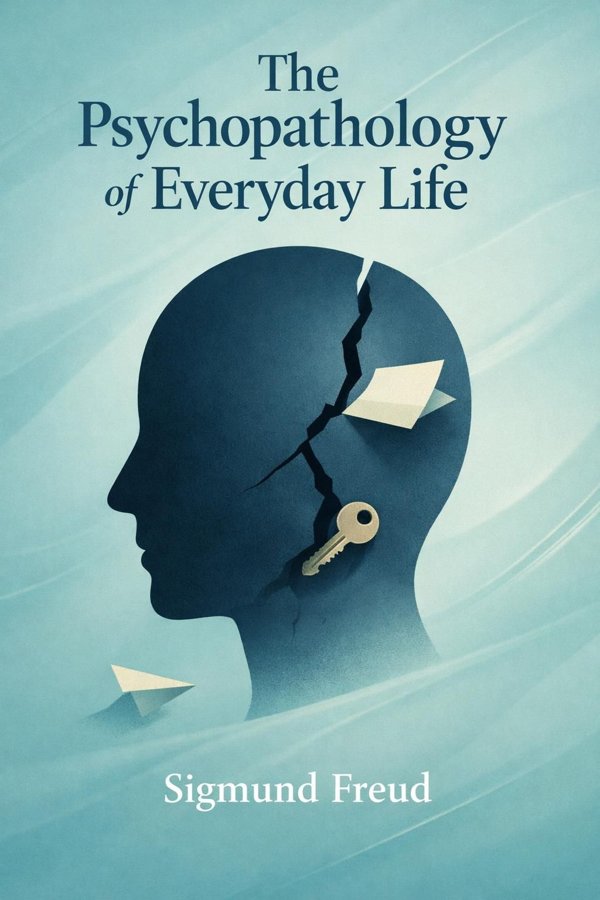
The Psychopathology of Everyday Life: Summary & Key Insights
 10 min9 chaptersAudio available
Key Takeaways from The Psychopathology of Everyday Life
A forgotten name can be more revealing than a confession.
Speech often betrays what politeness tries to hide.
What we fail to remember may reveal what we are trying not to face.
We do not always lose things by accident; sometimes we lose them with psychological assistance.
Much of what feels spontaneous may be secretly organized from below awareness.
What Is The Psychopathology of Everyday Life About?
The Psychopathology of Everyday Life by Sigmund Freud is a psychology book. What if your forgotten names, misplaced objects, missed appointments, and verbal slips were not random accidents, but meaningful clues to your inner life? In The Psychopathology of Everyday Life, Sigmund Freud argues that ordinary mistakes reveal hidden wishes, conflicts, fears, and memories operating beneath conscious awareness. Rather than treating everyday errors as trivial, he examines them as evidence of the unconscious at work in daily life. Through vivid examples of forgotten words, bungled actions, lost possessions, and the famous “Freudian slip,” Freud shows how mental life is far more layered and intentional than it appears. This book matters because it transformed how people think about the mind. It suggests that even the smallest disruptions in speech and behavior may have psychological significance, connecting daily experience with deeper emotional patterns. Whether or not one accepts all of Freud’s conclusions, the work remains foundational for psychology, psychotherapy, and modern self-examination. Freud’s authority comes from his role as the founder of psychoanalysis and one of the most influential thinkers in the history of psychology. This classic invites readers to look at ordinary life with new suspicion, curiosity, and insight.
This FizzRead summary covers all 9 key chapters of The Psychopathology of Everyday Life in approximately 10 minutes, distilling the most important ideas, arguments, and takeaways from Sigmund Freud's work. Also available as an audio summary and Key Quotes Podcast.
The Psychopathology of Everyday Life
What if your forgotten names, misplaced objects, missed appointments, and verbal slips were not random accidents, but meaningful clues to your inner life? In The Psychopathology of Everyday Life, Sigmund Freud argues that ordinary mistakes reveal hidden wishes, conflicts, fears, and memories operating beneath conscious awareness. Rather than treating everyday errors as trivial, he examines them as evidence of the unconscious at work in daily life. Through vivid examples of forgotten words, bungled actions, lost possessions, and the famous “Freudian slip,” Freud shows how mental life is far more layered and intentional than it appears.
This book matters because it transformed how people think about the mind. It suggests that even the smallest disruptions in speech and behavior may have psychological significance, connecting daily experience with deeper emotional patterns. Whether or not one accepts all of Freud’s conclusions, the work remains foundational for psychology, psychotherapy, and modern self-examination. Freud’s authority comes from his role as the founder of psychoanalysis and one of the most influential thinkers in the history of psychology. This classic invites readers to look at ordinary life with new suspicion, curiosity, and insight.
Who Should Read The Psychopathology of Everyday Life?
This book is perfect for anyone interested in psychology and looking to gain actionable insights in a short read. Whether you're a student, professional, or lifelong learner, the key ideas from The Psychopathology of Everyday Life by Sigmund Freud will help you think differently.
- ✓Readers who enjoy psychology and want practical takeaways
- ✓Professionals looking to apply new ideas to their work and life
- ✓Anyone who wants the core insights of The Psychopathology of Everyday Life in just 10 minutes
Want the full summary?
Get instant access to this book summary and 100K+ more with Fizz Moment.
Get Free SummaryAvailable on App Store • Free to download
Key Chapters
A forgotten name can be more revealing than a confession. One of Freud’s most provocative claims is that everyday errors are not mere accidents produced by chance, fatigue, or distraction alone. Instead, many of them express hidden mental processes. The mind, in his view, does not simply malfunction randomly; it often misfires in ways that serve an unconscious purpose. A slip of the tongue, a missed appointment, or a misplaced letter may disguise resistance, desire, fear, or conflict.
Freud calls attention to the fact that people usually dismiss such incidents as insignificant. Yet when examined closely, they often cluster around emotionally charged situations. You forget to return a call from someone you secretly resent. You “accidentally” lose a document connected to a task you dread. You call a current partner by an ex-partner’s name. For Freud, these are not meaningless glitches. They are compromise formations: small disturbances in conscious intention caused by competing unconscious motives.
The radical force of this idea lies in its challenge to the common image of rational self-control. We like to believe we fully know why we do what we do. Freud suggests the opposite: our ordinary lives are full of hidden influences. This does not mean every mistake carries deep symbolic importance, but it does mean that some mistakes deserve attention rather than dismissal.
In practice, this idea encourages more reflective self-observation. Instead of saying, “It meant nothing,” ask what the mistake occurred around, what feeling was present, and whether the error protected you from something uncomfortable. The actionable takeaway: when a small error repeats or occurs in an emotionally charged moment, pause and ask, “What part of me may have wanted this outcome?”
Speech often betrays what politeness tries to hide. Freud’s discussion of slips of the tongue remains one of the most famous parts of the book because it turns ordinary conversation into psychological evidence. A verbal error, in his interpretation, is not simply a defective word choice. It can be the visible result of conflict between what a person intends to say and what another part of the mind wishes to express, suppress, or distort.
A classic example is saying the wrong name, using an unintended phrase, or inserting a revealing word into a sentence. Someone introducing a colleague they envy may stumble over the introduction in a way that subtly undermines them. A person trying to sound enthusiastic about an obligation may accidentally voice reluctance. Freud believed such slips often emerge when conscious control weakens and repressed material finds a narrow path into expression.
The brilliance of this idea is not just that errors reveal secrets, but that language itself becomes a battlefield. Our stated intention may be sincere, yet it is not the whole story. Underneath conscious speech are buried attitudes, unresolved emotions, and private wishes. The slip becomes a compromise: the conscious statement survives, but the unconscious leaves a fingerprint.
In modern life, this concept is useful far beyond formal psychoanalysis. Notice when people repeatedly “joke” in ways that disclose irritation, attraction, or contempt. Observe your own moments of accidental honesty in meetings, relationships, or family conversations. Not every slip should be overinterpreted, but repeated patterns matter.
The actionable takeaway: pay close attention to slips that occur around emotionally loaded subjects. Write down the exact wording, the setting, and the feeling beneath it. Patterns in language can help uncover tensions you are not yet ready to admit directly.
What we fail to remember may reveal what we are trying not to face. Freud devotes major attention to forgetting names, intentions, impressions, and experiences, arguing that memory failures are often motivated. Rather than seeing forgetting as a neutral absence, he interprets certain lapses as active psychological events shaped by resistance. The mind does not only store information; it also pushes troubling material away.
This is especially evident, Freud suggests, when forgetting occurs selectively. You remember dozens of minor details but forget one person’s name. You remember your schedule except for the meeting you dread. You recall an entire conversation except the comment that embarrassed you. Such failures may reflect an unconscious wish to avoid discomfort, guilt, anxiety, or conflict. The forgotten item is not unimportant; it may be important precisely because it is emotionally charged.
Freud’s insight deepens our understanding of memory by connecting it to desire and defense. Forgetting becomes meaningful not because the conscious mind chooses it deliberately, but because another layer of mind interferes. The person who “simply forgot” may be telling the truth at one level while still participating in an unconscious refusal.
This idea has practical value in work, relationships, and self-knowledge. If you repeatedly forget tasks associated with a particular person, ask how you feel about them. If certain memories vanish whenever a topic arises, consider whether they carry shame or pain. Motivated forgetting can also explain procrastination disguised as absentmindedness.
The actionable takeaway: when you repeatedly forget the same type of thing, stop treating it as a memory defect alone. Ask what emotion, obligation, or relationship that forgotten item represents, and address the underlying issue rather than only the symptom.
Much of what feels spontaneous may be secretly organized from below awareness. Freud’s central contribution in this book is expanding the idea of the unconscious beyond dreams and neuroses into ordinary conduct. Everyday life, he argues, is full of subtle actions shaped by motives we do not recognize: omissions, detours, delays, substitutions, errors, and habits that seem insignificant until their emotional logic is traced.
This is a profound shift in how human behavior is understood. Instead of dividing life into normal actions and rare pathological symptoms, Freud shows continuity between the ordinary and the disturbed. The same mind that represses painful memories or forms neurotic symptoms also influences how we speak, remember, forget, and act in daily situations. The unconscious is not a remote subterranean system that appears only in illness. It is active all the time.
A person may consistently arrive late to encounters that evoke dependence, “forget” to send messages that would deepen intimacy, or commit small self-sabotaging errors whenever success approaches. On the surface, these seem like personal flaws or random tendencies. Freud invites us to ask what purpose they serve. Do they avoid vulnerability? Punish authority? Defend against guilt? Preserve an older identity?
This perspective fosters psychological humility. We are not fully transparent to ourselves. But it also creates possibility, because what is interpreted can become changeable. Once a repeated pattern is recognized as meaningful rather than accidental, it can be addressed.
The actionable takeaway: identify one recurring “minor” behavior that inconveniences you, such as lateness, forgetting, or misplaced items. Instead of asking only how to stop it, ask what emotional function it may be performing. Insight into purpose often precedes real change.
The mind often protects itself by pretending nothing is happening. Freud uses everyday mistakes to illustrate a broader psychoanalytic principle: resistance. Resistance is the force that keeps threatening thoughts, feelings, memories, or wishes out of awareness. It is not limited to therapy sessions; it shows up in common mental failures. We resist by forgetting, diverting attention, changing the subject, confusing facts, or bungling actions when something emotionally significant comes near consciousness.
This idea helps explain why insight is so difficult. People do not merely lack information about themselves; they actively defend against certain kinds of knowledge. A person may repeatedly forget the name of someone they wronged, stumble when discussing an uncomfortable truth, or postpone opening a letter that carries anxiety. These are not simply weak performances of cognition. They may be signs that the psyche is protecting itself from shame, conflict, or pain.
Freud’s notion of resistance gives everyday life dramatic psychological depth. Beneath the surface of convenience or forgetfulness lies a struggle between revelation and concealment. The same forces that produce symptoms also shape ordinary evasions. That is why self-observation can be frustrating: as soon as one approaches an uncomfortable realization, the mind may produce distraction, rationalization, or confusion.
For readers today, resistance remains a powerful lens. If you feel strangely blank, sleepy, irritated, or forgetful around certain topics, do not assume the topic is unimportant. Those reactions may be clues. Resistance points toward what matters most.
The actionable takeaway: notice where your attention repeatedly breaks down. When a topic makes you lose focus, forget details, or shift away quickly, treat that disruption as data. Ask what feeling or truth might be difficult to tolerate in that area.
The boundary between normality and pathology is thinner than most people imagine. Freud’s title itself makes a bold argument: psychopathology is not confined to hospitals or severe mental illness; it appears in everyday life. Ordinary errors are not identical to clinical disorders, but they arise from similar mental mechanisms, including repression, conflict, substitution, and compromise. In that sense, daily life contains miniature versions of the same processes found in more dramatic symptoms.
This was a revolutionary idea because it democratized psychological complexity. Freud refuses the comforting distinction between “healthy people” who act rationally and “sick people” who reveal hidden conflicts. Everyone, he suggests, is psychologically divided. Everyone is susceptible to slips, motivated forgetting, symbolic acts, and unconscious interference. The difference is often one of degree, not kind.
This insight changed both psychology and culture. It opened the way for a deeper, less moralistic understanding of behavior. Small lapses no longer had to be dismissed as stupidity or blamed as character defects. They could be studied as meaningful formations. It also made self-analysis more accessible: one need not wait for a crisis to examine the workings of the mind.
In modern terms, the idea remains valuable because it normalizes internal conflict. Feeling divided does not mean you are broken; it means you are human. The same mind can want and not want, know and not know, intend and interfere. Recognizing this complexity can make us more compassionate toward ourselves and more observant of others.
The actionable takeaway: treat minor psychological contradictions with curiosity rather than shame. When your behavior conflicts with your stated intention, ask what competing motive may be present. Self-understanding grows when contradiction is explored instead of denied.
The smallest incident can become a doorway to deeper self-understanding. Beneath Freud’s many examples lies a practical invitation: pay attention. The book teaches a disciplined form of self-observation in which minor errors are not brushed aside but explored for meaning. This habit transforms daily life into material for psychological insight. A forgotten task, a recurring confusion, an accidental phrase, or a misplaced object becomes not just an annoyance but an opportunity to study one’s own mind.
What makes this approach powerful is that it does not require extraordinary experiences. You do not need a dramatic breakdown to learn about yourself. Daily behavior already contains clues. If you repeatedly avoid one kind of task, fumble one name, lose one category of object, or make one style of social mistake, there may be a pattern worth examining. Freud’s method suggests that recurring disturbances often point to unresolved conflicts or concealed wishes.
At its best, this kind of observation produces both honesty and freedom. It helps people move from “I don’t know why I do this” to “I see what part of me is acting here.” That shift does not eliminate conflict overnight, but it weakens the power of unconscious repetition. Once hidden motives are named, they become less able to govern behavior invisibly.
In practical terms, readers can use journaling, reflection after emotionally charged conversations, and attention to repeated mishaps as tools of self-study. The goal is not paranoid overinterpretation, but thoughtful inquiry.
The actionable takeaway: begin a simple “everyday errors” journal for one week. Record slips, forgettings, delays, and lost items along with the surrounding context and feelings. Review the entries for patterns. Repetition is often the clearest path from annoyance to insight.
All Chapters in The Psychopathology of Everyday Life
About the Author
Sigmund Freud was an Austrian neurologist and the founder of psychoanalysis, born in 1856 in Freiberg, Moravia, then part of the Austrian Empire. He trained in medicine and began his career studying the nervous system before turning toward the treatment of psychological disorders. Freud developed groundbreaking theories about the unconscious mind, repression, dreams, sexuality, and the structure of personality. His major works, including The Interpretation of Dreams, The Psychopathology of Everyday Life, and Civilization and Its Discontents, reshaped psychology and deeply influenced literature, philosophy, and modern culture. Although many of his claims remain controversial, Freud’s impact on how people think about memory, desire, conflict, and self-knowledge is immense. He died in London in 1939 after fleeing Nazi-occupied Vienna.
Get This Summary in Your Preferred Format
Read or listen to the The Psychopathology of Everyday Life summary by Sigmund Freud anytime, anywhere. FizzRead offers multiple formats so you can learn on your terms — all free.
Available formats: App · Audio · PDF · EPUB — All included free with FizzRead
Download The Psychopathology of Everyday Life PDF and EPUB Summary
Key Quotes from The Psychopathology of Everyday Life
“A forgotten name can be more revealing than a confession.”
“Speech often betrays what politeness tries to hide.”
“What we fail to remember may reveal what we are trying not to face.”
“We do not always lose things by accident; sometimes we lose them with psychological assistance.”
“Much of what feels spontaneous may be secretly organized from below awareness.”
Frequently Asked Questions about The Psychopathology of Everyday Life
The Psychopathology of Everyday Life by Sigmund Freud is a psychology book that explores key ideas across 9 chapters. What if your forgotten names, misplaced objects, missed appointments, and verbal slips were not random accidents, but meaningful clues to your inner life? In The Psychopathology of Everyday Life, Sigmund Freud argues that ordinary mistakes reveal hidden wishes, conflicts, fears, and memories operating beneath conscious awareness. Rather than treating everyday errors as trivial, he examines them as evidence of the unconscious at work in daily life. Through vivid examples of forgotten words, bungled actions, lost possessions, and the famous “Freudian slip,” Freud shows how mental life is far more layered and intentional than it appears. This book matters because it transformed how people think about the mind. It suggests that even the smallest disruptions in speech and behavior may have psychological significance, connecting daily experience with deeper emotional patterns. Whether or not one accepts all of Freud’s conclusions, the work remains foundational for psychology, psychotherapy, and modern self-examination. Freud’s authority comes from his role as the founder of psychoanalysis and one of the most influential thinkers in the history of psychology. This classic invites readers to look at ordinary life with new suspicion, curiosity, and insight.
More by Sigmund Freud




You Might Also Like

The Body Keeps the Score
Bessel van der Kolk
10 min
Surrounded by Idiots
Thomas Erikson
10 min
Emotional Intelligence
Daniel Goleman
10 min
Attached
Amir Levine
10 min
Why Does He Do That
Lundy Bancroft
10 min
Women Who Run with the Wolves
Clarissa Pinkola Estés
10 minBrowse by Category
Ready to read The Psychopathology of Everyday Life?
Get the full summary and 100K+ more books with Fizz Moment.