
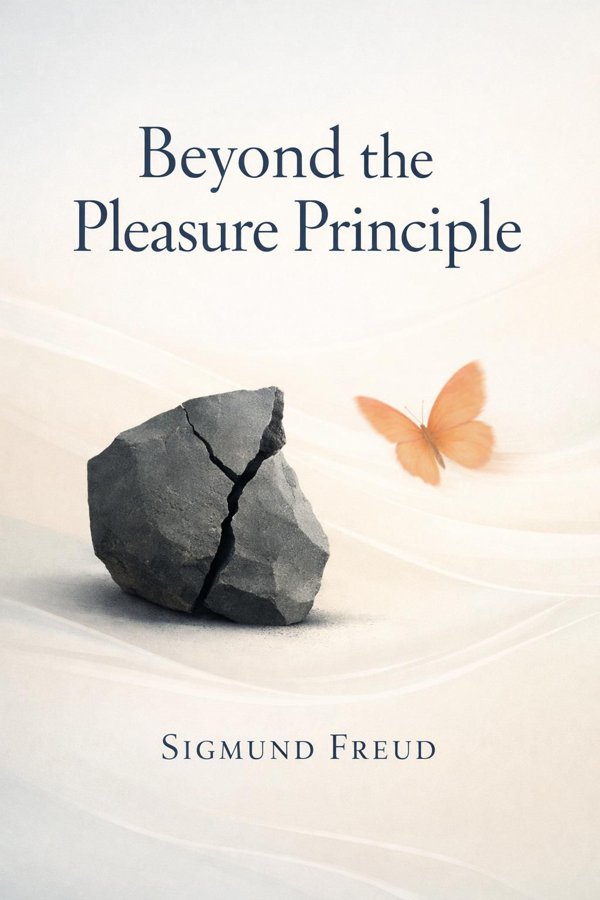
Beyond the Pleasure Principle: Summary & Key Insights
 10 min12 chaptersAudio available
What Is Beyond the Pleasure Principle About?
Beyond the Pleasure Principle by Sigmund Freud is a psychology book spanning 12 pages. First published in 1920, this seminal work by Sigmund Freud introduces the concept of the death drive, a fundamental instinct that goes beyond the pleasure principle. Freud explores phenomena such as repetition compulsion, trauma, and the unconscious to explain why humans sometimes repeat pain and suffering instead of seeking pleasure. The book marks a turning point in psychoanalytic theory and anticipates Freud’s later works on the ego and the id.
This FizzRead summary covers all 12 key chapters of Beyond the Pleasure Principle in approximately 10 minutes, distilling the most important ideas, arguments, and takeaways from Sigmund Freud's work. Also available as an audio summary and Key Quotes Podcast.
Beyond the Pleasure Principle
First published in 1920, this seminal work by Sigmund Freud introduces the concept of the death drive, a fundamental instinct that goes beyond the pleasure principle. Freud explores phenomena such as repetition compulsion, trauma, and the unconscious to explain why humans sometimes repeat pain and suffering instead of seeking pleasure. The book marks a turning point in psychoanalytic theory and anticipates Freud’s later works on the ego and the id.
Who Should Read Beyond the Pleasure Principle?
This book is perfect for anyone interested in psychology and looking to gain actionable insights in a short read. Whether you're a student, professional, or lifelong learner, the key ideas from Beyond the Pleasure Principle by Sigmund Freud will help you think differently.
- ✓Readers who enjoy psychology and want practical takeaways
- ✓Professionals looking to apply new ideas to their work and life
- ✓Anyone who wants the core insights of Beyond the Pleasure Principle in just 10 minutes
Want the full summary?
Get instant access to this book summary and 100K+ more with Fizz Moment.
Get Free SummaryAvailable on App Store • Free to download
Key Chapters
To begin, I reaffirm the foundational truth from which my earlier investigations sprang: the pleasure principle governs mental processes. In its simplest form, the principle asserts that our psychic apparatus strives to reduce tension—an unpleasant state—by seeking pleasure, thereby restoring equilibrium. The mind, in essence, is a mechanism that aims at the avoidance of unpleasure. This dynamic is observable in everything from the behavior of infants seeking the maternal breast to the complex social maneuverings of adults pursuing satisfaction in love and ambition.
However, this principle, though seemingly universal, encounters peculiar resistances. Life does not unfold as a steady march toward bliss; it is continually interrupted by suffering, frustration, and loss. Even when we have achieved the pleasure we sought, another tension arises, as though the mind could never remain in tranquil contentment. I began to suspect that the pleasure principle might not be the entire story—it might be a surface manifestation, masking deeper and more inscrutable forces. Nevertheless, its authority remains the logical starting point for any exploration of the psyche, for it defines the law that every subsequent anomaly must either obey or defy.
It was the observation of behaviors opposing this principle that forced me into new territory. Patients suffering from traumatic neuroses repeatedly exposed themselves, in dreams and thoughts, to the very situations that caused their pain. Children, too, seemed oddly fascinated by recreating experiences of loss or distress, as in the famous example of my grandson’s ‘fort/da’ game, in which he reenacted his mother’s departure and return. Even those without evident trauma displayed a tendency to repeat unpleasant past experiences—a puzzling compulsion that appeared to stand outside the normal bounds of pleasure seeking.
This contradiction struck me deeply. If the mind’s goal were only to avoid pain, how could it become absorbed in reproducing it? These behaviors could not be dismissed as mere accidents or failures of repression; they were systematic, persistent, sometimes even creative. It was as if the psyche were compelled to re-create suffering in order to master it—or perhaps to reaffirm its reality. The pleasure principle, I realized, governs much of our thought and behavior but not all. Something older, more primitive, lurks beneath it, a force indifferent to pleasure, driving repetition for its own sake.
+ 10 more chapters — available in the FizzRead app
All Chapters in Beyond the Pleasure Principle
About the Author
Sigmund Freud (1856–1939) was an Austrian neurologist and the founder of psychoanalysis. His theories on the unconscious mind, dream interpretation, and the structure of the psyche profoundly influenced psychology, literature, and culture throughout the 20th century.
Get This Summary in Your Preferred Format
Read or listen to the Beyond the Pleasure Principle summary by Sigmund Freud anytime, anywhere. FizzRead offers multiple formats so you can learn on your terms — all free.
Available formats: App · Audio · PDF · EPUB — All included free with FizzRead
Download Beyond the Pleasure Principle PDF and EPUB Summary
Key Quotes from Beyond the Pleasure Principle
“To begin, I reaffirm the foundational truth from which my earlier investigations sprang: the pleasure principle governs mental processes.”
“It was the observation of behaviors opposing this principle that forced me into new territory.”
Frequently Asked Questions about Beyond the Pleasure Principle
Beyond the Pleasure Principle by Sigmund Freud is a psychology book that explores key ideas across 12 chapters. First published in 1920, this seminal work by Sigmund Freud introduces the concept of the death drive, a fundamental instinct that goes beyond the pleasure principle. Freud explores phenomena such as repetition compulsion, trauma, and the unconscious to explain why humans sometimes repeat pain and suffering instead of seeking pleasure. The book marks a turning point in psychoanalytic theory and anticipates Freud’s later works on the ego and the id.
More by Sigmund Freud



You Might Also Like
The Body Keeps the Score
Bessel van der Kolk
10 min
Surrounded by Idiots
Thomas Erikson
10 min
Emotional Intelligence
Daniel Goleman
10 min
Attached
Amir Levine
10 min
Why Does He Do That
Lundy Bancroft
10 min
Women Who Run with the Wolves
Clarissa Pinkola Estés
10 minBrowse by Category
Ready to read Beyond the Pleasure Principle?
Get the full summary and 100K+ more books with Fizz Moment.