
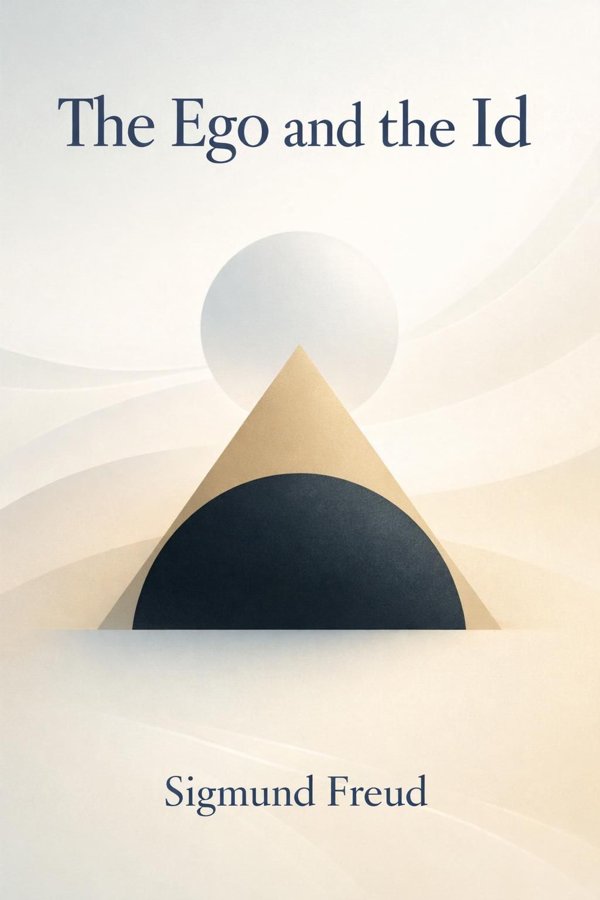
The Ego and the Id: Summary & Key Insights
 10 min9 chaptersAudio available
Key Takeaways from The Ego and the Id
A mind cannot be understood simply by asking what is conscious and what is hidden.
Beneath civilized behavior lies a far older force that does not care about logic, timing, or social approval.
The self you experience as “me” is not the whole mind but a fragile mediator formed under pressure.
What the mind cannot tolerate, it often pushes out of awareness—but repression is never as simple as forgetting.
The voice that judges you is not always the voice of truth; often it is the internalized echo of authority.
What Is The Ego and the Id About?
The Ego and the Id by Sigmund Freud is a psychology book spanning 9 pages. First published in 1923, The Ego and the Id is one of Sigmund Freud’s most important and enduring works, marking a major shift in how he explained the human mind. In this brief but dense text, Freud moves beyond his earlier distinction between the conscious and the unconscious and introduces a new structural model of the psyche: the id, the ego, and the superego. These three forces, he argues, are in constant tension, shaping our desires, decisions, conflicts, and sense of self. The book matters because it offers a powerful framework for understanding why human beings are often divided against themselves—why we want one thing, believe another, and do something else entirely. Freud also explores repression, guilt, morality, dreams, and the defensive maneuvers the mind uses to protect itself from inner conflict. Whether or not one accepts all of Freud’s conclusions, his ideas transformed psychology and left a deep mark on literature, therapy, philosophy, and modern culture. As the founder of psychoanalysis, Freud writes here with unmatched authority about the hidden dynamics of mental life.
This FizzRead summary covers all 9 key chapters of The Ego and the Id in approximately 10 minutes, distilling the most important ideas, arguments, and takeaways from Sigmund Freud's work. Also available as an audio summary and Key Quotes Podcast.
The Ego and the Id
First published in 1923, The Ego and the Id is one of Sigmund Freud’s most important and enduring works, marking a major shift in how he explained the human mind. In this brief but dense text, Freud moves beyond his earlier distinction between the conscious and the unconscious and introduces a new structural model of the psyche: the id, the ego, and the superego. These three forces, he argues, are in constant tension, shaping our desires, decisions, conflicts, and sense of self. The book matters because it offers a powerful framework for understanding why human beings are often divided against themselves—why we want one thing, believe another, and do something else entirely. Freud also explores repression, guilt, morality, dreams, and the defensive maneuvers the mind uses to protect itself from inner conflict. Whether or not one accepts all of Freud’s conclusions, his ideas transformed psychology and left a deep mark on literature, therapy, philosophy, and modern culture. As the founder of psychoanalysis, Freud writes here with unmatched authority about the hidden dynamics of mental life.
Who Should Read The Ego and the Id?
This book is perfect for anyone interested in psychology and looking to gain actionable insights in a short read. Whether you're a student, professional, or lifelong learner, the key ideas from The Ego and the Id by Sigmund Freud will help you think differently.
- ✓Readers who enjoy psychology and want practical takeaways
- ✓Professionals looking to apply new ideas to their work and life
- ✓Anyone who wants the core insights of The Ego and the Id in just 10 minutes
Want the full summary?
Get instant access to this book summary and 100K+ more with Fizz Moment.
Get Free SummaryAvailable on App Store • Free to download
Key Chapters
A mind cannot be understood simply by asking what is conscious and what is hidden. Freud’s major insight in The Ego and the Id is that the old topographical model of the mind—dividing mental life into the conscious, preconscious, and unconscious—was no longer enough. That model was useful for describing repression, because it showed how painful or forbidden material could be pushed out of awareness. But Freud discovered that parts of the ego itself could also be unconscious. In other words, not everything hidden belongs to repressed instinct; even the very part of us that seems rational and self-aware contains unknown motives and operations.
This matters because it changes how we think about self-knowledge. A person may believe they are acting reasonably while being guided by fears, identifications, and defenses they do not recognize. For example, someone who insists they are “just being practical” in rejecting a career change may actually be defending against anxiety, parental expectations, or guilt. Similarly, a person who harshly judges others may be expressing unconscious conflicts within themselves.
Freud’s revision adds depth to psychological explanation. Instead of asking only whether an idea is conscious, he asks what function a mental force plays and how it relates to instinct, reality, and morality. This shift leads directly to the structural model of id, ego, and superego.
The practical lesson is simple but profound: when your behavior does not match your stated intentions, do not assume you are being irrational for no reason. Pause and ask what hidden inner conflict may be shaping your choices.
Beneath civilized behavior lies a far older force that does not care about logic, timing, or social approval. Freud calls this force the id: the most primitive region of the psyche, wholly unconscious and driven by instinctual demands. The id seeks immediate discharge of tension and operates according to the pleasure principle. It wants satisfaction now, not later, and it does not distinguish between fantasy and reality in the way the conscious mind tries to do.
For Freud, the id contains the raw psychic energy of life: hunger, sexuality, aggression, desire, and impulse. It is not evil in a moral sense; it is simply prior to morality. A child crying for food, an adult erupting in jealousy, or a person fantasizing about total freedom from restraint all reveal something of the id at work. The id is the source of vitality and drive, but left unchecked it would make stable social life impossible.
Understanding the id helps explain why people often feel urges they do not endorse. You can value commitment and still feel temptation. You can care about kindness and still experience rage. Freud’s point is not that we are hypocrites but that human beings are layered. The existence of a forbidden impulse does not define character; what matters is how the rest of the psyche responds.
An actionable takeaway: instead of denying your impulses outright, learn to recognize them early. Naming a desire or frustration before it takes control is one of the first steps toward managing it constructively.
The self you experience as “me” is not the whole mind but a fragile mediator formed under pressure. Freud describes the ego as developing out of the id through contact with external reality. Unlike the id, which demands immediate gratification, the ego operates according to the reality principle. It learns delay, negotiation, planning, and adaptation. The ego asks not only, “What do I want?” but also, “What is possible, safe, and acceptable?”
This makes the ego the mind’s executive center, though not an all-powerful one. It governs perception, judgment, memory, and motor control, helping the individual survive in the real world. If the id wants to eat, the ego figures out where to get food. If the id wants revenge, the ego calculates the consequences. If desire threatens social standing or personal safety, the ego looks for compromise.
Yet Freud insists the ego is not master in its own house. It is dependent on the id for energy, on the external world for constraints, and later on the superego for moral pressure. In everyday life, this explains why decision-making often feels exhausting. We are not simply choosing between good and bad options; we are balancing impulse, reality, and conscience all at once.
Consider someone tempted to send an angry message after an argument. The id wants immediate release, but the ego imagines the fallout: damaged relationships, regret, escalation. A healthy ego does not erase anger; it channels it into a more workable response.
Actionable takeaway: strengthen your ego by inserting a pause between feeling and action. Even a short delay can create room for reflection, perspective, and better choices.
What the mind cannot tolerate, it often pushes out of awareness—but repression is never as simple as forgetting. Freud treats repression as a central process in mental life, one that protects the individual from anxiety by excluding unacceptable wishes, memories, or feelings from consciousness. Yet what is repressed does not disappear. It continues to operate indirectly, influencing symptoms, dreams, slips of the tongue, and emotional reactions.
This is why people may feel disproportionate fear, anger, shame, or attraction without understanding why. A person who cannot remember painful humiliation from childhood may still overreact to mild criticism at work. Another who represses hostility may become passive-aggressive rather than openly angry. Repression preserves psychic stability in the short term, but at a cost: what is buried often returns in disguised form.
Freud’s insight remains useful even outside clinical psychoanalysis. Many people today notice they “shut down,” avoid certain topics, or become numb when touching emotionally loaded areas of life. These patterns can be understood as defensive strategies meant to reduce distress. The trouble is that defenses also limit self-awareness and freedom.
Freud does not suggest that every forgotten event is repressed or that all distress must be unearthed immediately. His point is subtler: the mind has reasons for hiding what it hides. Psychological growth requires curiosity about those reasons.
Actionable takeaway: when your reactions feel larger than the situation warrants, treat that as a clue. Instead of asking only, “What happened just now?” also ask, “What might this moment be stirring up from earlier experiences or unacknowledged feelings?”
Much of human suffering comes from not wanting just one thing. Freud’s structural model is powerful because it portrays the mind as a field of negotiation and conflict among three agencies: the id presses for instinctual satisfaction, the superego imposes moral demands, and the ego tries to mediate between them while also accounting for external reality. Psychological life is therefore not unified by default; it is an uneasy compromise.
This framework explains ordinary inner conflict with remarkable clarity. Imagine someone drawn to a risky romance. The id desires excitement and gratification. The superego warns of betrayal, shame, or moral failure. The ego must weigh consequences, social obligations, and the person’s long-term well-being. The tension may produce anxiety, rationalization, indecision, or symptoms. Likewise, a person who wants career success may be driven by ambition, restricted by guilt, and paralyzed by fear of disappointing others.
Freud’s point is that these conflicts are not signs of weakness but expressions of the mind’s structure. The ego is tasked with an impossible job: serving three demanding masters at once. When the balance fails, the result may be neurosis, self-sabotage, impulsivity, or emotional exhaustion.
Seen practically, this model encourages more nuanced self-observation. Instead of labeling yourself lazy, immoral, or confused, you can ask which psychic forces are pulling against one another. That question often produces more compassion and more useful insight than self-blame.
Actionable takeaway: when facing a difficult choice, write down three columns—impulse, conscience, and reality. Identifying what each “voice” wants can help the ego negotiate a wiser compromise.
People are often tormented less by what they have done than by what they have wanted. Freud’s treatment of guilt shows that moral anxiety can arise not only from actual wrongdoing but from unacceptable wishes, aggressive impulses, and unconscious conflict. Because the superego judges intention as well as action, the ego may feel guilty for desires it never acted on and may not even fully recognize.
This helps explain many forms of self-punishment. Someone may sabotage success because achievement unconsciously feels like rebellion against parental authority. Another may remain in unhappy circumstances out of a hidden need to suffer. Still another may become excessively self-critical after experiencing anger toward a loved one, even if that anger was never expressed. In Freud’s view, guilt can become detached from reality and still retain enormous force.
This idea is especially important in understanding why some people cannot simply “be kinder to themselves” on command. If harsh self-judgment serves an unconscious moral function, it may feel necessary, even virtuous. The person experiences inner punishment as if it were justice. That is why insight matters: once guilt is examined, it may be revealed as disproportionate, inherited, or linked to fantasy rather than action.
Freud does not dismiss conscience; he shows how easily it can become excessive. Healthy morality helps us live responsibly with others. Pathological guilt keeps the self trapped in endless internal prosecution.
Actionable takeaway: when guilt appears, distinguish between responsibility and self-attack. Ask, “Did I actually violate a value, or am I condemning myself for a feeling, need, or fantasy that simply makes me uncomfortable?”
What feels like personal weakness is often the strain of impossible psychological labor. Freud famously emphasizes that the ego is not autonomous and sovereign but deeply dependent. It must satisfy the id enough to maintain inner stability, obey the superego enough to avoid guilt, and adapt to the external world enough to survive. The ego is therefore a negotiator under constant pressure, trying to transform instinct into workable action without being overwhelmed by desire, fear, or moral condemnation.
This picture is useful because it counters simplistic ideas of willpower. A person may sincerely want to change and still feel blocked because change threatens multiple layers of psychic organization. For example, setting boundaries may satisfy reality and self-respect, but it may also trigger guilt from the superego and anxiety about losing love. Quitting an addiction may align with the ego’s realistic aims, but the id resists the loss of immediate gratification. Progress can therefore feel like internal civil war.
Freud also highlights the ego’s bodily basis. The ego is tied to perception and to the body’s surface, arising partly from how the organism encounters the world. This suggests that psychological functioning is not abstract; it is rooted in sensation, tension, and embodied experience.
The practical implication is that effective self-management requires more than rules. It requires understanding what functions a habit serves and which inner demands it is balancing. Sustainable change usually comes through negotiation, not brute force.
Actionable takeaway: when you struggle to change a behavior, ask what that behavior is doing for you at the level of comfort, identity, or protection. Solving the problem often begins by understanding the service it provides.
All Chapters in The Ego and the Id
About the Author
Sigmund Freud (1856–1939) was an Austrian neurologist and the founder of psychoanalysis, one of the most influential intellectual movements of the modern era. Trained in medicine, he began his career studying the nervous system before turning his attention to hysteria, dreams, repression, and the unconscious mind. Freud developed a far-reaching theory of personality and mental conflict, introducing concepts such as the unconscious, defense mechanisms, infantile sexuality, and later the structural model of the id, ego, and superego. His major works include The Interpretation of Dreams, Civilization and Its Discontents, and The Ego and the Id. Though many of his ideas remain controversial, Freud profoundly shaped psychology, psychotherapy, literature, philosophy, and cultural criticism, and his influence continues to be felt across the humanities and social sciences.
Get This Summary in Your Preferred Format
Read or listen to the The Ego and the Id summary by Sigmund Freud anytime, anywhere. FizzRead offers multiple formats so you can learn on your terms — all free.
Available formats: App · Audio · PDF · EPUB — All included free with FizzRead
Download The Ego and the Id PDF and EPUB Summary
Key Quotes from The Ego and the Id
“A mind cannot be understood simply by asking what is conscious and what is hidden.”
“Beneath civilized behavior lies a far older force that does not care about logic, timing, or social approval.”
“The self you experience as “me” is not the whole mind but a fragile mediator formed under pressure.”
“What the mind cannot tolerate, it often pushes out of awareness—but repression is never as simple as forgetting.”
“The voice that judges you is not always the voice of truth; often it is the internalized echo of authority.”
Frequently Asked Questions about The Ego and the Id
The Ego and the Id by Sigmund Freud is a psychology book that explores key ideas across 9 chapters. First published in 1923, The Ego and the Id is one of Sigmund Freud’s most important and enduring works, marking a major shift in how he explained the human mind. In this brief but dense text, Freud moves beyond his earlier distinction between the conscious and the unconscious and introduces a new structural model of the psyche: the id, the ego, and the superego. These three forces, he argues, are in constant tension, shaping our desires, decisions, conflicts, and sense of self. The book matters because it offers a powerful framework for understanding why human beings are often divided against themselves—why we want one thing, believe another, and do something else entirely. Freud also explores repression, guilt, morality, dreams, and the defensive maneuvers the mind uses to protect itself from inner conflict. Whether or not one accepts all of Freud’s conclusions, his ideas transformed psychology and left a deep mark on literature, therapy, philosophy, and modern culture. As the founder of psychoanalysis, Freud writes here with unmatched authority about the hidden dynamics of mental life.
More by Sigmund Freud

You Might Also Like
The Body Keeps the Score
Bessel van der Kolk
10 min
Surrounded by Idiots
Thomas Erikson
10 min
Emotional Intelligence
Daniel Goleman
10 min
Attached
Amir Levine
10 min
Why Does He Do That
Lundy Bancroft
10 min
Women Who Run with the Wolves
Clarissa Pinkola Estés
10 minBrowse by Category
Ready to read The Ego and the Id?
Get the full summary and 100K+ more books with Fizz Moment.