
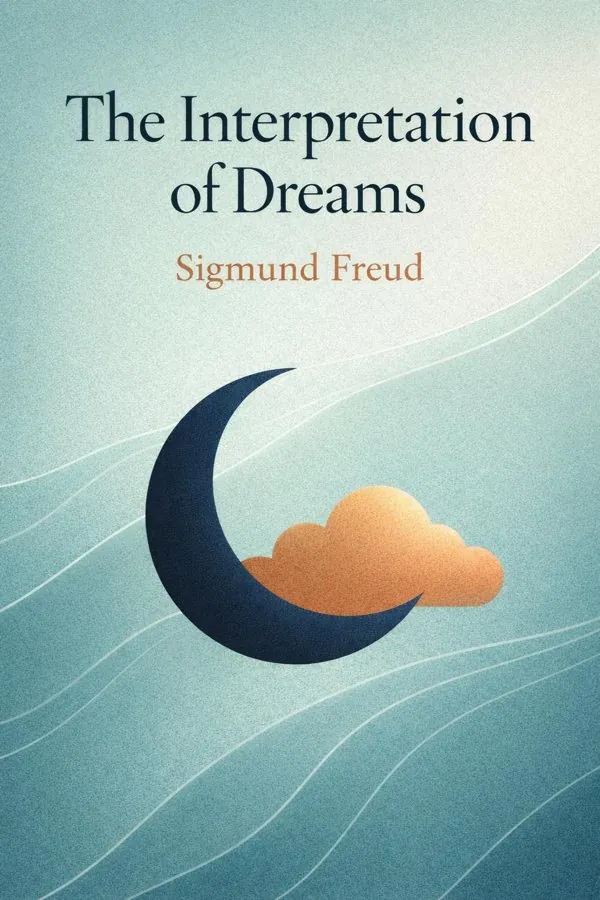
The Interpretation of Dreams: Summary & Key Insights
 10 min10 chaptersAudio available
Key Takeaways from The Interpretation of Dreams
A dream becomes interesting the moment we stop dismissing it as nonsense.
The most provocative claim in the book is also its most famous: every dream is, at its core, the fulfillment of a wish.
A dream rarely reveals its meaning through symbols alone; it yields its significance through the dreamer’s own associations.
What we remember in the morning is not the dream’s full meaning but its visible surface.
Dreams feel strange because the mind has altered the material before presenting it.
What Is The Interpretation of Dreams About?
The Interpretation of Dreams by Sigmund Freud is a psychology book spanning 12 pages. First published in 1900, The Interpretation of Dreams is the book that established Sigmund Freud as one of the most influential and controversial thinkers in modern psychology. In this ambitious work, Freud argues that dreams are not meaningless mental noise but disguised expressions of unconscious wishes, conflicts, memories, and fears. He presents dreams as coded productions shaped by a hidden mental process he calls dream-work, which transforms troubling latent thoughts into the strange images and narratives we remember upon waking. Through detailed case studies, including his own dreams, Freud introduces concepts that would become central to psychoanalysis: free association, repression, censorship, symbolism, condensation, and displacement. Whether one accepts Freud’s conclusions fully or reads him critically, this book matters because it changed how people think about the mind itself. It proposed that much of mental life lies outside conscious awareness and that everyday phenomena—dreams, slips of the tongue, symptoms, fantasies—carry psychological meaning. Freud wrote not as a casual observer but as a trained neurologist building a new method of inquiry into hidden mental life, making this a foundational text in psychology, psychotherapy, and modern intellectual history.
This FizzRead summary covers all 10 key chapters of The Interpretation of Dreams in approximately 10 minutes, distilling the most important ideas, arguments, and takeaways from Sigmund Freud's work. Also available as an audio summary and Key Quotes Podcast.
The Interpretation of Dreams
First published in 1900, The Interpretation of Dreams is the book that established Sigmund Freud as one of the most influential and controversial thinkers in modern psychology. In this ambitious work, Freud argues that dreams are not meaningless mental noise but disguised expressions of unconscious wishes, conflicts, memories, and fears. He presents dreams as coded productions shaped by a hidden mental process he calls dream-work, which transforms troubling latent thoughts into the strange images and narratives we remember upon waking. Through detailed case studies, including his own dreams, Freud introduces concepts that would become central to psychoanalysis: free association, repression, censorship, symbolism, condensation, and displacement. Whether one accepts Freud’s conclusions fully or reads him critically, this book matters because it changed how people think about the mind itself. It proposed that much of mental life lies outside conscious awareness and that everyday phenomena—dreams, slips of the tongue, symptoms, fantasies—carry psychological meaning. Freud wrote not as a casual observer but as a trained neurologist building a new method of inquiry into hidden mental life, making this a foundational text in psychology, psychotherapy, and modern intellectual history.
Who Should Read The Interpretation of Dreams?
This book is perfect for anyone interested in psychology and looking to gain actionable insights in a short read. Whether you're a student, professional, or lifelong learner, the key ideas from The Interpretation of Dreams by Sigmund Freud will help you think differently.
- ✓Readers who enjoy psychology and want practical takeaways
- ✓Professionals looking to apply new ideas to their work and life
- ✓Anyone who wants the core insights of The Interpretation of Dreams in just 10 minutes
Want the full summary?
Get instant access to this book summary and 100K+ more with Fizz Moment.
Get Free SummaryAvailable on App Store • Free to download
Key Chapters
A dream becomes interesting the moment we stop dismissing it as nonsense. Freud begins by arguing that the first task is not to explain dreams away, but to recognize how significant they are. Ancient cultures often treated dreams as messages, prophecies, or revelations, while modern scientific thought in Freud’s time tended to reduce them to random byproducts of sleep. Freud rejects both simple superstition and simple dismissal. He insists that dreams deserve serious psychological study because they emerge from the same mind that thinks, suffers, desires, and remembers during waking life.
This starting point matters because Freud is reframing the question. Instead of asking whether dreams predict the future or whether they are mere noise, he asks what psychic work they perform. Dreams appear bizarre, fragmented, and irrational, yet they may still possess structure and meaning. Their strangeness is not proof of meaninglessness; it may be evidence that hidden thoughts have been transformed before reaching consciousness. In that sense, the difficulty of understanding dreams is itself part of what must be explained.
A practical application of this idea is simple: when a recurring dream, vivid nightmare, or emotionally charged image stays with you, treat it as psychologically relevant. Rather than asking, “Was that dream true?” ask, “Why did my mind produce this image, at this moment, with this emotional tone?” For example, dreaming of missing a train before a major life decision may not foretell failure, but it may reveal anxiety, ambivalence, or a wish to escape pressure.
Actionable takeaway: stop treating dreams as disposable. Record them, note the feelings attached to them, and approach them as meaningful mental events worth investigating.
A dream rarely reveals its meaning through symbols alone; it yields its significance through the dreamer’s own associations. Freud’s method of free association is therefore central to interpretation. Instead of using a fixed dream dictionary that says a staircase always means one thing or water always means another, Freud asks the dreamer to take each element of the dream and say whatever comes to mind, without censorship, logic, or embarrassment. The chain of associations leads from the remembered dream image to the underlying thoughts that produced it.
This method reflects one of Freud’s deepest convictions: the dream belongs to the personal history of the dreamer. Two people might dream of the same object but connect it to entirely different memories, fears, and desires. A house might evoke childhood safety for one person and family conflict for another. A doctor in a dream may symbolize authority, illness, guilt, or a specific real-life relationship, depending on the associations that follow.
Free association also exposes resistance. When a dreamer says, “That part means nothing,” or “I’d rather not talk about this,” Freud hears not emptiness but psychological importance. The mind often hesitates precisely where the hidden material becomes threatening. In practical terms, this method can still be useful as a reflective exercise. Write down a dream image—say, a locked door—and then list every thought, memory, phrase, or emotion it triggers. You may uncover connections to secrecy, opportunity, exclusion, fear, or a specific life event.
Actionable takeaway: choose one striking dream image and free-write associations for five minutes without editing. Meaning often emerges from the chain, not from the image alone.
What we remember in the morning is not the dream’s full meaning but its visible surface. Freud distinguishes between manifest content and latent content to explain this gap. Manifest content is the dream as recalled: the scenes, characters, actions, and odd details that appear during sleep. Latent content is the underlying network of wishes, memories, thoughts, and conflicts that the dream expresses in disguised form. Interpretation, for Freud, is the work of moving from the manifest story to the latent psychological material.
This distinction helps explain why dreams often seem absurd. Their apparent incoherence may result from the transformation of deeper thoughts into images that can pass the mind’s internal censorship. A dream about wandering through unfamiliar rooms may manifest as a strange adventure, while its latent content could involve uncertainty about identity, changing family roles, or curiosity about hidden parts of oneself. The dream is not random; it is encoded.
In everyday life, this idea remains powerful because people often confuse the first layer of a mental experience with its actual significance. We do this with dreams, but also with emotional reactions. Someone who dreams repeatedly about losing their phone may think the dream is just about technology, when the latent issue may be fear of disconnection, loss of control, or social invisibility. The value of Freud’s model is that it teaches readers to look beneath the obvious storyline.
Actionable takeaway: after writing down a dream’s literal plot, create a second column labeled “possible underlying concerns.” Link each dream element to current tensions, relationships, and recurring emotions in waking life.
Dreams feel strange because the mind has altered the material before presenting it. Freud calls this transforming process dream-work, and he identifies several of its core mechanisms: condensation, displacement, representability, and secondary revision. Condensation compresses many ideas, memories, or people into a single image. Displacement shifts emotional intensity from an important idea onto a trivial detail. Representability turns abstract thoughts into visual scenes. Secondary revision smooths the dream into a more coherent story when we remember it.
These mechanisms explain why dream interpretation cannot be literal. A single figure in a dream may combine traits of a parent, a friend, and oneself. A trivial object may carry strong emotional charge because it stands in for something more threatening. An abstract concern such as guilt may appear as being chased, late, exposed, or unable to complete a task. Freud’s great insight is that dream distortion is not a defect but the very clue to the dream’s construction.
Modern readers can apply this idea beyond sleep. The mind often disguises what matters. In conversation, we may obsess over a minor issue because it is safer than confronting the real one. In fantasy, humor, or procrastination, emotional weight often gets displaced. Dream-work is thus one example of a broader psychological truth: mental life is indirect.
Suppose you dream of a former teacher criticizing your clothing. The teacher may condense authority figures, the clothing may represent self-presentation, and the criticism may displace a current fear of judgment at work. The dream becomes intelligible once you see how several concerns were woven into one image.
Actionable takeaway: when a dream detail seems oddly vivid, assume it may be carrying borrowed meaning from something more important, then ask what larger concern it might be standing in for.
If dreams express wishes, why are they so often confusing, indirect, or disturbing? Freud answers with the idea of censorship. Part of the mind resists unacceptable wishes and thoughts, especially those that conflict with morality, self-respect, or social rules. During sleep, this censorship relaxes but does not disappear. As a result, forbidden material gains access to consciousness only in distorted form. The dream is therefore a compromise: a wish finds expression, but only after being disguised enough to bypass internal resistance.
This model helps explain not just bizarre dreams but also the difficulty of interpreting them. Resistance continues after waking. The dreamer forgets key parts, dismisses details as meaningless, laughs off troubling associations, or insists that certain interpretations are impossible. Freud treats such resistance as diagnostically important. The places where the mind refuses to go are often the places where psychic conflict is most intense.
Even outside psychoanalysis, this is a valuable observation. People regularly avoid uncomfortable truths by redirecting attention, intellectualizing, minimizing, or joking. Dreams dramatize this process. A person who prides themselves on generosity may dream of stealing something small; the dream may not mean they consciously want theft, but it may reveal forbidden envy, resentment, or rivalry. The mind masks what it cannot openly own.
For self-reflection, the most useful moments are often the ones that provoke discomfort. If a dream image feels embarrassing, morally unsettling, or inexplicably emotional, it may point toward a conflict between conscious identity and unconscious impulse. The goal is not self-condemnation but curiosity.
Actionable takeaway: notice which dream elements you are most tempted to dismiss or avoid discussing. Those resisted details often deserve the closest attention.
A theory becomes persuasive when it can interpret real material, and Freud fills this book with examples to demonstrate exactly how dream analysis works. The most famous is the dream of Irma’s injection, which Freud treats as a foundational case. On the surface, the dream concerns a patient, medical examination, and questions of treatment. Through analysis, Freud argues that the dream fulfills a wish: it relieves him of blame over a troubling clinical situation by redistributing responsibility onto others and reshaping the emotional meaning of the event.
The importance of this example lies not only in its conclusion but in its method. Freud traces word associations, recent events, old memories, professional anxieties, rivalries, and bodily sensations, showing how a dream gathers material from many sources and organizes it around a hidden wish. He also demonstrates a radical intellectual move: the analyst must include himself in the analysis. Freud does not present dreams as abstract specimens but as deeply personal productions rooted in ordinary life.
This case-based approach teaches readers how interpretation proceeds in practice. You begin with the remembered dream, identify striking elements, follow associations, observe emotional emphasis, and connect the material to unresolved concerns. A modern example might be a manager who dreams of presenting in a room with no voice. The dream could connect to recent workplace stress, childhood experiences of not being heard, and an unconscious wish to be excused from performance pressure.
Freud’s examples also model honesty. He does not only analyze others; he exposes his own vanity, guilt, ambition, and defensiveness. That vulnerability is part of the book’s enduring force.
Actionable takeaway: treat one of your own dreams like a case study—list recent events, old memories it resembles, and the emotional problem it may be trying to solve.
Some dreams feel intensely personal, yet Freud observes that certain dream patterns appear across many lives. These typical dreams include falling, flying, being naked in public, missing a train, failing an examination, losing loved ones, or encountering the dead as if alive. Freud does not claim these dreams have one universal meaning in every case, but he argues that their recurrence points to common human conflicts involving shame, desire, fear, dependency, sexuality, guilt, and social judgment.
The dream of being naked before others, for example, often reflects exposure and vulnerability. It may involve childhood memories of bodily freedom transformed by adult modesty and shame. Examination dreams frequently appear long after school has ended, suggesting they symbolize broader anxieties about evaluation and readiness. Dreams of missing a train or arriving too late may condense fears about opportunity, mortality, commitment, or life direction.
Freud also explores dreams involving parents, siblings, and death, linking them to early ambivalence in family life. These interpretations are among the most controversial in the book, but they illustrate his broader principle: the dream often draws on emotionally charged universal experiences while shaping them to individual history.
A practical use of this idea is to view recurring dream themes as emotional barometers. If you repeatedly dream of being unprepared, ask where in waking life you feel judged or tested. If you dream of houses with hidden rooms, consider whether unexplored capacities or memories are coming into awareness. Typical dreams become more revealing when tied to present circumstances.
Actionable takeaway: identify any dream theme that returns across months or years and ask what enduring life conflict it may be symbolizing in your current situation.
Dreams do not emerge from nowhere. Freud argues that dream material comes from several sources, including recent events, bodily sensations during sleep, trivial impressions from the day before, and much older childhood memories. One of his most important observations is the role of the “day residue”: small details from recent waking life that provide the immediate trigger for a dream. Yet these recent impressions often become attached to deeper, older material, allowing long-buried wishes and conflicts to find expression.
This layered sourcing is one reason dreams feel both familiar and strangely archaic. A minor conversation from yesterday may reactivate an unresolved emotional pattern from decades earlier. A sound in the room or a physical sensation in the body may be woven into a dream narrative that reflects much more than the stimulus itself. For Freud, childhood is especially important because early emotional life leaves lasting traces. Adult dreams often return to early family relationships, first experiences of jealousy, dependence, fear, curiosity, and desire.
This insight can sharpen everyday self-understanding. If a dream seems bizarre, look first at recent events that may have supplied its imagery, then ask what older emotional pattern those events may have stirred up. For example, a curt email from a supervisor might trigger a dream about a stern parent or school punishment, revealing that present stress has activated an old vulnerability.
Freud’s point is not that dreams are fossils of childhood alone, but that the psyche is cumulative. New experiences awaken old meanings. Dreams show the mind stitching present stimuli to past emotional templates.
Actionable takeaway: when analyzing a dream, identify one recent trigger and one older memory or relational pattern it may connect to; the meaning often lies in their overlap.
Freud famously calls dreams the royal road to the unconscious, and this phrase captures the book’s larger significance. Dream interpretation is not merely a curiosity about sleep; it is a gateway to a broader theory of mind. Freud argues that unconscious processes shape thoughts, feelings, symptoms, slips, fantasies, and relationships far more than conscious self-knowledge admits. Dreams matter because they provide unusually direct access to this hidden mental life.
In the book’s larger framework, the mechanisms revealed in dreaming—repression, disguise, compromise formation, symbolic substitution, and resistance—also operate in neuroses and everyday behavior. This means dream analysis is not isolated from therapy; it becomes a central tool in psychoanalysis. By tracing dream imagery back to unconscious conflict, the analyst can uncover emotional truths that might otherwise remain inaccessible. Dreams thus bridge symptom and meaning, helping explain why people suffer in repetitive, self-defeating, or puzzling ways.
Even readers skeptical of classical psychoanalysis can appreciate the book’s enduring challenge: we are not fully transparent to ourselves. People often act from motives they only partly understand. They repeat patterns they did not choose consciously. They avoid painful knowledge until it appears indirectly in mood, fantasy, or sleep. Dreams dramatize this hidden dimension of mind.
Who should read this book? Anyone interested in psychology, psychotherapy, literature, philosophy, or the history of ideas will find it indispensable. It is especially valuable for readers willing to hold two attitudes at once: critical distance from Freud’s overstatements and openness to his core insight that the mind says more than it knows.
Actionable takeaway: use dreams as prompts for self-inquiry, not oracles. Let them reveal patterns, conflicts, and desires that your waking explanations may be overlooking.
All Chapters in The Interpretation of Dreams
About the Author
Sigmund Freud (1856–1939) was an Austrian neurologist and the founder of psychoanalysis, one of the most influential intellectual movements of the modern era. Born in Freiberg in the Austrian Empire and later based in Vienna, Freud trained in medicine and began his career studying the nervous system before turning toward the treatment of psychological disorders. His work introduced major concepts such as the unconscious, repression, infantile sexuality, defense mechanisms, and dream interpretation. Through books including The Interpretation of Dreams, Three Essays on the Theory of Sexuality, and The Ego and the Id, he reshaped how people think about desire, memory, conflict, and selfhood. Though many of his claims remain debated, Freud’s impact on psychology, psychotherapy, literature, and cultural thought is immense and enduring.
Get This Summary in Your Preferred Format
Read or listen to the The Interpretation of Dreams summary by Sigmund Freud anytime, anywhere. FizzRead offers multiple formats so you can learn on your terms — all free.
Available formats: App · Audio · PDF · EPUB — All included free with FizzRead
Download The Interpretation of Dreams PDF and EPUB Summary
Key Quotes from The Interpretation of Dreams
“A dream becomes interesting the moment we stop dismissing it as nonsense.”
“The most provocative claim in the book is also its most famous: every dream is, at its core, the fulfillment of a wish.”
“A dream rarely reveals its meaning through symbols alone; it yields its significance through the dreamer’s own associations.”
“What we remember in the morning is not the dream’s full meaning but its visible surface.”
“Dreams feel strange because the mind has altered the material before presenting it.”
Frequently Asked Questions about The Interpretation of Dreams
The Interpretation of Dreams by Sigmund Freud is a psychology book that explores key ideas across 10 chapters. First published in 1900, The Interpretation of Dreams is the book that established Sigmund Freud as one of the most influential and controversial thinkers in modern psychology. In this ambitious work, Freud argues that dreams are not meaningless mental noise but disguised expressions of unconscious wishes, conflicts, memories, and fears. He presents dreams as coded productions shaped by a hidden mental process he calls dream-work, which transforms troubling latent thoughts into the strange images and narratives we remember upon waking. Through detailed case studies, including his own dreams, Freud introduces concepts that would become central to psychoanalysis: free association, repression, censorship, symbolism, condensation, and displacement. Whether one accepts Freud’s conclusions fully or reads him critically, this book matters because it changed how people think about the mind itself. It proposed that much of mental life lies outside conscious awareness and that everyday phenomena—dreams, slips of the tongue, symptoms, fantasies—carry psychological meaning. Freud wrote not as a casual observer but as a trained neurologist building a new method of inquiry into hidden mental life, making this a foundational text in psychology, psychotherapy, and modern intellectual history.
More by Sigmund Freud


You Might Also Like
The Body Keeps the Score
Bessel van der Kolk
10 min
Surrounded by Idiots
Thomas Erikson
10 min
Emotional Intelligence
Daniel Goleman
10 min
Attached
Amir Levine
10 min
Why Does He Do That
Lundy Bancroft
10 min
Women Who Run with the Wolves
Clarissa Pinkola Estés
10 minBrowse by Category
Ready to read The Interpretation of Dreams?
Get the full summary and 100K+ more books with Fizz Moment.