
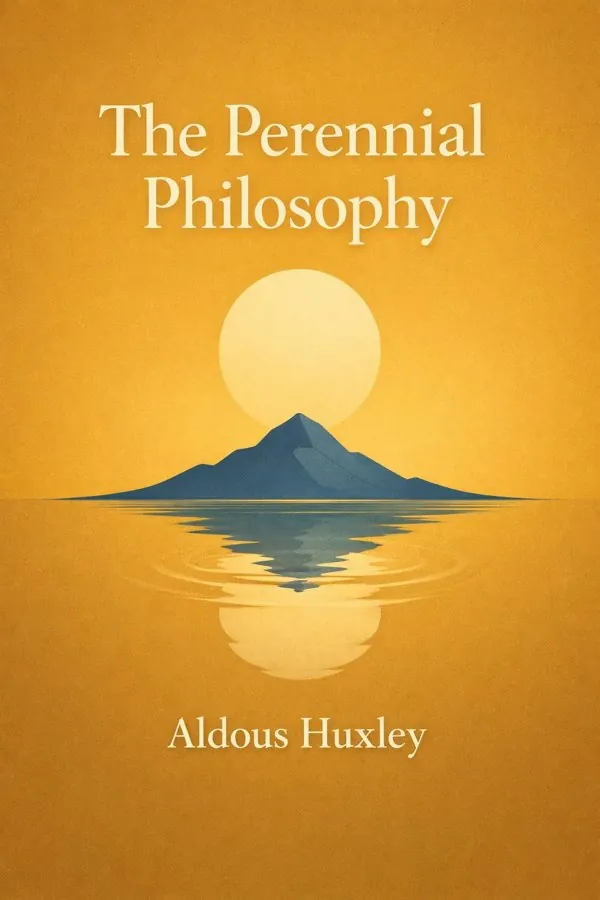
The Perennial Philosophy: An Interpretation of the Great Mystics, East and West: Summary & Key Insights
 10 min10 chaptersAudio available
Key Takeaways from The Perennial Philosophy: An Interpretation of the Great Mystics, East and West
The most revolutionary spiritual claim may also be the simplest: reality is deeper than appearances.
What if the person you defend so fiercely is not your truest identity?
Information can fill the mind while leaving the soul untouched.
Human effort matters, but it is not the whole story.
Evil is not only what shocks the world; it is also what subtly distorts the heart.
What Is The Perennial Philosophy: An Interpretation of the Great Mystics, East and West About?
The Perennial Philosophy: An Interpretation of the Great Mystics, East and West by Aldous Huxley is a eastern_wisdom book spanning 11 pages. Aldous Huxley’s The Perennial Philosophy is a bold and wide-ranging attempt to uncover the shared spiritual core beneath the world’s major religions. Drawing on Christian mystics, the Upanishads, Buddhist teachings, Sufi poetry, Taoist wisdom, and other sacred sources, Huxley argues that genuine religion is not primarily about dogma, institutions, or sectarian identity. It is about direct knowledge of ultimate Reality and the transformation of the self in light of that Reality. The book asks enduring questions: What is the deepest truth of existence? Why do human beings suffer? What stands in the way of inner freedom? And how have the wisest men and women across cultures answered these questions in strikingly similar ways? What makes this book matter is its combination of literary power, philosophical range, and spiritual seriousness. Huxley writes not as a narrow academic theologian but as an unusually perceptive interpreter of human experience. His authority comes from his command of comparative religion, philosophy, and mystical literature, as well as his lifelong interest in consciousness and human potential. The result is a profound invitation to look beyond religious surface differences and consider the universal truths that may unite humanity.
This FizzRead summary covers all 10 key chapters of The Perennial Philosophy: An Interpretation of the Great Mystics, East and West in approximately 10 minutes, distilling the most important ideas, arguments, and takeaways from Aldous Huxley's work. Also available as an audio summary and Key Quotes Podcast.
The Perennial Philosophy: An Interpretation of the Great Mystics, East and West
Aldous Huxley’s The Perennial Philosophy is a bold and wide-ranging attempt to uncover the shared spiritual core beneath the world’s major religions. Drawing on Christian mystics, the Upanishads, Buddhist teachings, Sufi poetry, Taoist wisdom, and other sacred sources, Huxley argues that genuine religion is not primarily about dogma, institutions, or sectarian identity. It is about direct knowledge of ultimate Reality and the transformation of the self in light of that Reality. The book asks enduring questions: What is the deepest truth of existence? Why do human beings suffer? What stands in the way of inner freedom? And how have the wisest men and women across cultures answered these questions in strikingly similar ways?
What makes this book matter is its combination of literary power, philosophical range, and spiritual seriousness. Huxley writes not as a narrow academic theologian but as an unusually perceptive interpreter of human experience. His authority comes from his command of comparative religion, philosophy, and mystical literature, as well as his lifelong interest in consciousness and human potential. The result is a profound invitation to look beyond religious surface differences and consider the universal truths that may unite humanity.
Who Should Read The Perennial Philosophy: An Interpretation of the Great Mystics, East and West?
This book is perfect for anyone interested in eastern_wisdom and looking to gain actionable insights in a short read. Whether you're a student, professional, or lifelong learner, the key ideas from The Perennial Philosophy: An Interpretation of the Great Mystics, East and West by Aldous Huxley will help you think differently.
- ✓Readers who enjoy eastern_wisdom and want practical takeaways
- ✓Professionals looking to apply new ideas to their work and life
- ✓Anyone who wants the core insights of The Perennial Philosophy: An Interpretation of the Great Mystics, East and West in just 10 minutes
Want the full summary?
Get instant access to this book summary and 100K+ more with Fizz Moment.
Get Free SummaryAvailable on App Store • Free to download
Key Chapters
The most revolutionary spiritual claim may also be the simplest: reality is deeper than appearances. Huxley argues that every authentic mystical tradition points toward an ultimate Reality he calls the Divine Ground, the timeless source and substance behind the changing world of forms. This Ground is not merely a god imagined in human likeness, nor a distant ruler standing apart from creation. It is the sacred foundation of all existence, closer to us than our own thoughts and yet beyond all ordinary concepts.
Across traditions, this insight appears in different language. Hindus speak of Brahman, Christians of Godhead, Taoists of the Tao, and Buddhists point toward an unconditioned reality beyond attachment and illusion. Huxley’s central claim is that these are not random similarities but converging testimonies. Human beings, when purified of ego and distraction, can awaken to this same truth.
This idea matters because it reframes daily life. If all beings arise from one spiritual source, then separation is less ultimate than we assume. Other people are not merely competitors, strangers, or obstacles. Nature is not just raw material. Even ordinary experience becomes charged with meaning when seen as an expression of a deeper order.
A practical way to apply this is to pause during the day and ask: What if this moment is not merely mundane, but grounded in something sacred? Whether you are washing dishes, listening to a friend, or sitting in traffic, this question softens restlessness and invites reverence.
Actionable takeaway: Spend five minutes each day in silent attention, contemplating the possibility that beneath the surface of all things lies one unifying Reality.
What if the person you defend so fiercely is not your truest identity? Huxley emphasizes a paradox found in the world’s mystical traditions: the false self must diminish for the true Self to emerge. The ego, in this sense, is not simply individuality or personality. It is the contracted identity built from cravings, fears, vanity, memory, and the constant urge to put oneself at the center of experience.
Mystics do not say that human beings should become empty machines or passive shadows. They say that the ego’s tyranny prevents us from perceiving reality clearly. When we cling to self-importance, we interpret everything through possession, status, injury, and desire. But beneath this noisy surface lies a deeper identity, one rooted in the Divine Ground rather than in personal drama.
In everyday life, ego appears in subtle forms: needing credit for a team effort, replaying an insult for days, comparing your life to others, or turning spiritual practice into a performance. Huxley would say that these habits tighten the prison of separateness. The spiritual path is therefore not self-glorification but self-transcendence.
This does not require dramatic withdrawal from life. It can begin with ordinary acts of humility: listening without preparing your rebuttal, apologizing without defensiveness, or serving someone without seeking recognition. Such practices weaken the ego’s grip and make room for a more spacious awareness.
Actionable takeaway: Choose one daily situation that usually triggers pride, irritation, or defensiveness, and practice responding from humility rather than self-protection for one week.
Information can fill the mind while leaving the soul untouched. One of Huxley’s most important distinctions is between conceptual knowledge and direct spiritual insight. The perennial philosophy does not reject theology, philosophy, or scripture, but it insists that secondhand belief is incomplete. Ultimate truth must be realized, not merely discussed.
This is why mystics across traditions often sound so different from religious literalists. They speak from encounter rather than inherited opinion. A person can memorize sacred texts, argue doctrine brilliantly, and still remain inwardly unchanged. Another person, perhaps with less formal learning, may possess profound wisdom because they have cultivated silence, selflessness, and inward attention.
In modern terms, this is the difference between reading about compassion and actually becoming compassionate, or studying mindfulness and genuinely observing the movement of your own mind. Huxley pushes readers to see that spiritual knowledge is verified in consciousness and conduct. Does it make you less fearful, less selfish, more lucid, more loving? If not, it may still be intellectual ornament rather than wisdom.
This insight is especially relevant in an age of endless content consumption. Many people collect spiritual ideas the way others collect productivity hacks. But insight without practice produces inflation, not transformation. Huxley’s message is that truth must descend from thought into being.
You can begin simply. After reading something profound, do not move on immediately. Sit quietly and ask what it reveals about your own attachments, reactions, and habits. Then test it in action.
Actionable takeaway: For every spiritual or philosophical idea you consume this week, pair it with one concrete practice so knowledge becomes lived experience.
Human effort matters, but it is not the whole story. Huxley repeatedly shows that the great traditions hold two truths in tension: spiritual growth requires discipline, yet awakening is never manufactured solely by willpower. There is also grace, a help, illumination, or inflow from beyond the ego that cannot be forced or earned like a transaction.
This balance corrects two common mistakes. The first is passivity: waiting for enlightenment, healing, or divine intervention while refusing the hard work of moral and mental purification. The second is spiritual pride: assuming that with enough techniques, effort, and self-mastery one can conquer transcendence like a personal achievement. Huxley suggests that real transformation involves both preparation and receptivity. We clear the ground, but we do not control the rain.
Virtue therefore becomes deeply practical. Humility, patience, honesty, chastity, nonviolence, generosity, and self-restraint are not merely moral rules imposed by institutions. They are conditions that make the soul more transparent to truth. By contrast, greed, resentment, cruelty, and vanity cloud perception.
Consider a person trying to meditate while living in chronic dishonesty or aggression. The mind remains agitated because character and consciousness are linked. Spiritual life is not a weekend escape from ethics; ethics is part of the path itself.
In practice, this means preparing inwardly while releasing entitlement. You show up to prayer, meditation, or service faithfully, but without demanding dramatic results. You cultivate goodness because it aligns you with reality, not because it guarantees spiritual rewards on your schedule.
Actionable takeaway: Pick one virtue you most need right now, such as patience or honesty, and treat it as a spiritual discipline rather than merely a moral preference.
Evil is not only what shocks the world; it is also what subtly distorts the heart. Huxley treats good and evil less as abstract labels and more as orientations of the soul. Good moves us toward reality, self-transcendence, love, and alignment with the Divine Ground. Evil moves us toward falsehood, egoic isolation, domination, and attachment to illusion.
This approach avoids simplistic moralism. It does not deny the reality of cruelty, injustice, or sin. Rather, it asks what inner conditions give rise to them. When people become enclosed within appetite, fear, resentment, or the lust for control, they lose contact with the deeper unity of being. Harm then becomes easier to justify. The spiritual problem is not just bad behavior but a consciousness cut off from truth.
This matters personally and socially. At the individual level, small compromises accumulate: exaggerating to impress, enjoying gossip, treating others as instruments, feeding anger because it feels energizing. At the collective level, entire systems can normalize greed and dehumanization when efficiency or ideology replaces reverence for persons.
Huxley’s perspective calls for vigilance. We often imagine evil as something other people commit in extreme situations. But the perennial philosophy insists that the seeds of alienation exist in ordinary consciousness. The remedy begins with self-examination, repentance, and reorientation toward the good.
A practical exercise is to review your day not only by what you accomplished, but by what kind of person you became while doing it. Did your actions increase clarity and compassion, or agitation and self-importance?
Actionable takeaway: End each day with a two-minute moral inventory, asking where you moved toward truth and where you drifted into ego-driven habits.
Most suffering is intensified by the mind’s habit of clinging. Huxley shows that detachment and renunciation are central themes in the perennial philosophy, not because the world is evil, but because attachment distorts our relationship to it. We suffer not only because things change, but because we demand that changing things provide permanent security, identity, and satisfaction.
Detachment is often misunderstood as indifference or emotional numbness. Huxley means something far subtler. To be detached is to engage life without enslavement to outcomes. It is to enjoy without grasping, to care without controlling, and to act without making the ego’s desires the measure of all things.
This insight applies powerfully today. People become attached to reputation, productivity, possessions, romantic projections, political identities, and even spiritual experiences. The result is chronic anxiety. When what we cling to is threatened, we feel as if we ourselves are collapsing. Renunciation, in this light, is not mere austerity. It is the intelligent refusal to let temporary things dictate the state of the soul.
A modern form of renunciation might include limiting compulsive scrolling, loosening the need for approval, simplifying possessions, or stepping back from constant self-display. These acts create interior space. They reveal how much of our unrest comes not from reality itself, but from possessiveness.
Detachment actually makes love purer and work wiser. When you are less desperate for results, you can serve more clearly. When you no longer need people to validate you, you can relate to them more truthfully.
Actionable takeaway: Identify one attachment that repeatedly unsettles your peace and practice a small, concrete fast from it this week.
Pain is unavoidable, but its meaning is not fixed. Huxley explores suffering and mortification as disciplines that can either embitter the ego or refine the soul. The perennial philosophy never glorifies pain for its own sake. Rather, it asks whether suffering can become an occasion for purification, surrender, and deeper insight.
Mortification, in traditional language, means the weakening of compulsive self-will. This can involve fasting, silence, vigils, or other forms of discipline, but the deeper aim is inward freedom. If we always obey impulse, avoid discomfort, and insist on convenience, we remain spiritually fragile. Small frustrations then dominate us. Deliberate discipline trains us to discover that we are not identical with every desire.
At the same time, involuntary suffering also plays a role. Illness, loss, failure, humiliation, and uncertainty can strip away illusion. They reveal how little control the ego actually has. Many spiritual traditions teach that if suffering is met consciously, it can break the shell of self-centeredness and open the heart to humility and dependence on the Real.
In ordinary life, this means not wasting pain. Instead of asking only, How do I escape this immediately, you might also ask, What is this exposing in me? Where am I being invited to grow in patience, courage, or trust? This does not cancel practical problem-solving. It adds depth to it.
The point is not self-punishment. It is transformation. Even brief voluntary disciplines, like postponing gratification or accepting inconvenience without complaint, can strengthen inner freedom.
Actionable takeaway: When discomfort arises this week, pause before reacting and ask what attachment, fear, or habit the experience is revealing.
Silence is not empty; it is often where reality becomes most audible. Huxley presents contemplation and prayer as essential means of moving from religious form to spiritual substance. In the perennial philosophy, contemplation is not daydreaming or mere relaxation. It is disciplined inward attention, a turning of the whole person toward the Divine Ground.
Prayer, likewise, is broader than petition. Asking for help has its place, but the higher forms of prayer involve adoration, surrender, recollection, and union. The soul learns to become still enough to receive rather than merely demand. This is why the mystics speak so often of silence, simplicity, and inward recollection. Noise strengthens fragmentation; contemplation gathers the scattered self.
For modern readers, this is an urgent corrective. Life is organized to keep attention externally occupied and internally agitated. Constant stimulation weakens our capacity for presence. Huxley reminds us that without some contemplative practice, spiritual ideas remain superficial because we never become quiet enough to test them at depth.
Contemplation can begin simply: sitting in silence, repeating a sacred word, observing the breath, practicing loving attention, or slowly reading a passage from a wisdom text until it sinks below the level of thought. Over time, such practice affects perception. One becomes less reactive, less fragmented, more capable of seeing situations without immediate egoic distortion.
The aim is not unusual experiences for their own sake. It is union, clarity, and transformation. Contemplation becomes authentic when it overflows into greater patience, compassion, and serenity in daily life.
Actionable takeaway: Create a nonnegotiable ten-minute daily period of silence, and protect it as seriously as any important meeting.
The holiest voices are often the least comfortable for institutions. Huxley’s portraits of saints, sages, and mystics reveal that those who touch ultimate reality rarely fit neatly into social expectations. They honor the deep truths within religious traditions, yet they also expose the ways religion can harden into mere habit, power, tribalism, or moral vanity.
Mystics are not necessarily rebels in temperament, but their loyalty is first to truth, not convention. Because they have seen beyond appearances, they are less impressed by status, ideology, and external piety. This gives them a quiet freedom that can unsettle both religious authorities and secular systems. They remind society that no civilization is healthy if it is organized entirely around consumption, competition, distraction, and force.
Huxley is especially interested in the tension between authentic spirituality and collective life. Societies need order, law, and institutions, but these can either support the inner life or suffocate it. Religion can guide people toward transcendence, or it can reduce transcendence to slogans and identity markers. The perennial philosophy therefore serves as a critique of both empty modern materialism and superficial religiosity.
This idea has practical implications now. It invites readers to ask whether their communities, habits, and media diets strengthen attention, virtue, and reverence, or whether they keep them spiritually scattered. It also encourages discernment in religious life: are we pursuing God, truth, and transformation, or merely belonging, certainty, and approval?
The mystic’s social message is not withdrawal from responsibility, but recovery of first things. A society without inner depth becomes efficient at producing distraction and misery.
Actionable takeaway: Examine one institution or routine in your life and ask whether it supports your deepest values or merely rewards conformity and distraction.
All Chapters in The Perennial Philosophy: An Interpretation of the Great Mystics, East and West
About the Author
Aldous Huxley (1894–1963) was an English novelist, essayist, and cultural critic whose work ranged across literature, philosophy, science, politics, psychology, and spirituality. He first gained wide recognition for his sharp social satire and later became globally famous for Brave New World, his dystopian masterpiece about technology, control, and dehumanization. Over the course of his life, Huxley’s interests expanded toward mysticism, comparative religion, consciousness, and human potential, subjects he explored in works such as The Perennial Philosophy, The Doors of Perception, and Island. Known for his intellectual breadth and lucid prose, Huxley was one of the twentieth century’s most distinctive public thinkers. His writing continues to attract readers seeking insight into modern civilization, inner life, and the search for transcendent meaning.
Get This Summary in Your Preferred Format
Read or listen to the The Perennial Philosophy: An Interpretation of the Great Mystics, East and West summary by Aldous Huxley anytime, anywhere. FizzRead offers multiple formats so you can learn on your terms — all free.
Available formats: App · Audio · PDF · EPUB — All included free with FizzRead
Download The Perennial Philosophy: An Interpretation of the Great Mystics, East and West PDF and EPUB Summary
Key Quotes from The Perennial Philosophy: An Interpretation of the Great Mystics, East and West
“The most revolutionary spiritual claim may also be the simplest: reality is deeper than appearances.”
“What if the person you defend so fiercely is not your truest identity?”
“Information can fill the mind while leaving the soul untouched.”
“Human effort matters, but it is not the whole story.”
“Evil is not only what shocks the world; it is also what subtly distorts the heart.”
Frequently Asked Questions about The Perennial Philosophy: An Interpretation of the Great Mystics, East and West
The Perennial Philosophy: An Interpretation of the Great Mystics, East and West by Aldous Huxley is a eastern_wisdom book that explores key ideas across 10 chapters. Aldous Huxley’s The Perennial Philosophy is a bold and wide-ranging attempt to uncover the shared spiritual core beneath the world’s major religions. Drawing on Christian mystics, the Upanishads, Buddhist teachings, Sufi poetry, Taoist wisdom, and other sacred sources, Huxley argues that genuine religion is not primarily about dogma, institutions, or sectarian identity. It is about direct knowledge of ultimate Reality and the transformation of the self in light of that Reality. The book asks enduring questions: What is the deepest truth of existence? Why do human beings suffer? What stands in the way of inner freedom? And how have the wisest men and women across cultures answered these questions in strikingly similar ways? What makes this book matter is its combination of literary power, philosophical range, and spiritual seriousness. Huxley writes not as a narrow academic theologian but as an unusually perceptive interpreter of human experience. His authority comes from his command of comparative religion, philosophy, and mystical literature, as well as his lifelong interest in consciousness and human potential. The result is a profound invitation to look beyond religious surface differences and consider the universal truths that may unite humanity.
More by Aldous Huxley


You Might Also Like
A New Earth
Eckhart Tolle
10 min
The Daily Stoic
Ryan Holiday, Stephen Hanselman
10 min
Buddhism: Plain and Simple
Steve Hagen
10 min
Enchiridion
Epictetus
10 min
The Book of Tea
Kakuzō Okakura
10 min
The Light We Give: How Sikh Wisdom Can Transform Your Life
Simran Jeet Singh
10 minBrowse by Category
Ready to read The Perennial Philosophy: An Interpretation of the Great Mystics, East and West?
Get the full summary and 100K+ more books with Fizz Moment.