
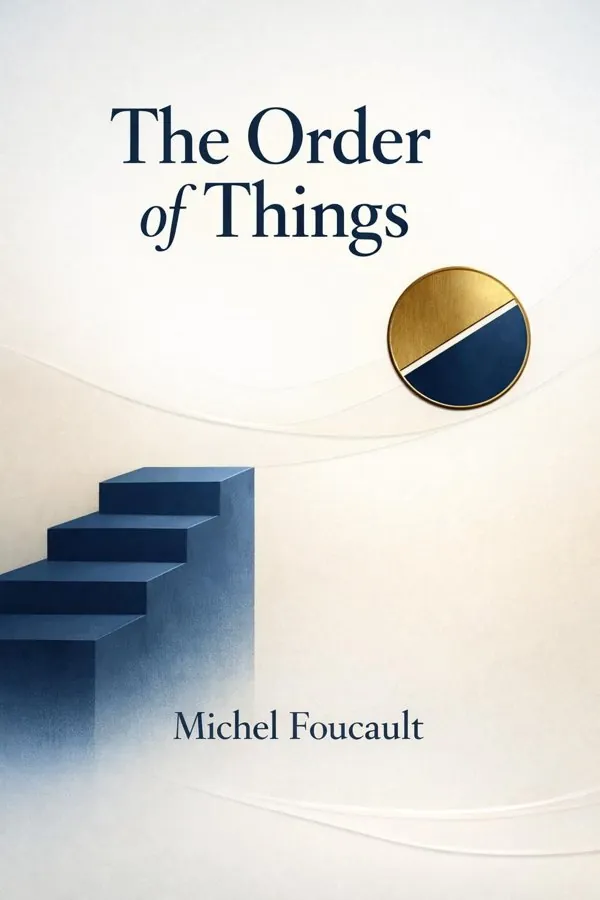
The Order of Things: An Archaeology of the Human Sciences: Summary & Key Insights
 10 min9 chaptersAudio available
Key Takeaways from The Order of Things: An Archaeology of the Human Sciences
What if a culture organized truth not through proof, but through likeness?
Sometimes knowledge advances not by discovering more things, but by rearranging how things are ordered.
Language often feels like a neutral tool, but Foucault shows that its role has changed dramatically across history.
The human sciences did not simply appear because people finally decided to study themselves.
Modern thought did not simply add new disciplines; it reorganized knowledge around three powerful domains: life, labor, and language.
What Is The Order of Things: An Archaeology of the Human Sciences About?
The Order of Things: An Archaeology of the Human Sciences by Michel Foucault is a western_phil book spanning 8 pages. Originally published in French in 1966 as Les Mots et les Choses, The Order of Things is Michel Foucault’s bold investigation into the hidden rules that make knowledge possible in different historical periods. Rather than telling a familiar story of intellectual progress, Foucault asks a more unsettling question: why do certain ways of thinking become obvious in one era and nearly unthinkable in another? To answer it, he traces major shifts in Western thought from the Renaissance through the Classical age to modernity, showing how fields such as biology, economics, philology, and psychology emerged from deeper changes in the organization of knowledge itself. The book matters because it destabilizes many assumptions we take for granted, including the idea that “man” has always been the center of inquiry. Foucault, one of the twentieth century’s most influential philosophers and historians of ideas, writes with extraordinary range and ambition. His concept of the episteme offers a powerful tool for understanding how culture, science, and language are shaped by historical conditions long before individuals become aware of them.
This FizzRead summary covers all 9 key chapters of The Order of Things: An Archaeology of the Human Sciences in approximately 10 minutes, distilling the most important ideas, arguments, and takeaways from Michel Foucault's work. Also available as an audio summary and Key Quotes Podcast.
The Order of Things: An Archaeology of the Human Sciences
Originally published in French in 1966 as Les Mots et les Choses, The Order of Things is Michel Foucault’s bold investigation into the hidden rules that make knowledge possible in different historical periods. Rather than telling a familiar story of intellectual progress, Foucault asks a more unsettling question: why do certain ways of thinking become obvious in one era and nearly unthinkable in another? To answer it, he traces major shifts in Western thought from the Renaissance through the Classical age to modernity, showing how fields such as biology, economics, philology, and psychology emerged from deeper changes in the organization of knowledge itself. The book matters because it destabilizes many assumptions we take for granted, including the idea that “man” has always been the center of inquiry. Foucault, one of the twentieth century’s most influential philosophers and historians of ideas, writes with extraordinary range and ambition. His concept of the episteme offers a powerful tool for understanding how culture, science, and language are shaped by historical conditions long before individuals become aware of them.
Who Should Read The Order of Things: An Archaeology of the Human Sciences?
This book is perfect for anyone interested in western_phil and looking to gain actionable insights in a short read. Whether you're a student, professional, or lifelong learner, the key ideas from The Order of Things: An Archaeology of the Human Sciences by Michel Foucault will help you think differently.
- ✓Readers who enjoy western_phil and want practical takeaways
- ✓Professionals looking to apply new ideas to their work and life
- ✓Anyone who wants the core insights of The Order of Things: An Archaeology of the Human Sciences in just 10 minutes
Want the full summary?
Get instant access to this book summary and 100K+ more with Fizz Moment.
Get Free SummaryAvailable on App Store • Free to download
Key Chapters
What if a culture organized truth not through proof, but through likeness? Foucault begins with the Renaissance, where knowledge was structured by resemblance, analogy, sympathy, and correspondence. In the sixteenth century, people often understood the world as a vast web of signs in which plants, stars, animals, bodies, and words mirrored one another. To know something was to decipher hidden affinities woven into creation. The universe seemed legible because everything echoed something else.
This does not mean Renaissance thinkers were irrational. Rather, they operated within a different order of knowledge. Herbal medicine, for example, often relied on the idea that a plant’s shape revealed its healing power. Language, too, was not seen as an arbitrary human system but as closely tied to the natural order. Words and things appeared bound together by deep correspondences.
Foucault’s point is not to mock this worldview, but to show that every age has its own standards of intelligibility. What counts as evidence, explanation, or method depends on a historical framework. Today we may favor experiment, measurement, and formal classification, but those are not timeless habits of reason.
A practical way to use this idea is to notice how your own assumptions shape what feels convincing. In organizations, schools, and public debate, people often mistake a current method for universal truth. Foucault reminds us that intellectual confidence is always historical. Actionable takeaway: when evaluating any theory, ask not only whether it is true, but what hidden rules make it seem true now.
Sometimes knowledge advances not by discovering more things, but by rearranging how things are ordered. For Foucault, the seventeenth and eighteenth centuries introduced a decisive break with Renaissance thought. Resemblance receded, and representation became central. The task of knowledge was no longer to trace cosmic affinities, but to classify, compare, and arrange visible identities and differences in systematic tables.
This is the world of taxonomy, grammar, and general ordering. Natural history categorized plants and animals through observable features. Grammar analyzed language as a representational system. Wealth was studied in terms of exchange and circulation. Across these domains, thought sought clarity, distinction, and order. Signs became tools of representation rather than echoes of nature’s hidden mysteries.
This shift matters because it reveals that reason itself changes form. The Classical age did not simply become more rational than the Renaissance; it adopted a new rationality. Knowledge aimed to display things in an organized space where they could be compared side by side. Think of library systems, spreadsheets, menus, or museum catalogs: all reflect the impulse to make the world intelligible by arranging it.
In modern life, this logic still appears in dashboards, standardized testing, market segmentation, and data classification. The benefit is precision. The danger is that what cannot be neatly represented may be ignored.
Foucault helps us see that systems of order do not merely describe reality; they also shape it. Actionable takeaway: whenever you encounter a classification system, ask what it makes visible, what it leaves out, and whose interests it serves.
Language often feels like a neutral tool, but Foucault shows that its role has changed dramatically across history. In the Classical age, language was increasingly understood as a transparent medium of representation. Words did not carry sacred correspondences as they often had in the Renaissance. Instead, they functioned as signs that could clearly represent ideas, objects, and relations within an ordered system.
This mattered enormously for logic, grammar, and science. If language could accurately represent the world, then analysis became a matter of clarifying signs and arranging them properly. Universal grammar, dictionaries, and rational discourse all depended on the belief that language could serve as a clean vehicle for thought. Meaning was expected to become more precise as language became more ordered.
But Foucault also shows the limits of this model. The apparent transparency of language concealed historical assumptions about how signs work. Once language is treated as a mirror, speakers may forget that meaning is shaped by convention, power, and context. The dream of perfectly clear language often ignores ambiguity, metaphor, and the social life of words.
Consider modern communication at work. Policy documents, legal contracts, and technical manuals all aim for precision, yet misunderstandings still arise because language is never purely neutral. The same phrase can guide, exclude, persuade, or obscure depending on who uses it and in what situation.
Foucault’s insight is useful far beyond philosophy. It encourages us to examine whether language is clarifying reality or imposing a framework onto it. Actionable takeaway: when reading authoritative language, ask what assumptions about truth, clarity, and representation are built into the words themselves.
The human sciences did not simply appear because people finally decided to study themselves. Foucault argues that disciplines such as psychology, sociology, and anthropology became possible only after a deeper rearrangement in the structure of knowledge. Before modernity, there was no stable conceptual space for “man” to emerge as both the subject who knows and the object to be known.
This is one of the book’s most famous claims. The modern age produced a peculiar figure: the human being understood as living organism, productive worker, and speaking subject. Once life, labor, and language became objects of scientific analysis, human beings could be studied through biology, political economy, and philology. From there, the human sciences formed at their intersections, seeking to explain consciousness, behavior, culture, and society.
Foucault is not saying these fields are useless. He is showing that they are historically conditioned. Their categories are not eternal discoveries about human nature, but products of a specific episteme. IQ, personality types, market behavior, and social norms may feel obvious today, yet they depend on particular ways of constructing the human subject.
This matters in contemporary institutions. Schools measure learning styles, companies profile workers, platforms track behavior, and governments classify populations. Such practices do more than observe people; they help define what a person is.
Foucault’s archaeology invites intellectual humility. The “human” in human sciences is not a fixed essence waiting to be discovered. Actionable takeaway: when confronted with expert claims about human nature, ask what historical assumptions made those categories thinkable in the first place.
Modern thought did not simply add new disciplines; it reorganized knowledge around three powerful domains: life, labor, and language. Foucault argues that in the nineteenth century, these became fundamental fields through which reality and humanity were understood. Biology replaced natural history, economics displaced the older analysis of wealth, and philology transformed the study of language.
The shift is subtle but profound. Natural history had classified visible forms; biology investigated the inner processes of life. Earlier economic thought emphasized exchange and representation; political economy turned to production, work, and the conditions of labor. Classical grammar studied how language represented ideas; philology examined historical development, transformation, and the deep structures of linguistic families.
These changes gave knowledge new depth. The visible surface was no longer enough. Thinkers searched for hidden processes beneath appearances: organic functions beneath bodies, labor beneath markets, historical change beneath words. Modern inquiry became interpretive, developmental, and often suspicious of surface order.
You can see this modern logic everywhere today. Health is discussed in terms of systems and functions, not just symptoms. Markets are analyzed through productivity, incentives, and labor conditions. Language is studied through history, identity, and discourse rather than simple correctness.
Foucault’s larger point is that these domains also made the modern image of the human possible. We became beings who live, work, and speak, and thus beings who can be scientifically analyzed. Actionable takeaway: when studying any social issue, look beneath visible categories and ask which deeper concepts of life, labor, or language are organizing the discussion.
One of Foucault’s most provocative insights is that “man” is not an eternal foundation of knowledge but a recent historical invention. Modernity created a strange double figure: the human being became both the knower and the known, the source of meaning and an object of scientific investigation. This is the central paradox of the human sciences.
In earlier epistemes, knowledge was not organized around the human subject in this way. But once life, labor, and language became the key domains of inquiry, human beings appeared at their crossing point. We became living creatures studied by biology, workers analyzed by economics, and speaking beings examined by philology and linguistics. Psychology and the other human sciences then tried to synthesize these dimensions into a coherent image of the self.
Foucault sees a tension here. If humans are shaped by structures they do not control, can they still be the sovereign origin of knowledge? The more modern thought investigates unconscious processes, social systems, and historical conditions, the less stable the autonomous subject appears.
This idea remains strikingly relevant. Today, algorithms model our preferences, neuroscience maps decision-making, and behavioral economics questions rational choice. The modern self is still pulled between freedom and explanation.
The practical lesson is not to deny agency, but to recognize how often identity is produced through institutions and discourses. Job titles, diagnoses, demographic categories, and personality labels can become ways of fixing what a person is. Actionable takeaway: treat every definition of “human nature” with caution, and ask how it shapes the people it claims merely to describe.
Some thinkers matter not because they fit an age neatly, but because they fracture it from within. Foucault highlights Marx, Nietzsche, and Freud as figures who revealed the limits of modern representation. Each showed that what appears on the surface is not the whole truth. Beneath ideas, morals, and consciousness lie deeper forces that disrupt transparent self-understanding.
Marx exposed economic relations hidden beneath political ideals and market appearances. Nietzsche traced moral values to struggles of power, interpretation, and resentment rather than universal reason. Freud uncovered unconscious desire beneath conscious intention. Together, they transformed critique into an act of suspicion. To interpret was no longer just to clarify meaning; it was to reveal what official meanings conceal.
For Foucault, these thinkers signal a crisis in the modern episteme. If the subject is shaped by labor, power, and unconscious drives, then the hope that humans can fully know themselves through representation becomes unstable. Thought turns inward only to discover opacity.
This legacy is alive in contemporary criticism. Journalists investigate hidden incentives, therapists explore unconscious patterns, and social critics analyze ideology, bias, and structural power. We have inherited a culture that often assumes there is always something beneath the stated reason.
That habit can be liberating, but also corrosive if it turns into reflexive cynicism. Not every statement masks a secret agenda. Foucault helps us balance suspicion with historical analysis. Actionable takeaway: practice critical interpretation, but direct it first at the systems and assumptions that produce meaning, not only at the motives of individuals.
Few lines in twentieth-century philosophy are as famous as Foucault’s suggestion that man may be erased like a face drawn in sand at the edge of the sea. This is not a call for violence or nihilism. It is a historical claim: if “man” emerged under specific conditions, then that figure can also disappear when those conditions change.
Foucault is challenging humanism as an unquestioned foundation. Modern thought often treats the human subject as the center of truth, morality, politics, and history. But if that subject is itself historically constructed, then it cannot serve as an eternal ground. The human sciences, which claimed to reveal what man essentially is, may instead belong to a passing arrangement of knowledge.
This idea has sharp contemporary relevance. Digital technology, artificial intelligence, biotechnology, and environmental crisis all pressure inherited notions of the human. Are we still best understood as autonomous individuals, or as nodes in networks of data, ecology, infrastructure, and code? Foucault’s argument prepares us to think beyond familiar categories.
Importantly, the “death of man” does not mean thought ends. It means thought may begin differently. Once we stop assuming the human subject is the timeless center, new questions become possible about power, discourse, embodiment, and collective life.
For readers, this can be unsettling but freeing. It loosens rigid ideas about identity and opens space for intellectual reinvention. Actionable takeaway: do not treat current definitions of the human as final; use their instability as an invitation to imagine new ways of thinking, studying, and living.
The deepest insight of The Order of Things is that every age thinks within conditions it rarely sees. Foucault calls this underlying structure an episteme: the set of relations that determines what counts as knowledge, what methods are legitimate, and what objects can appear for inquiry. An episteme is not a worldview people consciously choose. It is the historical field that makes certain statements meaningful and others impossible.
This concept helps explain why intellectual history cannot be reduced to great thinkers producing better ideas over time. Even the most brilliant mind works within limits set by its era. What changes from one period to another is not just content but the rules of formation themselves. That is why Foucault emphasizes discontinuity. The shift from resemblance to representation, and from representation to modern depth, marks transformations in the very conditions of thought.
In practical terms, the concept of episteme is useful whenever a society treats its own categories as natural. Consider current faith in data, optimization, and evidence-based policy. These may be powerful tools, but they also form part of a broader regime that defines what counts as serious knowledge. Questions that resist quantification can then seem vague or secondary.
Foucault does not ask us to reject knowledge. He asks us to historicize it. Once we see that our standards have conditions, we become less dogmatic and more alert to excluded possibilities. Actionable takeaway: in any debate, identify the unspoken rules deciding what can be said, measured, and believed before arguing about conclusions.
All Chapters in The Order of Things: An Archaeology of the Human Sciences
About the Author
Michel Foucault (1926–1984) was a French philosopher, historian of ideas, and social theorist whose work transformed the study of knowledge, power, and modern institutions. Educated at the École Normale Supérieure, he later held major academic posts, including Professor of the History of Systems of Thought at the Collège de France. Foucault became internationally influential through books such as Madness and Civilization, The Birth of the Clinic, Discipline and Punish, and The History of Sexuality. His method often traced how societies produce categories such as madness, criminality, sexuality, and normality through discourse and institutions. In The Order of Things, he developed one of his most famous ideas: that every historical era is shaped by deep, often invisible conditions that define what can be known and said.
Get This Summary in Your Preferred Format
Read or listen to the The Order of Things: An Archaeology of the Human Sciences summary by Michel Foucault anytime, anywhere. FizzRead offers multiple formats so you can learn on your terms — all free.
Available formats: App · Audio · PDF · EPUB — All included free with FizzRead
Download The Order of Things: An Archaeology of the Human Sciences PDF and EPUB Summary
Key Quotes from The Order of Things: An Archaeology of the Human Sciences
“What if a culture organized truth not through proof, but through likeness?”
“Sometimes knowledge advances not by discovering more things, but by rearranging how things are ordered.”
“Language often feels like a neutral tool, but Foucault shows that its role has changed dramatically across history.”
“The human sciences did not simply appear because people finally decided to study themselves.”
“Modern thought did not simply add new disciplines; it reorganized knowledge around three powerful domains: life, labor, and language.”
Frequently Asked Questions about The Order of Things: An Archaeology of the Human Sciences
The Order of Things: An Archaeology of the Human Sciences by Michel Foucault is a western_phil book that explores key ideas across 9 chapters. Originally published in French in 1966 as Les Mots et les Choses, The Order of Things is Michel Foucault’s bold investigation into the hidden rules that make knowledge possible in different historical periods. Rather than telling a familiar story of intellectual progress, Foucault asks a more unsettling question: why do certain ways of thinking become obvious in one era and nearly unthinkable in another? To answer it, he traces major shifts in Western thought from the Renaissance through the Classical age to modernity, showing how fields such as biology, economics, philology, and psychology emerged from deeper changes in the organization of knowledge itself. The book matters because it destabilizes many assumptions we take for granted, including the idea that “man” has always been the center of inquiry. Foucault, one of the twentieth century’s most influential philosophers and historians of ideas, writes with extraordinary range and ambition. His concept of the episteme offers a powerful tool for understanding how culture, science, and language are shaped by historical conditions long before individuals become aware of them.
More by Michel Foucault
The History of Sexuality, Volume 1: An Introduction
Michel Foucault
10 min
The Archaeology of Knowledge
Michel Foucault
10 min
Madness and Civilization: A History of Insanity in the Age of Reason
Michel Foucault
10 min
The Birth Of The Clinic: An Archaeology Of Medical Perception
Michel Foucault
10 minYou Might Also Like
A Little History of Philosophy
Nigel Warburton
10 min
Areopagitica
John Milton
10 min
How To Think Like A Philosopher: Essential Principles For Clear Thinking
Peter Cave
10 min
Language, Truth and Logic
A. J. Ayer
10 min
The Age of Reason
Thomas Paine
10 min
The Essays
Michel De Montaigne
10 minBrowse by Category
Ready to read The Order of Things: An Archaeology of the Human Sciences?
Get the full summary and 100K+ more books with Fizz Moment.