
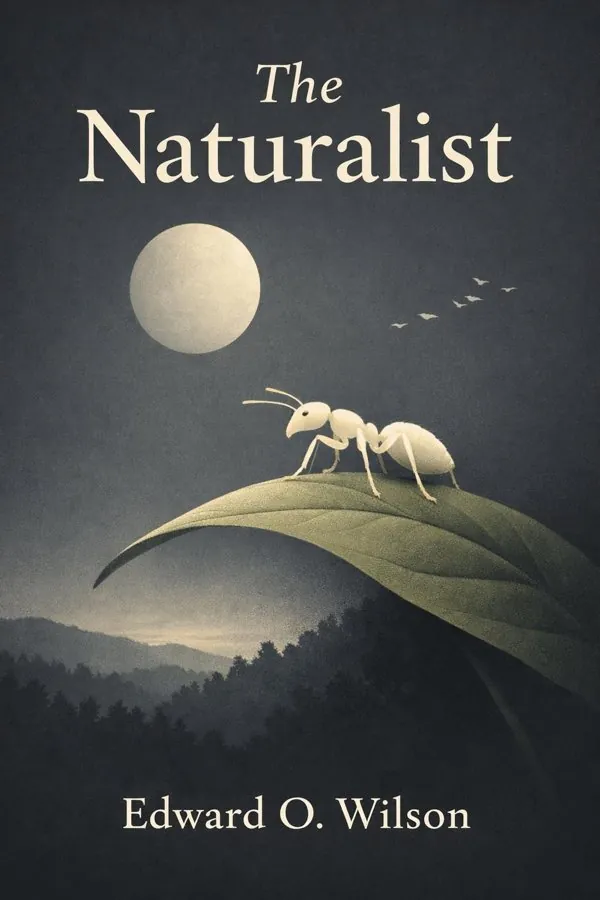
The Naturalist: Summary & Key Insights
 10 min9 chaptersAudio available
Key Takeaways from The Naturalist
A life in science often begins not in a laboratory, but in a moment of fascination.
Talent matters less than many people think; what matters more is apprenticeship.
The smallest organisms can open the door to the largest truths.
To understand society, we must first understand that social life is a biological achievement.
Great science is built at the intersection of muddy boots and bold ideas.
What Is The Naturalist About?
The Naturalist by Edward O. Wilson is a biographies book spanning 5 pages. The Naturalist is Edward O. Wilson’s deeply personal account of how a boy enchanted by insects, forests, and shorelines became one of the world’s most influential biologists. More than a standard autobiography, the book traces the growth of a scientific mind: from childhood wonder in the American South to pioneering research on ants, island biogeography, sociobiology, and biodiversity. Wilson shows that science is not only a body of knowledge but also a way of seeing—an ongoing act of attention to the living world. What makes this book matter is its fusion of memoir, intellectual history, and moral reflection. Wilson does not simply recount his achievements; he reveals how observation, discipline, and imagination shaped them. He also addresses the larger stakes of his work: how humans fit within evolution, why biological diversity is precious, and why modern civilization must learn to protect the natural systems it depends on. As a Harvard professor, two-time Pulitzer Prize winner, and one of the central evolutionary thinkers of the twentieth century, Wilson writes with unusual authority. Yet the book’s real power lies in its humility: great science begins with curiosity.
This FizzRead summary covers all 9 key chapters of The Naturalist in approximately 10 minutes, distilling the most important ideas, arguments, and takeaways from Edward O. Wilson's work. Also available as an audio summary and Key Quotes Podcast.
The Naturalist
The Naturalist is Edward O. Wilson’s deeply personal account of how a boy enchanted by insects, forests, and shorelines became one of the world’s most influential biologists. More than a standard autobiography, the book traces the growth of a scientific mind: from childhood wonder in the American South to pioneering research on ants, island biogeography, sociobiology, and biodiversity. Wilson shows that science is not only a body of knowledge but also a way of seeing—an ongoing act of attention to the living world.
What makes this book matter is its fusion of memoir, intellectual history, and moral reflection. Wilson does not simply recount his achievements; he reveals how observation, discipline, and imagination shaped them. He also addresses the larger stakes of his work: how humans fit within evolution, why biological diversity is precious, and why modern civilization must learn to protect the natural systems it depends on.
As a Harvard professor, two-time Pulitzer Prize winner, and one of the central evolutionary thinkers of the twentieth century, Wilson writes with unusual authority. Yet the book’s real power lies in its humility: great science begins with curiosity.
Who Should Read The Naturalist?
This book is perfect for anyone interested in biographies and looking to gain actionable insights in a short read. Whether you're a student, professional, or lifelong learner, the key ideas from The Naturalist by Edward O. Wilson will help you think differently.
- ✓Readers who enjoy biographies and want practical takeaways
- ✓Professionals looking to apply new ideas to their work and life
- ✓Anyone who wants the core insights of The Naturalist in just 10 minutes
Want the full summary?
Get instant access to this book summary and 100K+ more with Fizz Moment.
Get Free SummaryAvailable on App Store • Free to download
Key Chapters
A life in science often begins not in a laboratory, but in a moment of fascination. In The Naturalist, Edward O. Wilson shows how his earliest experiences in the rivers, woods, and coastal habitats of the American South formed the emotional foundation of his scientific life. As a child, he was captivated by butterflies, fish, birds, and especially insects. These encounters were not yet “research,” but they trained his eye to notice detail, variation, and behavior—skills that later became central to his work as a biologist.
Wilson’s story reminds us that curiosity is not a luxury; it is the engine of discovery. He did not grow up with exceptional scientific equipment or elite mentors from the beginning. What he had was attention. He watched, collected, compared, and remembered. Even a childhood eye injury, which limited his ability to observe larger animals, redirected him toward small creatures such as ants. What might have seemed like a setback became a defining advantage, teaching him that limitations can sharpen focus rather than end ambition.
This idea has broad application beyond biology. Many careers and breakthroughs begin when someone takes seriously the things that genuinely interest them. A child obsessed with maps may become a geographer; someone drawn to code may become an engineer. The important step is sustained engagement: returning again and again to the object of fascination until it reveals patterns others overlook.
Wilson’s early life also illustrates the importance of place. Local ponds, vacant lots, and patches of forest can become classrooms for observation. You do not need to travel far to begin understanding nature.
Actionable takeaway: Pay close attention to what repeatedly captures your curiosity, and turn that interest into a disciplined habit of observation.
Talent matters less than many people think; what matters more is apprenticeship. Wilson’s university years, especially at the University of Alabama, were crucial not because they placed him at the center of prestige, but because they gave him a community, a structure for learning, and opportunities to test himself. He discovered that becoming a scientist meant more than loving nature. It required method, patience, reading, collecting evidence, and learning how to ask questions that could actually be answered.
Wilson’s development shows that intellectual growth happens through gradual immersion. He learned taxonomy, field methods, scientific writing, and how to situate his own observations within the larger body of biological knowledge. The romance of discovery remained, but it became disciplined. He moved from admiring nature to investigating it. This transition is vital in any field. Interest becomes expertise only when it is shaped by training and practice.
Another lesson from this period is that institutions do not determine destiny. Wilson did not begin at the most famous universities, yet he built a foundation strong enough to carry him into world-class research. That is encouraging for readers who feel limited by circumstance. Serious work, done consistently, can overcome the absence of glamour.
In practical terms, apprenticeship means finding a way to learn by doing. A future writer should write regularly and study great prose. A future designer should make things, revise them, and seek critique. A future scientist should spend time in the field or lab, not only in abstract discussion.
Wilson also benefited from mentors and peers who recognized his seriousness. Apprenticeship is rarely solitary; it depends on guidance and standards.
Actionable takeaway: Convert your interests into a craft by seeking training, building routines, and learning from people who practice at a high level.
The smallest organisms can open the door to the largest truths. Wilson devoted much of his career to ants, creatures many people overlook or dismiss, yet through their behavior he uncovered profound lessons about ecology, social organization, and evolution. His choice of subject was not narrow in the limiting sense; it was narrow in the productive sense. By looking closely at one form of life, he found patterns that illuminated many others.
Ants offered Wilson an ideal subject because they are both abundant and highly organized. Their colonies display division of labor, communication, cooperation, conflict, adaptation, and environmental specialization. By studying how ants forage, reproduce, defend territory, and structure colonies, Wilson gained insight into how complex systems emerge from simple interactions. This work helped establish him as one of the leading myrmecologists in the world.
The broader principle is powerful: depth in one domain can lead to general understanding. Specialists are sometimes caricatured as people who know more and more about less and less. Wilson’s example shows the opposite. True specialization, when paired with imagination, can become a pathway to universality. A close study of one ecosystem, one organism, or one problem can reveal laws of broader significance.
This idea applies outside science too. A business leader who studies one customer group deeply may discover patterns about human behavior more generally. A teacher who carefully tracks how one student learns can improve an entire classroom approach. Precision often produces insight.
Wilson’s focus on ants also teaches intellectual humility. Nature does not arrange its greatest lessons according to human vanity. The answers we need may lie under our feet.
Actionable takeaway: Choose one neglected subject, study it deeply, and use that depth to uncover wider patterns that others miss.
To understand society, we must first understand that social life is a biological achievement. In The Naturalist, Wilson reflects on how his research on ants led him toward larger questions about cooperation, hierarchy, communication, and the evolution of social behavior. Ant colonies are not random gatherings. They are highly structured systems in which individuals perform specialized roles that support the survival of the whole. For Wilson, these systems became a window into the broader architecture of life.
This work eventually contributed to his controversial and influential ideas in sociobiology: the study of the biological roots of social behavior across species, including humans. Wilson did not argue that biology rigidly determines human life. Rather, he suggested that our behavior exists within an evolutionary framework, shaped in part by inherited tendencies that interact with culture, history, and environment. That claim sparked intense debate because it challenged the comforting idea that human social patterns can be explained entirely through culture alone.
Wilson’s account is valuable because it shows how major ideas emerge from patient empirical work. He did not begin with sweeping claims about human nature and then search for support. He began with ants. From colony behavior, he traced analogies, differences, and evolutionary principles that broadened into a larger theory.
For readers, the lesson is to resist simplistic either-or thinking. Human beings are neither blank slates nor prisoners of instinct. We are biological organisms with cultural flexibility. Good thinking requires holding both truths at once.
In everyday life, this perspective can deepen how we think about teamwork, institutions, family structure, and conflict. Social systems work best when we understand both individual incentives and collective needs.
Actionable takeaway: When analyzing human behavior, consider both biology and culture instead of relying on a single explanation.
Great science is built at the intersection of muddy boots and bold ideas. Wilson’s career demonstrates that observation in the field and conceptual thinking in the study are not opposing styles but complementary ones. His expeditions, collecting trips, and direct engagement with habitats gave him the raw material for broader theories. At the same time, his most influential contributions came from connecting isolated facts into explanatory frameworks.
One example is his collaboration with Robert MacArthur on the theory of island biogeography, a major contribution to ecology. The theory proposed that the number of species on an island reflects a dynamic balance between immigration and extinction, influenced by factors such as island size and distance from the mainland. Though elegant and mathematical, the theory was rooted in real biological patterns observed in nature. It changed how scientists think about ecosystems, habitat fragmentation, and conservation planning.
Wilson’s life therefore rejects a false divide between the practical and the abstract. Collecting specimens, identifying species, and recording habitats may appear old-fashioned compared with grand theory, but without such groundwork theory floats free of reality. Conversely, field notes without synthesis remain local and limited. Scientific progress requires both exact observation and conceptual ambition.
This principle applies in many professions. Data without interpretation is noise; strategy without evidence is fantasy. Effective leaders, researchers, and creators move repeatedly between particulars and patterns.
Wilson also reminds us that breakthroughs often come from asking deceptively simple questions: Why are some habitats richer in species than others? How do communities assemble? Why do some social systems evolve? These questions gain power when pursued rigorously.
Actionable takeaway: Strengthen your work by pairing hands-on observation with time set aside to identify the larger patterns hidden within it.
Science does more than explain the world; it can enlarge our sense of responsibility toward it. Wilson’s memoir is grounded in evidence, but it also carries a moral vision. He does not present science as cold detachment. Instead, he shows how careful knowledge of the natural world can lead to reverence, humility, and ethical concern. The more fully we understand life’s complexity, the less defensible indifference becomes.
Wilson believed that human beings need a worldview broad enough to join facts with values. He resisted superstition and anti-scientific thinking, yet he also resisted the notion that scientific understanding drains life of meaning. For him, evolution and ecology do not diminish wonder; they deepen it. Knowing how life emerged, diversified, and adapted makes existence more astonishing, not less. This perspective gives science a humanistic dimension. It helps us ask not only what is true, but what kind of world we ought to protect.
A particularly important part of Wilson’s moral outlook is humility. Humans are a remarkable species, but not the center of creation in any absolute sense. We are one branch of life among many, dependent on ecosystems older and larger than civilization. This recognition can counter arrogance in politics, economics, and culture.
In practical terms, Wilson’s moral vision encourages evidence-based decision-making guided by long-term stewardship. Whether the issue is environmental policy, education, or public health, facts matter. But facts alone do not compel action unless they are joined to care.
Readers can apply this by letting knowledge change behavior. Learning about pollinators might lead to planting native species. Learning about climate risks might reshape voting priorities. Information should move us toward responsibility.
Actionable takeaway: Use scientific understanding not just to know more, but to make wiser and more responsible choices.
A defining life direction can emerge from an accident no one would have chosen. Wilson’s partial loss of depth perception after a childhood fishing injury could easily have closed doors. It limited his ability to observe birds and mammals in the way he once might have wanted. Yet this constraint pushed him toward the miniature world of insects, where close-range observation became an advantage rather than a weakness. The injury did not diminish his vocation; it refined it.
This is one of the most encouraging themes in The Naturalist. Wilson does not romanticize hardship, but he shows that obstacles often reshape ambition in unexpectedly fruitful ways. The question is not whether life will impose constraints. It will. The more important question is how those constraints are interpreted. Some people see a limit and stop. Others adjust scale, method, or target until the limit becomes part of a new path.
Wilson’s example is especially relevant in a culture that often celebrates smooth success stories. Real achievement is usually messier. Careers bend. Plans collapse. Talents develop unevenly. The people who persist are often those who learn to reframe disappointment as information: this route is blocked, but another may be open.
The practical application is broad. A student rejected from one program may discover a better field. An athlete sidelined by injury may become a coach or analyst. A professional who cannot advance in one environment may find a niche elsewhere. Adaptability is not surrender; it is strategic resilience.
Wilson’s life suggests that identity should be rooted in a deeper purpose, not in one fixed form of success. He wanted to understand nature. That purpose survived because he was willing to change methods.
Actionable takeaway: When setbacks alter your plans, ask how the same deeper purpose can be pursued through a different and possibly better path.
The highest ambition is not merely to succeed, but to leave behind a way of seeing that helps others act. Wilson’s autobiography is not only retrospective; it is generative. He recounts his discoveries, debates, and intellectual evolution in order to inspire future naturalists, scientists, and citizens. He wants readers to understand that knowledge carries an obligation to future generations, especially in an age of ecological loss.
Throughout the book, Wilson presents science as a cumulative human enterprise. Every specimen collected, species described, theory refined, and ecosystem protected contributes to a larger inheritance. This is particularly important in biodiversity research, where much of life remains undocumented. The task is urgent because what is not known may disappear before it can even be understood. Wilson therefore frames the work of natural history as both scholarly and civilizational.
This idea broadens the meaning of legacy. Legacy is not only a list of awards or publications. It includes institutions strengthened, students mentored, ideas clarified, and public awareness raised. Wilson’s career influenced not just entomology or evolutionary theory, but conservation ethics and the public understanding of nature itself.
Readers can apply this lesson in any field by asking what they are building that will outlast immediate recognition. A teacher shapes future minds. A parent transmits habits and values. A local organizer protects community memory. A scientist creates knowledge others will extend. The point is not grandeur, but contribution.
Wilson’s life encourages long-range thinking at a time when many systems reward short-term gain. To work for the future requires patience, stewardship, and belief that unseen beneficiaries matter.
Actionable takeaway: Define your work not only by what it achieves now, but by what it preserves, teaches, or makes possible for those who come after you.
All Chapters in The Naturalist
About the Author
Edward Osborne Wilson (1929–2021) was an American biologist, naturalist, essayist, and one of the most influential scientific thinkers of the modern era. Best known for his pioneering research on ants, he helped reshape fields including ecology, evolution, sociobiology, and conservation biology. Wilson spent much of his academic career at Harvard University, where he taught and conducted groundbreaking work on social insects and biodiversity. He co-developed the theory of island biogeography with Robert MacArthur and became a leading advocate for the protection of Earth’s species and habitats. A gifted public writer as well as a major scientist, Wilson won two Pulitzer Prizes and authored numerous widely read books. His legacy lies in connecting rigorous science with a profound sense of wonder about the living world.
Get This Summary in Your Preferred Format
Read or listen to the The Naturalist summary by Edward O. Wilson anytime, anywhere. FizzRead offers multiple formats so you can learn on your terms — all free.
Available formats: App · Audio · PDF · EPUB — All included free with FizzRead
Download The Naturalist PDF and EPUB Summary
Key Quotes from The Naturalist
“A life in science often begins not in a laboratory, but in a moment of fascination.”
“Talent matters less than many people think; what matters more is apprenticeship.”
“The smallest organisms can open the door to the largest truths.”
“To understand society, we must first understand that social life is a biological achievement.”
“Great science is built at the intersection of muddy boots and bold ideas.”
Frequently Asked Questions about The Naturalist
The Naturalist by Edward O. Wilson is a biographies book that explores key ideas across 9 chapters. The Naturalist is Edward O. Wilson’s deeply personal account of how a boy enchanted by insects, forests, and shorelines became one of the world’s most influential biologists. More than a standard autobiography, the book traces the growth of a scientific mind: from childhood wonder in the American South to pioneering research on ants, island biogeography, sociobiology, and biodiversity. Wilson shows that science is not only a body of knowledge but also a way of seeing—an ongoing act of attention to the living world. What makes this book matter is its fusion of memoir, intellectual history, and moral reflection. Wilson does not simply recount his achievements; he reveals how observation, discipline, and imagination shaped them. He also addresses the larger stakes of his work: how humans fit within evolution, why biological diversity is precious, and why modern civilization must learn to protect the natural systems it depends on. As a Harvard professor, two-time Pulitzer Prize winner, and one of the central evolutionary thinkers of the twentieth century, Wilson writes with unusual authority. Yet the book’s real power lies in its humility: great science begins with curiosity.
More by Edward O. Wilson
You Might Also Like

An American Marriage
Tayari Jones
10 min
Benjamin Franklin: An American Life
Walter Isaacson
10 min
I Know Why The Caged Bird Sings
Maya Angelou
10 min
Long Walk to Freedom
Nelson Mandela
10 min
Persepolis
Marjane Satrapi
10 min
Surely You're Joking, Mr. Feynman!
Richard P. Feynman
10 minBrowse by Category
Ready to read The Naturalist?
Get the full summary and 100K+ more books with Fizz Moment.