
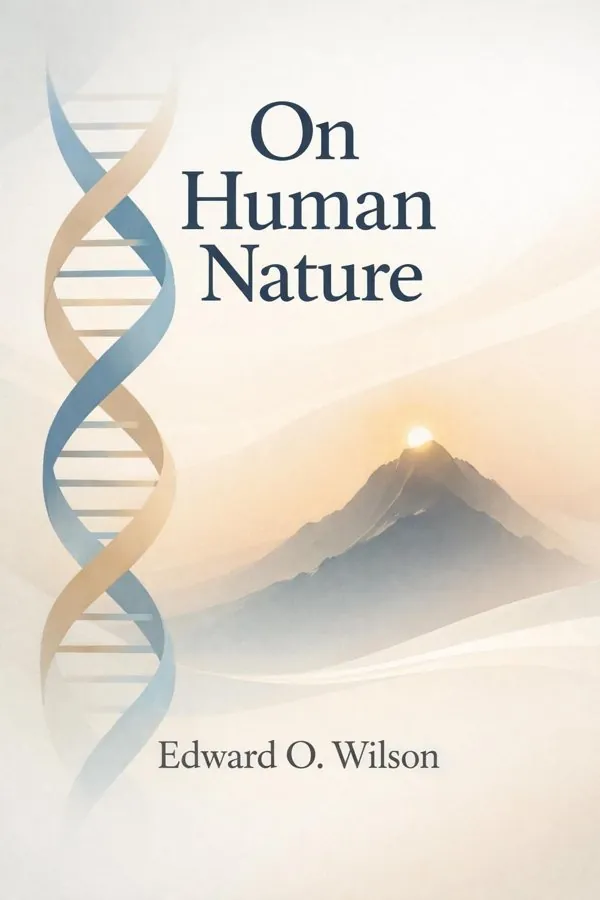
On Human Nature: Summary & Key Insights
 10 min9 chaptersAudio available
Key Takeaways from On Human Nature
A useful way to begin is with a provocative idea: much of what feels most personal is also profoundly ancient.
One of Wilson’s central insights is that culture is not the opposite of biology; it is one of biology’s greatest creations.
At first glance, altruism seems to challenge evolution.
Few topics are more uncomfortable than aggression, yet Wilson treats it as essential to understanding human nature.
This does not mean every individual conforms to a stereotype, nor that culture is powerless.
What Is On Human Nature About?
On Human Nature by Edward O. Wilson is a life_science book spanning 9 pages. In On Human Nature, Edward O. Wilson asks one of the oldest and most difficult questions in intellectual history: what, exactly, are human beings? His answer is bold, controversial, and deeply influential. Drawing on evolutionary biology, genetics, ethology, and anthropology, Wilson argues that many of the traits we treat as purely cultural or philosophical—morality, aggression, sexuality, religion, art, and social order—also have biological foundations shaped by natural selection. Rather than reducing humanity to genes, he tries to show how biology and culture continually interact to produce the richness of human life. The book matters because it challenges the familiar divide between the sciences and the humanities. Wilson insists that understanding human nature requires both empirical evidence and philosophical reflection. First published at a time when sociobiology stirred intense debate, the book remains relevant to contemporary conversations about gender, cooperation, conflict, ethics, and the future of our species. Wilson writes with the authority of one of the twentieth century’s most important biologists, a Harvard professor and Pulitzer Prize winner whose work reshaped how we think about evolution, society, and the living world.
This FizzRead summary covers all 9 key chapters of On Human Nature in approximately 10 minutes, distilling the most important ideas, arguments, and takeaways from Edward O. Wilson's work. Also available as an audio summary and Key Quotes Podcast.
On Human Nature
In On Human Nature, Edward O. Wilson asks one of the oldest and most difficult questions in intellectual history: what, exactly, are human beings? His answer is bold, controversial, and deeply influential. Drawing on evolutionary biology, genetics, ethology, and anthropology, Wilson argues that many of the traits we treat as purely cultural or philosophical—morality, aggression, sexuality, religion, art, and social order—also have biological foundations shaped by natural selection. Rather than reducing humanity to genes, he tries to show how biology and culture continually interact to produce the richness of human life.
The book matters because it challenges the familiar divide between the sciences and the humanities. Wilson insists that understanding human nature requires both empirical evidence and philosophical reflection. First published at a time when sociobiology stirred intense debate, the book remains relevant to contemporary conversations about gender, cooperation, conflict, ethics, and the future of our species. Wilson writes with the authority of one of the twentieth century’s most important biologists, a Harvard professor and Pulitzer Prize winner whose work reshaped how we think about evolution, society, and the living world.
Who Should Read On Human Nature?
This book is perfect for anyone interested in life_science and looking to gain actionable insights in a short read. Whether you're a student, professional, or lifelong learner, the key ideas from On Human Nature by Edward O. Wilson will help you think differently.
- ✓Readers who enjoy life_science and want practical takeaways
- ✓Professionals looking to apply new ideas to their work and life
- ✓Anyone who wants the core insights of On Human Nature in just 10 minutes
Want the full summary?
Get instant access to this book summary and 100K+ more with Fizz Moment.
Get Free SummaryAvailable on App Store • Free to download
Key Chapters
A useful way to begin is with a provocative idea: much of what feels most personal is also profoundly ancient. Wilson argues that human nature is not a blank slate written on entirely by culture. It is the product of evolutionary history, shaped by the same forces that molded every other species. Over countless generations, natural selection favored traits that helped our ancestors survive, reproduce, cooperate with allies, protect kin, compete for resources, and navigate social life. Those tendencies did not disappear when civilization emerged; they became the underlying architecture on which culture was built.
This does not mean genes rigidly determine behavior. Wilson’s point is subtler. Evolution equips human beings with predispositions, emotional biases, perceptual preferences, and social inclinations. We are born with capacities for attachment, rivalry, status-seeking, fear, reciprocity, and symbolic thinking. Different societies express these tendencies in different ways, but the tendencies themselves are not infinitely malleable. That is why certain patterns recur across cultures: family bonds, coalition building, moral judgments, sexual jealousy, and rituals surrounding birth, death, and belonging.
In practice, this perspective changes how we think about social problems. If aggression, favoritism, and competition have deep roots, they cannot be erased by slogans alone. Likewise, if empathy and cooperation are also part of our inheritance, institutions can be designed to strengthen them. Education, law, and culture matter enormously—but they work with human nature, not outside it.
Actionable takeaway: When trying to understand any human behavior, ask two questions at once: what cultural forces shape it, and what evolved predispositions might be making it easier, harder, or more persistent?
One of Wilson’s central insights is that culture is not the opposite of biology; it is one of biology’s greatest creations. Human beings evolved unusually large brains, long childhoods, intense parental investment, and remarkable learning capacity. These features made us a species that survives not only through instinct, but through transmission: teaching, imitation, language, memory, and shared symbols. Culture became an adaptive system because it allowed knowledge to accumulate faster than genes could change.
Wilson rejects the idea that culture floats free from our biological inheritance. Instead, he proposes a relationship of mutual influence. Genes helped create the brain structures and social tendencies that make culture possible, while culture in turn alters which traits are useful, rewarded, or suppressed. The result is a feedback loop. Farming changed diets and settlement patterns; settlement patterns changed disease exposure, social hierarchy, and family organization; those pressures then influenced subsequent development. Human history is therefore neither purely natural nor purely invented.
This helps explain why some cultural forms spread so easily. Storytelling, music, prestige hierarchies, rites of passage, and moral instruction appeal to evolved needs for cohesion, learning, identity, and emotional regulation. Even modern phenomena like social media can be understood through this lens: new technologies succeed when they tap ancient desires for attention, alliance, comparison, and belonging.
For parents, teachers, and leaders, the implication is practical. People do not absorb culture as passive vessels. They are biologically prepared to learn some things more readily than others, especially those tied to status, affiliation, threat, and narrative. Effective institutions recognize these psychological channels rather than ignoring them.
Actionable takeaway: If you want an idea, habit, or value to spread, connect it to basic human motives—belonging, meaning, imitation, reward, and shared identity—rather than relying on abstract arguments alone.
At first glance, altruism seems to challenge evolution. Why would natural selection favor helping others, especially at a cost to oneself? Wilson shows that this apparent paradox dissolves once we recognize that evolution operates in social environments. Helping relatives can preserve shared genes; cooperating with nonrelatives can bring reciprocal benefits; and groups with stronger internal coordination may outcompete less cohesive rivals. In this view, altruism is not a miraculous exception to nature, but one of its recurring strategies.
Wilson is careful not to romanticize human goodness. Altruism rarely appears in pure form. It is often selective, directed toward kin, friends, allies, or members of one’s own group. The same species that sacrifices for insiders may ignore or exploit outsiders. This duality is central to his account of human social life. Compassion and tribalism can arise from overlapping evolutionary pressures. We are equipped both to care deeply and to draw boundaries around who deserves that care.
This framework helps explain everyday behavior. People volunteer in communities, donate after disasters, protect family members, and feel guilty when they violate social expectations. At the same time, they may be indifferent to distant strangers or suspicious of competing groups. In workplaces, cooperative teams thrive when trust and reciprocity are reinforced. In public policy, systems that encourage repeated interaction, fairness, and reputation often generate more prosocial behavior than systems built on idealistic assumptions about universal benevolence.
The practical lesson is not cynical. It is realistic. To promote altruism, societies must create conditions in which helping is visible, reciprocated, admired, and woven into identity. Moral appeals work best when aligned with evolved social incentives.
Actionable takeaway: Strengthen altruism by building small, trustworthy circles of cooperation—family, team, neighborhood, or civic group—where people repeatedly experience the rewards of helping and being helped.
Few topics are more uncomfortable than aggression, yet Wilson treats it as essential to understanding human nature. His argument is not that violence is inevitable in every setting, but that tendencies toward aggression, dominance, territoriality, and competition have evolutionary histories. In ancestral environments, defending resources, deterring rivals, and competing for mates could affect survival and reproductive success. As a result, humans inherited emotional systems that can generate anger, retaliation, and status conflict under certain conditions.
But Wilson does not claim that biology excuses cruelty. A predisposition is not a command. Human beings also evolved capacities for restraint, alliance-building, foresight, and moral judgment. Whether aggression is triggered or controlled depends heavily on social structure, opportunity, norms, and institutions. Scarcity, humiliation, insecurity, and anonymity can inflame conflict. Stable rules, legitimate authority, fairness, and meaningful status alternatives can reduce it.
This makes Wilson’s analysis highly relevant today. Road rage, online hostility, factional politics, school bullying, and geopolitical rivalry all show how quickly status threat and group competition can activate aggressive patterns. Yet well-designed environments can redirect the same energies into sport, debate, entrepreneurship, scientific competition, or disciplined public service. The goal is not to imagine a humanity without competitive impulses, but to civilize those impulses.
Parents can teach conflict resolution early. Managers can reduce status anxiety by clarifying roles and rewards. Governments can lower violence by strengthening trust in institutions and reducing zero-sum conditions. Wilson’s realism invites prevention rather than denial.
Actionable takeaway: When conflict escalates, look beyond personalities and identify the underlying triggers—status threat, resource scarcity, humiliation, or group rivalry—then redesign the environment to reduce those pressures.
Wilson approaches sexual behavior and gender roles through evolutionary logic, arguing that mating strategies and family structures have been shaped in part by the different reproductive pressures faced by males and females over human history. Because reproduction carries unequal biological costs, he suggests, natural selection helped generate recurring patterns in attraction, jealousy, mate choice, parental investment, and competition. This does not mean every individual conforms to a stereotype, nor that culture is powerless. It means that some cross-cultural regularities may reflect deep adaptive problems our ancestors repeatedly faced.
His treatment is controversial because discussions of sex and gender easily slide into oversimplification. Yet Wilson’s broader point is that understanding biological predispositions can clarify why some social tensions are so persistent. For example, concerns about fidelity, pair bonding, mate value, child rearing, and social expectations around attractiveness often provoke powerful emotions because they touch ancient reproductive interests. Culture can transform these patterns dramatically, but it rarely does so from nothing.
In modern life, the mismatch between evolved tendencies and contemporary conditions is especially visible. Contraception, digital dating, delayed marriage, dual-career households, and changing gender norms create environments unlike those in which human psychology evolved. This can produce confusion as well as freedom. People inherit impulses shaped by one world while trying to build relationships in another.
The value of Wilson’s perspective lies in humility. It reminds us that intimate life is influenced by both biology and social design. Good relationships depend not on denying either side, but on understanding both.
Actionable takeaway: In conversations about sex, partnership, and family, separate description from prescription—recognize possible biological influences without turning them into rigid rules for how people must live.
Wilson examines religion not as a theologian defending doctrine, but as a scientist asking why religious belief is so widespread and enduring. His answer is that religion serves powerful social and psychological functions rooted in human nature. It binds communities, offers meaning in the face of suffering and death, sanctifies moral codes, and gives symbolic expression to fear, hope, awe, and belonging. In evolutionary terms, systems that intensified group cohesion and common purpose may have provided significant advantages.
This does not mean religion is merely illusion or manipulation. Wilson’s approach is explanatory rather than dismissive. He sees myth, ritual, sacred story, and transcendence as responses to real human needs. We are a symbolic species that seeks patterns, agency, and ultimate significance. Religion channels these tendencies into organized forms that can sustain identity across generations.
At the same time, the same mechanisms that produce solidarity can also produce exclusion. Sacred boundaries often strengthen in-group loyalty while sharpening conflict with outsiders. Religious systems can inspire compassion and sacrifice, but also dogmatism and intolerance. Wilson’s point is that both outcomes become more understandable once religion is seen as part of human social evolution rather than as an isolated cultural accident.
In modern secular societies, many people still seek substitutes for religion in nationalism, ideology, lifestyle movements, or moralized communities. The appetite for meaning does not disappear when doctrine fades. It simply takes new forms.
Actionable takeaway: Whether religious or not, pay attention to the human needs religion often serves—meaning, ritual, community, moral belonging, and transcendence—and seek healthy ways to meet those needs in your own life and institutions.
Why do human beings make music, paint images, tell stories, dance, decorate spaces, and seek beauty even when these activities seem unnecessary for survival? Wilson’s answer is that the arts and aesthetics are not ornamental luxuries floating above nature. They likely emerge from capacities that evolution strongly favored: pattern recognition, emotional communication, play, sexual display, environmental preference, and the ability to imagine possibilities beyond immediate experience.
Human beings are exquisitely responsive to rhythm, symmetry, contrast, narrative tension, and symbolic meaning. These sensitivities may have once helped our ancestors navigate landscapes, read social cues, attract mates, strengthen group identity, and transmit knowledge. Art takes those adaptive capacities and recombines them into expressive forms. A song can coordinate emotion across a group. A story can simulate danger without real risk. A painting can capture attention through visual features our brains are already prepared to notice.
This view elevates rather than diminishes art. It suggests that aesthetic experience is deeply human because it grows from the architecture of mind itself. We are not cultural machines reluctantly adding beauty on top of necessity; we are creatures for whom beauty, pattern, and meaning are integral to perception and social life.
In everyday terms, Wilson’s perspective helps explain why creative expression improves education, therapy, leadership, and community building. Art reaches layers of cognition that argument alone often cannot. It organizes emotion, memory, and shared experience.
Actionable takeaway: Treat artistic activity as a fundamental human need rather than an optional extra—make room for music, storytelling, design, or visual creation in your work, learning, and relationships.
A common mistake is to imagine that evolution ended once humans built cities, invented law, and developed technology. Wilson rejects that assumption. Human evolution continues, but under altered conditions. Medicine, agriculture, migration, communication networks, and global institutions change which traits are advantageous, which risks are reduced, and which behaviors become socially rewarded. Meanwhile, cultural evolution now moves at extraordinary speed, often outpacing genetic change and creating new mismatches between inherited dispositions and modern environments.
This mismatch is one of Wilson’s most important insights. Our brains were shaped in small groups with immediate feedback, limited anonymity, and direct contact with nature. Today we navigate mass societies, algorithmic attention systems, processed abundance, abstract institutions, and global moral obligations. Ancient appetites for sugar, status, novelty, and group identity can become maladaptive when amplified by modern technologies and markets.
Wilson’s perspective encourages a long-term view of civilization. The future of humanity will not be determined by biology alone or by culture alone, but by their interaction. Genetic engineering, reproductive technology, artificial intelligence, environmental crisis, and social fragmentation all raise questions about what kind of beings we are becoming. To answer them responsibly, we need a realistic account of the inherited mind.
For individuals and societies, this means designing environments that fit human needs better: communities that reduce loneliness, systems that protect attention, cities with green space, and institutions that channel competition into constructive ends. Progress depends on understanding the organism progress is trying to improve.
Actionable takeaway: Audit your daily environment for evolutionary mismatch—sleep, food, movement, attention, community, and nature exposure—and redesign it to support the kind of mind and body humans were built to sustain.
All Chapters in On Human Nature
About the Author
Edward Osborne Wilson (1929–2021) was an American biologist, naturalist, and writer whose work transformed modern thinking about evolution, social behavior, and biodiversity. A longtime professor at Harvard University, he became especially renowned for his research on ants, helping to establish myrmecology as a major field. Wilson also pioneered sociobiology, arguing that social behavior in animals and humans can be studied through evolutionary principles. His ideas sparked major debate but also reshaped discussions across biology, psychology, anthropology, and philosophy. In addition to his scientific research, Wilson was a gifted public intellectual and conservation advocate who wrote widely for general readers. He received two Pulitzer Prizes and remained one of the most influential voices in science, especially on the interconnectedness of life and the urgent need to protect Earth’s biodiversity.
Get This Summary in Your Preferred Format
Read or listen to the On Human Nature summary by Edward O. Wilson anytime, anywhere. FizzRead offers multiple formats so you can learn on your terms — all free.
Available formats: App · Audio · PDF · EPUB — All included free with FizzRead
Download On Human Nature PDF and EPUB Summary
Key Quotes from On Human Nature
“A useful way to begin is with a provocative idea: much of what feels most personal is also profoundly ancient.”
“One of Wilson’s central insights is that culture is not the opposite of biology; it is one of biology’s greatest creations.”
“At first glance, altruism seems to challenge evolution.”
“Few topics are more uncomfortable than aggression, yet Wilson treats it as essential to understanding human nature.”
“Because reproduction carries unequal biological costs, he suggests, natural selection helped generate recurring patterns in attraction, jealousy, mate choice, parental investment, and competition.”
Frequently Asked Questions about On Human Nature
On Human Nature by Edward O. Wilson is a life_science book that explores key ideas across 9 chapters. In On Human Nature, Edward O. Wilson asks one of the oldest and most difficult questions in intellectual history: what, exactly, are human beings? His answer is bold, controversial, and deeply influential. Drawing on evolutionary biology, genetics, ethology, and anthropology, Wilson argues that many of the traits we treat as purely cultural or philosophical—morality, aggression, sexuality, religion, art, and social order—also have biological foundations shaped by natural selection. Rather than reducing humanity to genes, he tries to show how biology and culture continually interact to produce the richness of human life. The book matters because it challenges the familiar divide between the sciences and the humanities. Wilson insists that understanding human nature requires both empirical evidence and philosophical reflection. First published at a time when sociobiology stirred intense debate, the book remains relevant to contemporary conversations about gender, cooperation, conflict, ethics, and the future of our species. Wilson writes with the authority of one of the twentieth century’s most important biologists, a Harvard professor and Pulitzer Prize winner whose work reshaped how we think about evolution, society, and the living world.
More by Edward O. Wilson
You Might Also Like
The Selfish Gene
Richard Dawkins
10 min
Awakenings
Oliver Sacks
10 min
Parasite Rex: Inside the Bizarre World of Nature's Most Dangerous Creatures
Carl Zimmer
10 min
The Atlas of Life on Earth
Various
10 min
The Book of Humans: The Story of How We Became Us
Adam Rutherford
10 min
The Horse
Wendy Williams
10 minBrowse by Category
Ready to read On Human Nature?
Get the full summary and 100K+ more books with Fizz Moment.