
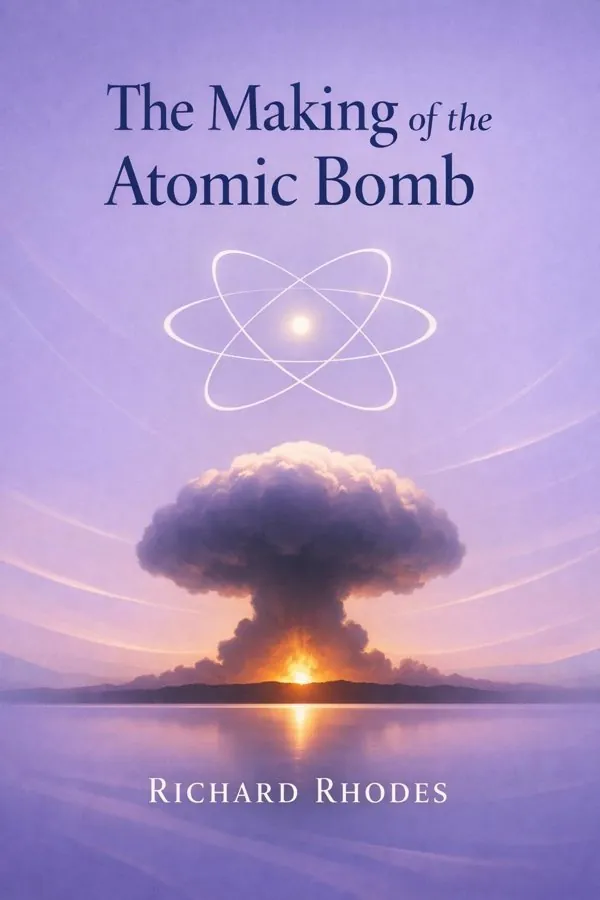
The Making of the Atomic Bomb: Summary & Key Insights
 10 min9 chaptersAudio available
Key Takeaways from The Making of the Atomic Bomb
World-changing technologies often begin as abstract questions that seem to have no practical use.
History can turn when a laboratory result collides with a political catastrophe.
Governments rarely act on distant threats until someone translates possibility into urgency.
Brilliance without organization rarely changes history at scale.
Some leaders succeed not by knowing everything, but by creating a place where exceptional people can think together at full intensity.
What Is The Making of the Atomic Bomb About?
The Making of the Atomic Bomb by Richard Rhodes is a world_history book spanning 6 pages. The Making of the Atomic Bomb is far more than a history of a weapon. Richard Rhodes tells the story of how modern physics, global war, political fear, and individual ambition converged to create a force that permanently changed human civilization. Beginning with the intellectual revolutions of nineteenth- and early twentieth-century science and ending with Hiroshima, Nagasaki, and the dawn of the nuclear age, the book traces the chain of discoveries and decisions that made the bomb possible. Along the way, it introduces an unforgettable cast of figures: Marie Curie, Ernest Rutherford, Leo Szilard, Niels Bohr, Enrico Fermi, J. Robert Oppenheimer, General Leslie Groves, and many others whose brilliance and anxieties shaped history. What makes this book endure is its ability to connect scientific explanation with human drama and moral consequence. Rhodes writes with the authority of a meticulous historian and the narrative power of a great storyteller. The result is a deeply researched, Pulitzer Prize-winning account that helps readers understand not only how the atomic bomb was built, but why its creation remains one of the defining events of the modern world.
This FizzRead summary covers all 9 key chapters of The Making of the Atomic Bomb in approximately 10 minutes, distilling the most important ideas, arguments, and takeaways from Richard Rhodes's work. Also available as an audio summary and Key Quotes Podcast.
The Making of the Atomic Bomb
The Making of the Atomic Bomb is far more than a history of a weapon. Richard Rhodes tells the story of how modern physics, global war, political fear, and individual ambition converged to create a force that permanently changed human civilization. Beginning with the intellectual revolutions of nineteenth- and early twentieth-century science and ending with Hiroshima, Nagasaki, and the dawn of the nuclear age, the book traces the chain of discoveries and decisions that made the bomb possible. Along the way, it introduces an unforgettable cast of figures: Marie Curie, Ernest Rutherford, Leo Szilard, Niels Bohr, Enrico Fermi, J. Robert Oppenheimer, General Leslie Groves, and many others whose brilliance and anxieties shaped history. What makes this book endure is its ability to connect scientific explanation with human drama and moral consequence. Rhodes writes with the authority of a meticulous historian and the narrative power of a great storyteller. The result is a deeply researched, Pulitzer Prize-winning account that helps readers understand not only how the atomic bomb was built, but why its creation remains one of the defining events of the modern world.
Who Should Read The Making of the Atomic Bomb?
This book is perfect for anyone interested in world_history and looking to gain actionable insights in a short read. Whether you're a student, professional, or lifelong learner, the key ideas from The Making of the Atomic Bomb by Richard Rhodes will help you think differently.
- ✓Readers who enjoy world_history and want practical takeaways
- ✓Professionals looking to apply new ideas to their work and life
- ✓Anyone who wants the core insights of The Making of the Atomic Bomb in just 10 minutes
Want the full summary?
Get instant access to this book summary and 100K+ more with Fizz Moment.
Get Free SummaryAvailable on App Store • Free to download
Key Chapters
World-changing technologies often begin as abstract questions that seem to have no practical use. Rhodes shows that the atomic bomb emerged from decades of pure scientific curiosity, not from an original plan to build a superweapon. Late nineteenth- and early twentieth-century physicists were trying to understand the structure of matter itself. Researchers such as J. J. Thomson, Ernest Rutherford, Max Planck, Albert Einstein, and Marie Curie transformed the atom from a philosophical idea into a measurable physical reality. Their experiments revealed electrons, radioactivity, atomic nuclei, and the strange relationship between mass and energy.
This foundation mattered because the bomb was not an engineering miracle built from nothing; it was the final consequence of a long chain of discoveries. Once scientists learned that atoms were not indivisible and that tiny amounts of mass could convert into enormous quantities of energy, the basic intellectual framework for nuclear weapons already existed. Yet at the time, most of this work belonged to academic laboratories, lecture halls, and scientific journals. It was driven by wonder, rivalry, and the desire to understand nature.
Rhodes emphasizes that scientific knowledge does not carry moral instructions with it. The same research culture that produced medical imaging and nuclear power also made atomic warfare imaginable. That tension remains relevant today in fields like artificial intelligence, biotechnology, and quantum computing. Breakthroughs developed for curiosity or public benefit can quickly become tools of power when political conditions change.
A practical lesson follows: when evaluating new technologies, do not focus only on immediate uses. Ask what basic principles are being uncovered, who might eventually control them, and what safeguards should accompany them. The actionable takeaway is simple: cultivate scientific literacy early, because the most consequential ethical debates often begin long before society recognizes a discovery’s full power.
History can turn when a laboratory result collides with a political catastrophe. By the late 1930s, physics was advancing rapidly, but Europe was also descending into fascism and war. In Berlin, Otto Hahn and Fritz Strassmann observed baffling experimental results while bombarding uranium. Lise Meitner, an Austrian Jewish physicist who had fled Nazi persecution, and her nephew Otto Frisch correctly interpreted the findings: the uranium nucleus had split. Nuclear fission was real, and it released extraordinary energy.
That discovery transformed theoretical possibility into practical urgency. If one fission event could trigger others in a chain reaction, then a bomb of unprecedented power might be feasible. Rhodes carefully links the scientific breakthrough to the human and political context surrounding it. Many of the scientists best able to understand fission were refugees from authoritarian Europe. Their exile was not incidental; it shaped the entire course of nuclear history. Men and women driven from Germany, Austria, Hungary, and Italy carried knowledge into Britain and the United States, where they also carried fear that Hitler might build the bomb first.
This chapter of the story demonstrates how talent migrates under pressure and how political systems can either destroy or concentrate intellectual power. Nazi anti-Semitism crippled Germany’s scientific capacity even as it threatened the world. Democracies, by contrast, became havens for displaced genius and benefitted strategically from that openness.
The modern application is clear in debates over immigration, academic freedom, and support for scientists at risk. Societies that protect inquiry and welcome talent gain more than moral credibility; they gain resilience and innovation. The actionable takeaway is to recognize that protecting free minds is not a luxury. It is a strategic necessity, especially in eras when science and security are tightly linked.
Governments rarely act on distant threats until someone translates possibility into urgency. That is exactly what happened with the famous Einstein-Szilard letter. Leo Szilard, already alarmed by the implications of fission and the danger of Nazi Germany, persuaded Albert Einstein to sign a letter to President Franklin D. Roosevelt in 1939. The letter warned that uranium research could lead to extraordinarily powerful bombs and urged the United States to pay attention.
Rhodes uses this episode to show that major public action often begins with a small act of advocacy. The letter did not instantly launch the Manhattan Project, but it initiated a chain of bureaucratic responses that gradually grew as the war intensified. Committees formed, studies were commissioned, and scientific uncertainty slowly gave way to strategic commitment. Once evidence mounted that a bomb might be possible, the U.S. government committed enormous industrial, financial, and military resources to the effort.
The Manhattan Project was remarkable not only for its scientific ambition but for its scale of coordination. Universities, private industry, Army engineers, and top physicists worked together under extreme secrecy. Massive plants at Oak Ridge and Hanford were built to enrich uranium and produce plutonium. What had begun as theoretical concern became one of the largest and most expensive research-and-development enterprises in history.
The broader insight is that complex problems require institutions capable of translating expert warning into organized action. Climate science, pandemic planning, and cybersecurity all present similar challenges today. Expert knowledge alone is not enough; it must be communicated persuasively, politically processed, and operationally implemented.
The actionable takeaway: if you want serious action on a complex risk, learn to bridge worlds. Scientific truth matters, but so do timing, communication, coalition-building, and institutional follow-through.
Brilliance without organization rarely changes history at scale. One of Rhodes’s most important contributions is showing that the atomic bomb was not made by scientists alone. It also required extraordinary management, logistics, and command. General Leslie Groves, who had previously overseen large military construction projects, became the hard-driving administrator of the Manhattan Project. He was not a physicist, but he understood deadlines, secrecy, procurement, and authority.
Groves selected sites, secured materials, imposed compartmentalization, and kept the sprawling operation moving despite technical uncertainty. He also chose J. Robert Oppenheimer to lead Los Alamos, a decision that proved pivotal. Groves’s strengths were not subtle: he was demanding, controlling, and relentless. But Rhodes makes clear that such traits were part of what turned an improbable scientific undertaking into a working wartime system.
This aspect of the story is a reminder that innovation depends on more than ideas. It requires funding structures, clear decision rights, disciplined execution, and leaders able to manage conflicting personalities under pressure. Oak Ridge, Hanford, and Los Alamos were not just research sites; they were components of a national machine designed to solve a problem before the enemy could.
Modern readers can see parallels in vaccine development, space programs, and large-scale clean energy projects. Visionary experts need operators who can build organizations, allocate resources, and absorb uncertainty without paralysis. Too often, management is treated as secondary to invention, when in reality it is what converts invention into impact.
The actionable takeaway is to assess ambitious projects from both sides: who has the insight, and who has the operational capacity to make that insight real? If either side is missing, the breakthrough may never leave the drawing board.
Some leaders succeed not by knowing everything, but by creating a place where exceptional people can think together at full intensity. Los Alamos, the secret laboratory in New Mexico, became the intellectual and emotional center of bomb design, and J. Robert Oppenheimer became its unlikely leader. Rhodes portrays him as brilliant, cultured, politically complicated, and astonishingly effective at synthesizing ideas across disciplines. He lacked a Nobel Prize and had never run a large laboratory, yet he united rival scientists around a common purpose.
At Los Alamos, theorists, experimentalists, chemists, metallurgists, explosives experts, and military personnel worked side by side under pressure that was scientific, political, and existential. The technical challenges were immense. Building a uranium gun-type bomb seemed difficult but manageable. Designing an implosion bomb for plutonium required entirely new methods of precision detonation and sophisticated calculations. Failure was a real possibility.
What made Los Alamos distinctive was its culture: intense collaboration under secrecy, intellectual freedom within mission constraints, and a constant awareness that the war might be decided before the work was finished. Oppenheimer excelled at translating among specialists and inspiring confidence, even when the science was uncertain. Rhodes uses him to illustrate a larger point: highly complex work often depends on leaders who can integrate rather than dominate.
The practical application reaches well beyond military history. In any interdisciplinary effort, the most valuable person may be the one who builds shared language, maintains urgency, and keeps talent aligned. Innovation teams in medicine, software, and public policy face similar coordination problems, even if the stakes differ.
The actionable takeaway is to develop integrative leadership. If you are leading experts, your job is not to outshine them individually; it is to create the conditions in which their combined intelligence produces something none could achieve alone.
There are moments when humanity sees proof of its own transformed power, and nothing afterward is quite the same. The Trinity test in July 1945 was such a moment. In the New Mexico desert, the Manhattan Project detonated the first atomic device, confirming that the implosion design worked and revealing a level of destructive energy few had truly grasped in emotional terms. For the scientists and military leaders present, the explosion was both triumph and omen.
Rhodes treats Trinity as more than a technical success. It was the culmination of years of theory, labor, secrecy, and sacrifice. It also changed the political and moral meaning of the weapon. Before Trinity, the bomb was still a possibility. After Trinity, it was an instrument ready for use. The existence of a demonstrated atomic bomb altered wartime calculations, diplomatic leverage, and postwar expectations almost instantly.
The test also raises an enduring issue: demonstration can itself become a form of policy. Once leaders possess a dramatic new capability, pressure grows to use or display it in ways that shape negotiations and perceptions. The debate over whether a demonstration blast might have warned Japan without attacking a city reflects this tension, though history moved too quickly and decision-makers too narrowly for that option to prevail.
Today, similar dynamics appear in cyber operations, missile tests, and emerging weapons systems. The mere proof that a technology works can alter strategy before it is widely deployed. That means demonstration is never purely technical; it is also communicative and political.
The actionable takeaway is to ask not only whether a powerful technology can be demonstrated, but what message the demonstration sends, what options it closes off, and how it reshapes decision-making for everyone involved.
Technical achievement can conceal human reality unless someone insists on looking directly at the victims. Rhodes does not allow readers to think of Hiroshima and Nagasaki as abstract strategic events alone. He recounts the bombings as historical decisions with devastating human consequences: cities obliterated, civilians burned and crushed, survivors poisoned by radiation, and the meaning of war permanently altered.
The U.S. leadership justified the attacks as a means to end the war quickly and avoid the massive casualties expected from an invasion of Japan. Rhodes does not reduce this argument to a slogan. Instead, he places it in context: firebombed cities, fanatical wartime resistance, racial hatred, bureaucratic momentum, the desire to shock Japan into surrender, and the emerging awareness of Soviet power. Yet even when strategic reasoning is explained, the moral burden remains. The bomb introduced a scale and speed of destruction that challenged inherited ideas of proportionality, military necessity, and civilian immunity.
This is one of the book’s most lasting strengths. It refuses easy conclusions. Some participants felt pride, some horror, some relief, and some enduring ambivalence. Knowledge had crossed into irreversible use. Once nuclear weapons destroyed cities, humanity had to live with a new category of risk.
For modern readers, the lesson is not confined to nuclear war. Any system capable of affecting millions, from autonomous weapons to engineered pathogens, requires ethical scrutiny that includes human outcomes, not just strategic logic. Metrics of efficiency can hide suffering.
The actionable takeaway is to discipline your thinking whenever power is discussed in abstract terms. Ask who bears the cost, whose voices are missing, and whether strategic language is masking irreversible human damage.
Creating something does not end responsibility for it; in many ways, it begins it. After the bombings, many scientists faced a painful shift from technical problem-solving to ethical reflection. During the war, urgency, secrecy, and fear of Nazi success had helped justify their work. After Germany’s defeat and Japan’s destruction, the moral landscape changed. Rhodes traces how physicists like Szilard, Bohr, Oppenheimer, and others struggled with the implications of what they had helped unleash.
Some argued for international control of atomic energy. Others warned against an arms race. Some believed the bomb had been necessary but feared what would follow if nuclear weapons spread. Their reactions differed, yet all confronted a shared reality: scientific work could no longer be treated as separate from political consequence. The old image of the detached researcher had become untenable.
This tension remains highly relevant. Researchers in artificial intelligence, genetics, surveillance technology, and advanced robotics confront similar questions. Is it enough to say, “If we do not build it, someone else will”? At what point should experts resist, speak publicly, or demand governance structures? Rhodes suggests that moral responsibility belongs not only to political leaders but also to those who understand a technology best.
Practical applications include ethics review boards, public engagement, whistleblower protections, and interdisciplinary education that joins technical training with history and philosophy. Expertise should expand foresight, not narrow it.
The actionable takeaway is to reject the comfort of neutrality in high-impact work. If you help build powerful systems, make ethical reflection part of the job from the beginning, and speak up before decisions harden into irreversible outcomes.
The atomic bomb did not end with World War II; it inaugurated a new era in which human beings could destroy civilization through their own inventions. Rhodes closes the story by showing that the bomb’s creation immediately transformed global politics. Wartime alliance gave way to suspicion. The Soviet Union accelerated its own nuclear program. Questions of secrecy, deterrence, proliferation, and arms control became permanent features of international life.
What began as a race to defeat Nazi Germany evolved into a condition of ongoing nuclear uncertainty. The existence of atomic weapons changed diplomacy, military planning, national budgets, and public consciousness. It also changed the psychology of modern history. For the first time, humanity possessed tools capable of self-annihilation on a vast scale. The bomb became not just a weapon, but a political fact shaping every major power relationship.
Rhodes’s larger argument is that technological revolutions do not stay confined to the circumstances of their birth. They restructure institutions and expectations for generations. That is why The Making of the Atomic Bomb remains so relevant. It is a case study in how discovery becomes system, system becomes doctrine, and doctrine becomes a condition of everyday life.
The practical implication is to think historically about emerging technologies before they harden into permanent structures. Whether the subject is AI, biosecurity, or climate engineering, the early governance choices matter enormously because they can define the architecture of the future.
The actionable takeaway is to treat transformative technologies as civilization-level issues, not niche technical topics. Stay informed, support serious public oversight, and assume that what begins as an emergency solution may shape the world far longer than anyone expects.
All Chapters in The Making of the Atomic Bomb
About the Author
Richard Rhodes is an American historian, journalist, and acclaimed nonfiction author known for exploring the intersection of science, technology, politics, and human consequence. Born in 1937, he built a reputation for combining rigorous research with vivid narrative storytelling, making complex subjects accessible to general readers without sacrificing depth. He won the Pulitzer Prize for General Nonfiction for The Making of the Atomic Bomb, widely considered one of the definitive works on nuclear history. Rhodes has also written extensively on energy, war, genocide, and social violence, often focusing on how ideas and institutions shape the modern world. His work is marked by intellectual clarity, moral seriousness, and a talent for turning large historical processes into compelling human stories.
Get This Summary in Your Preferred Format
Read or listen to the The Making of the Atomic Bomb summary by Richard Rhodes anytime, anywhere. FizzRead offers multiple formats so you can learn on your terms — all free.
Available formats: App · Audio · PDF · EPUB — All included free with FizzRead
Download The Making of the Atomic Bomb PDF and EPUB Summary
Key Quotes from The Making of the Atomic Bomb
“World-changing technologies often begin as abstract questions that seem to have no practical use.”
“History can turn when a laboratory result collides with a political catastrophe.”
“Governments rarely act on distant threats until someone translates possibility into urgency.”
“Brilliance without organization rarely changes history at scale.”
“Some leaders succeed not by knowing everything, but by creating a place where exceptional people can think together at full intensity.”
Frequently Asked Questions about The Making of the Atomic Bomb
The Making of the Atomic Bomb by Richard Rhodes is a world_history book that explores key ideas across 9 chapters. The Making of the Atomic Bomb is far more than a history of a weapon. Richard Rhodes tells the story of how modern physics, global war, political fear, and individual ambition converged to create a force that permanently changed human civilization. Beginning with the intellectual revolutions of nineteenth- and early twentieth-century science and ending with Hiroshima, Nagasaki, and the dawn of the nuclear age, the book traces the chain of discoveries and decisions that made the bomb possible. Along the way, it introduces an unforgettable cast of figures: Marie Curie, Ernest Rutherford, Leo Szilard, Niels Bohr, Enrico Fermi, J. Robert Oppenheimer, General Leslie Groves, and many others whose brilliance and anxieties shaped history. What makes this book endure is its ability to connect scientific explanation with human drama and moral consequence. Rhodes writes with the authority of a meticulous historian and the narrative power of a great storyteller. The result is a deeply researched, Pulitzer Prize-winning account that helps readers understand not only how the atomic bomb was built, but why its creation remains one of the defining events of the modern world.
More by Richard Rhodes
You Might Also Like
The Age of Capital
Eric Hobsbawm
10 min
The Gulag Archipelago
Aleksandr Solzhenitsyn
10 min
Jerusalem: The Biography
Simon Sebag Montefiore
10 min
The Anglo-Saxons
James Campbell
10 min
The Boer War
Thomas Pakenham
10 min
The Industrial Revolutionaries: The Making of the Modern World 1776–1914
Gavin Weightman
10 minBrowse by Category
Ready to read The Making of the Atomic Bomb?
Get the full summary and 100K+ more books with Fizz Moment.