
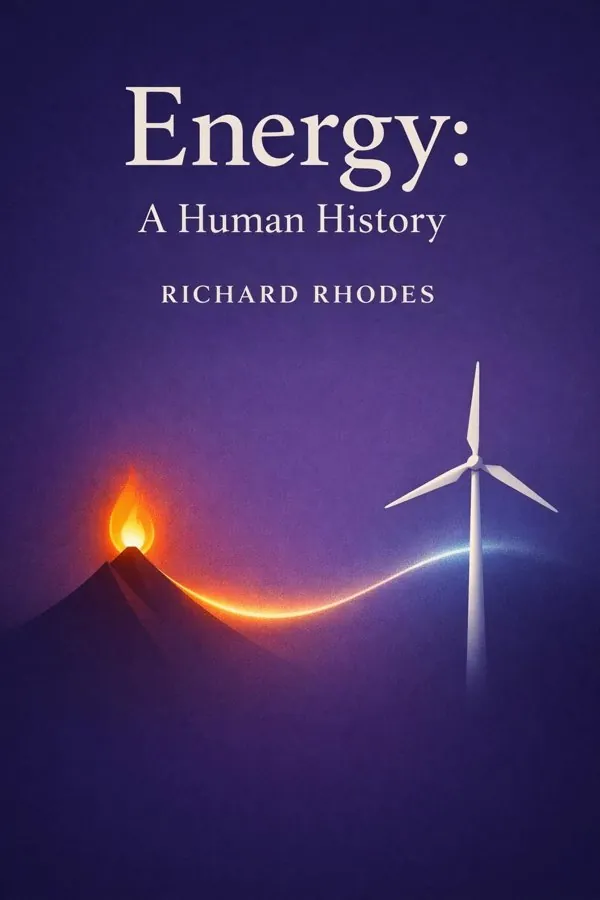
Energy: A Human History: Summary & Key Insights
 10 min10 chaptersAudio available
What Is Energy: A Human History About?
Energy: A Human History by Richard Rhodes is a popular_sci book spanning 10 pages. In this sweeping narrative, Pulitzer Prize–winning author Richard Rhodes explores the history of humankind’s quest for energy—from wood and coal to oil, nuclear power, and renewables. The book traces how energy innovations have shaped civilization, industry, and the environment, offering a compelling look at the technological and social transformations that have powered human progress.
This FizzRead summary covers all 10 key chapters of Energy: A Human History in approximately 10 minutes, distilling the most important ideas, arguments, and takeaways from Richard Rhodes's work. Also available as an audio summary and Key Quotes Podcast.
Energy: A Human History
In this sweeping narrative, Pulitzer Prize–winning author Richard Rhodes explores the history of humankind’s quest for energy—from wood and coal to oil, nuclear power, and renewables. The book traces how energy innovations have shaped civilization, industry, and the environment, offering a compelling look at the technological and social transformations that have powered human progress.
Who Should Read Energy: A Human History?
This book is perfect for anyone interested in popular_sci and looking to gain actionable insights in a short read. Whether you're a student, professional, or lifelong learner, the key ideas from Energy: A Human History by Richard Rhodes will help you think differently.
- ✓Readers who enjoy popular_sci and want practical takeaways
- ✓Professionals looking to apply new ideas to their work and life
- ✓Anyone who wants the core insights of Energy: A Human History in just 10 minutes
Want the full summary?
Get instant access to this book summary and 100K+ more with Fizz Moment.
Get Free SummaryAvailable on App Store • Free to download
Key Chapters
Everything begins with fire. The mastery of fire was the first true human revolution—our initial technological leap and our earliest encounter with energy management. Fire made us more than animals; it made us engineers.
In *Energy: A Human History*, I return to that primal moment, when our ancestors discovered that flame could be coaxed, controlled, and used to transform matter itself. Cooking food improved nutrition and efficiency, freeing time and energy for thought and creativity. Fire hardened clay, smelted copper and iron, and birthed metallurgy, the craft that underpinned every early civilization. Yet, fire also introduced vulnerability—the depletion of forests, the rise of smoke and ash, and dependence on stored fuels. Energy, from the very start, was both liberation and limitation.
Fire seeded our species’ fascination with transformation. Once humans learned that energy could turn ore into metal, heat into light, or raw into cooked, we began seeking ever more powerful ways to rearrange nature. But each new use demanded new control. In that tension—between mastery and risk—lies the story of energy itself.
Before coal darkened the skies of the Industrial Revolution, humanity turned rivers and air currents into mechanical partners. The age of water and wind spanned many centuries, and its devices—mills, wheels, and sails—were essential bridges from muscle power to mechanical labor.
I write of millwrights and tinkerers who learned to channel flowing streams into motion, grinding grain and sawing wood with astonishing precision. Waterwheels transformed local economies, allowing villages to feed cities and artisans to expand their reach. Similarly, wind became an agent of exploration, propelling ships across oceans. The sailor’s mastery of energy in motion opened the world to trade, conquest, and exchange.
This period demonstrated that energy could be drawn directly from nature’s continuous flows, not merely from burning or depletion. It was renewable in a proto-modern sense—a delicate partnership with the environment that depended on geography and weather. Yet its limits spurred the next leap. When water ran low or winds failed, humanity began to dream of a power that could be summoned on demand, indifferent to season or sky. That dream would find its answer underground, in dark seams of coal.
+ 8 more chapters — available in the FizzRead app
All Chapters in Energy: A Human History
About the Author
Richard Rhodes is an American historian, journalist, and author best known for his works on science, history, and human achievement. He won the Pulitzer Prize for 'The Making of the Atomic Bomb' and has written extensively on energy, nuclear power, and innovation.
Get This Summary in Your Preferred Format
Read or listen to the Energy: A Human History summary by Richard Rhodes anytime, anywhere. FizzRead offers multiple formats so you can learn on your terms — all free.
Available formats: App · Audio · PDF · EPUB — All included free with FizzRead
Download Energy: A Human History PDF and EPUB Summary
Key Quotes from Energy: A Human History
“The mastery of fire was the first true human revolution—our initial technological leap and our earliest encounter with energy management.”
“Before coal darkened the skies of the Industrial Revolution, humanity turned rivers and air currents into mechanical partners.”
Frequently Asked Questions about Energy: A Human History
Energy: A Human History by Richard Rhodes is a popular_sci book that explores key ideas across 10 chapters. In this sweeping narrative, Pulitzer Prize–winning author Richard Rhodes explores the history of humankind’s quest for energy—from wood and coal to oil, nuclear power, and renewables. The book traces how energy innovations have shaped civilization, industry, and the environment, offering a compelling look at the technological and social transformations that have powered human progress.
More by Richard Rhodes
You Might Also Like

Structures: Or Why Things Don"t Fall Down
J.E. Gordon
10 min
The Road to Wigan Pier
George Orwell
10 min
Bonk: The Curious Coupling of Science and Sex
Mary Roach
10 min
First Bite: How We Learn to Eat
Bee Wilson
10 min
In Pursuit Of The Unknown: 17 Equations That Changed The World
Ian Stewart
10 min
Napoleon's Buttons: 17 Molecules That Changed History
Penny Le Couteur and Jay Burreson
10 minBrowse by Category
Ready to read Energy: A Human History?
Get the full summary and 100K+ more books with Fizz Moment.