
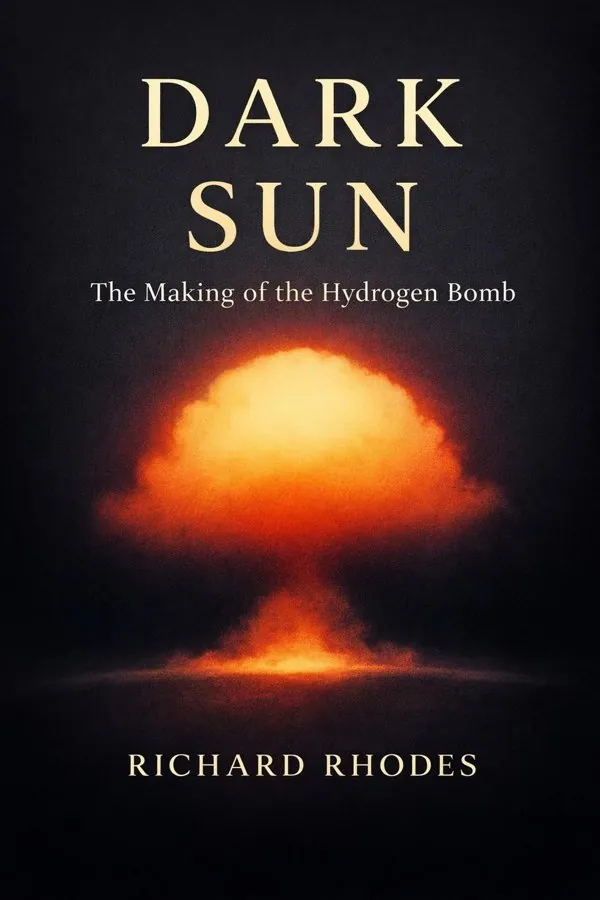
Dark Sun: The Making of the Hydrogen Bomb: Summary & Key Insights
 10 min9 chaptersAudio available
Key Takeaways from Dark Sun: The Making of the Hydrogen Bomb
A monopoly on ultimate force rarely stays a monopoly for long.
The leap from splitting atoms to fusing them was not just an incremental improvement; it was a transformation in scale, principle, and destructive potential.
History often celebrates inventions as moments of genius, but Rhodes reveals that breakthroughs are usually messy, contested, and collective.
The gravest technological decisions are often not about what can be built, but about whether it should be built.
Secrets can slow history, but rarely stop it.
What Is Dark Sun: The Making of the Hydrogen Bomb About?
Dark Sun: The Making of the Hydrogen Bomb by Richard Rhodes is a war_military book spanning 5 pages. Dark Sun: The Making of the Hydrogen Bomb is a sweeping history of how humanity moved from the first atomic bombs to the far more devastating thermonuclear age. Richard Rhodes traces the scientific breakthroughs, political struggles, intelligence battles, and moral crises that shaped the creation of the hydrogen bomb after World War II. This is not just a story about weapons; it is a story about power, fear, secrecy, ambition, and the fragile systems meant to control forces capable of ending civilization. What makes the book especially powerful is Rhodes’s ability to connect abstract physics to real people and real consequences. He brings to life scientists such as Edward Teller, Stanislaw Ulam, and J. Robert Oppenheimer, while also showing how presidents, generals, and spies pushed events forward. The result is both a political thriller and a profound meditation on responsibility in the age of extreme technology. Rhodes writes with exceptional authority. Already celebrated for The Making of the Atomic Bomb, he combines deep research, narrative skill, and historical judgment to explain not only how the hydrogen bomb was built, but why its creation transformed the modern world.
This FizzRead summary covers all 9 key chapters of Dark Sun: The Making of the Hydrogen Bomb in approximately 10 minutes, distilling the most important ideas, arguments, and takeaways from Richard Rhodes's work. Also available as an audio summary and Key Quotes Podcast.
Dark Sun: The Making of the Hydrogen Bomb
Dark Sun: The Making of the Hydrogen Bomb is a sweeping history of how humanity moved from the first atomic bombs to the far more devastating thermonuclear age. Richard Rhodes traces the scientific breakthroughs, political struggles, intelligence battles, and moral crises that shaped the creation of the hydrogen bomb after World War II. This is not just a story about weapons; it is a story about power, fear, secrecy, ambition, and the fragile systems meant to control forces capable of ending civilization.
What makes the book especially powerful is Rhodes’s ability to connect abstract physics to real people and real consequences. He brings to life scientists such as Edward Teller, Stanislaw Ulam, and J. Robert Oppenheimer, while also showing how presidents, generals, and spies pushed events forward. The result is both a political thriller and a profound meditation on responsibility in the age of extreme technology.
Rhodes writes with exceptional authority. Already celebrated for The Making of the Atomic Bomb, he combines deep research, narrative skill, and historical judgment to explain not only how the hydrogen bomb was built, but why its creation transformed the modern world.
Who Should Read Dark Sun: The Making of the Hydrogen Bomb?
This book is perfect for anyone interested in war_military and looking to gain actionable insights in a short read. Whether you're a student, professional, or lifelong learner, the key ideas from Dark Sun: The Making of the Hydrogen Bomb by Richard Rhodes will help you think differently.
- ✓Readers who enjoy war_military and want practical takeaways
- ✓Professionals looking to apply new ideas to their work and life
- ✓Anyone who wants the core insights of Dark Sun: The Making of the Hydrogen Bomb in just 10 minutes
Want the full summary?
Get instant access to this book summary and 100K+ more with Fizz Moment.
Get Free SummaryAvailable on App Store • Free to download
Key Chapters
A monopoly on ultimate force rarely stays a monopoly for long. In the years immediately following World War II, the United States stood alone as the world’s only nuclear power, but that advantage existed inside a rapidly hardening geopolitical conflict. Rhodes shows how the wartime alliance with the Soviet Union dissolved into mistrust, ideological hostility, and strategic competition. The bombings of Hiroshima and Nagasaki had ended one war, yet they also opened the possibility of a permanent state of nuclear confrontation.
This postwar environment shaped every major decision that followed. American leaders were forced to ask whether atomic superiority could be preserved, whether international control of nuclear energy was realistic, and whether scientific openness had become a national security risk. The Soviet Union, meanwhile, saw the American nuclear arsenal not merely as a weapon but as political coercion in physical form. As a result, the arms race did not begin with a single declaration. It emerged from fear, suspicion, and the conviction on both sides that delay could be fatal.
Rhodes makes clear that technology never develops in a vacuum. Scientific research was entangled with military planning, diplomacy, and domestic politics. The same laboratories that had solved wartime problems now became instruments of Cold War strategy. For modern readers, the lesson extends beyond nuclear history. Whether the issue is artificial intelligence, cyberwarfare, or biotechnology, breakthroughs quickly become strategic assets once rival powers believe they affect survival.
A practical way to apply this insight is to look at any major technology and ask two questions: who feels threatened by it, and how will that fear reshape policy? Actionable takeaway: when evaluating powerful innovations, focus not only on capability but on the rivalries that will determine how that capability is used.
The leap from splitting atoms to fusing them was not just an incremental improvement; it was a transformation in scale, principle, and destructive potential. Rhodes carefully explains how atomic bombs rely on fission, the splitting of heavy nuclei such as uranium or plutonium, while hydrogen bombs rely on fusion, forcing light nuclei to combine under extreme pressure and temperature. Fusion promised explosions vastly more powerful than those that destroyed Hiroshima and Nagasaki.
What makes this transition so striking is that it required both continuity and revolution. Scientists had to build upon wartime nuclear knowledge, but they also had to confront entirely new technical challenges. Fusion could not simply be ignited with conventional methods. It needed conditions similar to those found in stars, which meant creating a miniature sun on Earth for a fraction of a second. That challenge made the hydrogen bomb not only a military project but one of the most ambitious scientific undertakings in history.
Rhodes excels at making these concepts understandable without draining them of significance. He shows that the move from fission to fusion was driven by strategic logic as much as scientific curiosity. If one side could build a weapon hundreds of times more powerful, the other side believed it had to follow. That dynamic should feel familiar today: once a technology appears possible and militarily decisive, ethical hesitation often loses ground to strategic urgency.
In practical terms, this idea reminds us that technical literacy matters in public life. Citizens cannot evaluate policy if they do not understand the basic nature of the tools being debated. Actionable takeaway: whenever a public issue turns on science, learn the underlying principle well enough to distinguish hype, fear, and genuine risk.
History often celebrates inventions as moments of genius, but Rhodes reveals that breakthroughs are usually messy, contested, and collective. One of the book’s central episodes is the development of the Teller-Ulam design, the conceptual breakthrough that made the thermonuclear bomb practical. Before that solution, the hydrogen bomb remained more aspiration than weapon. Many proposed designs were either physically unworkable or militarily useless.
Edward Teller had long been the most forceful advocate for the so-called Super, driven by a mix of scientific vision, anti-Soviet urgency, and personal intensity. Yet Teller’s persistence alone did not solve the problem. Stanislaw Ulam’s insights into staging and compression helped unlock the path forward. Rhodes shows how the final design emerged not from a lone hero but from tension, revision, disagreement, and the collision of different styles of thinking. Radiation implosion, staging, and the separation of primary and secondary components turned thermonuclear theory into a deliverable weapon.
The larger significance of this story is that innovation often depends on uncomfortable collaboration. Strong personalities, clashing egos, and institutional competition can slow progress, but they can also sharpen ideas. In research, business, and public policy, the most important solutions may come from combining visionaries with skeptics, advocates with critics, and intuition with disciplined analysis.
A practical example is any high-stakes team project. If everyone thinks alike, blind spots multiply. If disagreement is structured well, quality improves. Rhodes’s account encourages readers to respect both ambition and scrutiny. Actionable takeaway: when solving complex problems, create teams where bold ideas must survive rigorous challenge rather than relying on charisma or authority alone.
The gravest technological decisions are often not about what can be built, but about whether it should be built. J. Robert Oppenheimer occupies this moral center in Dark Sun. Having led the wartime effort to create the atomic bomb, he became increasingly skeptical of the rush toward thermonuclear weapons. Rhodes portrays Oppenheimer not as a simple opponent of national defense, but as a figure wrestling with strategic prudence, moral consequence, and political reality.
His resistance to the hydrogen bomb arose from multiple concerns. He doubted its near-term technical feasibility, worried it would accelerate a limitless arms race, and saw its city-destroying scale as a further descent into indiscriminate annihilation. Yet in the climate of early Cold War fear, such caution was vulnerable to being recast as weakness or disloyalty. Rhodes shows how debates that should have remained strategic and ethical became personal and ideological. Oppenheimer’s eventual political downfall demonstrated how easily nuance is crushed when a nation feels existentially threatened.
This episode matters because it reveals a recurring pattern in modern governance. Experts who express qualified skepticism can be attacked as obstructive, especially when urgency dominates public debate. But skepticism is not the enemy of security; often it is one of its safeguards. Whether the issue is military intervention, surveillance systems, or emerging technologies, dissent can help prevent catastrophic overreach.
A practical application is to examine how institutions treat internal criticism. Healthy organizations protect principled disagreement instead of punishing it. Actionable takeaway: when facing high-risk decisions, deliberately include voices that question momentum, because the cost of silencing doubt is often discovered too late.
Secrets can slow history, but rarely stop it. One of Rhodes’s most compelling themes is the role of espionage in the nuclear age. The Soviet atomic program benefited from intelligence gathered from the Manhattan Project and related research networks, demonstrating that scientific secrecy has limits when knowledge is dispersed across many people, institutions, and nations. Nuclear weapons were born in secrecy, yet they entered a world where ideology, coercion, loyalty, and betrayal made containment extraordinarily difficult.
Rhodes does not reduce Soviet success to spying alone. Intelligence provided shortcuts and confidence, but Soviet scientists still had to understand, build, test, and industrialize their own systems. This distinction is important. Espionage accelerates capability; it does not replace competence. The broader implication is that once a scientific principle is known and strategically valuable, barriers to diffusion tend to erode over time. People move, papers circulate, states recruit talent, and rivals imitate methods.
For contemporary readers, this has obvious relevance. Cyber tools, biotechnology methods, semiconductor processes, and AI techniques all raise similar questions. How do you protect critical knowledge without strangling innovation? How do you distinguish between legitimate collaboration and dangerous transfer? Rhodes’s history suggests that the answer is never simple control. Resilience matters as much as secrecy.
A practical example is organizational risk management. Instead of assuming sensitive knowledge can be perfectly locked down, leaders should prepare for partial leakage by strengthening oversight, redundancy, and response capacity. Actionable takeaway: treat strategic knowledge as something that must be protected, but never assume protection is permanent; build policies around the likelihood that rivals will eventually catch up.
A weapon becomes politically real only when it leaves the blackboard and enters the world. The thermonuclear tests described by Rhodes, especially the massive early detonations, transformed the hydrogen bomb from theory and bureaucratic argument into undeniable reality. These tests were not just technical demonstrations. They were messages to allies, adversaries, military planners, and the public. They announced that human beings had created a device whose destructive force approached the scale of natural catastrophe.
Rhodes emphasizes how shocking these tests were even to many who helped make them possible. The size of the explosions, the cloud formations, the blast effects, and the radioactive consequences demonstrated that the thermonuclear era was qualitatively different from the fission era. This was not merely a bigger bomb. It was a redefinition of what warfare could mean. Civil defense planning, military doctrine, diplomacy, and strategic theory all had to adapt to a world in which entire metropolitan regions could be erased in moments.
The practical lesson is about thresholds. Many technologies seem abstract until a first dramatic deployment clarifies their true implications. The first large-scale use of drones, a breakthrough in generative AI, or a major gene-editing milestone can instantly shift public debate from speculation to urgency. Leaders who wait until demonstration to think seriously are already behind.
Rhodes’s account encourages anticipatory thinking. We should ask not only whether something works, but what institutions, norms, and protections must exist before it works at scale. Actionable takeaway: when a new capability approaches real-world deployment, move quickly from theoretical discussion to concrete planning for consequences.
The most unsettling paradox of the nuclear age is that weapons built for apocalyptic destruction came to be defended as instruments of peace. Rhodes explores how the hydrogen bomb intensified the logic of deterrence: if both superpowers could inflict unacceptable devastation, neither would dare strike first. In theory, terror became stabilizing. In practice, that stability rested on fragile assumptions about rationality, communication, command systems, and luck.
The thermonuclear balance altered strategy at every level. Conventional military strength still mattered, but the ultimate shadow over all conflict was escalation. Alliances became nuclear umbrellas. Diplomatic crises carried new risks. Military planners built doctrines around second-strike capability, survivability, and retaliation. Rhodes shows that deterrence was not a solved formula but an evolving improvisation, dependent on weapons design, delivery systems, warning time, and political interpretation.
This idea remains useful beyond military affairs because deterrence logic appears in many domains. Cybersecurity, financial regulation, and even personal negotiation often depend on credible consequences rather than actual use. But Rhodes also shows the danger of relying too heavily on abstract models of behavior. Systems meant to prevent catastrophe can generate their own forms of tension, error, and escalation.
A practical example is crisis planning in organizations. Rules designed to discourage harmful behavior must be clear, credible, and proportionate. If they are ambiguous or excessive, they may provoke the very instability they were meant to prevent. Actionable takeaway: treat deterrence as a delicate system requiring communication, restraint, and backup safeguards, not as a permanent guarantee of safety.
Modern states do not merely use science; they organize and absorb it. One of Rhodes’s most important contributions is his portrait of the institutional world behind the hydrogen bomb: laboratories, security clearances, advisory committees, military branches, contractors, and executive decision-making structures. The bomb was not created by isolated geniuses in a vacuum. It emerged from a vast apparatus that fused scientific inquiry with bureaucratic power.
This machinery changed the culture of science itself. Researchers who once valued openness had to navigate classification, surveillance, and political loyalty tests. Funding priorities increasingly reflected military aims. Prestige, influence, and access became tied to alignment with national security objectives. Rhodes’s history therefore illuminates a broader transformation of the twentieth century: the rise of big science under state direction.
That transformation is still with us. Today, frontier research in areas like AI, space, biotech, and energy often depends on large institutions with strategic interests. The question is not whether science should serve public needs; of course it should. The question is how to prevent urgent state goals from narrowing debate, reducing transparency, or turning experts into instruments of policy rather than independent contributors to it.
A practical application is to ask who controls a research agenda and what incentives shape outcomes. In any field, the source of funding influences the questions asked and the solutions prioritized. Rhodes’s account invites readers to follow institutions, not just ideas. Actionable takeaway: when evaluating scientific progress, examine the structures of power behind it, because institutions often determine which discoveries are pursued and how they are used.
History is often explained through systems, but systems still move through personalities. Dark Sun is filled with individuals whose temperaments mattered: Edward Teller’s relentless advocacy, Oppenheimer’s intellectual complexity, Truman’s blunt decisiveness, Ulam’s analytical brilliance, and the many military and political figures who translated theory into state action. Rhodes never treats character as trivial. He shows that judgment, vanity, courage, resentment, and ambition can alter the course of events when stakes are immense.
This focus on character deepens the book’s historical argument. The hydrogen bomb was not inevitable in the simple sense that physics guaranteed it. It became real through choices made by people under pressure, people who framed problems differently and pursued different visions of security. Some saw the bomb as a necessary deterrent. Others saw it as a moral abyss. Some thrived in secrecy and competition. Others were troubled by what success would mean.
For readers, this is a reminder that leadership cannot be separated from temperament. In business, government, science, and civic life, institutions matter enormously, but they are interpreted through human character. A brilliant but reckless leader can produce disaster. A flawed but reflective leader may create space for restraint. Rhodes’s narrative underscores how private traits become public consequences.
A practical example is hiring or promoting people into high-responsibility roles. Technical competence is not enough when decisions carry systemic risk. Integrity, emotional discipline, and openness to challenge matter too. Actionable takeaway: evaluate leaders not only by intelligence or achievement, but by the qualities of character that emerge when power and fear collide.
All Chapters in Dark Sun: The Making of the Hydrogen Bomb
About the Author
Richard Rhodes is an American writer, journalist, and historian renowned for his works on nuclear history, science, technology, and human conflict. He gained international recognition with The Making of the Atomic Bomb, which won the Pulitzer Prize, the National Book Award, and the National Book Critics Circle Award. His writing is distinguished by its ability to combine rigorous research with vivid storytelling, making complex scientific and political subjects accessible to general readers. In books such as Dark Sun, Rhodes examines not only how transformative technologies are created, but also how they reshape morality, power, and global security. His work has made him one of the most respected interpreters of the nuclear age and its enduring consequences.
Get This Summary in Your Preferred Format
Read or listen to the Dark Sun: The Making of the Hydrogen Bomb summary by Richard Rhodes anytime, anywhere. FizzRead offers multiple formats so you can learn on your terms — all free.
Available formats: App · Audio · PDF · EPUB — All included free with FizzRead
Download Dark Sun: The Making of the Hydrogen Bomb PDF and EPUB Summary
Key Quotes from Dark Sun: The Making of the Hydrogen Bomb
“A monopoly on ultimate force rarely stays a monopoly for long.”
“The leap from splitting atoms to fusing them was not just an incremental improvement; it was a transformation in scale, principle, and destructive potential.”
“History often celebrates inventions as moments of genius, but Rhodes reveals that breakthroughs are usually messy, contested, and collective.”
“The gravest technological decisions are often not about what can be built, but about whether it should be built.”
“Secrets can slow history, but rarely stop it.”
Frequently Asked Questions about Dark Sun: The Making of the Hydrogen Bomb
Dark Sun: The Making of the Hydrogen Bomb by Richard Rhodes is a war_military book that explores key ideas across 9 chapters. Dark Sun: The Making of the Hydrogen Bomb is a sweeping history of how humanity moved from the first atomic bombs to the far more devastating thermonuclear age. Richard Rhodes traces the scientific breakthroughs, political struggles, intelligence battles, and moral crises that shaped the creation of the hydrogen bomb after World War II. This is not just a story about weapons; it is a story about power, fear, secrecy, ambition, and the fragile systems meant to control forces capable of ending civilization. What makes the book especially powerful is Rhodes’s ability to connect abstract physics to real people and real consequences. He brings to life scientists such as Edward Teller, Stanislaw Ulam, and J. Robert Oppenheimer, while also showing how presidents, generals, and spies pushed events forward. The result is both a political thriller and a profound meditation on responsibility in the age of extreme technology. Rhodes writes with exceptional authority. Already celebrated for The Making of the Atomic Bomb, he combines deep research, narrative skill, and historical judgment to explain not only how the hydrogen bomb was built, but why its creation transformed the modern world.
More by Richard Rhodes

You Might Also Like

Patriot
Andrew Britton
10 min
War
John Hersey
10 min
An Army at Dawn: The War in North Africa, 1942–1943
Rick Atkinson
10 min
Brave New War: The Next Stage of Terrorism and the End of Globalization
John Robb
10 min
Catch-22
Joseph Heller
10 min
Command and Control: Nuclear Weapons, the Damascus Accident, and the Illusion of Safety
Eric Schlosser
10 minBrowse by Category
Ready to read Dark Sun: The Making of the Hydrogen Bomb?
Get the full summary and 100K+ more books with Fizz Moment.