
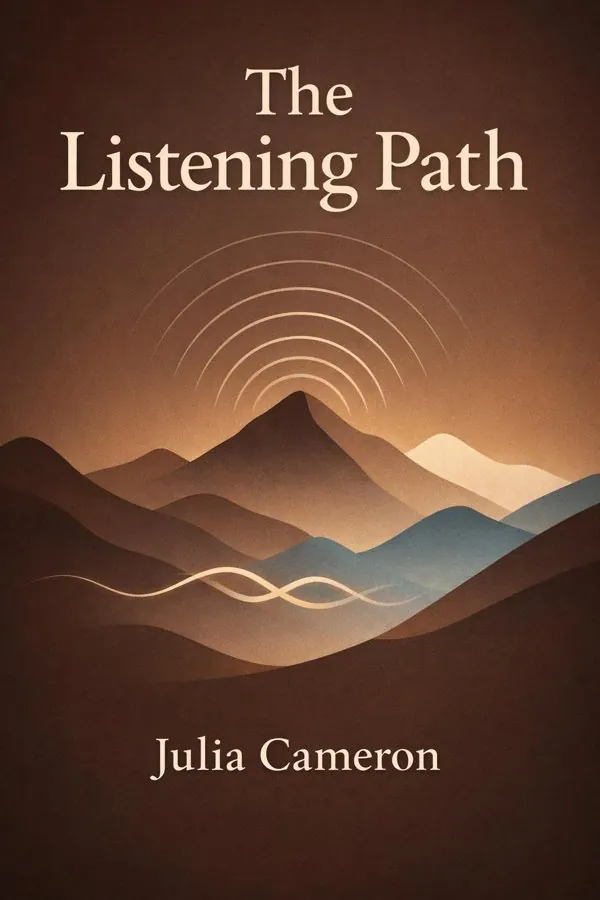
The Listening Path: The Creative Art of Attention: Summary & Key Insights
 10 min9 chaptersAudio available
Key Takeaways from The Listening Path: The Creative Art of Attention
Creativity often reawakens not when we try harder, but when we notice more.
Most people want to be heard, yet few know how to truly listen.
What we most need to hear is often drowned out by noise.
Many of life’s best directions do not arrive as commands.
Not everything meaningful can be neatly explained.
What Is The Listening Path: The Creative Art of Attention About?
The Listening Path: The Creative Art of Attention by Julia Cameron is a creativity book spanning 7 pages. In The Listening Path, Julia Cameron revisits one of her lifelong themes: creativity does not begin with force, brilliance, or productivity, but with attention. Best known for The Artist’s Way, Cameron expands her creative philosophy into a six-week practice centered on listening—first to the world around us, then to other people, silence, intuition, mystery, and finally life itself. Her argument is simple yet transformative: when we truly listen, we become more present, more receptive, and more creatively alive. This book matters because modern life trains us to skim, react, and perform. Cameron offers the opposite discipline. Through walks, writing prompts, reflection, and gentle spiritual inquiry, she shows that listening is not passive. It is an active creative art that restores sensitivity, clarity, and connection. The result is not only better artistic work, but richer relationships, deeper self-trust, and a renewed sense of meaning. Cameron writes with the warmth and encouragement that made her a trusted guide for artists and blocked creatives alike. Whether you are a writer, entrepreneur, teacher, or simply someone seeking more presence, The Listening Path offers a practical way to hear your life again.
This FizzRead summary covers all 9 key chapters of The Listening Path: The Creative Art of Attention in approximately 10 minutes, distilling the most important ideas, arguments, and takeaways from Julia Cameron's work. Also available as an audio summary and Key Quotes Podcast.
The Listening Path: The Creative Art of Attention
In The Listening Path, Julia Cameron revisits one of her lifelong themes: creativity does not begin with force, brilliance, or productivity, but with attention. Best known for The Artist’s Way, Cameron expands her creative philosophy into a six-week practice centered on listening—first to the world around us, then to other people, silence, intuition, mystery, and finally life itself. Her argument is simple yet transformative: when we truly listen, we become more present, more receptive, and more creatively alive.
This book matters because modern life trains us to skim, react, and perform. Cameron offers the opposite discipline. Through walks, writing prompts, reflection, and gentle spiritual inquiry, she shows that listening is not passive. It is an active creative art that restores sensitivity, clarity, and connection. The result is not only better artistic work, but richer relationships, deeper self-trust, and a renewed sense of meaning.
Cameron writes with the warmth and encouragement that made her a trusted guide for artists and blocked creatives alike. Whether you are a writer, entrepreneur, teacher, or simply someone seeking more presence, The Listening Path offers a practical way to hear your life again.
Who Should Read The Listening Path: The Creative Art of Attention?
This book is perfect for anyone interested in creativity and looking to gain actionable insights in a short read. Whether you're a student, professional, or lifelong learner, the key ideas from The Listening Path: The Creative Art of Attention by Julia Cameron will help you think differently.
- ✓Readers who enjoy creativity and want practical takeaways
- ✓Professionals looking to apply new ideas to their work and life
- ✓Anyone who wants the core insights of The Listening Path: The Creative Art of Attention in just 10 minutes
Want the full summary?
Get instant access to this book summary and 100K+ more with Fizz Moment.
Get Free SummaryAvailable on App Store • Free to download
Key Chapters
Creativity often reawakens not when we try harder, but when we notice more. Cameron begins her listening journey with the environment because our senses are the doorway to attention. Many people move through their days half-absorbed in worries, screens, schedules, or internal chatter. As a result, the world becomes background noise. But for the artistically alive person, the world is never merely background. It is stimulus, invitation, and conversation.
To listen to the environment is to slow down enough to register sounds, textures, rhythms, colors, and moods. A morning walk becomes a creative exercise when you hear birdsong layered over traffic, feel changing light on buildings, or notice the emotional tone of a neighborhood. This kind of attention does more than relax the mind. It replenishes it. It gives the imagination raw material and reminds us that inspiration is not manufactured internally from sheer effort. It arrives through contact.
Cameron treats listening as a sensory practice. She encourages readers to leave familiar routines, walk without agenda, and let the world speak first. A park, a bus ride, a grocery store, or a rainy street can become a source of insight when approached receptively. Writers may notice dialogue snippets. Painters may catch unusual color relationships. Anyone can rediscover wonder through careful noticing.
This first stage is foundational because it trains humility. We stop assuming we already know our surroundings and begin experiencing them anew. The environment, once ignored, becomes a teacher.
Actionable takeaway: Take a 20-minute listening walk this week with no phone or podcast. Focus on what you hear, see, and feel, and record at least ten sensory observations afterward.
Most people want to be heard, yet few know how to truly listen. Cameron’s second week turns from the outer landscape to the interpersonal one. Here she makes an important point: listening to others is not waiting for your turn to speak. It is not advising, interpreting, correcting, or mentally rehearsing your response. Genuine listening is an act of respect. It says, for this moment, your experience matters enough for me to set aside myself.
This form of listening has creative consequences. Relationships feed art, and conversations shape our emotional and imaginative lives. When we listen closely, we hear not only words but tone, hesitation, subtext, and longing. We become more empathetic and more observant. These are core creative capacities. A novelist hears character. A leader hears morale. A friend hears pain beneath politeness.
Cameron suggests that poor listening often comes from ego, haste, or fear. We want to solve, impress, or defend. But when we suspend these impulses, richer communication emerges. In practice, this may mean asking one more question instead of offering advice, allowing silence after someone speaks, or reflecting back what you heard before replying. It can transform ordinary exchanges into moments of intimacy and trust.
Listening to others also expands our world. We become less trapped in our own narrative. Another person’s perspective can challenge assumptions, reveal blind spots, and spark new ideas. Creative people especially benefit from this because originality is often born from contact with realities beyond our own.
Actionable takeaway: In your next important conversation, aim to speak less than usual. Ask clarifying questions, do not interrupt, and summarize what the other person said before offering your own view.
What we most need to hear is often drowned out by noise. In the third stage of Cameron’s path, silence becomes not an absence but a medium of perception. Many people experience silence as uncomfortable because it removes distraction. Without constant stimulation, unresolved feelings, anxieties, and buried desires begin to surface. Yet this is exactly why silence matters. It reveals what noise conceals.
Cameron frames silence as an active creative practice. When external input decreases, inner signals become clearer. We begin noticing subtle intuitions, emotional truths, and patterns in our thinking. Silence creates space for incubation, the often invisible process through which ideas ripen. Artists know that forcing solutions rarely works for long. Often the breakthrough comes after stopping, stepping back, and allowing quiet to do its work.
Practically, silence can be cultivated in small ways. A few minutes before checking your phone in the morning. A device-free walk. Driving without music. Sitting still after journaling. Even brief periods of intentional quiet can reset attention. In silence, details sharpen. A sentence arrives. A memory returns. A decision feels obvious.
Importantly, Cameron does not present silence as perfection or emptiness of thought. Minds will wander. Emotions will arise. The task is not to eliminate inner activity but to become more aware of it without immediately escaping. Over time, silence increases tolerance for stillness and strengthens self-trust. We learn that we do not need to fill every gap.
Actionable takeaway: Schedule ten minutes of daily silence for one week. No phone, music, reading, or multitasking. Afterward, write down whatever thoughts, feelings, or ideas surfaced.
Many of life’s best directions do not arrive as commands. They arrive as nudges. In week four, Cameron invites readers to listen to what she calls the Higher Self—the wiser, steadier inner voice beneath fear, habit, and social conditioning. Whether readers interpret this spiritually, psychologically, or intuitively, the central insight is the same: there is a part of us that knows more than our panic does.
The challenge is that this voice is rarely dramatic. Fear shouts. Ego argues. Obligation pressures. The Higher Self tends to whisper. It may appear as a repeated idea, a calm sense of rightness, an unexpected attraction to a project, or a discomfort that signals misalignment. Learning to hear it requires discernment. Not every impulse is wisdom, but not every quiet desire should be dismissed either.
Cameron’s practices help readers separate inner truth from mental noise. Journaling is one tool because it reveals recurring themes. Walks are another because movement loosens rigid thinking. Prayer or reflection can also help create an inward posture of receptivity. The goal is not self-obsession, but self-honesty. What do you know but avoid admitting? What longing keeps returning? What decision brings relief when imagined?
Listening to the Higher Self is creatively powerful because it restores congruence. Work improves when it comes from deeper alignment rather than performance or trend-chasing. Life also becomes simpler. Instead of living entirely by external approval, we begin using inner resonance as a guide.
Actionable takeaway: Write one page answering this question without overthinking: “What do I already know is true for me right now?” Circle any phrases that feel calm, clear, and repeated.
Not everything meaningful can be neatly explained. In week five, Cameron moves beyond ordinary perception and invites readers to listen beyond the veil—to intuition, coincidence, memory, dreams, and the subtle sense that life may be communicating through more than logic alone. This is one of the book’s most spiritual sections, but its usefulness extends even to skeptical readers. The key idea is that reality is richer when we remain open to patterns and signals we cannot fully control.
Creative work has always involved this territory. Artists often describe receiving ideas, not just inventing them. A song appears whole. A solution arrives in a dream. A conversation unexpectedly answers a private question. Cameron encourages readers not to dismiss such moments too quickly. Paying attention to synchronicity can deepen trust in the creative process and make life feel participatory rather than mechanical.
This does not require superstition. It requires receptivity. Keep a dream journal. Notice meaningful repetitions. Observe which books, people, or themes suddenly keep appearing. Ask a question before a walk and see what image or phrase stays with you. These practices sharpen symbolic attention. They help us engage mystery without needing to dominate it.
Listening beyond the veil also humbles the rational mind. We do not have to understand everything immediately to benefit from it. Sometimes a feeling, image, or coincidence becomes clear only later. Creativity thrives when certainty relaxes.
Actionable takeaway: For the next seven days, keep a synchronicity log. Record dreams, surprising coincidences, recurring symbols, or moments that feel strangely timely, then review for patterns at week’s end.
Attention becomes transformative when it extends beyond personal growth into participation with the wider world. In the sixth week, Cameron expands listening outward again, but now at a deeper level. Having listened to environment, people, silence, intuition, and mystery, readers are asked to hear the world itself—its needs, energies, tensions, beauty, and callings. Creativity is not only self-expression. It is response.
This idea helps correct a common misconception that art is purely private. In reality, meaningful creative work often arises from relation: to culture, community, justice, beauty, loss, memory, or possibility. Listening to the world means asking, what is asking to be noticed here? What is missing? What wants voice? A teacher may notice students’ unspoken anxiety. A designer may detect the need for clarity in a cluttered system. A writer may sense a cultural conversation that has not yet found its right words.
Cameron suggests that the world offers assignments if we are attentive enough to hear them. This can happen through news, local experience, overheard stories, public spaces, or a growing emotional response to something larger than ourselves. The point is not to carry the whole world’s burden. It is to recognize that creative life is relational and ethically awake.
When we listen this way, purpose becomes less abstract. We discover where our gifts meet a need. That intersection is often where the most alive work happens.
Actionable takeaway: Ask yourself, “What in my community or field is asking for attention?” Write down three needs you notice and one small way your skills could respond to one of them this month.
Insight without ritual fades quickly. One of Cameron’s enduring strengths is her insistence that creativity is sustained through regular practices, not occasional inspiration. The Listening Path is structured as a course because transformation occurs through repetition. Listening, like drawing or playing an instrument, improves when exercised. The more often we attend carefully, the more natural attention becomes.
This matters because many people approach creativity emotionally. They create when they feel inspired and stop when they feel blocked. Cameron offers a more dependable model: build habits that make inspiration easier to receive. Her familiar tools—especially morning pages and artist dates—support this process. Morning pages clear mental clutter and reveal what is happening internally. Artist dates cultivate delight, solitude, and sensory nourishment. Listening walks anchor the whole method in embodied awareness.
The practical genius of these rituals is that they lower the threshold for creativity. You do not need a masterpiece in mind. You need a notebook, some time, and willingness. Over days and weeks, patterns emerge. Emotional noise decreases. Observational sharpness improves. Unexpected ideas begin arriving because there is finally room for them.
This principle applies beyond the arts. A manager can keep a daily reflection notebook. A parent can take a weekly solo walk. A student can begin each morning without digital input. The specific form matters less than the consistency.
Actionable takeaway: Choose two listening rituals to practice for the next fourteen days—for example, three pages of morning writing and one 20-minute listening walk—and track how your mood, clarity, and ideas change.
Distraction is not just inconvenient; it can divide us against ourselves. One of the deeper themes running through Cameron’s book is that inattention fragments experience. We skim our days, override our feelings, miss beauty, half-hear others, and ignore inner signals until life feels flat or confusing. Listening reverses this fragmentation by restoring continuity between sensation, feeling, thought, intuition, and action.
This is why the book resonates even with readers who do not identify as artists. At its core, The Listening Path is about becoming less scattered and more whole. When you listen to your environment, you re-enter the present. When you listen to others, you exit self-absorption. When you listen to silence and the Higher Self, you stop abandoning your own inner life. Together these practices create integration.
Emotionally, this can be healing. People often discover through listening that they are more tired, sad, hopeful, curious, or resentful than they realized. Such awareness can feel unsettling, but it is healthier than numbness. What is heard can be responded to. What is ignored tends to leak out indirectly through irritability, avoidance, or creative block.
Cameron’s approach is gentle rather than clinical, but the effect can be profound. Attention makes us available to reality. That availability is the beginning of both art and repair.
Actionable takeaway: At the end of each day, ask three questions: “What did I notice today? What did I feel today? What might this be asking of me?” Write brief answers for one week.
The most liberating idea in Cameron’s work is that creativity is not reserved for professionals. It is a way of engaging life. The Listening Path shows that art begins long before the canvas, manuscript, or business plan. It begins in how we pay attention. A person who listens deeply experiences ordinary life as vivid, meaningful, and generative. The world becomes material, mirror, and muse.
This shifts the definition of the creative life. You do not need to produce constantly to live creatively. You need to be awake. Washing dishes while noticing rhythm and memory can inspire an essay. Listening to an elderly relative’s stories can preserve a family archive. Observing the mood of a city block can lead to photography, activism, or simply deeper presence. The boundary between art and life becomes more porous.
Cameron’s contribution here is especially encouraging for blocked or intimidated readers. If creativity starts with listening, then anyone can begin immediately. You can notice light in your kitchen, overhear a phrase worth writing down, sense the emotional truth behind your restlessness, or follow a hunch toward a class, hobby, or conversation. These small acts are not trivial. They are the beginnings of a more inhabited life.
Ultimately, listening transforms creativity from performance into relationship: relationship with self, others, place, mystery, and time. That is why it feels sustaining rather than draining.
Actionable takeaway: Keep a “creative sightings” list for one week. Each day, write down five ordinary things that strike you as beautiful, strange, moving, or idea-provoking, and use one as the seed for a small creative act.
All Chapters in The Listening Path: The Creative Art of Attention
About the Author
Julia Cameron is an American author and multidisciplinary artist whose work has shaped modern conversations about creativity, artistic recovery, and spiritual practice. She is best known for The Artist’s Way, a landmark book that introduced millions of readers to tools such as morning pages and artist dates. Over the course of her career, she has also worked as a poet, playwright, novelist, essayist, filmmaker, and composer, bringing a broad artistic perspective to her teaching. Cameron’s books often blend practical exercises with reflections on intuition, attention, and personal transformation. Her approach is especially valued for making creativity feel accessible to everyone, not just professional artists. Through decades of writing and teaching, she has helped readers overcome creative blocks, deepen self-trust, and build more meaningful, imaginative lives.
Get This Summary in Your Preferred Format
Read or listen to the The Listening Path: The Creative Art of Attention summary by Julia Cameron anytime, anywhere. FizzRead offers multiple formats so you can learn on your terms — all free.
Available formats: App · Audio · PDF · EPUB — All included free with FizzRead
Download The Listening Path: The Creative Art of Attention PDF and EPUB Summary
Key Quotes from The Listening Path: The Creative Art of Attention
“Creativity often reawakens not when we try harder, but when we notice more.”
“Most people want to be heard, yet few know how to truly listen.”
“What we most need to hear is often drowned out by noise.”
“Many of life’s best directions do not arrive as commands.”
“Not everything meaningful can be neatly explained.”
Frequently Asked Questions about The Listening Path: The Creative Art of Attention
The Listening Path: The Creative Art of Attention by Julia Cameron is a creativity book that explores key ideas across 9 chapters. In The Listening Path, Julia Cameron revisits one of her lifelong themes: creativity does not begin with force, brilliance, or productivity, but with attention. Best known for The Artist’s Way, Cameron expands her creative philosophy into a six-week practice centered on listening—first to the world around us, then to other people, silence, intuition, mystery, and finally life itself. Her argument is simple yet transformative: when we truly listen, we become more present, more receptive, and more creatively alive. This book matters because modern life trains us to skim, react, and perform. Cameron offers the opposite discipline. Through walks, writing prompts, reflection, and gentle spiritual inquiry, she shows that listening is not passive. It is an active creative art that restores sensitivity, clarity, and connection. The result is not only better artistic work, but richer relationships, deeper self-trust, and a renewed sense of meaning. Cameron writes with the warmth and encouragement that made her a trusted guide for artists and blocked creatives alike. Whether you are a writer, entrepreneur, teacher, or simply someone seeking more presence, The Listening Path offers a practical way to hear your life again.
More by Julia Cameron
You Might Also Like
Dimensions Of Creativity
Margaret A. Boden
10 min
How to Fly a Horse: The Secret History of Creation, Invention, and Discovery
Kevin Ashton
10 min
Imagine: How Creativity Works
Jonah Lehrer
10 min
The Accidental Creative: How to Be Brilliant at a Moment's Notice
Todd Henry
10 min
The Origins of Creativity
Edward O. Wilson
10 min
Wired to Create: Unraveling the Mysteries of the Creative Mind
Scott Barry Kaufman, Carolyn Gregoire
10 minBrowse by Category
Ready to read The Listening Path: The Creative Art of Attention?
Get the full summary and 100K+ more books with Fizz Moment.