
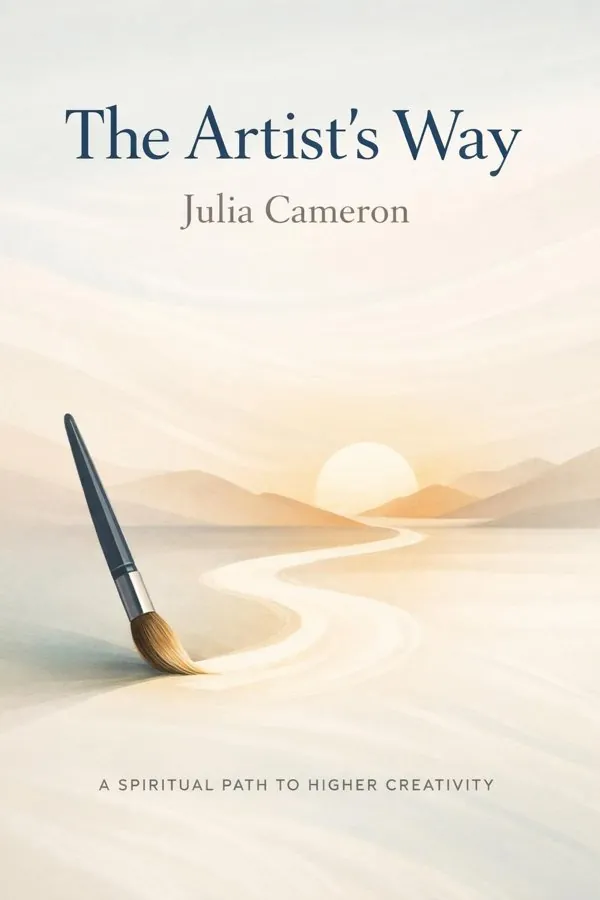
The Artist's Way: A Spiritual Path to Higher Creativity: Summary & Key Insights
 10 min9 chaptersAudio available
Key Takeaways from The Artist's Way: A Spiritual Path to Higher Creativity
Many creative lives do not fail from lack of talent; they stall from lack of permission.
One of Cameron’s most famous tools rests on a surprising truth: the mind becomes more original when it stops trying so hard to be impressive.
Creativity withers when life becomes only duty, efficiency, and output.
A creative block is often an identity block in disguise.
Creative people often lose power not because they lack ability, but because they give away decision-making energy to fear, guilt, and other people’s chaos.
What Is The Artist's Way: A Spiritual Path to Higher Creativity About?
The Artist's Way: A Spiritual Path to Higher Creativity by Julia Cameron is a creativity book spanning 13 pages. The Artist's Way is both a creativity manual and a gentle spiritual recovery program for anyone who has ever said, “I’m not really creative,” despite secretly wanting to make, write, perform, design, or live more imaginatively. In this influential book, Julia Cameron presents a twelve-week process for dismantling creative blocks, healing self-doubt, and rebuilding trust in one’s artistic instincts. Her central claim is radical in its simplicity: creativity is not a rare gift reserved for professionals or geniuses, but a natural human birthright. What makes the book endure is its practicality. Cameron does not rely on abstract inspiration alone; she gives readers repeatable tools, especially Morning Pages and the weekly Artist Date, to clear mental clutter and rekindle curiosity. She also addresses the emotional realities that suffocate creativity: fear, perfectionism, shame, envy, and the need for approval. Cameron writes with unusual authority because her work emerges from decades as a practicing artist and teacher across multiple disciplines. More than a book about making art, The Artist’s Way is about reclaiming a fuller, freer relationship with life itself.
This FizzRead summary covers all 9 key chapters of The Artist's Way: A Spiritual Path to Higher Creativity in approximately 10 minutes, distilling the most important ideas, arguments, and takeaways from Julia Cameron's work. Also available as an audio summary and Key Quotes Podcast.
The Artist's Way: A Spiritual Path to Higher Creativity
The Artist's Way is both a creativity manual and a gentle spiritual recovery program for anyone who has ever said, “I’m not really creative,” despite secretly wanting to make, write, perform, design, or live more imaginatively. In this influential book, Julia Cameron presents a twelve-week process for dismantling creative blocks, healing self-doubt, and rebuilding trust in one’s artistic instincts. Her central claim is radical in its simplicity: creativity is not a rare gift reserved for professionals or geniuses, but a natural human birthright.
What makes the book endure is its practicality. Cameron does not rely on abstract inspiration alone; she gives readers repeatable tools, especially Morning Pages and the weekly Artist Date, to clear mental clutter and rekindle curiosity. She also addresses the emotional realities that suffocate creativity: fear, perfectionism, shame, envy, and the need for approval.
Cameron writes with unusual authority because her work emerges from decades as a practicing artist and teacher across multiple disciplines. More than a book about making art, The Artist’s Way is about reclaiming a fuller, freer relationship with life itself.
Who Should Read The Artist's Way: A Spiritual Path to Higher Creativity?
This book is perfect for anyone interested in creativity and looking to gain actionable insights in a short read. Whether you're a student, professional, or lifelong learner, the key ideas from The Artist's Way: A Spiritual Path to Higher Creativity by Julia Cameron will help you think differently.
- ✓Readers who enjoy creativity and want practical takeaways
- ✓Professionals looking to apply new ideas to their work and life
- ✓Anyone who wants the core insights of The Artist's Way: A Spiritual Path to Higher Creativity in just 10 minutes
Want the full summary?
Get instant access to this book summary and 100K+ more with Fizz Moment.
Get Free SummaryAvailable on App Store • Free to download
Key Chapters
Many creative lives do not fail from lack of talent; they stall from lack of permission. Julia Cameron begins her program by arguing that before we can produce meaningful work, we must first recover a sense of safety. For many people, creativity became linked early on with criticism, embarrassment, or dismissal. A child draws, sings, or writes and is told it is impractical, silly, or not good enough. Over time, the creative impulse learns to hide.
Cameron’s first insight is that blocked artists are often wounded artists. The problem is not laziness but fear. If making art feels dangerous, procrastination becomes self-protection. That is why the early stage of creative recovery focuses less on output and more on emotional repair. Readers are encouraged to notice the voices of “crazymakers,” inner critics, and old authority figures that continue to police their imagination.
A practical way to apply this idea is to lower the stakes of creative action. Instead of trying to write a brilliant chapter, write one bad page. Instead of painting a masterpiece, spend fifteen minutes with color and form. Safety grows through repetition, not theory. Small acts teach the nervous system that creativity no longer leads to punishment.
This week also introduces a compassionate approach to artistic identity: you do not earn the right to create by being good; you create because creating is part of being human. The takeaway is simple but powerful: build a safe inner climate by separating experimentation from judgment, and let yourself begin before you feel fully confident.
One of Cameron’s most famous tools rests on a surprising truth: the mind becomes more original when it stops trying so hard to be impressive. Morning Pages are three pages of longhand, stream-of-consciousness writing done first thing in the morning. They are not meant to be literary, organized, or even useful in an obvious way. Their purpose is to empty the mental attic.
Most people wake into a storm of worries, plans, resentments, and comparisons. That noise clogs creative attention. By writing it all out on paper, readers remove the psychic debris that blocks concentration and intuition. Morning Pages often contain complaints, anxieties, grocery lists, pettiness, and repetitive thoughts. Cameron insists that this is not failure; it is the cleansing process itself.
In practice, Morning Pages work because they bypass performance. No audience sees them. No one grades them. A songwriter may discover a lyric hidden inside a rant. A business founder may spot a pattern beneath recurring frustration. A parent who thinks they have no artistic identity may reconnect with buried desires after weeks of uncensored writing.
The real power of the practice is cumulative. Over time, Morning Pages expose self-sabotaging beliefs, reveal neglected dreams, and create a habit of honest self-listening. They also reduce the pressure to hold every thought in the mind, freeing energy for real work.
Actionable takeaway: for the next week, write three handwritten pages every morning without editing or rereading. Treat them as mental hygiene, not art, and trust that creative clarity will follow consistency.
Creativity withers when life becomes only duty, efficiency, and output. Cameron’s Artist Date is her antidote to that dryness: a weekly solo excursion designed to nourish the inner artist through play, wonder, and attention. The key idea is that art does not arise only from discipline; it also depends on replenishment.
Many adults assume inspiration should appear on command, yet they rarely feed the senses. They move between work, obligations, and digital distraction without leaving room for surprise. The Artist Date counters this by requiring intentional, solitary pleasure. It might be a visit to a museum, a walk through a flower market, browsing a used bookstore, taking photographs in an unfamiliar neighborhood, buying crayons, or spending an hour listening to street musicians.
Why must it be done alone? Because solitude prevents the experience from becoming social management. When we are with others, we often adjust, entertain, or explain ourselves. Alone, we can follow attraction more honestly. The point is not productivity but receptivity. A playwright may hear a fragment of dialogue on a train ride. A designer may rediscover texture and color in a fabric shop. A burnt-out accountant may realize they miss pottery.
Artist Dates also heal the belief that creativity must always be serious. Play is not a distraction from art; it is one of its sources. Delight opens perception, and perception fuels originality.
Actionable takeaway: schedule one hour this week for a solo experience chosen purely for interest, not usefulness. Protect it like an important appointment and notice what sparks emotion, memory, or fresh ideas.
A creative block is often an identity block in disguise. In the second stage of Cameron’s process, readers are asked to recover a sense of identity by facing a difficult question: whose life am I living? Many aspiring artists organize themselves around approval. They become the responsible one, the practical one, the helpful one, the successful one, while the deeper self goes underground.
Cameron argues that recovering creativity requires dismantling false selves built from expectation. This does not always involve dramatic rebellion. More often, it means admitting small truths: you prefer writing to networking, illustration to management, movement to meetings, experimentation to certainty. Such honesty can feel disruptive because identity has social consequences. If you change creatively, some relationships may need to change too.
The book encourages readers to notice where they have outsourced authority. Do you wait for credentials before calling yourself an artist? Do you dismiss what you love because it seems unprofitable or childish? A person who always wanted to act may realize they have spent years only praising others’ bravery. A manager with a passion for photography may discover that their exhaustion comes partly from never giving expression to what feels most alive.
Identity recovery also includes trying on possibilities before fully believing in them. Saying “I am becoming a novelist” or “I am exploring music again” can be more psychologically workable than demanding immediate certainty.
Actionable takeaway: write down three identities you secretly long to claim, then choose one tiny behavior that supports it this week, such as taking a class, buying supplies, or introducing yourself differently in your own journal.
Creative people often lose power not because they lack ability, but because they give away decision-making energy to fear, guilt, and other people’s chaos. In the middle weeks of The Artist’s Way, Cameron explores recovery through power, integrity, possibility, and abundance. Together, these themes point to one lesson: creativity strengthens when you stop treating your time and attention as endlessly available.
A common obstacle is the “crazymaker,” Cameron’s term for people or dynamics that create confusion, drama, or dependency. These patterns drain focus and keep artists reactive rather than generative. The issue is not only external. We can become our own crazymakers through constant busyness, overcommitting, and moving goalposts so that nothing is ever enough.
Power is restored when readers begin making cleaner choices. That may mean setting limits on draining conversations, refusing projects that violate your values, or carving out work periods that are not negotiable. Integrity enters when your calendar reflects what you claim matters. Possibility returns when you stop assuming the future must resemble the past. Abundance emerges when you shift from scarcity thinking—there is not enough time, talent, money, luck—to noticing available resources, allies, and openings.
For example, an aspiring screenwriter may not be able to quit their job, but they can protect two evenings a week for writing and stop apologizing for it. A painter may create a modest studio corner at home rather than waiting for ideal conditions.
Actionable takeaway: identify one recurring drain on your creative energy and set a specific boundary around it this week, then redirect the reclaimed time toward a meaningful creative action.
One of Cameron’s most liberating ideas is that jealousy, comparison, and competitiveness often signal blocked desire rather than personal failure. When someone else’s success makes us uncomfortable, it may reveal a part of ourselves that wants expression. Instead of treating envy as shameful, Cameron invites readers to use it diagnostically.
This shift matters because scarcity thinking is toxic to creativity. If you believe there is only room for a few talented people, another person’s achievement feels like your exclusion. But Cameron frames creativity as participation in a larger source, not a narrow contest. In that view, someone else’s breakthrough can become evidence that expression is possible, not proof that you are too late.
Connection is equally important. Creative recovery does not mean isolating yourself with your talent; it means reconnecting with people, places, and experiences that make you feel awake. Nature, conversation, art, music, prayer, and ordinary beauty can all restore contact with what Cameron sees as a spiritual current. You do not need to share her exact theology to benefit from the principle: creativity increases when you cultivate receptivity, gratitude, and relationship rather than control.
A practical example is the person who feels defeated by a friend publishing a book. Instead of spiraling into comparison, they can ask, “What does this show me that I want?” The answer may be a writing practice, a class, or the courage to submit work.
Actionable takeaway: the next time envy appears, translate it into information. Write down what the other person’s success awakens in you, then take one concrete step toward your own version of that desire.
Creative recovery is rarely linear. Progress is often followed by resistance, emotional turbulence, or the sudden urge to quit. Cameron addresses this through the themes of strength, compassion, and self-protection. Her point is deeply humane: becoming more creative often makes us temporarily more sensitive, and sensitivity requires skillful care.
When people reconnect with buried ambition, they also reconnect with old grief. They may remember discouragement, lost years, abandoned projects, or parts of themselves they betrayed in order to belong. At this stage, harsh self-discipline can backfire. Cameron advocates compassionate persistence instead: keep going, but do not bully yourself.
Self-protection is crucial here. Not every idea should be exposed too early. Not every critic deserves access. A seedling needs shelter before weathering a storm, and so does a new creative life. This may mean sharing work only with supportive readers, reducing exposure to cynical environments, or refusing to joke dismissively about your own aspirations.
Strength, in Cameron’s framework, is not emotional numbness. It is the ability to continue with tenderness. A dancer returning after years away may feel shame about lost technique; compassion allows practice to resume. A writer facing rejection may use Morning Pages to process pain instead of concluding they are talentless.
What sustains momentum is regular return. You do not need perfect faith, a perfect routine, or perfect confidence. You need a willingness to begin again after each wobble.
Actionable takeaway: choose one protective measure for your creative life this week—such as a supportive accountability partner, a private workspace, or a limit on exposure to discouraging feedback—and pair it with one small act of continued practice.
By the later stages of The Artist’s Way, Cameron turns toward autonomy and faith. These ideas are not about becoming isolated or self-important. They are about learning to trust one’s own creative direction rather than living entirely by external validation. The mature artist still learns from others, but no longer waits passively to be chosen.
Autonomy often begins with listening. What subjects keep calling to you? What forms of expression generate energy rather than depletion? Which projects linger in your thoughts even when they are inconvenient? Cameron asks readers to take these signals seriously. Inner guidance does not always arrive as certainty; sometimes it appears as recurring fascination.
Faith, in the book, refers to trusting the process even when results are invisible. Many creative people stop too soon because they expect immediate proof. Cameron encourages a longer view. When you show up repeatedly, coincidences, opportunities, and insights begin to accumulate. A chance conversation leads to collaboration. A journaling habit reveals a book idea. A weekly date rekindles a forgotten medium.
Even readers who are not spiritually inclined can translate this into practical terms: attention shapes reality. What you honor with time and belief tends to grow. Autonomy means building a life where your creative practice is not an afterthought but a core relationship.
Actionable takeaway: write a short personal artist contract for the next month that states what you are making, how often you will show up, and how you will measure success by consistency rather than external approval.
Although The Artist’s Way is structured as a twelve-week course, its deeper promise is not a one-time transformation but a repeatable way of living. The appendices, check-ins, and weekly tasks reinforce that creativity is sustained by habits, reflection, and periodic renewal. Cameron does not present healing as a finish line. She offers a toolkit for ongoing artistic maintenance.
This matters because many readers approach creativity with an all-or-nothing mindset. They want to be permanently unblocked, permanently inspired, permanently confident. Cameron’s framework replaces that fantasy with rhythm. There will be active seasons and dormant ones, productive stretches and uncertain ones. The goal is not to eliminate fluctuation but to create practices that help you return.
The genius of the book lies in combining spirituality with pragmatism. Morning Pages become a daily reset. Artist Dates prevent imaginative starvation. Weekly inventories reveal patterns. Reading deprivation, walks, affirmations, and synchronicity tracking all train attention toward what supports aliveness. Over time, readers become less dependent on mood and more skilled at creating conditions for expression.
A practical application is to revisit the program whenever life narrows: after burnout, grief, career transition, parenthood, retirement, or creative disappointment. What worked once can work again in a different form. The system remains flexible because it is built around listening rather than rigid doctrine.
Actionable takeaway: after finishing the book, keep the two core practices—Morning Pages and Artist Dates—for another month, and schedule a weekly review to ask what is nourishing your creativity and what is quietly shutting it down.
All Chapters in The Artist's Way: A Spiritual Path to Higher Creativity
About the Author
Julia Cameron is an American author, artist, poet, playwright, novelist, filmmaker, and teacher whose work has shaped modern thinking about creativity and artistic recovery. She is best known for The Artist’s Way, a landmark book that introduced millions of readers to practices such as Morning Pages and Artist Dates. Cameron has written more than forty books spanning creativity, spirituality, memoir, fiction, and personal development. Her authority comes not only from teaching but from a long career as a working artist across disciplines. Drawing on her own experiences with creative struggle and renewal, she developed a practical, compassionate method for helping people overcome fear, self-doubt, and artistic paralysis. Her work continues to influence artists, entrepreneurs, and professionals around the world.
Get This Summary in Your Preferred Format
Read or listen to the The Artist's Way: A Spiritual Path to Higher Creativity summary by Julia Cameron anytime, anywhere. FizzRead offers multiple formats so you can learn on your terms — all free.
Available formats: App · Audio · PDF · EPUB — All included free with FizzRead
Download The Artist's Way: A Spiritual Path to Higher Creativity PDF and EPUB Summary
Key Quotes from The Artist's Way: A Spiritual Path to Higher Creativity
“Many creative lives do not fail from lack of talent; they stall from lack of permission.”
“One of Cameron’s most famous tools rests on a surprising truth: the mind becomes more original when it stops trying so hard to be impressive.”
“Creativity withers when life becomes only duty, efficiency, and output.”
“A creative block is often an identity block in disguise.”
“Creative people often lose power not because they lack ability, but because they give away decision-making energy to fear, guilt, and other people’s chaos.”
Frequently Asked Questions about The Artist's Way: A Spiritual Path to Higher Creativity
The Artist's Way: A Spiritual Path to Higher Creativity by Julia Cameron is a creativity book that explores key ideas across 9 chapters. The Artist's Way is both a creativity manual and a gentle spiritual recovery program for anyone who has ever said, “I’m not really creative,” despite secretly wanting to make, write, perform, design, or live more imaginatively. In this influential book, Julia Cameron presents a twelve-week process for dismantling creative blocks, healing self-doubt, and rebuilding trust in one’s artistic instincts. Her central claim is radical in its simplicity: creativity is not a rare gift reserved for professionals or geniuses, but a natural human birthright. What makes the book endure is its practicality. Cameron does not rely on abstract inspiration alone; she gives readers repeatable tools, especially Morning Pages and the weekly Artist Date, to clear mental clutter and rekindle curiosity. She also addresses the emotional realities that suffocate creativity: fear, perfectionism, shame, envy, and the need for approval. Cameron writes with unusual authority because her work emerges from decades as a practicing artist and teacher across multiple disciplines. More than a book about making art, The Artist’s Way is about reclaiming a fuller, freer relationship with life itself.
More by Julia Cameron
You Might Also Like
Dimensions Of Creativity
Margaret A. Boden
10 min
How to Fly a Horse: The Secret History of Creation, Invention, and Discovery
Kevin Ashton
10 min
Imagine: How Creativity Works
Jonah Lehrer
10 min
The Accidental Creative: How to Be Brilliant at a Moment's Notice
Todd Henry
10 min
The Origins of Creativity
Edward O. Wilson
10 min
Wired to Create: Unraveling the Mysteries of the Creative Mind
Scott Barry Kaufman, Carolyn Gregoire
10 minBrowse by Category
Ready to read The Artist's Way: A Spiritual Path to Higher Creativity?
Get the full summary and 100K+ more books with Fizz Moment.