
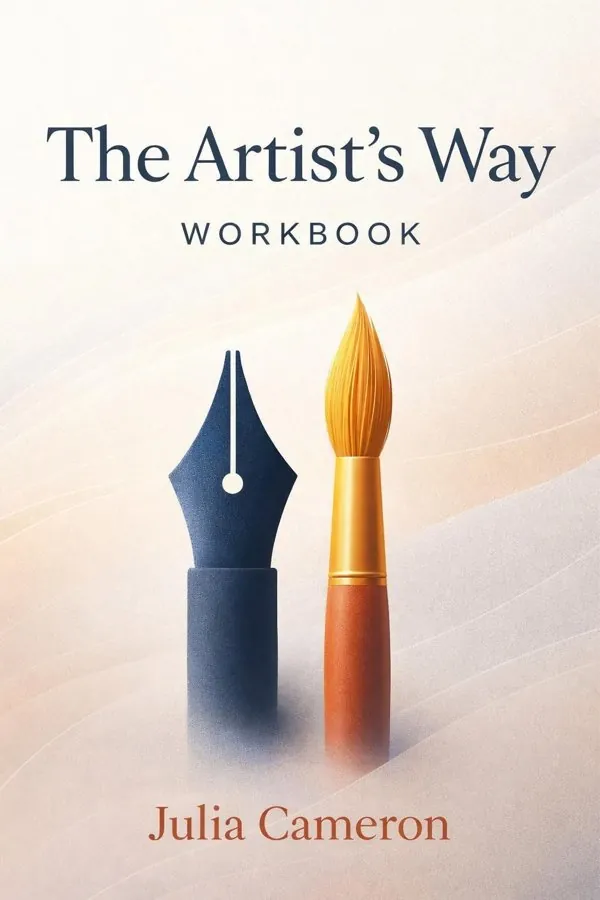
The Artist's Way Workbook: Summary & Key Insights
 10 min9 chaptersAudio available
Key Takeaways from The Artist's Way Workbook
Creative renewal rarely begins with brilliance; it begins with safety.
Many creative blocks are really identity blocks.
The harsh inner voice often sounds authoritative precisely because it is familiar.
Creative life weakens when your outer behavior repeatedly violates your inner truth.
Stagnation often comes from over-defining what creativity should look like.
What Is The Artist's Way Workbook About?
The Artist's Way Workbook by Julia Cameron is a creativity book spanning 12 pages. The Artist's Way Workbook is Julia Cameron’s practical companion to her landmark creativity classic, The Artist’s Way. Rather than offering abstract inspiration, it turns creative recovery into a guided twelve-week practice filled with prompts, check-ins, reflections, and exercises. At its core, the workbook is designed to help people reconnect with the part of themselves that has been silenced by fear, perfectionism, criticism, overwork, or the belief that creativity belongs only to “real artists.” Cameron argues that creativity is a natural human capacity, not a rare gift, and that it can be restored through steady attention and ritual. Her approach matters because it speaks not only to painters, writers, and musicians, but also to anyone who wants to live with greater energy, honesty, and imagination. As a longtime teacher of creative recovery and the author of more than forty books, Cameron brings decades of experience to this process. The result is a workbook that is both gentle and demanding: a structured invitation to reclaim your voice, your curiosity, and your creative life.
This FizzRead summary covers all 9 key chapters of The Artist's Way Workbook in approximately 10 minutes, distilling the most important ideas, arguments, and takeaways from Julia Cameron's work. Also available as an audio summary and Key Quotes Podcast.
The Artist's Way Workbook
The Artist's Way Workbook is Julia Cameron’s practical companion to her landmark creativity classic, The Artist’s Way. Rather than offering abstract inspiration, it turns creative recovery into a guided twelve-week practice filled with prompts, check-ins, reflections, and exercises. At its core, the workbook is designed to help people reconnect with the part of themselves that has been silenced by fear, perfectionism, criticism, overwork, or the belief that creativity belongs only to “real artists.” Cameron argues that creativity is a natural human capacity, not a rare gift, and that it can be restored through steady attention and ritual. Her approach matters because it speaks not only to painters, writers, and musicians, but also to anyone who wants to live with greater energy, honesty, and imagination. As a longtime teacher of creative recovery and the author of more than forty books, Cameron brings decades of experience to this process. The result is a workbook that is both gentle and demanding: a structured invitation to reclaim your voice, your curiosity, and your creative life.
Who Should Read The Artist's Way Workbook?
This book is perfect for anyone interested in creativity and looking to gain actionable insights in a short read. Whether you're a student, professional, or lifelong learner, the key ideas from The Artist's Way Workbook by Julia Cameron will help you think differently.
- ✓Readers who enjoy creativity and want practical takeaways
- ✓Professionals looking to apply new ideas to their work and life
- ✓Anyone who wants the core insights of The Artist's Way Workbook in just 10 minutes
Want the full summary?
Get instant access to this book summary and 100K+ more with Fizz Moment.
Get Free SummaryAvailable on App Store • Free to download
Key Chapters
Creative renewal rarely begins with brilliance; it begins with safety. Julia Cameron’s first major insight is that many people are not blocked because they lack talent, but because they have learned to associate self-expression with danger. Old criticism from parents, teachers, peers, or inner expectations can make creativity feel risky. Before imagination can open, the nervous system needs reassurance that experimentation will not lead to shame.
This is why the workbook starts by identifying limiting beliefs. Thoughts such as “I’m not talented,” “It’s too late,” “Art is selfish,” or “If I can’t do it perfectly, I shouldn’t do it at all” are treated not as facts, but as inherited scripts. Cameron encourages readers to notice where these scripts came from and how they still govern behavior. Once these beliefs are named, they lose some of their hidden power.
The exercises support this process by asking readers to track inner resistance, write down negative messages, and replace them with more truthful alternatives. A person who always wanted to write but heard that writing was impractical might begin by saying, “My creativity deserves time, even if it never becomes a career.” Someone afraid of drawing badly might allow themselves to sketch privately for ten minutes a day without evaluation.
The larger lesson is simple but profound: creativity grows in protected conditions. You do not force a seed to bloom by criticizing it. You create the right environment and let it emerge. Actionable takeaway: make a list of five beliefs that make creativity feel unsafe, then rewrite each one into a kinder, more liberating statement you are willing to practice this week.
Many creative blocks are really identity blocks. Cameron suggests that people often lose touch with their creative vitality because they begin living according to roles, expectations, and obligations rather than genuine interests. Over time, they stop asking what they love and start asking only what is useful, approved, or efficient. The workbook’s second movement is about remembering the self beneath adaptation.
Recovering identity means noticing what has been abandoned. It may be a childhood love of music, fascination with design, delight in nature, or desire to tell stories. These interests often seem small or impractical, yet they point toward real creative energy. Cameron treats them as clues rather than distractions. The workbook invites readers to inventory what they enjoy, what they envy in others, and what they once wanted to try but never pursued.
This process is especially powerful because envy is reframed as guidance. If you envy someone who paints, teaches, performs, or builds beautiful spaces, the envy may reveal a neglected part of yourself asking for expression. Instead of using envy as proof of inadequacy, Cameron uses it as a map.
Practical application can be modest. Someone who misses dance may take a beginner class. Someone drawn to photography might start taking daily pictures on a phone. Someone who loved theater as a teenager may volunteer at a local production or read plays again. Identity recovery is less about making a dramatic life change than about honoring buried preferences.
Creative work becomes easier when it is connected to who you really are rather than who you think you should be. Actionable takeaway: write down ten things you loved as a child or teenager, circle three that still stir emotion, and schedule one small action related to one of them this week.
The harsh inner voice often sounds authoritative precisely because it is familiar. Cameron shows that one of the biggest obstacles to creativity is the internal critic: the running commentary that dismisses ideas before they have a chance to develop. This voice may present itself as realism, maturity, or high standards, but in practice it often functions as sabotage. It keeps people from beginning, sharing, experimenting, and finishing.
In the workbook, readers are encouraged to separate themselves from this voice. The critic says, “This is stupid,” “You’re behind,” “Nobody cares,” or “You’ll embarrass yourself.” Cameron’s method is not to defeat the critic through force, but to expose its exaggerations and refuse its authority. Once you recognize that these thoughts are repetitive and inherited, they become easier to challenge.
A practical way to apply this idea is through written dialogue. You write the critic’s statement, then answer it from a wiser, more compassionate perspective. For example, if the critic says, “You are not a real writer,” the response might be, “Writers write. I am writing today.” If it says, “This painting is amateur,” the reply could be, “Beginnings are allowed to look like beginnings.” This technique interrupts the critic’s monopoly on truth.
Cameron also emphasizes that creative growth requires volume. Bad pages, weak sketches, awkward songs, and unfinished attempts are not evidence of failure; they are part of the process. The critic wants immediate excellence, but creativity depends on permission.
Actionable takeaway: for the next seven days, write down one recurring critical thought each morning and answer it in one calm, specific sentence that supports your creative practice instead of undermining it.
Creative life weakens when your outer behavior repeatedly violates your inner truth. Cameron’s exploration of authenticity and integrity makes the case that artistic blocks are not just technical problems; they are often signals that something in life is out of alignment. When people say yes too often, suppress what they feel, stay in draining environments, or pretend to care about things they no longer value, creative energy gets consumed by self-betrayal.
The workbook asks readers to notice where they are living dishonestly—not necessarily in dramatic ways, but in subtle daily compromises. Perhaps you keep postponing your writing because you tell yourself everyone else’s needs come first. Perhaps you say you are “too busy” to make art when the truth is you are afraid to be seen. Perhaps your schedule reflects your obligations but not your values. Cameron treats these gaps as spiritually and creatively costly.
Integrity, in this context, means becoming more congruent. It means making choices that support your real priorities, speaking more truthfully, and honoring emotional signals instead of overriding them. For a musician, this may mean reducing a commitment that leaves no room for practice. For a designer, it may mean declining work that pays well but deadens the spirit. For a parent, it may mean protecting one evening a week for creative work without guilt.
Authenticity is not selfishness. It is the condition under which meaningful contribution becomes possible. Work created from falseness feels thin; work created from alignment carries life.
Actionable takeaway: identify one area where your schedule, relationships, or habits conflict with your creative values, and make one concrete correction this week—a boundary, a truth spoken, or a block of protected time.
Stagnation often comes from over-defining what creativity should look like. Cameron argues that many people trap themselves by assuming their creative path must be serious, linear, profitable, or immediately impressive. The workbook pushes against this rigidity by reintroducing experimentation, surprise, and play. Possibility opens not when you figure everything out, but when you become willing to explore.
This shift matters because creativity feeds on novelty. Repetition, overwork, and perfectionism narrow perception. Play broadens it. Cameron encourages readers to try things that seem unrelated to their main goal: visiting a museum, taking a walk in a new neighborhood, collecting images, singing, gardening, reading poetry, browsing a bookstore, or making something badly on purpose. These activities are not distractions from creative work; they are sources of input and reanimation.
The workbook’s idea of the “artist date” is especially useful here: a solo excursion meant to nourish curiosity. It can be simple and inexpensive—a trip to a flea market, an hour in a fabric store, sitting in a park and observing people, or attending a local concert. What matters is the spirit of attention. By stepping away from productivity and into discovery, you refill the creative well.
In practical life, this can help someone stuck in a professional rut. A marketer who feels uninspired might take a pottery class. A novelist facing writer’s block might spend an afternoon sketching buildings. A teacher may reignite energy by learning calligraphy. The point is not mastery; it is stimulation.
Actionable takeaway: schedule one solo “artist date” this week that feels slightly whimsical or unnecessary, and treat it as essential creative maintenance rather than a reward you must earn.
Scarcity is not only a financial feeling; it is also a creative mindset. Cameron observes that blocked artists often believe there is not enough time, talent, support, opportunity, or permission to create. This sense of deprivation can become self-confirming. When you are preoccupied with what is missing, you stop noticing the resources already available to you. The workbook counters this by cultivating gratitude, receptivity, and trust in small increments of support.
Cameron does not deny real limitations. Instead, she shows that the mind often magnifies them while ignoring evidence of possibility. Gratitude shifts attention. When readers begin listing what is working—a free hour, a notebook, one encouraging friend, access to a library, a corner of a room, a body capable of walking, a song that inspires them—they start to feel less trapped and more resourced.
This idea is practical because abundance grows through use. If you appreciate a small window of time, you are more likely to write in it. If you value a modest tool, you are more likely to create with it. If you recognize supportive relationships, you may ask for help instead of isolating. Gratitude becomes a creative strategy, not just a pleasant emotion.
For example, someone who says, “I never have enough time to paint,” might begin by noticing they reliably have twenty minutes after dinner three nights a week. Someone who believes, “I need a perfect studio,” might realize the kitchen table can serve for now. Creative abundance often begins with using what is present instead of waiting for ideal conditions.
Actionable takeaway: every day for one week, write down five specific things that currently support your creative life, then use at least one of them that same day in a concrete act of making or reflection.
Perfectionism often disguises itself as ambition, but Cameron treats it as a form of fear. If work must be excellent before it can exist, then most work never begins. If every effort is judged while it is still forming, spontaneity dries up. The workbook’s emphasis on self-compassion is therefore not sentimental; it is operational. People create more, and better, when they are allowed to be learners.
This principle becomes especially important in the middle of a long creative process, when enthusiasm fades and self-doubt rises. Cameron encourages readers to respond to these moments with patience rather than punishment. Creative recovery is not linear. There will be days of energy and days of resistance. Missing a practice does not mean the process is broken. Producing uneven work does not mean you have regressed.
Self-compassion includes speaking to yourself in a tone you would use with a beloved beginner. It also includes recognizing that rest, grief, uncertainty, and ordinary life affect output. A compassionate creative practice makes room for fluctuation without collapsing into defeat. For example, a person trying to write every day may decide that on difficult days they will write one paragraph instead of none. A visual artist may keep making rough studies without showing them to anyone. A songwriter may record voice memos of fragments rather than waiting for a finished song.
Imperfection is not the enemy of mastery; it is the path to it. The workbook repeatedly reminds readers that quantity leads to quality because practice creates fluency.
Actionable takeaway: choose one creative project you have delayed because you want to do it perfectly, and complete a deliberately imperfect first version within the next three days.
Talent alone does not create a body of work; protected energy does. Cameron highlights that creative people are often highly permeable. They absorb the moods, demands, opinions, and emergencies of others, then wonder why they feel depleted. The workbook teaches that sustaining creativity requires boundaries around time, attention, and emotional exposure.
This becomes more important as creative confidence grows. Once you begin reconnecting with your voice, you may also become more aware of what drains it: chaotic schedules, compulsive comparison, toxic feedback, digital distraction, or relationships that mock your aspirations. Cameron does not suggest total withdrawal from the world. Rather, she asks readers to become discerning about what they allow into their inner space.
Protecting creative energy can take many forms. It may mean setting phone-free morning hours for writing. It may mean not sharing a fragile new idea with people who are dismissive. It may mean limiting commitments that leave no room for reflection. It may mean creating rituals that signal entry into creative work—a candle, a walk, a playlist, a closed door, a dedicated notebook.
The workbook also connects protection with independence. When your sense of worth depends entirely on external approval, your creative life becomes reactive. Independence means staying rooted in process even when praise is absent or inconsistent. A painter continues painting before the exhibition is secured. A writer keeps drafting before publication is guaranteed. A maker remains faithful to the work itself.
Actionable takeaway: identify the two biggest drains on your creative energy and create one boundary for each this week, such as a protected hour, reduced exposure, or a rule about when and with whom you share unfinished work.
The end of a twelve-week program is not the end of creative recovery; it is the beginning of a new relationship with your inner life. Cameron’s final insight is that creativity is sustained through ongoing practice, not a one-time breakthrough. The workbook is structured as a temporary container, but its real aim is to help readers build habits and attitudes they can continue long after the formal process ends.
By the final stage, the reader has ideally learned several things: how to notice and interrupt self-sabotage, how to draw nourishment from solitude and play, how to face fear without obeying it, and how to trust small acts of making. These shifts matter because creative life is cyclical. Periods of expansion are followed by doubt, fatigue, and uncertainty. Renewal depends on having tools to return to.
Cameron’s methods are intentionally repeatable. Morning writing can continue as a clearing practice. Artist dates can remain a source of inspiration. Check-ins, gratitude lists, and honesty about resistance can become regular forms of self-guidance. The goal is not to become permanently unblocked, as if difficulty will disappear forever. It is to become more resilient, more aware, and less intimidated by the inevitable fluctuations of creative work.
This makes the workbook useful far beyond the arts. Entrepreneurs, teachers, leaders, caregivers, and anyone navigating change can use its methods to stay connected to imagination and meaning. Creative renewal, in Cameron’s view, is really a way of living with attention and courage.
Actionable takeaway: after finishing the workbook, choose three practices you will keep for the next month—such as morning pages, a weekly artist date, and one weekly creative check-in—and put them into your calendar now.
All Chapters in The Artist's Way Workbook
About the Author
Julia Cameron is an American author, artist, poet, playwright, novelist, filmmaker, and composer whose work has shaped modern conversations about creativity and personal renewal. She is best known for The Artist’s Way, the influential classic that introduced readers to tools such as Morning Pages and the Artist Date. Over a career spanning decades, Cameron has written more than forty books across nonfiction and fiction, focusing on creative process, spirituality, artistic discipline, and self-discovery. Her work stands out for treating creativity not as a rare talent, but as a recoverable human birthright. Through books, teaching, and workshops, she has helped millions of readers overcome fear, perfectionism, and artistic paralysis, making her one of the most recognizable and trusted voices in the field of creative recovery.
Get This Summary in Your Preferred Format
Read or listen to the The Artist's Way Workbook summary by Julia Cameron anytime, anywhere. FizzRead offers multiple formats so you can learn on your terms — all free.
Available formats: App · Audio · PDF · EPUB — All included free with FizzRead
Download The Artist's Way Workbook PDF and EPUB Summary
Key Quotes from The Artist's Way Workbook
“Creative renewal rarely begins with brilliance; it begins with safety.”
“Many creative blocks are really identity blocks.”
“The harsh inner voice often sounds authoritative precisely because it is familiar.”
“Creative life weakens when your outer behavior repeatedly violates your inner truth.”
“Stagnation often comes from over-defining what creativity should look like.”
Frequently Asked Questions about The Artist's Way Workbook
The Artist's Way Workbook by Julia Cameron is a creativity book that explores key ideas across 9 chapters. The Artist's Way Workbook is Julia Cameron’s practical companion to her landmark creativity classic, The Artist’s Way. Rather than offering abstract inspiration, it turns creative recovery into a guided twelve-week practice filled with prompts, check-ins, reflections, and exercises. At its core, the workbook is designed to help people reconnect with the part of themselves that has been silenced by fear, perfectionism, criticism, overwork, or the belief that creativity belongs only to “real artists.” Cameron argues that creativity is a natural human capacity, not a rare gift, and that it can be restored through steady attention and ritual. Her approach matters because it speaks not only to painters, writers, and musicians, but also to anyone who wants to live with greater energy, honesty, and imagination. As a longtime teacher of creative recovery and the author of more than forty books, Cameron brings decades of experience to this process. The result is a workbook that is both gentle and demanding: a structured invitation to reclaim your voice, your curiosity, and your creative life.
More by Julia Cameron
The Artist's Way: A Spiritual Path to Higher Creativity
Julia Cameron
10 min
The Artist’s Way at Work: Riding the Dragon: Twelve Weeks to Creative Freedom
Mark McGuinness, Julia Cameron, and Catherine Allen
10 min
The Listening Path: The Creative Art of Attention
Julia Cameron
10 minYou Might Also Like
Dimensions Of Creativity
Margaret A. Boden
10 min
How to Fly a Horse: The Secret History of Creation, Invention, and Discovery
Kevin Ashton
10 min
Imagine: How Creativity Works
Jonah Lehrer
10 min
The Accidental Creative: How to Be Brilliant at a Moment's Notice
Todd Henry
10 min
The Origins of Creativity
Edward O. Wilson
10 min
Wired to Create: Unraveling the Mysteries of the Creative Mind
Scott Barry Kaufman, Carolyn Gregoire
10 minBrowse by Category
Ready to read The Artist's Way Workbook?
Get the full summary and 100K+ more books with Fizz Moment.