
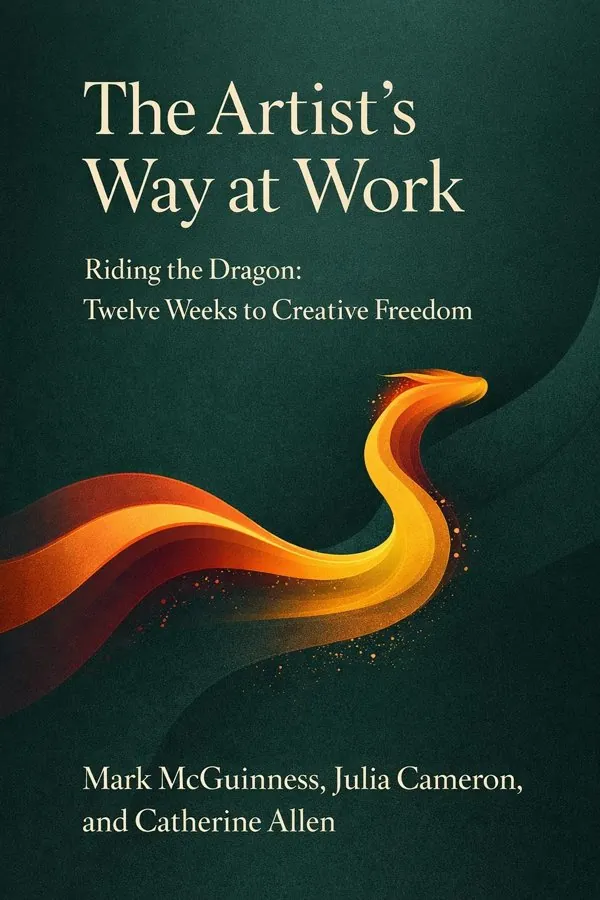
The Artist’s Way at Work: Riding the Dragon: Twelve Weeks to Creative Freedom: Summary & Key Insights
by Mark McGuinness, Julia Cameron, and Catherine Allen
 10 min8 chaptersAudio available
Key Takeaways from The Artist’s Way at Work: Riding the Dragon: Twelve Weeks to Creative Freedom
Creativity rarely disappears all at once; more often, it gets buried under habits of fear.
A crowded mind cannot hear subtle ideas.
Creative people do not thrive on output alone; they also need replenishment.
Resistance is often smartest when it sounds reasonable.
Serious work often improves when people stop being so serious about themselves.
What Is The Artist’s Way at Work: Riding the Dragon: Twelve Weeks to Creative Freedom About?
The Artist’s Way at Work: Riding the Dragon: Twelve Weeks to Creative Freedom by Mark McGuinness, Julia Cameron, and Catherine Allen is a creativity book spanning 12 pages. The Artist’s Way at Work: Riding the Dragon brings Julia Cameron’s influential creative-recovery method into the realities of modern professional life. Co-authored with Mark McGuinness and Catherine Allen, the book adapts the spirit of The Artist’s Way for people whose creativity must survive meetings, deadlines, office politics, burnout, and the pressure to perform. Rather than treating creativity as a luxury reserved for artists, the authors argue that it is a practical, renewable force that improves problem-solving, resilience, communication, and meaning at work. Structured as a twelve-week program, the book combines reflection, habits, and experiments that help readers identify what blocks their imagination and reconnect with curiosity, courage, and purpose. Practices such as morning pages, the artist’s date, honest self-inquiry, and conscious risk-taking are translated into workplace terms, making them relevant for managers, entrepreneurs, writers, consultants, and anyone trying to do original work inside demanding systems. What makes this book matter is its insistence that creative freedom is not separate from professional success. Cameron’s longstanding authority in creative development, combined with McGuinness’s coaching perspective and Allen’s organizational expertise, gives the book both soul and practical credibility.
This FizzRead summary covers all 8 key chapters of The Artist’s Way at Work: Riding the Dragon: Twelve Weeks to Creative Freedom in approximately 10 minutes, distilling the most important ideas, arguments, and takeaways from Mark McGuinness, Julia Cameron, and Catherine Allen's work. Also available as an audio summary and Key Quotes Podcast.
The Artist’s Way at Work: Riding the Dragon: Twelve Weeks to Creative Freedom
The Artist’s Way at Work: Riding the Dragon brings Julia Cameron’s influential creative-recovery method into the realities of modern professional life. Co-authored with Mark McGuinness and Catherine Allen, the book adapts the spirit of The Artist’s Way for people whose creativity must survive meetings, deadlines, office politics, burnout, and the pressure to perform. Rather than treating creativity as a luxury reserved for artists, the authors argue that it is a practical, renewable force that improves problem-solving, resilience, communication, and meaning at work.
Structured as a twelve-week program, the book combines reflection, habits, and experiments that help readers identify what blocks their imagination and reconnect with curiosity, courage, and purpose. Practices such as morning pages, the artist’s date, honest self-inquiry, and conscious risk-taking are translated into workplace terms, making them relevant for managers, entrepreneurs, writers, consultants, and anyone trying to do original work inside demanding systems.
What makes this book matter is its insistence that creative freedom is not separate from professional success. Cameron’s longstanding authority in creative development, combined with McGuinness’s coaching perspective and Allen’s organizational expertise, gives the book both soul and practical credibility.
Who Should Read The Artist’s Way at Work: Riding the Dragon: Twelve Weeks to Creative Freedom?
This book is perfect for anyone interested in creativity and looking to gain actionable insights in a short read. Whether you're a student, professional, or lifelong learner, the key ideas from The Artist’s Way at Work: Riding the Dragon: Twelve Weeks to Creative Freedom by Mark McGuinness, Julia Cameron, and Catherine Allen will help you think differently.
- ✓Readers who enjoy creativity and want practical takeaways
- ✓Professionals looking to apply new ideas to their work and life
- ✓Anyone who wants the core insights of The Artist’s Way at Work: Riding the Dragon: Twelve Weeks to Creative Freedom in just 10 minutes
Want the full summary?
Get instant access to this book summary and 100K+ more with Fizz Moment.
Get Free SummaryAvailable on App Store • Free to download
Key Chapters
Creativity rarely disappears all at once; more often, it gets buried under habits of fear. The opening stage of the book asks readers to begin not with ambition, but with honesty. In professional settings, many people operate with hidden assumptions: I must get it right the first time, I should not ask naive questions, I cannot afford to fail, and my value depends on constant competence. These beliefs create a defensive style of working that protects the ego but weakens imagination.
The authors frame the start of the journey as a process of noticing what shuts creativity down. For one person, the block may be perfectionism that delays every draft. For another, it may be cynicism that dismisses new ideas before they can develop. In teams, the same pattern appears as overplanning, excessive approval chains, or a culture where only safe ideas are rewarded. The book invites readers to stop pretending these dynamics are normal and to see them as barriers that can be changed.
This first step matters because creative recovery requires self-awareness before strategy. You cannot build a more original working life while remaining loyal to the habits that keep you small. An employee who identifies fear of criticism can start sharing rough concepts earlier. A manager who notices a need for control can create more room for experimentation in meetings. A freelancer who sees burnout can redesign their schedule around energy rather than panic.
Actionable takeaway: Write down three recurring thoughts or workplace behaviors that limit your creativity, and next to each one, note one small experiment that would challenge it this week.
A crowded mind cannot hear subtle ideas. One of Julia Cameron’s signature tools, morning pages, is presented here as a discipline for professionals as much as for artists. The practice is simple: write three pages by hand every morning, without editing, censoring, or trying to sound smart. The point is not literary quality. The point is to empty the noise so that insight has room to emerge.
At work, people often confuse constant thinking with useful thinking. But much of what fills the mind is repetitive worry: unfinished tasks, imagined criticism, low-level resentment, anxiety about the future. Morning pages act like a daily sweep of the internal floor. By putting everything onto paper, readers begin to separate genuine ideas from recycled fears. Over time, patterns become visible. You may notice that your procrastination increases after certain meetings, or that your best ideas come when you stop trying to be strategic and let your thoughts wander.
The practice also strengthens self-trust. In many workplaces, employees are trained to react outwardly before listening inwardly. Morning pages reverse that habit. They create a private space where confusion can be explored without judgment. A founder can discover the real reason a project feels wrong. A teacher can uncover buried excitement about redesigning a course. A manager can recognize that irritation with a colleague is actually frustration with their own lack of boundaries.
Actionable takeaway: For the next seven mornings, write three uncensored pages before checking email or messages, then underline one sentence each day that reveals what most needs your attention.
Creative people do not thrive on output alone; they also need replenishment. The artist’s date is the book’s answer to the starvation that many professionals mistake for discipline. This practice involves setting aside regular solo time to do something that sparks curiosity, delight, or fascination. It is not networking, productivity hacking, or skill optimization. It is intentional input for the imagination.
In workplace culture, unstructured inspiration is often treated as indulgent because it does not produce immediate metrics. Yet the authors argue that originality depends on feeding the inner source from which ideas arise. A designer may visit a museum and return with a fresh visual concept. A consultant may take a long walk through an unfamiliar neighborhood and suddenly see a client problem differently. A software developer may spend an hour in a bookstore, drift into a section on biology or architecture, and discover a metaphor that unlocks a technical challenge.
The artist’s date also restores the relationship between work and pleasure. Many adults become so identified with usefulness that they lose contact with wonder. The result is efficient but lifeless effort. By making time for small adventures, readers relearn receptivity. They become more observant, more playful, and less dependent on external pressure to generate ideas. Importantly, the date should be done alone, because solitude heightens attention and reduces the impulse to perform enthusiasm for others.
Actionable takeaway: Put one hour on your calendar this week for a solo activity chosen purely for curiosity, and afterward capture three ideas, images, or questions that it stirred in you.
Resistance is often smartest when it sounds reasonable. One of the book’s most valuable insights is that creative avoidance rarely announces itself as fear. Instead, it arrives dressed as efficiency, fatigue, realism, or busyness. You tell yourself you need more research before starting, that now is not the right time, or that the idea is not important enough to justify the effort. These narratives feel rational, which is why they are so effective.
The authors encourage readers to study resistance as a pattern rather than a personal flaw. When you begin creative work, discomfort rises because originality invites uncertainty. Resistance is the psyche’s attempt to retreat to the familiar. In the office, this can look like polishing slides instead of deciding, attending unnecessary meetings instead of writing, or endlessly revising a proposal rather than sharing it. In leadership, resistance can show up as micromanagement: controlling details to avoid the vulnerability of trying something new.
What changes the game is learning not to wait for resistance to disappear. The goal is not perfect confidence but practiced movement. Break large creative tasks into small visible actions. Start with a rough draft, a sketch, a voice note, a whiteboard outline. Use deadlines as containers rather than threats. Tell a trusted colleague what you are making so momentum becomes social as well as personal. Resistance loses power when it is named and answered with action.
Actionable takeaway: Identify one project you have delayed, write down the excuse that keeps appearing, and replace it with a 20-minute starter task you can do today before resistance grows stronger.
Serious work often improves when people stop being so serious about themselves. The book insists that play is not the opposite of professionalism; it is one of its hidden engines. When adults lose access to experimentation, humor, surprise, and improvisation, their work becomes rigid. They may still be competent, but they stop discovering. Play reintroduces flexibility, which is essential for problem-solving and creative confidence.
In practical terms, play means allowing room for exploration without immediate utility. A team brainstorming session becomes more productive when participants can propose absurd ideas before narrowing down realistic ones. A writer may generate stronger material by free-associating around a topic instead of forcing a polished outline. A product manager might use sketches, sticky notes, or role-play scenarios to understand user experience rather than relying only on spreadsheets. These approaches work because play lowers the internal censor and encourages associative thinking.
The authors also connect play to emotional recovery. Workplaces often reward control and punish visible uncertainty, which makes people defensive. Play softens that tension. It reconnects workers with enjoyment and opens pathways to insight that pressure alone cannot access. Importantly, play does not mean carelessness. It means a temporary suspension of judgment so ideas can emerge before they are evaluated.
When organizations skip this step, they often get predictable solutions to unpredictable problems. Individuals who reintroduce play into their routines frequently find that motivation returns alongside originality.
Actionable takeaway: Choose one task this week and redesign your approach to make it more playful, whether through sketching, rapid ideation, mind mapping, prototyping, or setting a challenge to generate ten bad ideas before seeking one good one.
What you repeatedly notice becomes the raw material of your creative life. The book emphasizes attention as a discipline: the ability to observe what is happening within you and around you with freshness instead of autopilot. In overstimulated work environments, attention is fragmented by notifications, multitasking, and low-grade urgency. The result is not only fatigue but superficial thinking. Creativity suffers when nothing is seen deeply enough to become meaningful.
The authors invite readers to treat attention as a form of respect. When you truly pay attention to a client, a problem, a sentence, a meeting dynamic, or your own emotional response, new information appears. A consultant may hear the real issue behind a client’s polished request. A leader may notice that a quiet team member has the most useful insight. A marketer may observe a subtle customer frustration that leads to a breakthrough campaign. Attention converts ordinary experience into usable intelligence.
This idea also applies inwardly. Many professionals ignore signals of boredom, resentment, excitement, or intuition because they seem less objective than data. Yet these responses often reveal where energy is available and where it is blocked. Paying attention helps readers distinguish between healthy challenge and soul-draining misalignment.
Practical attention can be trained through simple rituals: taking notes by hand, pausing before responding, working in focused intervals, limiting digital interruptions, or ending the day by asking what genuinely caught your interest. Over time, attention becomes less scattered and more selective, allowing better decisions and stronger creative judgment.
Actionable takeaway: Set aside one 30-minute distraction-free work session each day this week and finish it by writing down one thing you noticed that you would normally have missed.
Many people imagine creativity as a solitary act, but at work it often lives or dies in relationships. The book highlights collaboration and communication as essential parts of creative freedom. Even brilliant ideas can fail in environments where people do not feel heard, where competition replaces trust, or where feedback is delivered with ego instead of care. To do original work with others, you need both courage and generosity.
The authors encourage readers to move away from defensive communication. That means saying what you think more clearly, listening more closely, and asking for help before frustration turns into resentment. In practice, this might involve presenting an unfinished concept and inviting development rather than waiting for perfection. It could mean replacing vague criticism like “this doesn’t work” with specific observations and suggestions. For leaders, it means creating team cultures where dissent is not punished and where experimentation is discussed openly, including what failed and what was learned.
Collaboration also requires boundaries. Creative partnerships deteriorate when one person overfunctions and another withdraws, or when people agree publicly but sabotage privately. Honest collaboration asks each person to own their contribution. A project lead can define decision rights clearly. A team member can state capacity before overcommitting. A creative professional can seek feedback from people who strengthen the work rather than simply validate insecurity.
The deeper point is that communication is not separate from creativity; it is one of its delivery systems. Ideas gain strength when they are articulated, tested, refined, and shared in psychologically safe spaces.
Actionable takeaway: In your next collaboration, contribute one unfinished idea early and ask for concrete feedback using a specific question such as, “What feels strongest here, and what is still unclear?”
A creative career becomes sustainable when courage is anchored in meaning. In the later arc of the book, the authors connect three themes that many professionals keep separate: risk, vision, and integrity. Risk is necessary because creative work always involves uncertainty. Vision is necessary because without a larger sense of direction, risk becomes random. Integrity is necessary because success without alignment eventually feels empty.
At work, people often settle into forms of safety that slowly diminish them. They pursue promotions they do not want, maintain styles of communication that feel false, or keep producing acceptable work that no longer expresses their real strengths. The authors challenge readers to ask not only “What can I do?” but also “What is mine to do?” This question shifts the focus from external validation to inner purpose.
Taking risks in this framework does not mean reckless reinvention. It means making choices that are true enough to restore vitality. A professional might speak up about a strategic concern instead of staying agreeable. An employee may reshape a role around their strengths. An entrepreneur may narrow an offering to match their values rather than chasing every opportunity. Vision provides the long view; authenticity provides the moral center.
The final weeks of the journey emphasize integration and renewal. Creative freedom is not a one-time breakthrough but a way of working that must be maintained through reflection, celebration, and recommitment. Progress becomes durable when readers recognize wins, honor what has changed, and continue the practices that support their best work.
Actionable takeaway: Write a short statement describing the kind of work you want to be known for, then identify one risk you can take this month that would bring your daily actions closer to that vision.
All Chapters in The Artist’s Way at Work: Riding the Dragon: Twelve Weeks to Creative Freedom
About the Authors
Mark McGuinness is a British poet, creative coach, and author known for helping writers, entrepreneurs, and professionals develop original work without losing focus or momentum. Julia Cameron is an American teacher and bestselling author whose landmark book The Artist’s Way transformed the conversation around creativity by introducing practices such as morning pages and the artist’s date. She is widely regarded as one of the most influential voices in creative recovery. Catherine Allen is a consultant specializing in creativity, leadership, and organizational development, with a focus on helping people and institutions work more imaginatively and effectively. Together, McGuinness, Cameron, and Allen combine artistic insight, coaching experience, and workplace expertise to show how creativity can thrive not only in studios, but also in offices, businesses, and everyday professional life.
Get This Summary in Your Preferred Format
Read or listen to the The Artist’s Way at Work: Riding the Dragon: Twelve Weeks to Creative Freedom summary by Mark McGuinness, Julia Cameron, and Catherine Allen anytime, anywhere. FizzRead offers multiple formats so you can learn on your terms — all free.
Available formats: App · Audio · PDF · EPUB — All included free with FizzRead
Download The Artist’s Way at Work: Riding the Dragon: Twelve Weeks to Creative Freedom PDF and EPUB Summary
Key Quotes from The Artist’s Way at Work: Riding the Dragon: Twelve Weeks to Creative Freedom
“Creativity rarely disappears all at once; more often, it gets buried under habits of fear.”
“A crowded mind cannot hear subtle ideas.”
“Creative people do not thrive on output alone; they also need replenishment.”
“Resistance is often smartest when it sounds reasonable.”
“Serious work often improves when people stop being so serious about themselves.”
Frequently Asked Questions about The Artist’s Way at Work: Riding the Dragon: Twelve Weeks to Creative Freedom
The Artist’s Way at Work: Riding the Dragon: Twelve Weeks to Creative Freedom by Mark McGuinness, Julia Cameron, and Catherine Allen is a creativity book that explores key ideas across 8 chapters. The Artist’s Way at Work: Riding the Dragon brings Julia Cameron’s influential creative-recovery method into the realities of modern professional life. Co-authored with Mark McGuinness and Catherine Allen, the book adapts the spirit of The Artist’s Way for people whose creativity must survive meetings, deadlines, office politics, burnout, and the pressure to perform. Rather than treating creativity as a luxury reserved for artists, the authors argue that it is a practical, renewable force that improves problem-solving, resilience, communication, and meaning at work. Structured as a twelve-week program, the book combines reflection, habits, and experiments that help readers identify what blocks their imagination and reconnect with curiosity, courage, and purpose. Practices such as morning pages, the artist’s date, honest self-inquiry, and conscious risk-taking are translated into workplace terms, making them relevant for managers, entrepreneurs, writers, consultants, and anyone trying to do original work inside demanding systems. What makes this book matter is its insistence that creative freedom is not separate from professional success. Cameron’s longstanding authority in creative development, combined with McGuinness’s coaching perspective and Allen’s organizational expertise, gives the book both soul and practical credibility.
You Might Also Like
Dimensions Of Creativity
Margaret A. Boden
10 min
How to Fly a Horse: The Secret History of Creation, Invention, and Discovery
Kevin Ashton
10 min
Imagine: How Creativity Works
Jonah Lehrer
10 min
The Accidental Creative: How to Be Brilliant at a Moment's Notice
Todd Henry
10 min
The Origins of Creativity
Edward O. Wilson
10 min
Wired to Create: Unraveling the Mysteries of the Creative Mind
Scott Barry Kaufman, Carolyn Gregoire
10 minBrowse by Category
Ready to read The Artist’s Way at Work: Riding the Dragon: Twelve Weeks to Creative Freedom?
Get the full summary and 100K+ more books with Fizz Moment.