
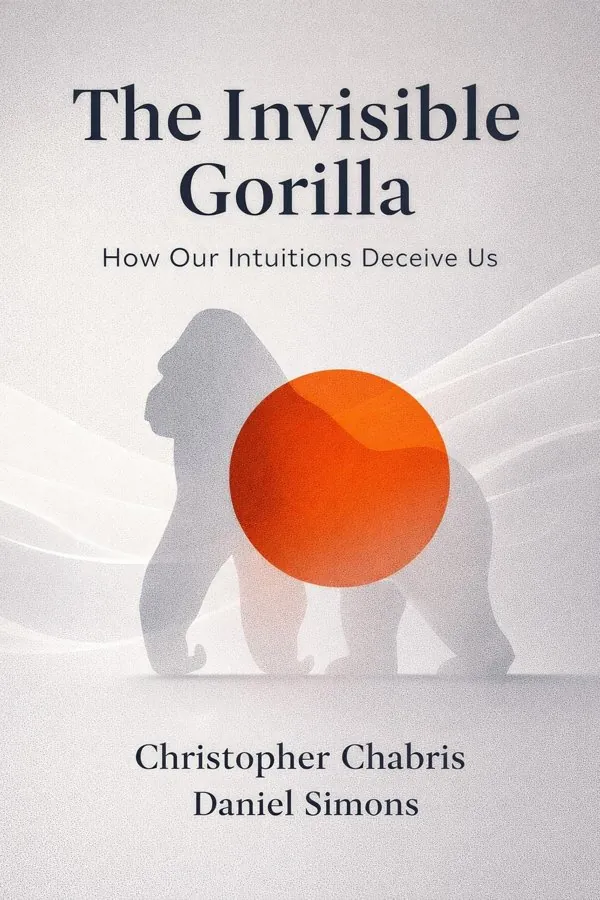
The Invisible Gorilla: How Our Intuitions Deceive Us: Summary & Key Insights
by Christopher Chabris, Daniel Simons
 10 min9 chaptersAudio available
Key Takeaways from The Invisible Gorilla: How Our Intuitions Deceive Us
We like to believe that if something important happens right in front of us, we will notice it.
Memory feels like a mental recording, but it is closer to reconstruction than replay.
Certainty is persuasive, but it is not the same as correctness.
Most of us understand less than we think we do.
Humans are natural storytellers, and stories need causes.
What Is The Invisible Gorilla: How Our Intuitions Deceive Us About?
The Invisible Gorilla: How Our Intuitions Deceive Us by Christopher Chabris, Daniel Simons is a cognition book spanning 8 pages. What if the biggest obstacle to seeing reality clearly is not lack of intelligence, but misplaced trust in your own mind? In The Invisible Gorilla, cognitive psychologists Christopher Chabris and Daniel Simons reveal a deeply unsettling truth: people routinely miss what is right in front of them, remember events inaccurately, feel certain when they are wrong, and believe they understand far more than they actually do. Drawing on their famous “invisible gorilla” experiment and a wide range of psychological research, they show that the mind is powerful but far less reliable than intuition suggests. This book matters because its lessons reach far beyond the lab. They affect driving, eyewitness testimony, medical decisions, workplace judgment, personal relationships, and public debate. Chabris and Simons are especially credible guides because they are not offering pop-psychology slogans; they are explaining what decades of research in attention, perception, and memory have demonstrated about human cognition. The result is a practical, eye-opening book that challenges readers to become more humble, more skeptical of mental shortcuts, and more deliberate in how they observe, decide, and interpret the world around them.
This FizzRead summary covers all 9 key chapters of The Invisible Gorilla: How Our Intuitions Deceive Us in approximately 10 minutes, distilling the most important ideas, arguments, and takeaways from Christopher Chabris, Daniel Simons's work. Also available as an audio summary and Key Quotes Podcast.
The Invisible Gorilla: How Our Intuitions Deceive Us
What if the biggest obstacle to seeing reality clearly is not lack of intelligence, but misplaced trust in your own mind? In The Invisible Gorilla, cognitive psychologists Christopher Chabris and Daniel Simons reveal a deeply unsettling truth: people routinely miss what is right in front of them, remember events inaccurately, feel certain when they are wrong, and believe they understand far more than they actually do. Drawing on their famous “invisible gorilla” experiment and a wide range of psychological research, they show that the mind is powerful but far less reliable than intuition suggests.
This book matters because its lessons reach far beyond the lab. They affect driving, eyewitness testimony, medical decisions, workplace judgment, personal relationships, and public debate. Chabris and Simons are especially credible guides because they are not offering pop-psychology slogans; they are explaining what decades of research in attention, perception, and memory have demonstrated about human cognition. The result is a practical, eye-opening book that challenges readers to become more humble, more skeptical of mental shortcuts, and more deliberate in how they observe, decide, and interpret the world around them.
Who Should Read The Invisible Gorilla: How Our Intuitions Deceive Us?
This book is perfect for anyone interested in cognition and looking to gain actionable insights in a short read. Whether you're a student, professional, or lifelong learner, the key ideas from The Invisible Gorilla: How Our Intuitions Deceive Us by Christopher Chabris, Daniel Simons will help you think differently.
- ✓Readers who enjoy cognition and want practical takeaways
- ✓Professionals looking to apply new ideas to their work and life
- ✓Anyone who wants the core insights of The Invisible Gorilla: How Our Intuitions Deceive Us in just 10 minutes
Want the full summary?
Get instant access to this book summary and 100K+ more with Fizz Moment.
Get Free SummaryAvailable on App Store • Free to download
Key Chapters
We like to believe that if something important happens right in front of us, we will notice it. The unsettling truth is that attention is not a wide-open spotlight but a narrow beam, and whatever falls outside it can effectively disappear. Chabris and Simons demonstrate this through the now-famous basketball video in which viewers asked to count passes often fail to notice a person in a gorilla suit walking through the scene. The point is not that people are careless. It is that focused attention is selective by design.
This phenomenon, known as inattentional blindness, has serious consequences. Drivers talking on phones may look directly at a motorcyclist and still not register the bike. Professionals in high-stakes jobs can miss abnormalities on scans, dashboard warnings, or safety cues because their attention is committed elsewhere. In daily life, it explains why we overlook a friend’s changed mood, miss an obvious typo in our own writing, or fail to see a risk that someone else notices immediately.
The deeper lesson is that seeing is not the same as noticing. Perception depends on goals, expectations, and what the mind is currently prioritizing. Confidence in “I would have seen it” is often an illusion created after the fact.
A practical response is to stop assuming important information will automatically capture your attention. Build habits that compensate for attentional limits: use checklists, reduce multitasking, pause before critical decisions, and invite others to scan for what you may be missing. Actionable takeaway: when accuracy matters, design your environment and routines as if your attention will fail—because sometimes it will.
Memory feels like a mental recording, but it is closer to reconstruction than replay. We experience our recollections as vivid and stable, which is exactly why they can mislead us. Chabris and Simons explain that each time we remember an event, we are not pulling a perfect file from storage. We are rebuilding the past from fragments, expectations, emotions, and later information.
This matters because people often treat memory as trustworthy evidence. Eyewitnesses can sincerely identify the wrong suspect. Friends can confidently disagree about what was said in a conversation. Employees can remember a project decision differently depending on what later happened. Even highly emotional memories, which feel unforgettable, can be distorted over time. The confidence attached to a memory does not guarantee its accuracy.
The authors do not argue that memory is useless. Rather, memory is adaptive, not exact. It helps us create meaning, anticipate the future, and maintain a narrative of who we are. But because it is flexible, it is vulnerable to suggestion, leading questions, repetition, and hindsight. Once new details get woven into the story, they can feel original.
In practice, this means you should be cautious when relying on recollection alone. Write important details down immediately. Prefer contemporaneous notes over later certainty. In disagreements, treat memory as a starting point for inquiry, not final proof. Actionable takeaway: whenever the stakes are high—legal, professional, financial, or personal—trust documented evidence and prompt records more than confident memories, including your own.
Certainty is persuasive, but it is not the same as correctness. One of the book’s most important insights is that people routinely mistake confidence for competence, both in themselves and in others. We assume that someone who speaks firmly must know what they are talking about, and we assume our own strong feelings of certainty reflect sound judgment. Yet confidence often grows from personality, repetition, familiarity, or social reinforcement rather than accuracy.
This illusion appears everywhere. A job candidate who answers smoothly may seem more capable than a cautious but better-informed applicant. Investors may overestimate their market insight because a few successful guesses made them feel skilled. A doctor, manager, or political commentator may project certainty in situations filled with uncertainty. The problem is not merely arrogance. Human beings are poor at calibrating how much they know.
Chabris and Simons show that confidence and performance are only loosely connected. People can be highly confident and wrong, or hesitant and correct. This mismatch becomes especially dangerous when decisions are made quickly or when authority goes unchallenged. Organizations that reward assertiveness over evidence become vulnerable to preventable mistakes.
A better approach is calibration: learning to align confidence with actual reliability. Ask what evidence supports a claim, what assumptions it depends on, and what might disconfirm it. In your own thinking, separate “I feel sure” from “I have checked carefully.” Actionable takeaway: before trusting confidence—yours or someone else’s—look for track record, data, and openness to correction, not just conviction.
Most of us understand less than we think we do. We live in a world full of tools, systems, and institutions that feel familiar, so we assume we could explain how they work. But when asked to do so in detail, our understanding often collapses. Chabris and Simons highlight this illusion of explanatory depth: the mistaken belief that our knowledge is deeper, more complete, and more coherent than it really is.
This illusion thrives because modern life lets us borrow understanding from our surroundings. We know that toilets flush, elections happen, markets move, and apps function, so we feel as if we understand the mechanisms behind them. In reality, much of what we “know” is social knowledge distributed across experts, networks, and institutions. We mistake access to knowledge for possession of knowledge.
The consequences are significant. People hold strong opinions about education, medicine, technology, or public policy without grasping the underlying complexities. Teams make weak plans because everyone assumes someone else has worked out the details. Individuals overestimate how prepared they are to solve a problem until reality exposes the gaps.
One useful strategy is the explanation test: try to explain a concept simply and step by step, either aloud or in writing. If you get stuck, you have identified a gap rather than demonstrated mastery. This is not a failure; it is an opportunity to learn accurately.
Actionable takeaway: whenever you feel strongly informed, pause and ask yourself, “Could I clearly explain how this works?” If not, replace certainty with curiosity and seek deeper understanding before acting.
Humans are natural storytellers, and stories need causes. The problem is that our minds are quick to see patterns and assign explanations even when the real relationships are weak, hidden, or nonexistent. Chabris and Simons show that we often jump from “these two things happened together” to “one caused the other,” creating false confidence in our explanations of success, failure, health, behavior, and social trends.
This tendency is understandable. Clear causes make the world feel manageable. If a stock rose after a CEO announcement, we assume the announcement caused the rise. If a new productivity routine helps on a good week, we may declare it the reason for our improvement. If a child struggles after a change in school, adults may latch onto the most obvious explanation and overlook many other factors. In reality, outcomes usually reflect multiple causes, random variation, and factors we never observe.
The illusion of cause fuels superstition, weak management decisions, and misleading self-help conclusions. It also powers hindsight: once we know an outcome, causes seem more obvious than they actually were. We rewrite uncertainty into inevitability.
To think better, distinguish correlation from causation and single causes from systems. Ask what alternative explanations exist, whether the pattern repeats, and what evidence would show the assumed cause is wrong. Controlled comparisons, base rates, and patient observation usually beat snap interpretations.
Actionable takeaway: when something happens and the cause seems obvious, slow down. List at least three other plausible explanations before committing to one. That simple habit can dramatically improve judgment.
People love hidden-talent stories. We imagine that with the right test, coach, or audition, we can identify who will become exceptional. Yet Chabris and Simons argue that predicting future performance is far harder than most of us believe. The illusion of potential is our tendency to overestimate how well current impressions reveal future ability.
This is especially visible in education, sports, hiring, and talent development. Recruiters trust first impressions, interviews, and “gut feel” when selecting candidates. Coaches believe they can spot greatness early. Parents and teachers may label children as gifted, average, or limited based on partial evidence. But long-term success depends on many variables: practice quality, motivation, opportunity, health, feedback, timing, and luck. Raw promise is only one piece of the puzzle.
The book challenges simplistic narratives that some people are obviously destined to excel while others are not. Early performance may not predict later outcomes nearly as well as we assume. At the same time, structured practice and environment can matter more than surface talent. This does not mean potential is unknowable, but it is more uncertain and context-dependent than intuition suggests.
In practical terms, this should make us more humble evaluators. Instead of asking who “has it,” ask what systems help people improve and what evidence actually predicts performance in a given role. Use repeated observation, work samples, and measurable feedback instead of relying on charisma or early labels.
Actionable takeaway: treat judgments about potential as provisional. Invest in development and evidence-based evaluation rather than assuming your first read on someone’s future is the right one.
Cognitive errors rarely arrive alone. One of the book’s most powerful contributions is showing how different mental illusions interact, making us even more vulnerable than any single bias would suggest. We fail to notice something, misremember what happened, feel sure about our version, believe we understand the causes, and then become more convinced that our judgment is sound. The result is a self-sealing mental system.
Imagine a workplace mistake. A manager overlooks a warning sign because attention is elsewhere. Later, memory smooths the sequence of events. Confidence turns a fuzzy recollection into a firm account. The illusion of cause produces a neat explanation blaming one employee or one decision. The illusion of knowledge makes everyone feel they now understand what happened. Because the story feels coherent, the organization may never discover the deeper systemic problem.
The same pattern appears in relationships, politics, and public controversies. People notice selective facts, remember supporting examples, speak with confidence, and build causal stories that flatter their existing beliefs. Each illusion strengthens the others. That is why debate often produces more certainty rather than more clarity.
Recognizing this interaction changes how we should think about error. Mistakes are not always signs of laziness or bad intentions. Often they emerge from normal mental processes working together in misleading ways. This insight should increase both skepticism and compassion.
Actionable takeaway: when you feel highly certain about a complex event, audit your conclusion from multiple angles: What might I have missed? What am I remembering imperfectly? Why does this explanation feel so satisfying? That three-part check can interrupt reinforcing illusions.
The goal of The Invisible Gorilla is not to make readers distrust their minds completely. It is to replace naive trust with wiser habits. Since our intuitions are often unreliable, the answer is not more intuition but better systems for thinking, noticing, and deciding. Chabris and Simons emphasize that cognitive humility is a strength, not a weakness.
In practical terms, this means designing processes that protect us from predictable errors. Pilots use checklists because expertise does not eliminate attentional failures. Good interviewers use structured questions because first impressions distort judgment. Doctors seek second opinions because memory, confidence, and causal assumptions can all mislead. Teams improve decisions by inviting dissent and reviewing evidence before choosing a story. Individuals reduce mistakes by writing things down, testing assumptions, and revisiting decisions after outcomes are known.
This chapter of the book’s message is especially empowering. You do not need perfect awareness to become wiser. You need routines that compensate for imperfection. A driver can reduce distraction. A leader can build a culture where uncertainty is voiced openly. A student can test understanding by teaching concepts back. A couple can resolve conflict better by checking texts, calendars, or notes instead of arguing from memory alone.
The broad lesson is simple: reality is too complex to be navigated by feeling alone. Strong thinking requires feedback, structure, and humility.
Actionable takeaway: choose one recurring area of life—meetings, study, finances, or relationships—and add one anti-error habit this week, such as note-taking, checklists, or a deliberate pause before final judgments.
The book does not claim that intuition is always wrong. A more subtle point is that intuition works best in environments that are stable, familiar, and rich in feedback. When people have repeated experience, clear patterns, and opportunities to learn from mistakes, instincts can become useful. But in complex, noisy, or novel situations, intuitive confidence often outruns actual understanding.
This distinction matters because many bad decisions begin with overgeneralizing success from one domain to another. A skilled emergency nurse may develop excellent clinical intuition through thousands of cases and immediate feedback. That does not mean she will have equally reliable instincts about investing, hiring, or legal guilt. A seasoned chess player may intuit strong moves on the board but still fall prey to false causal stories in everyday life. Expertise is often narrow.
Chabris and Simons encourage readers to ask when intuition deserves trust and when it deserves scrutiny. Environments with delayed outcomes, hidden variables, and ambiguous cause-effect relationships are especially dangerous. Here, gut feelings can feel compelling while being poorly calibrated. The wiser response is to combine intuition with verification.
In practice, this means respecting experience without romanticizing it. Use intuition to generate hypotheses, not to end inquiry. Let instinct point to what might matter, then test it with evidence, procedure, or outside input.
Actionable takeaway: before acting on a strong gut feeling, ask whether this is a domain where you have repeated practice and clear feedback. If not, treat intuition as a prompt to investigate, not a verdict to obey.
All Chapters in The Invisible Gorilla: How Our Intuitions Deceive Us
About the Authors
Christopher Chabris and Daniel Simons are prominent cognitive psychologists best known for their research on attention, perception, and the limits of human awareness. Chabris has taught and conducted research in psychology and behavioral science, with interests spanning decision-making, intelligence, and behavioral economics. Simons is a professor of psychology whose work has focused extensively on visual cognition, attention, and memory. Together, they became internationally recognized for the “invisible gorilla” experiment, a landmark study showing that people can miss highly visible events when their attention is directed elsewhere. Their collaboration combines academic rigor with unusually clear communication, making complex findings from cognitive science accessible to general readers. Through their research and writing, they have helped reshape how people think about observation, confidence, and the reliability of intuition.
Get This Summary in Your Preferred Format
Read or listen to the The Invisible Gorilla: How Our Intuitions Deceive Us summary by Christopher Chabris, Daniel Simons anytime, anywhere. FizzRead offers multiple formats so you can learn on your terms — all free.
Available formats: App · Audio · PDF · EPUB — All included free with FizzRead
Download The Invisible Gorilla: How Our Intuitions Deceive Us PDF and EPUB Summary
Key Quotes from The Invisible Gorilla: How Our Intuitions Deceive Us
“We like to believe that if something important happens right in front of us, we will notice it.”
“Memory feels like a mental recording, but it is closer to reconstruction than replay.”
“Certainty is persuasive, but it is not the same as correctness.”
“Most of us understand less than we think we do.”
“Humans are natural storytellers, and stories need causes.”
Frequently Asked Questions about The Invisible Gorilla: How Our Intuitions Deceive Us
The Invisible Gorilla: How Our Intuitions Deceive Us by Christopher Chabris, Daniel Simons is a cognition book that explores key ideas across 9 chapters. What if the biggest obstacle to seeing reality clearly is not lack of intelligence, but misplaced trust in your own mind? In The Invisible Gorilla, cognitive psychologists Christopher Chabris and Daniel Simons reveal a deeply unsettling truth: people routinely miss what is right in front of them, remember events inaccurately, feel certain when they are wrong, and believe they understand far more than they actually do. Drawing on their famous “invisible gorilla” experiment and a wide range of psychological research, they show that the mind is powerful but far less reliable than intuition suggests. This book matters because its lessons reach far beyond the lab. They affect driving, eyewitness testimony, medical decisions, workplace judgment, personal relationships, and public debate. Chabris and Simons are especially credible guides because they are not offering pop-psychology slogans; they are explaining what decades of research in attention, perception, and memory have demonstrated about human cognition. The result is a practical, eye-opening book that challenges readers to become more humble, more skeptical of mental shortcuts, and more deliberate in how they observe, decide, and interpret the world around them.
More by Christopher Chabris, Daniel Simons
You Might Also Like
A Field Guide to Lies: Critical Thinking in the Information Age
Daniel J. Levitin
10 min
A Theory of Cognitive Dissonance
Leon Festinger
10 min
Black-And-White Thinking: The Burden of a Binary Brain in a Complex World
Kevin Dutton
10 min
Born Liars: Why We Can’t Live Without Deceit
Ian Leslie
10 min
Collective Illusions: Conformity, Complicity, and the Science of Why We Make Bad Decisions
Todd Rose
10 min
Concrete Mathematics: A Foundation for Computer Science
Ronald L. Graham, Donald E. Knuth, Oren Patashnik
10 minBrowse by Category
Ready to read The Invisible Gorilla: How Our Intuitions Deceive Us?
Get the full summary and 100K+ more books with Fizz Moment.