

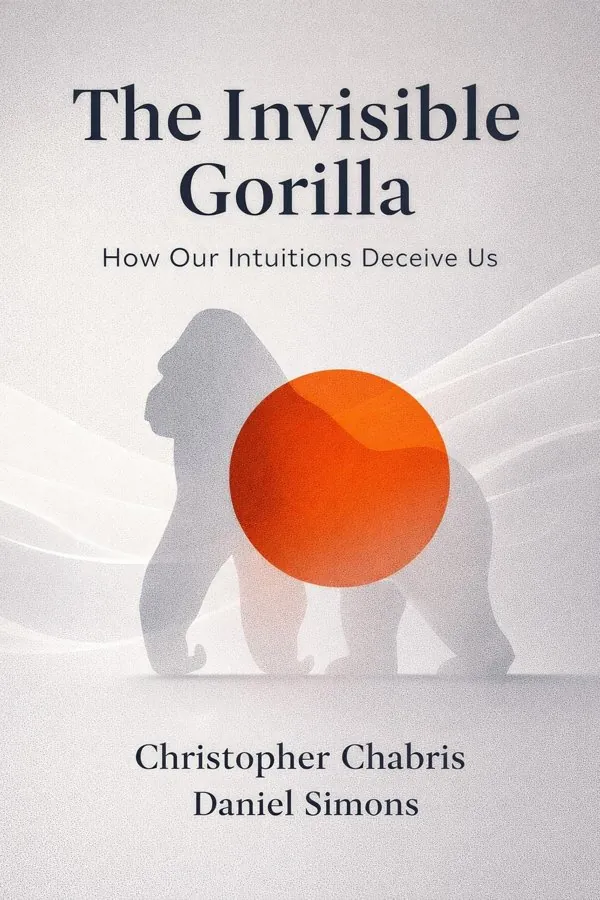
The Invisible Gorilla: And Other Ways Our Intuitions Deceive Us: Summary & Key Insights
by Christopher Chabris, Daniel Simons
 10 min9 chaptersAudio available
What Is The Invisible Gorilla: And Other Ways Our Intuitions Deceive Us About?
The Invisible Gorilla: And Other Ways Our Intuitions Deceive Us by Christopher Chabris, Daniel Simons is a cognition book spanning 9 pages. The Invisible Gorilla explores how our minds can deceive us through six everyday illusions—attention, memory, confidence, knowledge, cause, and potential. Drawing from their famous 'gorilla experiment,' cognitive psychologists Christopher Chabris and Daniel Simons reveal how these illusions shape our perceptions and decisions, often leading us to overestimate our awareness and understanding of the world.
This FizzRead summary covers all 9 key chapters of The Invisible Gorilla: And Other Ways Our Intuitions Deceive Us in approximately 10 minutes, distilling the most important ideas, arguments, and takeaways from Christopher Chabris, Daniel Simons's work. Also available as an audio summary and Key Quotes Podcast.
The Invisible Gorilla: And Other Ways Our Intuitions Deceive Us
The Invisible Gorilla explores how our minds can deceive us through six everyday illusions—attention, memory, confidence, knowledge, cause, and potential. Drawing from their famous 'gorilla experiment,' cognitive psychologists Christopher Chabris and Daniel Simons reveal how these illusions shape our perceptions and decisions, often leading us to overestimate our awareness and understanding of the world.
Who Should Read The Invisible Gorilla: And Other Ways Our Intuitions Deceive Us?
This book is perfect for anyone interested in cognition and looking to gain actionable insights in a short read. Whether you're a student, professional, or lifelong learner, the key ideas from The Invisible Gorilla: And Other Ways Our Intuitions Deceive Us by Christopher Chabris, Daniel Simons will help you think differently.
- ✓Readers who enjoy cognition and want practical takeaways
- ✓Professionals looking to apply new ideas to their work and life
- ✓Anyone who wants the core insights of The Invisible Gorilla: And Other Ways Our Intuitions Deceive Us in just 10 minutes
Want the full summary?
Get instant access to this book summary and 100K+ more with Fizz Moment.
Get Free SummaryAvailable on App Store • Free to download
Key Chapters
Most of us walk through the world believing that our eyes are like cameras, recording everything around us. The truth is quite the opposite: attention is selective, and we see only what we attend to. When people in our gorilla video fail to notice the gorilla, it shocks them not because they missed a small detail, but because they missed something absurdly obvious. That shock exposes a deep misconception about our own mental capacities.
Inattentional blindness occurs because attention is finite. We cannot process every object and event in our visual field, so our minds must filter ruthlessly. What is filtered out is not stored somewhere waiting to be discovered; it is as though it never existed in our experience. This has profound implications. Drivers who look directly at motorcycles can still collide with them because they were attending to cars. Air traffic controllers, pilots, and security personnel can overlook critical anomalies despite years of training. The illusion lies not only in our blindness, but in our inability to believe we could be blind in the first place.
Once we grasp this, we can begin to approach attention differently. The goal is not to expand attention infinitely—it’s to recognize its limits. Knowing that you can miss something obvious makes you more likely to check your assumptions, design safer systems, and forgive others for perceptual lapses. Awareness of the illusion of attention transforms how you interpret both your experiences and those of others. It replaces blame with understanding and invulnerability with humility.
If attention deceives us about what we see, memory deceives us about what we know. We treat memory like a recording that can be played back at will, but it is really a dynamic reconstruction—a story remade each time we recall it. Decades of psychological research have shown that confidence and accuracy in memory are only weakly correlated. People can vividly remember events that never occurred, misplace details, or merge separate incidents into one coherent but false narrative.
In the courtroom, this illusion can have devastating consequences. Eyewitnesses often identify the wrong person because their memories have been unconsciously reshaped by suggestion, conversation, or even their own expectations. Yet juries—and often the witnesses themselves—trust those memories with unshakable certainty. Everyday life offers gentler examples. Two friends can remember the same evening in utterly different ways, each sure of their version. The memory feels real because it was reconstructed in good faith; we do not experience the gaps and edits that make it up.
The danger of this illusion is that it convinces us our recollections are factual records rather than interpretive stories. Recognizing this doesn’t make memory useless—it makes it human. To live wisely is to understand that remembering is an act of meaning-making, not reproduction. When we appreciate this, we approach others’ memories with empathy and our own with caution. The past, after all, is not a library; it’s a living portrait repainted every time we look at it.
+ 7 more chapters — available in the FizzRead app
All Chapters in The Invisible Gorilla: And Other Ways Our Intuitions Deceive Us
About the Authors
Christopher F. Chabris is a cognitive psychologist and professor known for his research on attention, intelligence, and decision-making. Daniel J. Simons is a professor of psychology at the University of Illinois, specializing in visual cognition and human performance. Together, they are best known for their groundbreaking 'invisible gorilla' experiment on inattentional blindness.
Get This Summary in Your Preferred Format
Read or listen to the The Invisible Gorilla: And Other Ways Our Intuitions Deceive Us summary by Christopher Chabris, Daniel Simons anytime, anywhere. FizzRead offers multiple formats so you can learn on your terms — all free.
Available formats: App · Audio · PDF · EPUB — All included free with FizzRead
Download The Invisible Gorilla: And Other Ways Our Intuitions Deceive Us PDF and EPUB Summary
Key Quotes from The Invisible Gorilla: And Other Ways Our Intuitions Deceive Us
“Most of us walk through the world believing that our eyes are like cameras, recording everything around us.”
“If attention deceives us about what we see, memory deceives us about what we know.”
Frequently Asked Questions about The Invisible Gorilla: And Other Ways Our Intuitions Deceive Us
The Invisible Gorilla: And Other Ways Our Intuitions Deceive Us by Christopher Chabris, Daniel Simons is a cognition book that explores key ideas across 9 chapters. The Invisible Gorilla explores how our minds can deceive us through six everyday illusions—attention, memory, confidence, knowledge, cause, and potential. Drawing from their famous 'gorilla experiment,' cognitive psychologists Christopher Chabris and Daniel Simons reveal how these illusions shape our perceptions and decisions, often leading us to overestimate our awareness and understanding of the world.
More by Christopher Chabris, Daniel Simons
You Might Also Like
A Field Guide to Lies: Critical Thinking in the Information Age
Daniel J. Levitin
10 min
A Theory of Cognitive Dissonance
Leon Festinger
10 min
Black-And-White Thinking: The Burden of a Binary Brain in a Complex World
Kevin Dutton
10 min
Born Liars: Why We Can’t Live Without Deceit
Ian Leslie
10 min
Collective Illusions: Conformity, Complicity, and the Science of Why We Make Bad Decisions
Todd Rose
10 min
Concrete Mathematics: A Foundation for Computer Science
Ronald L. Graham, Donald E. Knuth, Oren Patashnik
10 minBrowse by Category
Ready to read The Invisible Gorilla: And Other Ways Our Intuitions Deceive Us?
Get the full summary and 100K+ more books with Fizz Moment.