
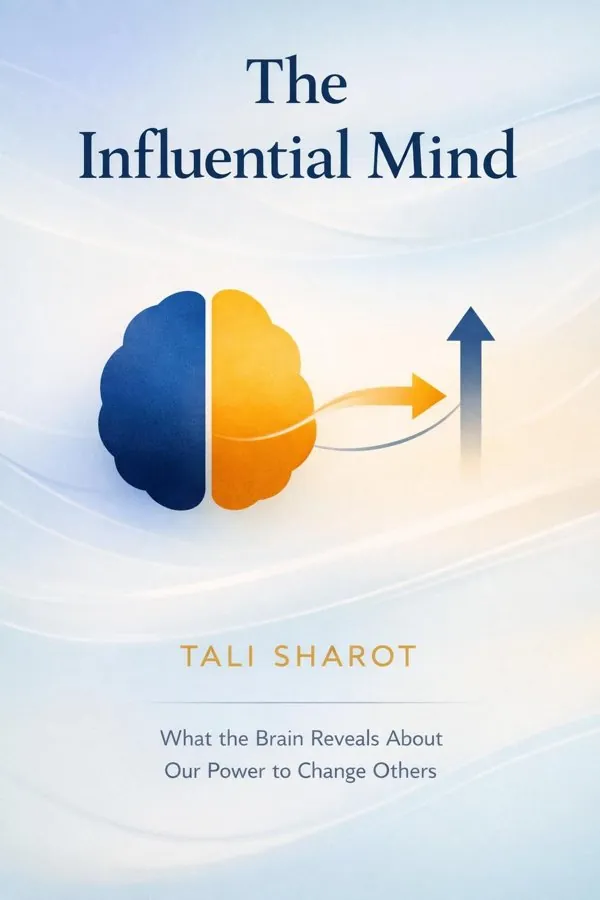
The Influential Mind: What the Brain Reveals About Our Power to Change Others: Summary & Key Insights
by Tali Sharot
 10 min9 chaptersAudio available
Key Takeaways from The Influential Mind: What the Brain Reveals About Our Power to Change Others
One of the most uncomfortable truths about influence is that information is not the same as persuasion.
People like to imagine they make decisions with reason and then sprinkle in feeling afterward.
A surprising source of influence is the brain’s tendency toward optimism.
Much of what we think, choose, and do is shaped by what we see other people doing.
We often assume certainty persuades and uncertainty weakens a message.
What Is The Influential Mind: What the Brain Reveals About Our Power to Change Others About?
The Influential Mind: What the Brain Reveals About Our Power to Change Others by Tali Sharot is a cognition book spanning 11 pages. Why do smart, well-intentioned people so often fail to change other people’s minds? We present evidence, cite facts, and make logical arguments—yet our listener stays unconvinced. In The Influential Mind, cognitive neuroscientist Tali Sharot explains that persuasion is not mainly a battle of information, but a process shaped by emotion, social connection, reward, threat, and the brain’s built-in biases. Drawing on neuroscience, psychology, and behavioral economics, she shows why facts alone rarely work, why optimism can be more persuasive than fear, and why people resist influence when they feel controlled. This book matters because influence is part of everyday life. We try to persuade colleagues, motivate children, encourage healthier habits, sell ideas, lead teams, and advocate for causes. Sharot offers a science-based guide to doing that more effectively and ethically. As a professor of cognitive neuroscience at University College London and a leading researcher on decision-making, emotion, and optimism, she brings both academic rigor and practical clarity. The result is a highly readable exploration of how minds change—and how they usually don’t.
This FizzRead summary covers all 9 key chapters of The Influential Mind: What the Brain Reveals About Our Power to Change Others in approximately 10 minutes, distilling the most important ideas, arguments, and takeaways from Tali Sharot's work. Also available as an audio summary and Key Quotes Podcast.
The Influential Mind: What the Brain Reveals About Our Power to Change Others
Why do smart, well-intentioned people so often fail to change other people’s minds? We present evidence, cite facts, and make logical arguments—yet our listener stays unconvinced. In The Influential Mind, cognitive neuroscientist Tali Sharot explains that persuasion is not mainly a battle of information, but a process shaped by emotion, social connection, reward, threat, and the brain’s built-in biases. Drawing on neuroscience, psychology, and behavioral economics, she shows why facts alone rarely work, why optimism can be more persuasive than fear, and why people resist influence when they feel controlled.
This book matters because influence is part of everyday life. We try to persuade colleagues, motivate children, encourage healthier habits, sell ideas, lead teams, and advocate for causes. Sharot offers a science-based guide to doing that more effectively and ethically. As a professor of cognitive neuroscience at University College London and a leading researcher on decision-making, emotion, and optimism, she brings both academic rigor and practical clarity. The result is a highly readable exploration of how minds change—and how they usually don’t.
Who Should Read The Influential Mind: What the Brain Reveals About Our Power to Change Others?
This book is perfect for anyone interested in cognition and looking to gain actionable insights in a short read. Whether you're a student, professional, or lifelong learner, the key ideas from The Influential Mind: What the Brain Reveals About Our Power to Change Others by Tali Sharot will help you think differently.
- ✓Readers who enjoy cognition and want practical takeaways
- ✓Professionals looking to apply new ideas to their work and life
- ✓Anyone who wants the core insights of The Influential Mind: What the Brain Reveals About Our Power to Change Others in just 10 minutes
Want the full summary?
Get instant access to this book summary and 100K+ more with Fizz Moment.
Get Free SummaryAvailable on App Store • Free to download
Key Chapters
One of the most uncomfortable truths about influence is that information is not the same as persuasion. People often assume that if others simply had the right facts, they would update their beliefs and behavior. But Sharot shows that the brain does not treat all information equally. We are more receptive to evidence that confirms what we already think, and more likely to discount data that threatens our identity, habits, or worldview. In other words, facts enter a mind that is already structured by emotion, prior belief, and self-protection.
This helps explain why public health campaigns, workplace initiatives, and political debates so often fall flat. Telling smokers about cancer risks, employees about low savings rates, or citizens about policy statistics may provide accurate information without producing meaningful change. The problem is not ignorance alone; it is that information that feels irrelevant, hostile, or identity-threatening gets filtered out.
Sharot does not argue that facts are useless. Rather, she argues that facts need the right psychological vehicle. They become more persuasive when tied to values people already care about, delivered by trusted messengers, and framed in ways that reduce defensiveness. A doctor who links exercise to playing with grandchildren may persuade more effectively than one who cites abstract health probabilities. A manager who connects a new policy to team pride may succeed where spreadsheets fail.
Actionable takeaway: Before presenting facts, ask what beliefs, emotions, and identities your listener brings to the conversation, then frame your evidence in a way that feels personally relevant and nonthreatening.
People like to imagine they make decisions with reason and then sprinkle in feeling afterward. The brain usually works the other way around. Emotion directs attention, strengthens memory, and signals what matters. Sharot explains that when a message triggers feeling—hope, curiosity, empathy, concern, excitement—it becomes more mentally vivid and more likely to guide action. Dry rational appeals may be understood, but they are often quickly forgotten.
This is why stories are more persuasive than statistics alone. A single vivid example can mobilize concern in ways that a large data set cannot, not because the example is more representative, but because it is emotionally legible. A nonprofit fundraising appeal built around one family’s experience often outperforms a broad description of a social issue. A leader inspiring a team through a meaningful narrative can create motivation that a performance dashboard never will.
Emotion also shapes interpersonal influence. If people feel judged, they close off. If they feel understood, they open up. Even difficult conversations become more productive when emotional tone is managed well. Parents, teachers, and managers who acknowledge feelings before giving advice are more likely to be heard.
Sharot’s broader point is not that we should manipulate people through emotional theatrics. It is that the human brain naturally prioritizes information that carries emotional significance. Ignoring that fact leads to ineffective communication.
Actionable takeaway: When you want to persuade, do not just ask, “Is my argument logical?” Also ask, “What will my listener feel, and will that feeling make the message memorable and motivating?”
A surprising source of influence is the brain’s tendency toward optimism. Sharot’s earlier research on optimism informs this book’s central insight: people are often more willing to absorb information that suggests a better future than information that predicts pain, loss, or failure. The brain does not neutrally weigh all incoming evidence. It tends to update more readily when the news is favorable.
This matters because many attempts at persuasion rely on warnings. We tell people what could go wrong if they do not change: disease, debt, failure, conflict, environmental disaster. Such messages can capture attention, but they do not always generate constructive action. If the threat feels distant, overwhelming, or uncontrollable, people may dismiss it, minimize it, or avoid thinking about it altogether.
By contrast, messages that highlight achievable gains can be far more effective. A financial advisor may get better results by emphasizing the security and freedom that savings create rather than the catastrophe of not saving. A fitness coach may motivate more consistently by focusing on energy, confidence, and progress instead of shame. A leader introducing change may gain support by painting a credible picture of improvement.
Optimism works best when it is realistic. Empty positivity erodes trust. The goal is to help people see a better outcome that feels both desirable and attainable. Hope becomes influential when paired with a clear path.
Actionable takeaway: When encouraging change, frame it around meaningful gains and realistic improvement rather than relying mainly on warnings about what people should fear.
We often assume certainty persuades and uncertainty weakens a message. Sharot complicates that view. The brain is highly sensitive to uncertainty because uncertainty signals that something important may be happening. Not knowing what comes next can heighten attention, increase arousal, and make outcomes feel especially significant.
This principle helps explain why suspense grabs us, why variable rewards are so compelling, and why people obsess over ambiguous feedback. In influence terms, uncertainty can either engage or unsettle. A leader announcing vague organizational changes may trigger anxiety and rumor. A teacher posing a puzzle before revealing the answer can intensify curiosity. A salesperson who creates intrigue may hold attention, but too much ambiguity can undermine trust.
The key is in how uncertainty is managed. When uncertainty is paired with possibility and a path forward, it can energize people. When it is paired with powerlessness, it often produces stress. Consider health communication: vague threats such as “you may be at risk” can provoke fear without action, while a message that explains what is unknown, what is known, and what steps can be taken is more constructive.
Sharot’s insight is that influence is not only about what people know, but also about how they experience the unknown. Good communicators use uncertainty to spark interest, then reduce it in ways that build clarity and confidence.
Actionable takeaway: Use uncertainty to create curiosity or focus attention, but quickly pair it with clear guidance so people feel engaged rather than helpless.
If you want someone to change, your instinct may be to warn them about consequences. But Sharot shows that the brain often responds more effectively to reward than to punishment. Anticipating a positive outcome activates motivational systems that energize action, learning, and persistence. Threat, by contrast, can narrow attention and produce short-term compliance, avoidance, or shutdown rather than sustained change.
This does not mean consequences never matter. In urgent situations, fear can prompt immediate reaction. But as a long-term strategy for influencing behavior, reward tends to be more reliable. Employees work more creatively when they feel progress and recognition, not constant fear of criticism. Children learn better when good behavior is noticed and reinforced, not only when bad behavior is punished. People trying to build habits do better when they can feel immediate wins, not just distant obligations.
Reward is not limited to money or prizes. Social approval, autonomy, mastery, meaning, and visible progress can all function as powerful incentives. A language-learning app that celebrates streaks and small gains often keeps users engaged longer than one that merely reminds them of failure. A manager who highlights improvement and competence may get better performance than one who focuses only on errors.
Sharot’s broader message is that influence works best when people can imagine and experience benefits. Positive reinforcement tells the brain, “Move toward this.”
Actionable takeaway: Design your messages, systems, and feedback around visible rewards—progress, recognition, meaning, and achievable benefits—rather than relying primarily on criticism or penalties.
Fear gets attention, but attention is not the same as transformation. Sharot explains that threat-related messages can be effective only under specific conditions. If people perceive a danger and also believe there is a clear, doable action they can take, fear may motivate change. But when a threat feels overwhelming, remote, or uncontrollable, the brain often protects itself through denial, avoidance, or numbing.
This is why many fear-based campaigns fail. Graphic warnings about health risks may momentarily disturb people without changing behavior if they do not feel capable of quitting, changing diet, or seeking help. Dire organizational warnings can demoralize a team if employees feel they have no influence over the outcome. In personal relationships, repeated alarm or criticism can cause defensiveness rather than growth.
The missing ingredient is efficacy. People need to believe, “There is something I can do, and it will matter.” A climate message that only emphasizes catastrophe can paralyze; one that combines urgency with specific actions, community progress, and practical steps is more likely to mobilize. A doctor warning about diabetes risk will be more persuasive if the warning is paired with concrete, manageable changes and support.
Fear can open the door, but only control lets people walk through it. Sustainable influence requires moving from alarm to agency.
Actionable takeaway: If you use threat information, always pair it with a practical, realistic action plan so people feel capable of responding rather than tempted to disengage.
Nothing activates resistance faster than the feeling of being controlled. Sharot argues that people are more likely to accept influence when they retain a sense of agency. The brain values autonomy deeply; when choice is threatened, even good advice can feel like an attack. This is why direct orders, pressure, and coercive messaging often trigger stubbornness rather than cooperation.
The effect appears across domains. Patients are more likely to follow treatment when doctors involve them in decisions. Employees are more committed to change when leaders invite input rather than impose plans from above. Teenagers often reject sensible guidance if it comes packaged as domination. In each case, the content of the message matters less than whether the person feels respected as an active participant.
Autonomy does not mean abandoning standards or never making requests. It means structuring influence so people can see options, make choices, and connect actions to their own goals. Even small degrees of control can increase receptivity: asking someone which of two next steps they prefer, inviting them to set the timeline, or framing a suggestion as a tool rather than a command.
This principle also has ethical importance. Influence becomes healthier when it supports people’s capacity to choose rather than bypassing it. Sharot’s science points toward persuasion that is both more effective and more humane.
Actionable takeaway: To reduce resistance, offer choices, invite participation, and connect your message to the other person’s own goals instead of relying on pressure or command.
The same idea can succeed or fail depending on who says it and how it is framed. Sharot highlights that influence is never just about content. The brain evaluates the source of a message for trustworthiness, similarity, expertise, and intent. It also responds differently depending on whether information is framed as a gain or a loss, a norm or an exception, a threat or an opportunity.
Messenger effects are everywhere. People are more persuaded by those they trust, identify with, or perceive as acting in their interest. This is why peer advocates can outperform official authorities, and why a familiar colleague may sell an idea internally better than a senior executive. Expertise matters, but so does warmth. A source seen as knowledgeable but hostile may not persuade; one seen as well-meaning and credible often can.
Framing shapes meaning before reasoning even begins. Saying a treatment has a 90 percent survival rate feels different from saying it has a 10 percent mortality rate, even though the statistics are equivalent. Describing a workplace change as an opportunity to improve service may be received differently than presenting it as a response to failure. Good framing does not distort reality; it highlights the aspect of reality most likely to motivate thoughtful action.
Sharot’s practical lesson is that persuasion is contextual. Effective influence requires attention to trust, identity, timing, wording, and emotional tone—not just the strength of the argument itself.
Actionable takeaway: Match important messages with the right messenger and frame them in terms of meaningful gains, trusted relationships, and shared values.
All Chapters in The Influential Mind: What the Brain Reveals About Our Power to Change Others
About the Author
Tali Sharot is a cognitive neuroscientist, author, and professor at University College London whose work focuses on how people make decisions, process emotion, form beliefs, and influence one another. She is especially known for her research on optimism bias—the tendency to expect positive outcomes even when evidence is mixed—as well as for studies on learning, risk, and social behavior. Sharot has held research positions at leading institutions, including MIT, and has become a prominent public voice in applying neuroscience to real-world questions. Her writing and talks translate academic research into accessible insights about human behavior. In both The Influential Mind and her earlier book The Optimism Bias, she combines scientific rigor with practical relevance, helping readers understand why people think, choose, and respond the way they do.
Get This Summary in Your Preferred Format
Read or listen to the The Influential Mind: What the Brain Reveals About Our Power to Change Others summary by Tali Sharot anytime, anywhere. FizzRead offers multiple formats so you can learn on your terms — all free.
Available formats: App · Audio · PDF · EPUB — All included free with FizzRead
Download The Influential Mind: What the Brain Reveals About Our Power to Change Others PDF and EPUB Summary
Key Quotes from The Influential Mind: What the Brain Reveals About Our Power to Change Others
“One of the most uncomfortable truths about influence is that information is not the same as persuasion.”
“People like to imagine they make decisions with reason and then sprinkle in feeling afterward.”
“A surprising source of influence is the brain’s tendency toward optimism.”
“Much of what we think, choose, and do is shaped by what we see other people doing.”
“We often assume certainty persuades and uncertainty weakens a message.”
Frequently Asked Questions about The Influential Mind: What the Brain Reveals About Our Power to Change Others
The Influential Mind: What the Brain Reveals About Our Power to Change Others by Tali Sharot is a cognition book that explores key ideas across 9 chapters. Why do smart, well-intentioned people so often fail to change other people’s minds? We present evidence, cite facts, and make logical arguments—yet our listener stays unconvinced. In The Influential Mind, cognitive neuroscientist Tali Sharot explains that persuasion is not mainly a battle of information, but a process shaped by emotion, social connection, reward, threat, and the brain’s built-in biases. Drawing on neuroscience, psychology, and behavioral economics, she shows why facts alone rarely work, why optimism can be more persuasive than fear, and why people resist influence when they feel controlled. This book matters because influence is part of everyday life. We try to persuade colleagues, motivate children, encourage healthier habits, sell ideas, lead teams, and advocate for causes. Sharot offers a science-based guide to doing that more effectively and ethically. As a professor of cognitive neuroscience at University College London and a leading researcher on decision-making, emotion, and optimism, she brings both academic rigor and practical clarity. The result is a highly readable exploration of how minds change—and how they usually don’t.
More by Tali Sharot
You Might Also Like

A Field Guide to Lies: Critical Thinking in the Information Age
Daniel J. Levitin
10 min
A Theory of Cognitive Dissonance
Leon Festinger
10 min
Black-And-White Thinking: The Burden of a Binary Brain in a Complex World
Kevin Dutton
10 min
Born Liars: Why We Can’t Live Without Deceit
Ian Leslie
10 min
Collective Illusions: Conformity, Complicity, and the Science of Why We Make Bad Decisions
Todd Rose
10 min
Concrete Mathematics: A Foundation for Computer Science
Ronald L. Graham, Donald E. Knuth, Oren Patashnik
10 minBrowse by Category
Ready to read The Influential Mind: What the Brain Reveals About Our Power to Change Others?
Get the full summary and 100K+ more books with Fizz Moment.