
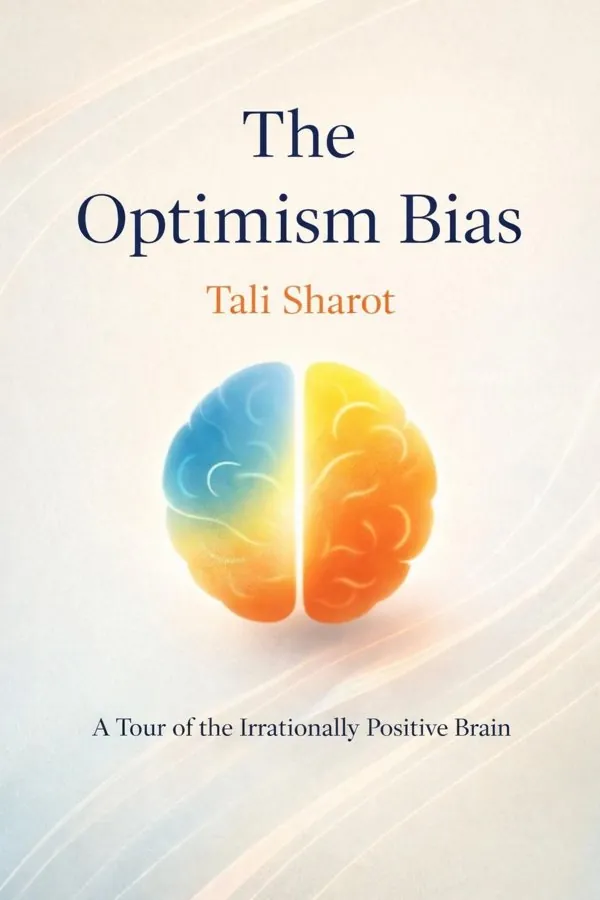
The Optimism Bias: A Tour of the Irrationally Positive Brain: Summary & Key Insights
by Tali Sharot
 10 min9 chaptersAudio available
What Is The Optimism Bias: A Tour of the Irrationally Positive Brain About?
The Optimism Bias: A Tour of the Irrationally Positive Brain by Tali Sharot is a neuroscience book spanning 9 pages. In this book, neuroscientist Tali Sharot explores the biological and psychological foundations of optimism. Drawing on her research in cognitive neuroscience, she explains how the brain generates hope, why humans tend to overestimate positive outcomes, and how this bias affects decision-making, memory, and emotional well-being. The work combines scientific insight with accessible storytelling to reveal how optimism shapes human behavior and survival.
This FizzRead summary covers all 9 key chapters of The Optimism Bias: A Tour of the Irrationally Positive Brain in approximately 10 minutes, distilling the most important ideas, arguments, and takeaways from Tali Sharot's work. Also available as an audio summary and Key Quotes Podcast.
The Optimism Bias: A Tour of the Irrationally Positive Brain
In this book, neuroscientist Tali Sharot explores the biological and psychological foundations of optimism. Drawing on her research in cognitive neuroscience, she explains how the brain generates hope, why humans tend to overestimate positive outcomes, and how this bias affects decision-making, memory, and emotional well-being. The work combines scientific insight with accessible storytelling to reveal how optimism shapes human behavior and survival.
Who Should Read The Optimism Bias: A Tour of the Irrationally Positive Brain?
This book is perfect for anyone interested in neuroscience and looking to gain actionable insights in a short read. Whether you're a student, professional, or lifelong learner, the key ideas from The Optimism Bias: A Tour of the Irrationally Positive Brain by Tali Sharot will help you think differently.
- ✓Readers who enjoy neuroscience and want practical takeaways
- ✓Professionals looking to apply new ideas to their work and life
- ✓Anyone who wants the core insights of The Optimism Bias: A Tour of the Irrationally Positive Brain in just 10 minutes
Want the full summary?
Get instant access to this book summary and 100K+ more with Fizz Moment.
Get Free SummaryAvailable on App Store • Free to download
Key Chapters
It may seem counterintuitive that an organism would evolve to see the world through rose-colored glasses. Yet when we look closely at the forces that shaped human survival, optimism emerges as a powerful adaptive advantage. Early humans faced uncertainty at every turn: predators, disease, famine. Those who believed the future held a chance of success were more likely to persevere—to hunt again after failure, to venture into unknown territories, to form alliances. Optimists did not simply dream; they acted. Their readiness to expect a positive outcome often became a self-fulfilling prophecy.
In psychological terms, optimism enhances motivation. People who anticipate success invest more effort and persist longer. This persistence increases the odds of actual success, reinforcing the optimistic mindset. Across evolution, this feedback loop likely selected for individuals whose brains tilted slightly toward hope. Optimism also promotes social cooperation. Groups led by hopeful visionaries tend to unite around shared goals, an advantage in both prehistoric survival and modern collective action. Thus, while the pessimists may sometimes be right about danger, it is often the optimists who rewrite the story of humanity.
Understanding optimism requires peering into the brain itself. Through imaging studies, we can see that the optimism bias is not abstract—it is biologically embedded. When individuals contemplate their personal future, certain regions light up on brain scans: notably the prefrontal cortex, especially the rostral anterior cingulate cortex, and the amygdala. These regions are deeply involved in emotional evaluation, error correction, and belief updating. Interestingly, when participants imagine positive events, neural activity in these regions increases, indicating that optimism is not merely a belief but an active neural process.
In my research, I found that the brain’s ability to maintain optimism depends on how it processes information about risk and reward. The prefrontal cortex weighs incoming evidence about the future, but it tends to integrate good news more readily than bad. This asymmetry—known as the optimism bias mechanism—exists because our brain’s error-monitoring systems are less responsive to undesirable information. It’s as if our minds automatically dampen signals of doom to maintain emotional balance.
These findings challenge the assumption that rationality requires detachment from emotion. Emotions and beliefs are tightly coupled. Optimism, it turns out, is not a distortion of logic; it is a reflection of how the emotional brain prioritizes information that sustains motivation and well-being.
+ 7 more chapters — available in the FizzRead app
All Chapters in The Optimism Bias: A Tour of the Irrationally Positive Brain
About the Author
Tali Sharot is a cognitive neuroscientist and professor at University College London. Her research focuses on emotion, decision-making, and the neural mechanisms underlying optimism and belief formation. She has published widely in scientific journals and is known for her ability to translate complex neuroscience into engaging public discourse.
Get This Summary in Your Preferred Format
Read or listen to the The Optimism Bias: A Tour of the Irrationally Positive Brain summary by Tali Sharot anytime, anywhere. FizzRead offers multiple formats so you can learn on your terms — all free.
Available formats: App · Audio · PDF · EPUB — All included free with FizzRead
Download The Optimism Bias: A Tour of the Irrationally Positive Brain PDF and EPUB Summary
Key Quotes from The Optimism Bias: A Tour of the Irrationally Positive Brain
“It may seem counterintuitive that an organism would evolve to see the world through rose-colored glasses.”
“Understanding optimism requires peering into the brain itself.”
Frequently Asked Questions about The Optimism Bias: A Tour of the Irrationally Positive Brain
The Optimism Bias: A Tour of the Irrationally Positive Brain by Tali Sharot is a neuroscience book that explores key ideas across 9 chapters. In this book, neuroscientist Tali Sharot explores the biological and psychological foundations of optimism. Drawing on her research in cognitive neuroscience, she explains how the brain generates hope, why humans tend to overestimate positive outcomes, and how this bias affects decision-making, memory, and emotional well-being. The work combines scientific insight with accessible storytelling to reveal how optimism shapes human behavior and survival.
More by Tali Sharot
You Might Also Like

Anxious
Joseph LeDoux
10 min
Hallucinations
Oliver Sacks
10 min
The Biological Mind: How Brain, Body, and Environment Collaborate to Make Us Who We Are
Alan Jasanoff
10 min
The Feeling of Life Itself: Why Consciousness Is Widespread but Can't Be Computed
Christof Koch
10 min
The No-Nonsense Meditation Book
Steven Laureys
10 min
A General Theory of Love
Thomas Lewis, Fari Amini, Richard Lannon
10 minBrowse by Category
Ready to read The Optimism Bias: A Tour of the Irrationally Positive Brain?
Get the full summary and 100K+ more books with Fizz Moment.