
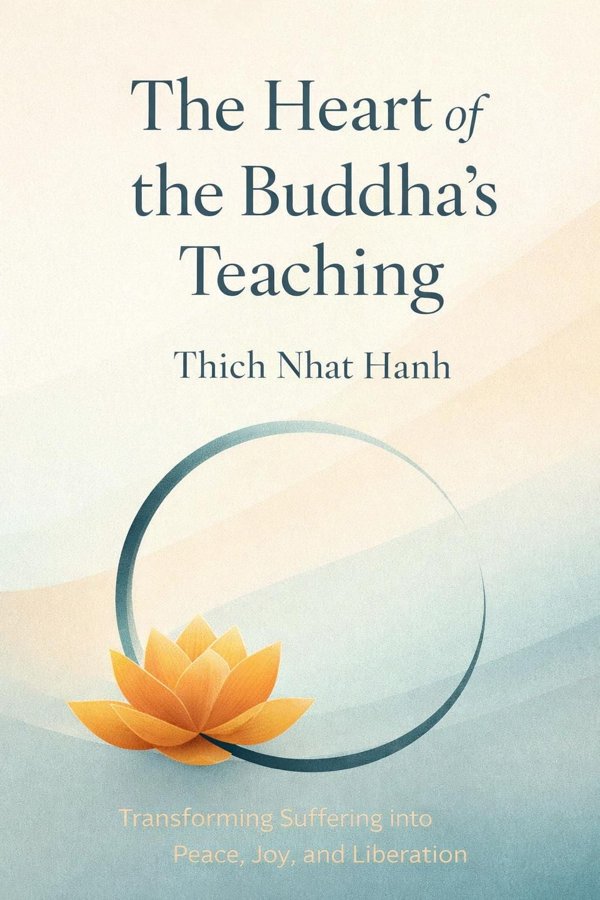
The Heart of the Buddha's Teaching: Transforming Suffering into Peace, Joy, and Liberation: Summary & Key Insights
 10 min5 chaptersAudio available
What Is The Heart of the Buddha's Teaching: Transforming Suffering into Peace, Joy, and Liberation About?
The Heart of the Buddha's Teaching: Transforming Suffering into Peace, Joy, and Liberation by Thich Nhat Hanh is a eastern_wisdom book spanning 5 pages. In this foundational work, Vietnamese Zen master Thich Nhat Hanh presents the core teachings of the Buddha in clear, accessible language. He explains key concepts such as the Four Noble Truths, the Noble Eightfold Path, and the Three Dharma Seals, offering practical guidance for transforming suffering into peace and happiness through mindfulness and compassion.
This FizzRead summary covers all 5 key chapters of The Heart of the Buddha's Teaching: Transforming Suffering into Peace, Joy, and Liberation in approximately 10 minutes, distilling the most important ideas, arguments, and takeaways from Thich Nhat Hanh's work. Also available as an audio summary and Key Quotes Podcast.
The Heart of the Buddha's Teaching: Transforming Suffering into Peace, Joy, and Liberation
In this foundational work, Vietnamese Zen master Thich Nhat Hanh presents the core teachings of the Buddha in clear, accessible language. He explains key concepts such as the Four Noble Truths, the Noble Eightfold Path, and the Three Dharma Seals, offering practical guidance for transforming suffering into peace and happiness through mindfulness and compassion.
Who Should Read The Heart of the Buddha's Teaching: Transforming Suffering into Peace, Joy, and Liberation?
This book is perfect for anyone interested in eastern_wisdom and looking to gain actionable insights in a short read. Whether you're a student, professional, or lifelong learner, the key ideas from The Heart of the Buddha's Teaching: Transforming Suffering into Peace, Joy, and Liberation by Thich Nhat Hanh will help you think differently.
- ✓Readers who enjoy eastern_wisdom and want practical takeaways
- ✓Professionals looking to apply new ideas to their work and life
- ✓Anyone who wants the core insights of The Heart of the Buddha's Teaching: Transforming Suffering into Peace, Joy, and Liberation in just 10 minutes
Want the full summary?
Get instant access to this book summary and 100K+ more with Fizz Moment.
Get Free SummaryAvailable on App Store • Free to download
Key Chapters
When the Buddha first spoke, his words arose from direct insight into human suffering. The Four Noble Truths are not bleak proclamations of pain—they are maps of healing. The first truth tells us that life has suffering: birth, aging, sickness, and death touch us all. But this is not meant to make us despair; it is meant to help us see clearly. By acknowledging suffering, we begin to understand its nature and can therefore transform it.
The second truth reveals the origin of suffering—our attachment and craving, the desires that bind us to things impermanent. We suffer when we want life to be other than it is. The third truth offers hope: cessation is possible. When we stop feeding ignorance and desire, suffering ceases. The fourth truth points to the path—the Noble Eightfold Path—as the living practice by which we transform ourselves.
Understanding these truths is not merely intellectual. It requires mindfulness so that every experience, even pain, becomes a lesson in awareness. When we breathe and stay with our suffering, we begin to see the seeds of peace already present. We discover that suffering and happiness inter-are: without mud, there can be no lotus. The Four Noble Truths, therefore, are the heart of our transformation. They invite us to touch the mud with gentleness and patience, knowing that the lotus is waiting within.
The Noble Eightfold Path is the Buddha’s complete vision of how to live mindfully and compassionately in the world. It is composed of right view, right thinking, right speech, right action, right livelihood, right diligence, right mindfulness, and right concentration. Rather than seeing these steps as rigid commandments, we practice them as flowing aspects of one complete way of life, supporting one another in continuous harmony.
Right view begins with understanding the nature of reality—seeing impermanence, non-self, and interbeing. With right view, we don’t cling to opinions or prejudices; we see life as it truly is. Right thinking flows naturally from right view; it means nurturing thoughts of love, compassion, and understanding. Right speech arises when we speak in ways that build connection, refraining from lies, harsh words, or divisive talk. When our speech reflects mindfulness, our relationships flourish.
Right action and right livelihood bring our ethical awareness into daily practice. We act in ways that relieve suffering and pursue work that contributes to the well-being of others. Right diligence means maintaining effort—not in striving or tension, but in steady, joyful perseverance. Right mindfulness is the heart of the path; it anchors us in the present moment. Right concentration deepens that mindfulness into stillness, allowing wisdom to blossom naturally.
Walking this path, we find that it’s not about achieving some distant enlightenment. It’s about living beautifully, with compassion, right here and now.
+ 3 more chapters — available in the FizzRead app
All Chapters in The Heart of the Buddha's Teaching: Transforming Suffering into Peace, Joy, and Liberation
About the Author
Thich Nhat Hanh (1926–2022) was a Vietnamese Buddhist monk, peace activist, and founder of the Plum Village tradition. Renowned for his teachings on mindfulness and engaged Buddhism, he authored more than 100 books and was nominated for the Nobel Peace Prize by Martin Luther King Jr.
Get This Summary in Your Preferred Format
Read or listen to the The Heart of the Buddha's Teaching: Transforming Suffering into Peace, Joy, and Liberation summary by Thich Nhat Hanh anytime, anywhere. FizzRead offers multiple formats so you can learn on your terms — all free.
Available formats: App · Audio · PDF · EPUB — All included free with FizzRead
Download The Heart of the Buddha's Teaching: Transforming Suffering into Peace, Joy, and Liberation PDF and EPUB Summary
Key Quotes from The Heart of the Buddha's Teaching: Transforming Suffering into Peace, Joy, and Liberation
“When the Buddha first spoke, his words arose from direct insight into human suffering.”
“The Noble Eightfold Path is the Buddha’s complete vision of how to live mindfully and compassionately in the world.”
Frequently Asked Questions about The Heart of the Buddha's Teaching: Transforming Suffering into Peace, Joy, and Liberation
The Heart of the Buddha's Teaching: Transforming Suffering into Peace, Joy, and Liberation by Thich Nhat Hanh is a eastern_wisdom book that explores key ideas across 5 chapters. In this foundational work, Vietnamese Zen master Thich Nhat Hanh presents the core teachings of the Buddha in clear, accessible language. He explains key concepts such as the Four Noble Truths, the Noble Eightfold Path, and the Three Dharma Seals, offering practical guidance for transforming suffering into peace and happiness through mindfulness and compassion.
More by Thich Nhat Hanh
The Miracle of Mindfulness: An Introduction to the Practice of Meditation
Thich Nhat Hanh
10 min
The Heart of Understanding: Commentaries on the Prajñāpāramitā Heart Sutra
Thich Nhat Hanh
10 min
Anger: Wisdom for Cooling the Flames
Thich Nhat Hanh
10 min
Savor: Mindful Eating, Mindful Life
Thich Nhat Hanh, Lilian Cheung
10 minYou Might Also Like

A New Earth
Eckhart Tolle
10 min
The Daily Stoic
Ryan Holiday, Stephen Hanselman
10 min
Buddhism: Plain and Simple
Steve Hagen
10 min
Enchiridion
Epictetus
10 min
The Book of Tea
Kakuzō Okakura
10 min
The Light We Give: How Sikh Wisdom Can Transform Your Life
Simran Jeet Singh
10 minBrowse by Category
Ready to read The Heart of the Buddha's Teaching: Transforming Suffering into Peace, Joy, and Liberation?
Get the full summary and 100K+ more books with Fizz Moment.