
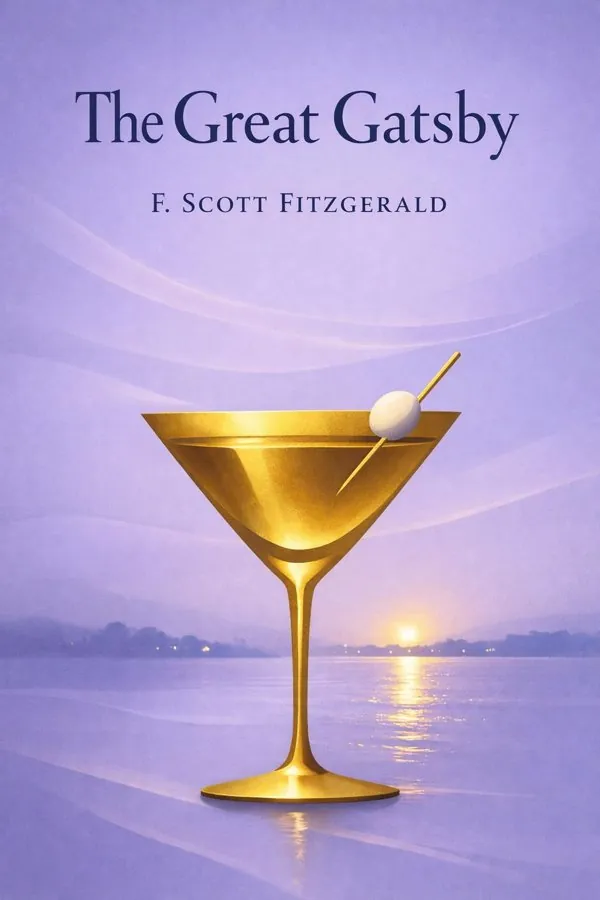
The Great Gatsby: Summary & Key Insights
 10 min9 chaptersAudio available
Key Takeaways from The Great Gatsby
A new place often reveals more about a society than those born into it ever notice.
Some people do not simply enter a story; they arrive as if they have already become a legend.
Money can buy access, but it cannot always buy acceptance.
Extravagance often looks like freedom, but it can also be a mask for emptiness.
The most dangerous dreams are often the ones that ask us to reverse time.
What Is The Great Gatsby About?
The Great Gatsby by F. Scott Fitzgerald is a fiction book published in 1925 spanning 4 pages. The Great Gatsby is a short novel with an unusually long shadow. Set in the glittering world of Long Island and New York during the Roaring Twenties, it follows Nick Carraway as he becomes entangled with his wealthy, enigmatic neighbor Jay Gatsby—a man who has built a dazzling life around a single impossible desire: to win back Daisy Buchanan, the woman he loved before the war. What begins as a story of romance and ambition gradually reveals itself as something darker: a study of class, self-invention, moral emptiness, and the fragile promises of the American Dream. Fitzgerald’s genius lies in how he turns parties, mansions, and social rituals into symbols of a culture intoxicated by money yet hollow at its core. More than a portrait of an era, the novel remains enduring because it asks timeless questions: Can we remake ourselves? Can love survive illusion? And what happens when our dreams are built on denial? Fitzgerald, one of the defining voices of the Jazz Age, gives these questions unforgettable emotional force.
This FizzRead summary covers all 9 key chapters of The Great Gatsby in approximately 10 minutes, distilling the most important ideas, arguments, and takeaways from F. Scott Fitzgerald's work. Also available as an audio summary and Key Quotes Podcast.
The Great Gatsby
The Great Gatsby is a short novel with an unusually long shadow. Set in the glittering world of Long Island and New York during the Roaring Twenties, it follows Nick Carraway as he becomes entangled with his wealthy, enigmatic neighbor Jay Gatsby—a man who has built a dazzling life around a single impossible desire: to win back Daisy Buchanan, the woman he loved before the war. What begins as a story of romance and ambition gradually reveals itself as something darker: a study of class, self-invention, moral emptiness, and the fragile promises of the American Dream. Fitzgerald’s genius lies in how he turns parties, mansions, and social rituals into symbols of a culture intoxicated by money yet hollow at its core. More than a portrait of an era, the novel remains enduring because it asks timeless questions: Can we remake ourselves? Can love survive illusion? And what happens when our dreams are built on denial? Fitzgerald, one of the defining voices of the Jazz Age, gives these questions unforgettable emotional force.
Who Should Read The Great Gatsby?
This book is perfect for anyone interested in fiction and looking to gain actionable insights in a short read. Whether you're a student, professional, or lifelong learner, the key ideas from The Great Gatsby by F. Scott Fitzgerald will help you think differently.
- ✓Readers who enjoy fiction and want practical takeaways
- ✓Professionals looking to apply new ideas to their work and life
- ✓Anyone who wants the core insights of The Great Gatsby in just 10 minutes
Want the full summary?
Get instant access to this book summary and 100K+ more with Fizz Moment.
Get Free SummaryAvailable on App Store • Free to download
Key Chapters
A new place often reveals more about a society than those born into it ever notice. Fitzgerald begins with Nick Carraway because Nick stands at the threshold: he is not fully innocent, but he is not yet corrupted either. Coming from the Midwest, where he associates life with steadiness, restraint, and a recognizable moral order, Nick moves East to learn the bond business and to participate in the energy of modern America. What he finds on Long Island is a divided world in which wealth determines not only comfort, but identity, belonging, and even the right to be taken seriously.
The contrast between East Egg and West Egg is one of the novel’s first major revelations. East Egg, home to Tom and Daisy Buchanan, represents inherited money, established status, and social confidence. West Egg, where Gatsby and Nick live, is newer, flashier, and socially suspect. Both are rich, but Fitzgerald insists that not all wealth carries the same meaning. Nick’s observations help readers see this distinction clearly. He is attracted by the glamour around him, yet he also senses something brittle and careless beneath the surface.
This idea still feels practical today. People continue to enter new industries, cities, and social circles believing success is straightforward, only to discover hidden hierarchies, coded behavior, and unequal access. Nick’s experience reminds us that every environment has visible and invisible rules.
Actionable takeaway: When entering a new world—professional, social, or cultural—observe before you imitate. Notice who holds power, what values are rewarded, and what moral compromises are being normalized.
Some people do not simply enter a story; they arrive as if they have already become a legend. Gatsby’s introduction is carefully delayed, and that delay matters. Before we meet him, we hear rumors: he may be a spy, a murderer, an Oxford man, a criminal. By the time he finally appears—gracious, smiling, almost improbably self-possessed—he feels less like a person than a performance. Fitzgerald uses that effect to show how modern identity can be manufactured. Gatsby has created himself so completely that even those who party in his mansion know almost nothing real about him.
But beneath the mystery is a simple and devastating truth: Gatsby has built his fortune for Daisy Buchanan. His parties are not celebrations of joy, but acts of hope. He buys the mansion across the bay so he can remain physically close to the life he lost. His wealth, clothing, speech, and social position all serve one emotional aim: to make himself worthy of being loved again by the woman who once represented beauty, status, and possibility.
This makes Gatsby deeply romantic, but also deeply tragic. His devotion is not directed toward Daisy as she really is in the present. It is directed toward an idealized Daisy preserved in memory. In modern life, people often do something similar—rebuild themselves for an imagined reunion, a lost version of success, or the approval of someone from the past.
Actionable takeaway: Ask whether your ambition serves your present values or an old fantasy. Reinvention can be powerful, but not when it is chained to an illusion.
Money can buy access, but it cannot always buy acceptance. One of the novel’s sharpest insights is that wealth is not a single category. Gatsby becomes fabulously rich, yet he never fully enters the world of people like Tom and Daisy. He can imitate their style, host larger parties, wear finer clothes, and own a grander car, but class in Fitzgerald’s world is cultural as much as financial. Tom represents inherited privilege—the kind that feels entitled, secure, and contemptuous. Gatsby represents earned or acquired wealth, and because it is self-made, it is treated as theatrical, suspect, and somehow illegitimate.
This distinction drives much of the novel’s tension. Tom immediately senses Gatsby as a threat, not simply because of Daisy, but because Gatsby violates the unspoken rules of class. Gatsby’s existence suggests that identity can be constructed and status can be challenged. Tom responds by defending his social position with cruelty, racism, and moral hypocrisy. Fitzgerald exposes how elites often protect themselves by pretending their advantages are natural rather than inherited.
The practical relevance is obvious. In many societies today, credentials, accent, taste, education, family background, and networks still shape opportunity. People may be told that success is open to everyone, yet informal gatekeeping remains powerful. The novel helps us see that inequality is maintained not only through money, but through belonging.
Actionable takeaway: Learn to distinguish between achievement and social permission. If you feel excluded despite success, the barrier may not be personal failure—it may be a system designed to preserve hierarchy.
Extravagance often looks like freedom, but it can also be a mask for emptiness. Gatsby’s parties are among the most famous scenes in American fiction because they capture the seduction and shallowness of spectacle. Guests arrive uninvited, drink his alcohol, gossip about him, dance until dawn, and disappear without gratitude or loyalty. The mansion glows with music and abundance, yet the atmosphere is strangely impersonal. People consume the experience without caring about the person who makes it possible.
Fitzgerald uses these scenes to critique a culture that confuses display with meaning. Gatsby’s hospitality is less about community than about signaling wealth and creating a stage on which Daisy might reappear. The guests, meanwhile, treat luxury as entertainment detached from responsibility. The result is a world where surfaces are vivid but relationships are thin.
This feels remarkably current in an age of curated lifestyles, social media image-making, and performative success. Many people spend enormous energy projecting a life of excitement, taste, and abundance, while privately feeling lonely or directionless. Fitzgerald understood that glamour can intensify isolation when it replaces genuine connection.
A practical example: think of networking events, online branding, or status-driven consumption. These can be useful tools, but they become dangerous when the performance overtakes the person. Gatsby is admired by crowds but truly known by almost no one.
Actionable takeaway: Build fewer spectacles and more real relationships. Ask whether what you are displaying is bringing people closer to you—or merely attracting attention without loyalty.
The most dangerous dreams are often the ones that ask us to reverse time. Gatsby’s love for Daisy is not only intense; it is structured around an impossible belief that the past can be perfectly recovered. He does not merely want Daisy in the present. He wants to erase the years, undo her marriage, and restore the emotional purity of their earlier romance. When Nick tells him, “You can’t repeat the past,” Gatsby responds with disbelief. That response captures the novel’s emotional core: he is not pursuing reality, but restoration.
Fitzgerald shows how memory transforms desire. Gatsby has idealized Daisy into a symbol of everything he lacked—beauty, status, legitimacy, and emotional fulfillment. The longer he waits, the more powerful the symbol becomes. By the time they reunite, no real person could bear the weight of what he has projected onto her. Daisy inevitably disappoints him, not because she changes suddenly, but because she was never equal to the dream.
This pattern is deeply recognizable. People often romanticize former relationships, past careers, childhood homes, or earlier versions of themselves. They forget the complexity and retain only the emotional glow. Rebuilding life around such nostalgia can lead to self-deception and poor decisions.
The practical application is simple but difficult: honor the past without demanding that it return unchanged. Memory can guide us, but it should not govern us.
Actionable takeaway: When you long for something you lost, ask whether you miss the reality or the meaning you attached to it. That distinction can protect you from chasing ghosts.
The novel’s moral indictment falls most heavily on people who let others absorb the consequences of their choices. Tom and Daisy are not the most dramatic characters, but they may be the most destructive. They move through life protected by money, social position, and emotional irresponsibility. They betray each other, manipulate others, create chaos, and then retreat into privilege when the damage becomes serious. Fitzgerald’s famous judgment of them as “careless people” is one of the novel’s clearest ethical statements.
Their carelessness stands in contrast to Gatsby’s intensity. Gatsby is flawed, deluded, and complicit in questionable business, but he cares deeply. Tom and Daisy care selectively, and usually only when their comfort is threatened. This distinction matters because Fitzgerald is not simply contrasting rich and poor, or dreamers and cynics. He is exposing a deeper moral failure: the refusal to take responsibility for the lives one affects.
This idea remains highly relevant. In workplaces, families, politics, and public life, some people generate disorder and rely on status, charm, or resources to avoid accountability. The harm may then fall on those with less power. The novel asks us to notice this pattern and refuse to glamorize it.
Practical examples include leaders who make reckless decisions and leave others to clean up the aftermath, or individuals who exploit emotional relationships without honesty. Fitzgerald reminds us that charm without accountability is dangerous.
Actionable takeaway: Judge people less by polish or confidence and more by what happens around them. Ask who pays the price for their behavior—and whether they ever do.
Every glittering center creates a neglected margin. Between the mansions of Long Island and the energy of Manhattan lies the Valley of Ashes, one of the novel’s most haunting images. It is a gray industrial wasteland where dust, labor, and exhaustion accumulate—an environment inhabited by George and Myrtle Wilson, whose lives stand in stark contrast to the ease of the wealthy. The Valley of Ashes is not just a setting; it is Fitzgerald’s visual argument that prosperity for some is built on waste, invisibility, and human diminishment for others.
The characters who pass through this space rarely truly see it. For Tom, it is a convenient route to his affair. For the rich, it is a corridor between pleasures. For the Wilsons, it is inescapable reality. This difference in perception is central to the novel’s critique. The same society that celebrates self-invention and abundance also produces exhaustion, social immobility, and despair.
The eyes of Doctor T. J. Eckleburg—faded and watchful above the wasteland—intensify the sense of spiritual emptiness. Whether they symbolize God, judgment, or only the absence of meaning, they remind readers that the modern world can be materially developed yet morally vacant.
Today, the Valley of Ashes can be read as any hidden cost behind comfort: underpaid labor, environmental damage, burnout, or communities excluded from economic growth. Fitzgerald asks us to look at what prosperity prefers to hide.
Actionable takeaway: Whenever something appears glamorous or efficient, ask what invisible labor, suffering, or neglect makes it possible. Ethical clarity begins with seeing what the culture edits out.
Dreams become destructive when reality is forced to submit to them. In the novel’s final movement, Gatsby’s idealism collides with the hard facts of character, class, and consequence. He believes Daisy will renounce her husband, declare she never loved him, and step into the future he has prepared. But Daisy cannot perform the absolute emotional clarity Gatsby demands. She is too compromised, too weak, and too attached to comfort. In that moment, the dream begins to break—not because desire itself is foolish, but because Gatsby has confused longing with truth.
Fitzgerald is careful here. He does not mock aspiration. Gatsby’s capacity to hope is, in some sense, noble. What destroys him is his insistence that the world must validate his private myth. He cannot accept that Daisy is human, that time has passed, and that love cannot be recreated by force of belief alone. The tragedy is therefore both social and psychological: the world is cruel, but Gatsby also participates in his own undoing.
This has practical value beyond literature. Many people suffer when they attach identity to a single outcome—a promotion, a relationship, a public success, a life plan—and interpret anything less as total failure. When ideals become rigid, they stop guiding us and start ruling us.
A healthier version of ambition allows for revision. It preserves passion but admits reality, feedback, and change. Gatsby never learns this flexibility.
Actionable takeaway: Pursue your ideals intensely, but hold your scripts loosely. If a dream requires denying reality, the dream may need to evolve before it destroys you.
Symbols endure when they compress an entire philosophy into a single image. The green light at the end of Daisy’s dock is the novel’s most famous symbol because it represents longing in its purest and most elusive form. For Gatsby, it is Daisy, the future, success, completion, and arrival—all shimmering just beyond reach. Its power lies in distance. Once Daisy is physically near him again, the light loses some of its enchantment, suggesting that dreams often depend on separation more than possession.
The green light also expands beyond Gatsby’s private desire into a meditation on the American Dream. America promises reinvention, mobility, and the possibility of self-made greatness. Gatsby appears to embody that promise: he creates a new identity, acquires wealth, and reaches toward a higher world. Yet the novel reveals the dream’s distortion. Reinvention is possible, but not equally available. Success can be achieved, yet still fail to grant belonging, moral worth, or emotional fulfillment. The dream survives as an ideal while breaking down in practice.
Nick’s closing reflection—about boats beating against the current, borne back ceaselessly into the past—suggests that striving is both human and tragic. We continue reaching forward even as memory, history, and social reality pull us backward.
In modern life, the green light may be financial freedom, recognition, love, status, or a perfect future self. The question is not whether we should strive, but whether we understand what we are striving for.
Actionable takeaway: Keep your green light, but define it carefully. Let your ambitions inspire movement, not illusion. The best dreams illuminate the road ahead without blinding you to reality.
All Chapters in The Great Gatsby
About the Author
Francis Scott Key Fitzgerald (1896–1940) was an American novelist, essayist, and short story writer whose work came to define the glamour and disillusionment of the Jazz Age. Born in St. Paul, Minnesota, he gained early fame with This Side of Paradise and became a prominent literary voice of the 1920s. Fitzgerald wrote often about ambition, wealth, romance, class, and the gap between illusion and reality. His marriage to Zelda Fitzgerald became almost as famous as his fiction, symbolizing both the excitement and instability of the era he portrayed. Although his reputation declined during parts of his lifetime, he is now regarded as one of the greatest American authors. The Great Gatsby, published in 1925, remains his most celebrated novel and a central work in American literature.
Get This Summary in Your Preferred Format
Read or listen to the The Great Gatsby summary by F. Scott Fitzgerald anytime, anywhere. FizzRead offers multiple formats so you can learn on your terms — all free.
Available formats: App · Audio · PDF · EPUB — All included free with FizzRead
Download The Great Gatsby PDF and EPUB Summary
Key Quotes from The Great Gatsby
“A new place often reveals more about a society than those born into it ever notice.”
“Some people do not simply enter a story; they arrive as if they have already become a legend.”
“Money can buy access, but it cannot always buy acceptance.”
“Extravagance often looks like freedom, but it can also be a mask for emptiness.”
“The most dangerous dreams are often the ones that ask us to reverse time.”
Frequently Asked Questions about The Great Gatsby
The Great Gatsby by F. Scott Fitzgerald is a fiction book that explores key ideas across 9 chapters. The Great Gatsby is a short novel with an unusually long shadow. Set in the glittering world of Long Island and New York during the Roaring Twenties, it follows Nick Carraway as he becomes entangled with his wealthy, enigmatic neighbor Jay Gatsby—a man who has built a dazzling life around a single impossible desire: to win back Daisy Buchanan, the woman he loved before the war. What begins as a story of romance and ambition gradually reveals itself as something darker: a study of class, self-invention, moral emptiness, and the fragile promises of the American Dream. Fitzgerald’s genius lies in how he turns parties, mansions, and social rituals into symbols of a culture intoxicated by money yet hollow at its core. More than a portrait of an era, the novel remains enduring because it asks timeless questions: Can we remake ourselves? Can love survive illusion? And what happens when our dreams are built on denial? Fitzgerald, one of the defining voices of the Jazz Age, gives these questions unforgettable emotional force.
Compare The Great Gatsby
You Might Also Like


Featured In
Browse by Category
Ready to read The Great Gatsby?
Get the full summary and 100K+ more books with Fizz Moment.