
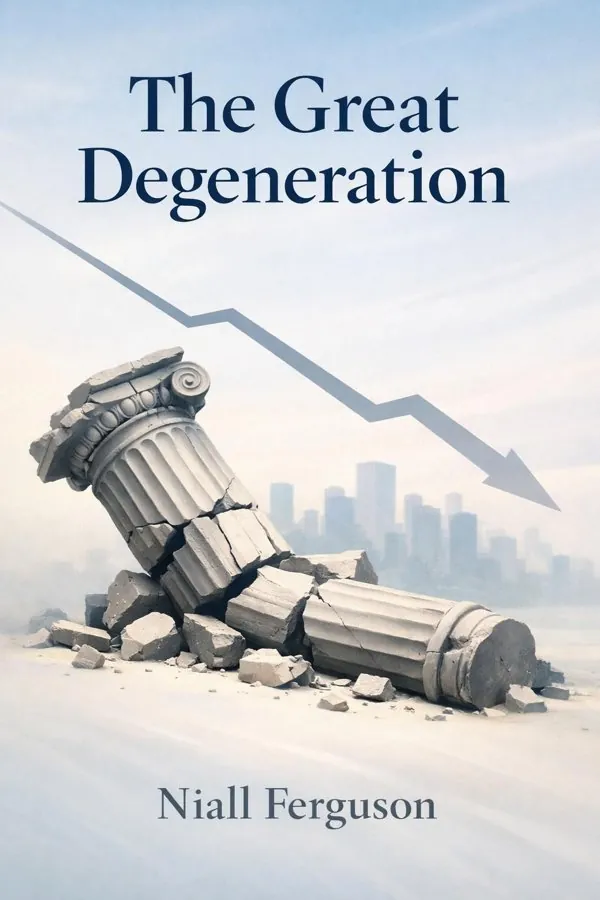
The Great Degeneration: How Institutions Decay and Economies Die: Summary & Key Insights
 10 min11 chaptersAudio available
What Is The Great Degeneration: How Institutions Decay and Economies Die About?
The Great Degeneration: How Institutions Decay and Economies Die by Niall Ferguson is a economics book spanning 11 pages. In this book, historian Niall Ferguson argues that the Western world is experiencing institutional decline. He examines the deterioration of key pillars of Western civilization—democracy, capitalism, the rule of law, and civil society—and warns that without reform, the West risks losing its global leadership. Drawing on historical analysis and contemporary examples, Ferguson calls for a revival of civic engagement and institutional renewal to reverse the trend of degeneration.
This FizzRead summary covers all 11 key chapters of The Great Degeneration: How Institutions Decay and Economies Die in approximately 10 minutes, distilling the most important ideas, arguments, and takeaways from Niall Ferguson's work. Also available as an audio summary and Key Quotes Podcast.
The Great Degeneration: How Institutions Decay and Economies Die
In this book, historian Niall Ferguson argues that the Western world is experiencing institutional decline. He examines the deterioration of key pillars of Western civilization—democracy, capitalism, the rule of law, and civil society—and warns that without reform, the West risks losing its global leadership. Drawing on historical analysis and contemporary examples, Ferguson calls for a revival of civic engagement and institutional renewal to reverse the trend of degeneration.
Who Should Read The Great Degeneration: How Institutions Decay and Economies Die?
This book is perfect for anyone interested in economics and looking to gain actionable insights in a short read. Whether you're a student, professional, or lifelong learner, the key ideas from The Great Degeneration: How Institutions Decay and Economies Die by Niall Ferguson will help you think differently.
- ✓Readers who enjoy economics and want practical takeaways
- ✓Professionals looking to apply new ideas to their work and life
- ✓Anyone who wants the core insights of The Great Degeneration: How Institutions Decay and Economies Die in just 10 minutes
Want the full summary?
Get instant access to this book summary and 100K+ more with Fizz Moment.
Get Free SummaryAvailable on App Store • Free to download
Key Chapters
To understand degeneration, we must first recall what made Western civilization exceptional in the first place. When I examine the long arc of history—from the Renaissance through the Enlightenment and into the Industrial Revolution—I see not merely the triumphs of genius but the triumphs of institutions. The West’s rise did not happen because Europeans were innately more intelligent or industrious than other peoples. It occurred because over centuries, we developed frameworks that rewarded innovation, protected property, and restrained arbitrary power. Representative government emerged from a belief that no ruler should wield unchecked authority. Capitalism evolved as a system of voluntary exchange governed by contracts and laws rather than coercion. The rule of law ensured that rights could not be trampled by privilege. And civil society provided the moral and social glue that allowed individuals to cooperate for mutual benefit beyond the control of the state.
Every one of these innovations was hard-won. The constitutional struggles of seventeenth-century England, the commercial revolutions of the Dutch Republic, and the civic republicanism of early America were all experiments in institutional design. What they shared was the conviction that power must be limited, transparency enhanced, and participation encouraged. The institutions of the West became what the economist Douglass North called “rules of the game” for human interaction. These rules channeled ambition into productive enterprise rather than predation. They allowed an individual like James Watt to transform a steam engine into a revolution rather than an aristocrat’s toy, and they provided the legal structures through which entrepreneurs could build vast networks of trade and credit. In short, the West’s success was institutional before it was technological.
But this success bred complacency. Institutions, once vital and contested, began to ossify. Instead of seeing them as living entities requiring continuous attention and renewal, we came to view them as automatic, self-sustaining machines. And herein lies the root of degeneration: the moment we assume that our system runs on its own, we cease to nurture the civic virtues that keep it alive.
The decline of democracy manifests not in the abolition of elections but in the hollowing out of what those elections once meant. Voter apathy today is perhaps the most visible symptom of political degeneration. Where citizens once viewed participation as a duty, many now regard it as a futile act. Governments, meanwhile, have morphed into vast bureaucratic ecosystems that shield decision-makers from accountability. Power has become dispersed, responsibility diluted. The result is not tyranny but lethargy—a system that responds sluggishly to the needs and desires of its citizens.
I often draw a distinction between democracy in form and democracy in function. We have preserved the former—a ritual of elections, parliaments, and debates—but lost much of the latter, which is the ability of ordinary people to influence the direction of policy through informed engagement. Lobbyists, interest groups, and transnational bureaucracies dominate the landscape, while civic participation dwindles. The corrosion of trust between citizens and their representatives feeds a dangerous cycle: apathy breeds unaccountability, which in turn breeds more apathy.
Bureaucratic expansion is another feature of political degeneration. Weber’s rational bureaucracy, conceived as a tool for efficiency and fairness, has metastasized into a labyrinth of rules that smothers initiative. Governments now regulate almost every sphere of life yet remain strangely incapable of addressing their core responsibilities—security, education, fiscal prudence. Part of the reason lies in incentives. Politicians, driven by short electoral horizons, prioritize populist gestures over long-term institutional health. Public debt skyrockets, not because we lack wealth, but because we have lost the capacity for restraint.
The erosion of accountability is the logical consequence. The culture of responsibility that once underpinned office-holding in Western democracy has weakened under the strain of mass politics and digital warfare. Scandal replaces substance; identity replaces integrity. What remains is a spectacle of democratic ritual without democratic substance—an open invitation to degeneration.
+ 9 more chapters — available in the FizzRead app
All Chapters in The Great Degeneration: How Institutions Decay and Economies Die
About the Author
Niall Ferguson is a British historian and senior fellow at the Hoover Institution, Stanford University. He is known for his works on economic and financial history, empire, and international relations, including 'The Ascent of Money' and 'Empire: How Britain Made the Modern World.'
Get This Summary in Your Preferred Format
Read or listen to the The Great Degeneration: How Institutions Decay and Economies Die summary by Niall Ferguson anytime, anywhere. FizzRead offers multiple formats so you can learn on your terms — all free.
Available formats: App · Audio · PDF · EPUB — All included free with FizzRead
Download The Great Degeneration: How Institutions Decay and Economies Die PDF and EPUB Summary
Key Quotes from The Great Degeneration: How Institutions Decay and Economies Die
“To understand degeneration, we must first recall what made Western civilization exceptional in the first place.”
“The decline of democracy manifests not in the abolition of elections but in the hollowing out of what those elections once meant.”
Frequently Asked Questions about The Great Degeneration: How Institutions Decay and Economies Die
The Great Degeneration: How Institutions Decay and Economies Die by Niall Ferguson is a economics book that explores key ideas across 11 chapters. In this book, historian Niall Ferguson argues that the Western world is experiencing institutional decline. He examines the deterioration of key pillars of Western civilization—democracy, capitalism, the rule of law, and civil society—and warns that without reform, the West risks losing its global leadership. Drawing on historical analysis and contemporary examples, Ferguson calls for a revival of civic engagement and institutional renewal to reverse the trend of degeneration.
More by Niall Ferguson

Doom: The Politics of Catastrophe
Niall Ferguson
10 min
The Square and the Tower: Networks and Power, from the Freemasons to Facebook
Niall Ferguson
10 min
Empire: How Britain Made the Modern World
Niall Ferguson
10 min
The Ascent Of Money: A Financial History Of The World
Niall Ferguson
10 minYou Might Also Like
Business Adventures
John Brooks
10 min
Nudge
Richard H. Thaler, Cass R. Sunstein
10 min
The Hitchhiker"s Guide to the Galaxy
Douglas Adams
10 minThe Muqaddimah
Ibn Khaldun
10 minThe Outsiders
William N. Thorndike
10 min
A Little History of Economics
Niall Kishtainy
10 minBrowse by Category
Ready to read The Great Degeneration: How Institutions Decay and Economies Die?
Get the full summary and 100K+ more books with Fizz Moment.