
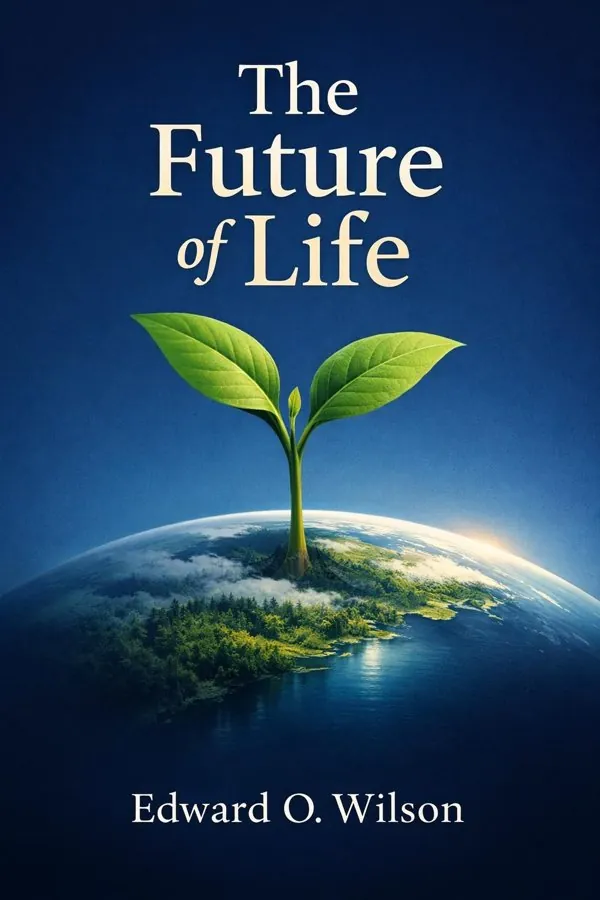
The Future of Life: Summary & Key Insights
 10 min10 chaptersAudio available
Key Takeaways from The Future of Life
The most dangerous environmental mistake is to think of nature as scenery instead of system.
Progress becomes perilous when success outruns restraint.
A species does not need to be useful to deserve protection, but many are useful in ways we barely understand.
Extinction is natural, but the current wave is not.
Good intentions are not enough when ecosystems are collapsing; conservation must be informed by evidence.
What Is The Future of Life About?
The Future of Life by Edward O. Wilson is a environment book spanning 11 pages. The Future of Life is Edward O. Wilson’s urgent, elegant argument that humanity has become powerful enough to damage the living systems it depends on—and wise enough, if it chooses, to protect them. Blending biology, ethics, economics, and conservation science, Wilson examines the accelerating destruction of habitats, the rapid loss of species, and the fragile condition of Earth’s biosphere. He shows that biodiversity is not a luxury for birdwatchers or scientists; it is the foundation of stable ecosystems, food systems, medicine, and human well-being. What makes this book especially compelling is Wilson’s authority. One of the world’s most celebrated biologists and a leading voice in biodiversity research, he writes not as an alarmist but as a scientist who deeply understands the complexity of life on Earth. Yet his argument is also moral and humanistic. He asks readers to reconsider humanity’s relationship with nature and to recognize that conservation is not anti-progress—it is essential to any meaningful future. The book matters because it reframes environmental decline not as a distant issue, but as one of the defining tests of civilization.
This FizzRead summary covers all 10 key chapters of The Future of Life in approximately 10 minutes, distilling the most important ideas, arguments, and takeaways from Edward O. Wilson's work. Also available as an audio summary and Key Quotes Podcast.
The Future of Life
The Future of Life is Edward O. Wilson’s urgent, elegant argument that humanity has become powerful enough to damage the living systems it depends on—and wise enough, if it chooses, to protect them. Blending biology, ethics, economics, and conservation science, Wilson examines the accelerating destruction of habitats, the rapid loss of species, and the fragile condition of Earth’s biosphere. He shows that biodiversity is not a luxury for birdwatchers or scientists; it is the foundation of stable ecosystems, food systems, medicine, and human well-being.
What makes this book especially compelling is Wilson’s authority. One of the world’s most celebrated biologists and a leading voice in biodiversity research, he writes not as an alarmist but as a scientist who deeply understands the complexity of life on Earth. Yet his argument is also moral and humanistic. He asks readers to reconsider humanity’s relationship with nature and to recognize that conservation is not anti-progress—it is essential to any meaningful future. The book matters because it reframes environmental decline not as a distant issue, but as one of the defining tests of civilization.
Who Should Read The Future of Life?
This book is perfect for anyone interested in environment and looking to gain actionable insights in a short read. Whether you're a student, professional, or lifelong learner, the key ideas from The Future of Life by Edward O. Wilson will help you think differently.
- ✓Readers who enjoy environment and want practical takeaways
- ✓Professionals looking to apply new ideas to their work and life
- ✓Anyone who wants the core insights of The Future of Life in just 10 minutes
Want the full summary?
Get instant access to this book summary and 100K+ more with Fizz Moment.
Get Free SummaryAvailable on App Store • Free to download
Key Chapters
The most dangerous environmental mistake is to think of nature as scenery instead of system. Wilson begins by portraying the biosphere as an intricately connected web of organisms, climates, soils, waters, and energy flows that together make life on Earth possible. Forests regulate rainfall, wetlands filter water, insects pollinate crops, fungi recycle nutrients, and oceans stabilize climate. None of these functions operates in isolation. The biosphere is not a collection of separate parts but a dynamic whole in which every species plays some role, whether visible or hidden.
This perspective matters because modern societies often treat ecosystems as if they can be dismantled without consequence. We clear forests for short-term gain, drain marshes for development, or overfish oceans as if these systems were endlessly replaceable. Wilson argues that they are not. Ecological networks are resilient up to a point, but once enough pieces are removed, collapse can become sudden and irreversible. A missing predator can reshape an entire food web. A declining insect population can affect birds, crops, and soil health.
In practical terms, seeing the biosphere as a living whole changes how we make decisions. Urban planning must account for watersheds and green corridors. Agriculture must protect pollinators and soil organisms. Business must evaluate environmental costs beyond immediate profit. Even personal choices—diet, travel, consumption—participate in this larger system.
The core insight is humility: humanity is not outside nature, managing it from above, but embedded within it. Our economies, health, and survival depend on biological stability we did not create and cannot easily rebuild once lost.
Actionable takeaway: Before supporting any project or lifestyle choice, ask not only what it produces for people today, but what it removes from the living systems that sustain tomorrow.
Progress becomes perilous when success outruns restraint. Wilson does not deny the achievements of modern civilization: longer life spans, rising productivity, technological innovation, and expanded human reach. But he insists that these gains have come with escalating ecological damage. Population growth, industrial expansion, urban sprawl, fossil fuel dependence, and intensive land use have pushed natural systems beyond their capacity to recover.
The problem is not humanity itself but the scale and speed of its impact. A single village clearing a patch of forest may have little global effect; billions of people consuming energy-intensive goods, industrial meat, plastics, timber, and minerals at modern rates create a planetary burden. Habitat destruction is the clearest example. Roads divide forests, farms replace grasslands, cities expand into wetlands, and resource extraction fragments landscapes that species need in order to migrate, breed, and survive.
Wilson also highlights an uncomfortable truth: human intelligence has amplified both our creative power and our destructive reach. We can transform rivers, engineer crops, and transport goods worldwide, but those same capacities allow us to overharvest fisheries, spread invasive species, and destabilize climate systems. Our tools have grown faster than our moral discipline.
This idea has practical applications across society. Governments can guide growth through land-use planning, family planning support, clean energy investment, and ecosystem protection. Companies can reduce waste, redesign supply chains, and avoid sourcing from destroyed habitats. Individuals can consume less, waste less, and support policies that align prosperity with ecological limits.
Wilson’s warning is not anti-human. It is a call to mature as a species—to recognize that civilization cannot continue expanding as if the planet were empty and inexhaustible.
Actionable takeaway: Measure progress by whether it improves human life without degrading the land, water, and species on which future prosperity depends.
A species does not need to be useful to deserve protection, but many are useful in ways we barely understand. Wilson argues that biodiversity matters on several levels at once. Ecologically, diverse systems are more stable and productive. Economically, they support agriculture, forestry, fisheries, tourism, and medicine. Scientifically, they contain information accumulated through millions of years of evolution. Ethically, they represent forms of life with intrinsic worth beyond human convenience.
One reason biodiversity loss is so dangerous is that people often notice value only after it disappears. A wild plant may hold compounds for future medicines. A seemingly insignificant insect may control pests or pollinate crops. A rare amphibian may reveal clues about water quality or disease resistance. Once extinct, these possibilities vanish forever. Wilson urges readers to reject the narrow idea that only immediately profitable species matter.
He also broadens the ethical frame. The living world is not simply raw material for human ambition. To drive species to extinction through negligence, greed, or indifference is to erase unique evolutionary lineages that can never be recreated. That is not just a technical failure but a moral one.
In daily life, this principle can guide everything from land management to school curricula. Communities can protect local habitats, gardeners can plant native species, and consumers can support products that do not depend on ecosystem destruction. At the institutional level, governments can value ecosystem services in budgets and planning, while conservation groups can communicate the emotional, scientific, and economic reasons to preserve life.
Wilson’s point is powerful because it unites reason and reverence. Biodiversity is both useful and precious. It feeds us, teaches us, stabilizes the planet, and deserves respect in its own right.
Actionable takeaway: Treat every ecosystem not as surplus land waiting for development, but as a reservoir of value—practical, scientific, and moral—that may be irreplaceable.
Extinction is natural, but the current wave is not. Wilson places today’s biodiversity crisis in the context of Earth’s history, where five mass extinctions have already reshaped life. The difference now is agency. This time, a single species—humanity—is the principal driver. Habitat destruction, overhunting, invasive species, pollution, and climate disruption are eliminating plants and animals at rates far above the background pace of evolution.
This matters because extinction is final. A polluted river can sometimes be cleaned. A degraded forest can sometimes regrow. But a vanished species is gone forever, along with its ecological role, genetic uniqueness, and evolutionary history. Wilson emphasizes that many extinctions happen quietly. Before the public notices a charismatic mammal or bird is threatened, countless insects, amphibians, freshwater species, and plants may already be disappearing undocumented.
A practical example is tropical deforestation. When a rainforest is cleared, scientists may lose thousands of species before many are even named. Coral reefs offer another case: warming waters, acidification, and pollution are dismantling some of the most diverse habitats on Earth. As these systems decline, fisheries, coastal protection, and tourism decline with them.
Wilson’s larger point is that extinction is not just about losing beauty; it is about unraveling ecological complexity. Every disappearance weakens resilience and narrows future possibilities for nature and humanity alike.
Responding requires urgency. Protected areas must expand, wildlife trade must be controlled, degraded habitats must be restored, and scientific inventory work must accelerate so that species are known before they are lost.
Actionable takeaway: Support conservation efforts that prevent extinction at the source—especially habitat protection—because once a species is gone, no amount of regret can bring it back.
Good intentions are not enough when ecosystems are collapsing; conservation must be informed by evidence. Wilson stresses the importance of conservation biology as a discipline that studies how species survive, how habitats function, and what interventions actually work. Protecting nature is not a matter of setting aside random parcels of land and hoping for the best. It requires data on population size, migration routes, reproductive patterns, genetic diversity, and ecological interdependence.
One of Wilson’s key insights is that conservation becomes more effective when it moves from reactive rescue to strategic design. Instead of waiting until a species is nearly extinct, scientists and policymakers can identify biodiversity hotspots, wildlife corridors, breeding grounds, and vulnerable ecosystems in advance. This allows limited resources to be used where they will have the greatest impact.
Examples are everywhere. A protected area may fail if it is too small or isolated for large mammals to roam. River restoration may succeed only if pollution, upstream dams, and invasive species are addressed together. Saving a single endangered bird may depend on preserving the insect populations and forest structure it relies on.
Wilson also values the role of taxonomy and field biology. You cannot protect what you do not know exists. Cataloging life, especially in species-rich regions, is therefore not academic trivia but a frontline conservation task.
For readers, this idea translates into smarter engagement. Support organizations that use science-based metrics, not just emotional appeals. Encourage local leaders to rely on ecological assessment before approving development. If you work in education or business, promote decisions grounded in long-term environmental evidence.
Actionable takeaway: Back conservation strategies that are specific, measurable, and science-led, because protecting biodiversity works best when guided by knowledge rather than symbolism.
Nature does not recognize national borders, and neither do many environmental threats. Wilson expands the discussion beyond local habitat loss to show that biodiversity decline is entangled with global forces: climate change, international trade, ocean degradation, invasive species, and inequality between wealthy and poor nations. A product consumed in one country may drive deforestation in another. Emissions released by industrial economies alter habitats worldwide. Plastic discarded on land can enter marine food chains thousands of miles away.
This global dimension makes environmental responsibility more complex but also more realistic. It is not enough for one nation to create parks if global markets continue rewarding ecological destruction elsewhere. Nor is it fair to demand strict conservation from poorer countries without addressing debt, development needs, and the historical environmental footprint of richer societies.
Wilson’s analysis encourages cooperation rather than blame. International agreements on climate, fisheries, endangered species, and land protection become essential because ecosystems are shared and interconnected. At the same time, local communities must be included in solutions. Conservation imposed without economic alternatives often fails, while efforts that combine protection with education, livelihoods, and community ownership are more durable.
A clear example is tropical forest conservation. Global consumers benefit from commodities linked to forest loss, but the immediate pressures fall on local governments and communities. Sustainable financing, fair trade, indigenous land rights, and global accountability can help align incentives with preservation.
Wilson reminds us that ecological damage is a systems problem produced by economics, politics, and culture as much as biology. Solving it requires institutions that can think across scales, from local watershed councils to global treaties.
Actionable takeaway: When evaluating an environmental issue, trace the full chain of cause and effect—from local habitat to global market—and support solutions that share responsibility across borders.
Development that destroys the conditions for future life is not development at all. Wilson argues for a model of progress that allows human societies to improve living standards without liquidating natural capital. This means rejecting the false choice between economic growth and environmental protection. The real challenge is to design economies that operate within ecological limits.
Sustainable development, in Wilson’s view, requires practical trade-offs and structural change. Agriculture must become more efficient without expanding endlessly into wild land. Energy systems must move away from polluting sources that destabilize climate and health. Cities must be designed to use land, water, and transportation more intelligently. Resource extraction must account for long-term ecological costs instead of treating them as externalities.
He is especially attentive to poverty. Environmental degradation and human deprivation often reinforce each other. Poor communities may depend directly on local forests, fisheries, and soils, making them vulnerable when ecosystems decline. At the same time, desperation can drive overuse. Sustainable development therefore includes education, reproductive health, economic opportunity, and governance that gives people alternatives to ecological destruction.
Real-world applications include agroforestry, marine protected zones paired with community fisheries management, compact urban design, renewable energy investment, and payment systems that reward ecosystem stewardship. Businesses can also participate by measuring supply-chain impacts, reducing waste, and valuing resilience over short-term extraction.
Wilson’s contribution is to frame sustainability not as a fashionable slogan but as a survival strategy. Human civilization can thrive, but only if it stops consuming the biological systems that make prosperity possible.
Actionable takeaway: Support policies and products that improve human well-being while reducing habitat loss, pollution, and resource depletion, because true development leaves both people and ecosystems stronger.
Laws can protect nature only up to the limit of what people are willing to value. Wilson therefore argues that environmental reform requires more than regulation or science; it needs an ethic—a shared moral understanding that the nonhuman world deserves care, restraint, and respect. Without this deeper cultural change, conservation remains fragile, vulnerable to every political cycle and market fluctuation.
This ethic begins with a shift in identity. Instead of seeing ourselves as conquerors of nature, we must see ourselves as participants in a larger community of life. Wilson does not propose abandoning human aspirations, but he insists that power should be guided by stewardship. The ability to alter ecosystems does not confer the right to impoverish them.
Ethics matter in ordinary choices as much as in public policy. A landowner deciding whether to preserve a woodland, a school deciding what values to teach, a voter considering environmental protections, or a company debating whether to destroy habitat for profit—each faces a moral question, not just a practical one. Wilson’s vision suggests that protecting life should become part of what civilized societies consider honorable.
Education is central here. Children who experience living ecosystems directly are more likely to value them. Religious traditions, civic institutions, and cultural leaders can also help articulate a sense of responsibility toward future generations and other species.
Wilson’s environmental ethic is ultimately about character. It asks whether humanity will use its intelligence merely to dominate or also to preserve. The answer will shape not only the planet’s biological future but our own moral legacy.
Actionable takeaway: Build environmental responsibility into your values—through education, community involvement, and daily choices—so conservation becomes a habit of conscience, not just a reaction to crisis.
Despair is tempting in the face of ecological decline, but Wilson resists fatalism. He acknowledges that technology has often amplified environmental damage, yet he also argues that science, innovation, and policy can become tools for repair. Better satellite monitoring can detect deforestation quickly. Genetic and ecological research can improve species recovery plans. Cleaner energy systems can reduce pressure on climate and habitat. Smarter regulations can realign markets with conservation goals.
The key is direction. Technology is not inherently redemptive; it reflects the values of those who deploy it. Agricultural technology can either intensify chemical dependency or improve yields on existing land and spare forests from conversion. Data systems can help manage fisheries sustainably—or help exploit them more efficiently. Policy determines which path is rewarded.
Wilson therefore sees political leadership as indispensable. Protected-area systems, endangered-species laws, pollution controls, carbon policies, habitat restoration funding, and international environmental agreements all matter because they shape incentives at scale. Markets alone rarely preserve what they do not price correctly. Public institutions must help defend long-term ecological interests against short-term extraction.
For ordinary readers, this idea encourages engagement rather than withdrawal. Voting, civic pressure, philanthropy, research funding, and consumer choices all influence which technologies and policies prevail. Municipal initiatives such as green infrastructure, local habitat restoration, and public transit can also deliver measurable benefits.
Wilson’s message is balanced: tools exist, knowledge exists, and successful models exist. What remains uncertain is whether societies will act before losses become irreversible.
Actionable takeaway: Support innovations and public policies that reduce environmental harm at scale, and judge technology not by novelty alone but by whether it protects the living world.
The future of life is not predetermined; it is a test of collective choice. Wilson closes with a sober but hopeful vision: humanity stands at a turning point where it can continue simplifying the planet through neglect and overconsumption, or deliberately preserve the richness of life that took billions of years to evolve. The stakes are immense because what is lost in this century may remain lost for geological time.
His final argument brings together science, ethics, and practicality. Protecting biodiversity is not a fringe concern competing with human interests. It is inseparable from climate stability, food security, health, beauty, cultural meaning, and the long-term viability of civilization. The deeper issue is whether we can expand our time horizon. Societies often optimize for quarterly profit, electoral cycles, or immediate convenience. Wilson asks us to think in generations.
There are reasons for hope. Conservation successes have shown that species can recover, landscapes can be restored, and public values can change. Communities have revived rivers, nations have expanded protected lands, and citizen movements have altered corporate and political behavior. But these successes remain partial unless they scale to match the size of the crisis.
The book’s enduring power lies in its insistence that realism and hope are not opposites. We must look directly at extinction, habitat loss, and ecological overshoot without denial. Yet because the damage is human-driven, meaningful reduction is also humanly possible.
Wilson leaves readers with responsibility rather than comfort. The question is not whether nature matters in theory, but whether we will live, govern, and consume as though it does.
Actionable takeaway: Commit to one sustained form of stewardship—political, professional, financial, or personal—and treat biodiversity protection as a long-term responsibility, not a passing concern.
All Chapters in The Future of Life
About the Author
Edward Osborne Wilson (1929–2021) was an American biologist, naturalist, and author whose work transformed the modern understanding of biodiversity. A longtime professor at Harvard University, he became renowned for his research on ants, his contributions to island biogeography and sociobiology, and his powerful public advocacy for conservation. Wilson combined deep scientific expertise with exceptional literary skill, helping broad audiences understand the complexity and value of the natural world. He received two Pulitzer Prizes and wrote numerous influential books on evolution, ecology, and human nature. More than a specialist, he was one of the great interpreters of life on Earth, arguing that protecting biodiversity is both a scientific necessity and a moral obligation.
Get This Summary in Your Preferred Format
Read or listen to the The Future of Life summary by Edward O. Wilson anytime, anywhere. FizzRead offers multiple formats so you can learn on your terms — all free.
Available formats: App · Audio · PDF · EPUB — All included free with FizzRead
Download The Future of Life PDF and EPUB Summary
Key Quotes from The Future of Life
“The most dangerous environmental mistake is to think of nature as scenery instead of system.”
“Progress becomes perilous when success outruns restraint.”
“A species does not need to be useful to deserve protection, but many are useful in ways we barely understand.”
“Extinction is natural, but the current wave is not.”
“Good intentions are not enough when ecosystems are collapsing; conservation must be informed by evidence.”
Frequently Asked Questions about The Future of Life
The Future of Life by Edward O. Wilson is a environment book that explores key ideas across 10 chapters. The Future of Life is Edward O. Wilson’s urgent, elegant argument that humanity has become powerful enough to damage the living systems it depends on—and wise enough, if it chooses, to protect them. Blending biology, ethics, economics, and conservation science, Wilson examines the accelerating destruction of habitats, the rapid loss of species, and the fragile condition of Earth’s biosphere. He shows that biodiversity is not a luxury for birdwatchers or scientists; it is the foundation of stable ecosystems, food systems, medicine, and human well-being. What makes this book especially compelling is Wilson’s authority. One of the world’s most celebrated biologists and a leading voice in biodiversity research, he writes not as an alarmist but as a scientist who deeply understands the complexity of life on Earth. Yet his argument is also moral and humanistic. He asks readers to reconsider humanity’s relationship with nature and to recognize that conservation is not anti-progress—it is essential to any meaningful future. The book matters because it reframes environmental decline not as a distant issue, but as one of the defining tests of civilization.
More by Edward O. Wilson
You Might Also Like
A Life on Our Planet: My Witness Statement and a Vision for the Future
David Attenborough
10 min
A Sky Full Of Birds
Matt Merritt
10 min
Carbon Zero: Imagining Cities That Can Save the Planet
Alex Steffen
10 min
Eaarth: Making a Life on a Tough New Planet
Bill McKibben
10 min
The Social Contract and Environmental Governance
Various Editors
10 min
The Wild Places
Robert Macfarlane
10 minBrowse by Category
Ready to read The Future of Life?
Get the full summary and 100K+ more books with Fizz Moment.