
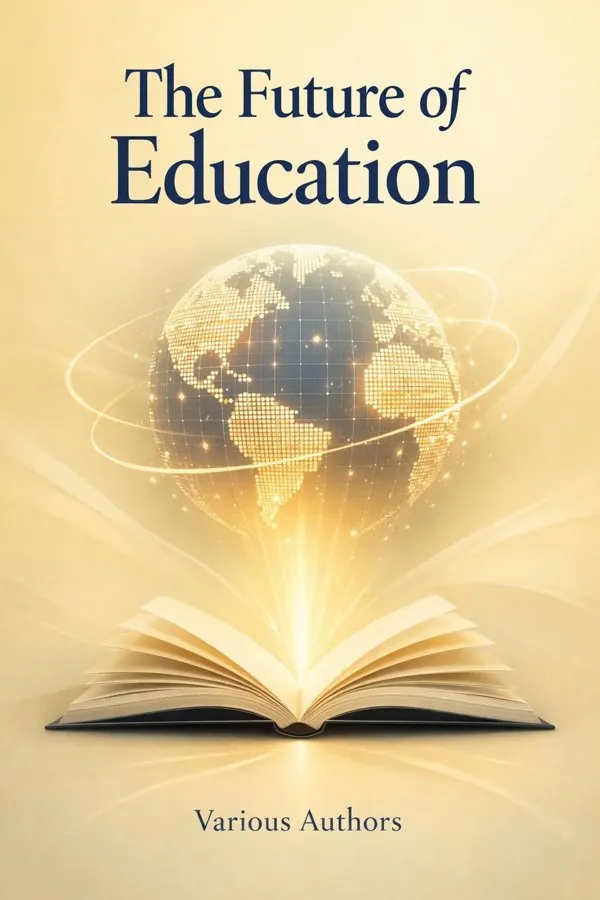
The Future of Education: Summary & Key Insights
 10 min7 chaptersAudio available
What Is The Future of Education About?
The Future of Education by Various Authors is a education book spanning 7 pages. A collection of essays and research papers exploring emerging trends, technologies, and pedagogical models shaping the future of education. The book discusses digital learning, personalized instruction, global education policy, and the role of artificial intelligence in transforming teaching and learning environments.
This FizzRead summary covers all 7 key chapters of The Future of Education in approximately 10 minutes, distilling the most important ideas, arguments, and takeaways from Various Authors's work. Also available as an audio summary and Key Quotes Podcast.
The Future of Education
A collection of essays and research papers exploring emerging trends, technologies, and pedagogical models shaping the future of education. The book discusses digital learning, personalized instruction, global education policy, and the role of artificial intelligence in transforming teaching and learning environments.
Who Should Read The Future of Education?
This book is perfect for anyone interested in education and looking to gain actionable insights in a short read. Whether you're a student, professional, or lifelong learner, the key ideas from The Future of Education by Various Authors will help you think differently.
- ✓Readers who enjoy education and want practical takeaways
- ✓Professionals looking to apply new ideas to their work and life
- ✓Anyone who wants the core insights of The Future of Education in just 10 minutes
Want the full summary?
Get instant access to this book summary and 100K+ more with Fizz Moment.
Get Free SummaryAvailable on App Store • Free to download
Key Chapters
To understand where we might go next, we must first understand how we arrived here. Education systems as we recognize them today—the graded classroom, the standardized exam, the teacher as sole authority—emerged from an era defined by industrial production. Factories required workers who could follow routines, memorize instructions, and adhere to schedules. As chapters in this section demonstrate, these patterns of thought shaped curricula and institutional organization for over a century.
When the industrial model dominated, efficiency and uniformity were celebrated. Students were products, assessment was quality control, and creativity was often sidelined as inefficiency. Mass public schooling was an unprecedented social project, creating literacy and shared civic knowledge at scale. Yet the rigidity of that system grew increasingly anachronistic once information became fluid and accessible beyond authoritative institutions.
The essays here trace this legacy through historical comparisons—from Prussian educational reforms in the nineteenth century to the mid-twentieth-century expansion of compulsory schooling across Europe, North America, and Asia. The learning environment reflected not just technological limits but philosophical priorities: the emphasis was on order, predictability, and measurable output.
Recognizing this helps us appreciate the urgency of the current transformation. The contemporary world requires flexibility, problem-solving, and global literacy, which older systems struggle to fully nurture. Education must evolve from replication to innovation—a transition that echoes across cultures and economies. In revisiting these roots, contributors reveal the need to unlearn the industrial assumptions embedded in our schools, allowing space for inquiry-driven and personalized approaches to flourish.
The digital revolution marks the most visible catalyst of educational change explored in this book. Online platforms, mobile technologies, and flexible connectivity have shattered the constraints of geography and time. Learning, once bound to classroom walls, now occurs in global digital ecosystems where students collaborate, simulate, and create knowledge dynamically.
As we discuss in this section, technology’s role is not to replace teachers but to augment the capacity for access and interactivity. When learners engage with massive open online courses, virtual reality environments, or adaptive tutoring systems, they are participating in a redefinition of pedagogy. Concepts like flipped classrooms emerge from this reorientation—the learner becomes active, discovering rather than receiving.
However, disruption is never neutral. Unequal infrastructure, differing digital literacy, and cultural resistance affect implementation. Several contributors examine how emerging economies face dual realities: technology can democratize education while simultaneously reinforcing privilege when connectivity gaps persist.
Real-world examples include national projects expanding rural internet access, cloud-based collaboration platforms connecting students across continents, and gamified learning modules fostering engagement beyond rote memorization. Underlying each innovation is a philosophical question: what happens when knowledge becomes fundamentally decentralized?
The digital turn requires educators to relinquish the illusion of control and instead cultivate critical navigation skills—how to evaluate, reflect, and synthesize information. Pedagogical transformation thus arises not from devices themselves, but from reimagining the very meaning of learning. It is about participation, creativity, and co-construction of knowledge in a digital commons.
+ 5 more chapters — available in the FizzRead app
All Chapters in The Future of Education
About the Author
This volume brings together contributions from multiple scholars, educators, and policy experts specializing in education technology, curriculum design, and learning innovation.
Get This Summary in Your Preferred Format
Read or listen to the The Future of Education summary by Various Authors anytime, anywhere. FizzRead offers multiple formats so you can learn on your terms — all free.
Available formats: App · Audio · PDF · EPUB — All included free with FizzRead
Download The Future of Education PDF and EPUB Summary
Key Quotes from The Future of Education
“To understand where we might go next, we must first understand how we arrived here.”
“The digital revolution marks the most visible catalyst of educational change explored in this book.”
Frequently Asked Questions about The Future of Education
The Future of Education by Various Authors is a education book that explores key ideas across 7 chapters. A collection of essays and research papers exploring emerging trends, technologies, and pedagogical models shaping the future of education. The book discusses digital learning, personalized instruction, global education policy, and the role of artificial intelligence in transforming teaching and learning environments.
More by Various Authors



You Might Also Like

Bedtime Biography: Florence Nightingale
Isabel Thomas
10 min
Introduction To Museum Studies
Howard H. Hoyt
10 min
A Mind for Numbers: How to Excel at Math and Science (Even If You Flunked Algebra)
Barbara Oakley
10 min
AI for Educators: Learning Strategies, Teacher Empowerment, and the Future of Education
Matt Miller
10 min
Animation For Beginners
Morr Meroz
10 min
Artificial Intelligence for Learning
Donald Clark
10 minBrowse by Category
Ready to read The Future of Education?
Get the full summary and 100K+ more books with Fizz Moment.