
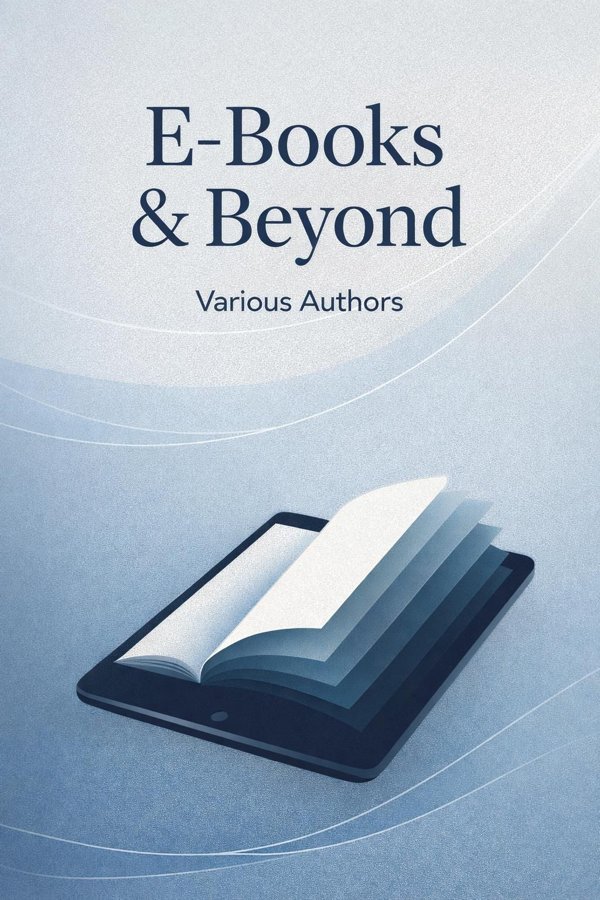
E‑Books & Beyond: Summary & Key Insights
 10 min9 chaptersAudio available
Key Takeaways from E‑Books & Beyond
A book stops being a fixed object the moment it becomes software.
How we read is influenced by where and how text appears.
In digital publishing, invisibility is often not a content problem but a metadata problem.
Owning a digital book and accessing a digital book are often not the same thing.
When reading goes digital, libraries become more important, not less.
What Is E‑Books & Beyond About?
E‑Books & Beyond by Various Authors is a digital_culture book. E‑Books & Beyond is a wide-ranging exploration of how digital publishing has transformed the way books are created, distributed, read, and preserved. Rather than treating the e-book as a simple electronic copy of print, this collection of essays and research papers examines the larger ecosystem around digital texts: platforms, devices, metadata, libraries, accessibility, copyright, reader behavior, and the economics of publishing in a networked world. The result is a book that is less about one technology and more about a cultural shift. What makes the volume especially valuable is its multi-perspective authority. Because it draws on the work of scholars, publishing specialists, technologists, and information professionals, it captures the complexity of digital culture from several angles at once. Some contributors focus on market change, others on reader experience, discoverability, design, or institutional challenges. Together, they show that digital publishing is not just a technical upgrade but a redefinition of what a book can be. For readers trying to understand the future of reading, education, media, and knowledge access, E‑Books & Beyond offers a thoughtful foundation. It helps explain why digital publishing matters far beyond publishing itself.
This FizzRead summary covers all 9 key chapters of E‑Books & Beyond in approximately 10 minutes, distilling the most important ideas, arguments, and takeaways from Various Authors's work. Also available as an audio summary and Key Quotes Podcast.
E‑Books & Beyond
E‑Books & Beyond is a wide-ranging exploration of how digital publishing has transformed the way books are created, distributed, read, and preserved. Rather than treating the e-book as a simple electronic copy of print, this collection of essays and research papers examines the larger ecosystem around digital texts: platforms, devices, metadata, libraries, accessibility, copyright, reader behavior, and the economics of publishing in a networked world. The result is a book that is less about one technology and more about a cultural shift.
What makes the volume especially valuable is its multi-perspective authority. Because it draws on the work of scholars, publishing specialists, technologists, and information professionals, it captures the complexity of digital culture from several angles at once. Some contributors focus on market change, others on reader experience, discoverability, design, or institutional challenges. Together, they show that digital publishing is not just a technical upgrade but a redefinition of what a book can be.
For readers trying to understand the future of reading, education, media, and knowledge access, E‑Books & Beyond offers a thoughtful foundation. It helps explain why digital publishing matters far beyond publishing itself.
Who Should Read E‑Books & Beyond?
This book is perfect for anyone interested in digital_culture and looking to gain actionable insights in a short read. Whether you're a student, professional, or lifelong learner, the key ideas from E‑Books & Beyond by Various Authors will help you think differently.
- ✓Readers who enjoy digital_culture and want practical takeaways
- ✓Professionals looking to apply new ideas to their work and life
- ✓Anyone who wants the core insights of E‑Books & Beyond in just 10 minutes
Want the full summary?
Get instant access to this book summary and 100K+ more with Fizz Moment.
Get Free SummaryAvailable on App Store • Free to download
Key Chapters
A book stops being a fixed object the moment it becomes software. One of the central insights of E‑Books & Beyond is that digital publishing does not merely change format; it changes function. In print culture, a book is a bounded artifact with a stable layout and predictable circulation path. In digital culture, a book can be updated, searched, linked, annotated, licensed, measured, and distributed globally in seconds. That shift turns the book into part of a wider platform economy.
The essays show that this transformation affects everyone involved. Publishers no longer manage only manuscripts and print runs; they manage file formats, metadata, vendor relationships, and cross-device compatibility. Readers do not just buy books; they access them through ecosystems such as subscription services, institutional databases, learning platforms, and proprietary apps. Libraries, too, move from owning copies to negotiating licenses and access terms.
A practical example is the difference between a printed textbook and a digital educational title. The print version is sold once. The digital version may include search functions, embedded media, updates, analytics, and chapter-level access, but it may also be restricted by platform, device, or institutional licensing. That means the value proposition changes from possession to utility.
The broader implication is that a digital book must be designed as an experience within a system, not as a PDF substitute. Publishers need to think about interoperability, discoverability, and user behavior from the start. Readers and institutions must also become more aware of the trade-offs between convenience and control.
Actionable takeaway: Evaluate every digital book not just by content quality, but by the platform rules, access model, and long-term usability that shape the reading experience.
How we read is influenced by where and how text appears. A recurring theme in E‑Books & Beyond is that digital reading is not inferior or superior to print in any absolute sense; it is different. Screen-based reading encourages search, skimming, hyperlinking, highlighting, and jumping between sections, while print often supports longer, slower, and more spatially grounded attention. The book argues that understanding these differences is essential for educators, publishers, and readers alike.
The contributors examine how device design, interface choices, and file structure affect comprehension and engagement. On a dedicated e-reader, a novel may feel immersive and distraction-light. On a phone or browser, the same text competes with notifications and multitasking. Academic reading in digital environments often becomes fragmented: readers search for terms, extract passages, and move quickly through content rather than reading linearly.
This shift has practical consequences. A publisher producing scholarly works may need better navigation, annotation tools, stable page references, and clean typography. An educator assigning digital readings may need to teach strategies for active engagement, such as note-taking, offline reading, or section-based discussion. Readers may need to match format to purpose: print for deep study, digital for portability and reference, or a mix of both.
The book does not romanticize print or celebrate digital without critique. Instead, it urges a more realistic view: reading practices evolve with media environments. If digital publishing is to support thoughtful reading, it must be designed with cognitive habits in mind.
Actionable takeaway: Choose reading formats intentionally—use digital for search and access, but create habits and environments that protect focus when comprehension matters most.
In digital publishing, invisibility is often not a content problem but a metadata problem. E‑Books & Beyond highlights a critical yet overlooked truth: discoverability is one of the defining challenges of the digital book ecosystem. In physical bookstores and libraries, shelf placement, cover design, and human browsing help readers encounter books. Online, discovery depends heavily on metadata—titles, keywords, subject tags, author identifiers, descriptions, formats, rights data, and catalog standards.
The essays show how metadata functions as the infrastructure of access. It helps retailers recommend books, libraries catalog them, search engines index them, and readers filter massive information environments. Poor metadata can bury excellent work; strong metadata can connect niche content with the right audience. This is especially important for academic books, multilingual collections, independent publishing, and library databases, where the audience may be highly specific.
A practical example is an e-book on digital humanities that is uploaded with a vague description and limited subject tagging. It may disappear in search results. The same title, enriched with accurate categories, chapter abstracts, author profiles, and relevant keywords, becomes easier to find across platforms. Metadata also affects accessibility, informing users whether a file supports reflowable text, screen readers, or other assistive features.
The book’s broader contribution is to show that digital publishing is not only about production but about organization. The digital shelf is invisible, but it still needs arrangement. Publishers and institutions that neglect metadata weaken the reach and value of their content.
Actionable takeaway: Treat metadata as part of editorial strategy—invest in accurate, detailed, standardized information so the right readers can actually discover the book.
Owning a digital book and accessing a digital book are often not the same thing. One of the most important arguments in E‑Books & Beyond is that digital publishing shifts power from physical possession to contractual access. In print, a library or reader who buys a book typically owns that copy and can lend, preserve, or resell it within legal limits. In digital environments, access is frequently governed by license agreements, platform rules, digital rights management, and subscription models.
This change affects institutions and individuals in profound ways. Libraries may pay repeatedly for temporary access instead of building permanent collections. Readers may lose access when a vendor closes, a license expires, or a device ecosystem changes. Educators may assign digital texts that students can only access under restrictive terms. Publishers gain new control over distribution and copying, but they also become dependent on dominant platforms that mediate customer relationships.
The collection explores the tension between protecting intellectual property and ensuring broad public access to knowledge. Excessive restrictions can limit fair use, frustrate readers, and undermine preservation. Too little protection may weaken sustainable revenue models for creators and publishers. The challenge, the book suggests, is not to reject licensing but to govern it wisely.
A useful example is the difference between downloading a DRM-heavy e-book from a proprietary storefront and accessing an open standard EPUB through a library or independent seller. The first may be convenient in the short term but fragile in the long term. The second may offer greater flexibility and preservation value.
Actionable takeaway: Before choosing digital content or platforms, check the licensing terms carefully—access rights, lending rules, device limits, and preservation options matter as much as price.
When reading goes digital, libraries become more important, not less. E‑Books & Beyond challenges the simplistic idea that online abundance makes libraries obsolete. Instead, the collection presents libraries as crucial mediators in the digital text ecosystem. They organize information, negotiate access, support literacy, preserve cultural memory, and help readers navigate an increasingly commercialized and fragmented publishing environment.
The essays describe how libraries have had to reinvent core functions. Collection development now includes licensing negotiations, platform evaluation, accessibility compliance, and usage analytics. Reference support increasingly involves teaching users how to search databases, use e-readers, cite digital texts, and assess source credibility. Preservation work becomes more complicated because digital materials can disappear through format obsolescence, vendor shutdowns, or rights restrictions.
A concrete example is the academic library that licenses e-book packages for students and researchers. Access may be broader and faster than with print, especially for remote users, but only if authentication systems, platform design, and license terms work well. Public libraries face similar tensions: patrons want instant borrowing on phones and tablets, yet publishers may impose lending caps, high prices, or embargoes.
The book argues that libraries should not simply adapt passively to vendor systems. They should advocate for open standards, fair lending models, accessibility, and preservation rights. Their public mission gives them a unique role in balancing commercial publishing interests with long-term knowledge access.
Actionable takeaway: If you work with digital books, involve libraries early—as partners in access, preservation, usability, and reader support, not just as downstream buyers.
A truly digital book is not just portable; it is adaptable. One of the most hopeful themes in E‑Books & Beyond is the potential of digital publishing to expand access for readers with different needs, preferences, and contexts. Adjustable font sizes, screen reader compatibility, text-to-speech, reflowable layouts, contrast controls, and navigable structure can make reading easier for people with visual impairments, learning differences, mobility limitations, or temporary constraints such as fatigue and screen conditions.
But the book also emphasizes that accessibility does not happen automatically. A poorly structured file, image-only text, inaccessible DRM, or bad navigation can make an e-book less usable than print. Accessibility must be designed into workflows from the beginning—through semantic tagging, alt text, clean formatting, keyboard navigation, and standards-based production.
The contributors frame accessibility not as a niche compliance issue but as a broader publishing principle. Features that help one group often improve usability for many others. Searchable text helps researchers. Reflowable design helps mobile readers. Audio support helps commuters and language learners. Clear structure helps everyone orient themselves in long documents.
A practical application is educational publishing. A digital textbook designed with accessibility in mind can support a more inclusive classroom and reduce the need for expensive retrofitting. Institutions benefit too, because accessible content is easier to deploy across multiple devices and settings.
The larger lesson is simple: digital publishing can democratize reading only when inclusivity is treated as a core quality standard rather than an afterthought.
Actionable takeaway: Build accessibility into content creation from the start—use open standards, test with assistive tools, and treat inclusive design as part of good publishing, not extra work.
Technological change in publishing is never purely technological; it is also economic. E‑Books & Beyond makes clear that the growth of e-books is shaped by business models as much as by devices and reader demand. Publishers, retailers, aggregators, libraries, and authors all respond to incentives involving pricing, margins, discoverability, data ownership, and market control. To understand digital publishing, you have to follow the money.
The collection explores several economic tensions. Digital distribution can reduce printing, warehousing, and shipping costs, but it introduces new expenses in platform integration, conversion, metadata management, DRM, customer support, and continual updates. Lower marginal distribution costs do not automatically mean lower prices, because publishers are also protecting perceived value and navigating retailer power. Meanwhile, dominant platforms can pressure pricing, capture user data, and reshape audience relationships.
A familiar example is the contrast between direct sales and subscription access. A direct purchase may generate more revenue per title but depends on active consumer choice. Subscription services can expand reach and usage, yet they may lower perceived unit value and shift power to platform operators. Similar trade-offs affect academic and library markets, where bundled packages can increase access while reducing collection control.
The book’s value lies in showing that format debates often mask structural business questions. Why does one file type dominate? Why do some titles stay print-heavy? Why are some digital books expensive? Often the answer lies not in reader preference alone but in institutional and commercial strategy.
Actionable takeaway: When evaluating digital publishing trends, ask not only what technology allows, but which business model rewards a particular format, pricing structure, or access system.
The most mature view of digital publishing is not that e-books will eliminate print, but that reading culture is becoming hybrid. E‑Books & Beyond resists simplistic narratives of technological succession. Instead of presenting digital books as the inevitable replacement for printed ones, the collection shows how formats coexist, compete, and complement each other depending on context, purpose, audience, and institution.
This hybrid reality is visible everywhere. Trade readers may prefer print for gifting and immersive reading, but use digital for travel and instant purchase. Students may rely on e-books for affordability and searchability, yet print for intensive study. Researchers may use digital versions for keyword discovery and print for sustained engagement. Publishers increasingly release titles in multiple formats because each serves a different function. Libraries similarly balance shelf collections with remote-access platforms.
The essays suggest that the real future lies in format-aware publishing rather than format absolutism. Instead of asking which medium will win, better questions are: Which format works best for this type of content? How can users move smoothly between them? What design choices preserve the strengths of each? A digital scholarly edition, for instance, may benefit from searchable notes and linked sources, while a printed edition may offer better reading continuity.
The book’s broader message is intellectually refreshing: media change is additive as often as it is disruptive. New forms reshape old ones, but they do not erase human reading needs.
Actionable takeaway: Build and choose publishing strategies that support multiple formats thoughtfully, matching the medium to the reader’s task instead of assuming one format should dominate every use case.
All Chapters in E‑Books & Beyond
About the Author
Various Authors refers to a collaborative group of contributors rather than a single named writer. In a volume like E‑Books & Beyond, this typically includes scholars, librarians, publishing professionals, technologists, and researchers with expertise in digital media and the evolving book ecosystem. Their combined authority is one of the book’s greatest strengths. Instead of presenting a single opinion, the collection brings together multiple informed perspectives on e-books, digital publishing, accessibility, licensing, metadata, libraries, and preservation. This kind of interdisciplinary authorship is especially valuable in digital culture, where technical, economic, legal, and social issues are deeply connected. The result is a richer and more balanced account of how digital books are reshaping reading and publishing.
Get This Summary in Your Preferred Format
Read or listen to the E‑Books & Beyond summary by Various Authors anytime, anywhere. FizzRead offers multiple formats so you can learn on your terms — all free.
Available formats: App · Audio · PDF · EPUB — All included free with FizzRead
Download E‑Books & Beyond PDF and EPUB Summary
Key Quotes from E‑Books & Beyond
“A book stops being a fixed object the moment it becomes software.”
“How we read is influenced by where and how text appears.”
“In digital publishing, invisibility is often not a content problem but a metadata problem.”
“Owning a digital book and accessing a digital book are often not the same thing.”
“When reading goes digital, libraries become more important, not less.”
Frequently Asked Questions about E‑Books & Beyond
E‑Books & Beyond by Various Authors is a digital_culture book that explores key ideas across 9 chapters. E‑Books & Beyond is a wide-ranging exploration of how digital publishing has transformed the way books are created, distributed, read, and preserved. Rather than treating the e-book as a simple electronic copy of print, this collection of essays and research papers examines the larger ecosystem around digital texts: platforms, devices, metadata, libraries, accessibility, copyright, reader behavior, and the economics of publishing in a networked world. The result is a book that is less about one technology and more about a cultural shift. What makes the volume especially valuable is its multi-perspective authority. Because it draws on the work of scholars, publishing specialists, technologists, and information professionals, it captures the complexity of digital culture from several angles at once. Some contributors focus on market change, others on reader experience, discoverability, design, or institutional challenges. Together, they show that digital publishing is not just a technical upgrade but a redefinition of what a book can be. For readers trying to understand the future of reading, education, media, and knowledge access, E‑Books & Beyond offers a thoughtful foundation. It helps explain why digital publishing matters far beyond publishing itself.
More by Various Authors

You Might Also Like
An Ugly Truth: Inside Facebook’s Battle for Domination
Sheera Frenkel, Cecilia Kang
10 min
Cyber Citizens
Ian Goodfellow
10 min
Digital Minimalism: Choosing a Focused Life in a Noisy World
Cal Newport
10 min
The Future of Media
Various Authors
10 min
This Is Why We Can't Have Nice Things
Whitney Phillips
10 min
A History of Fake Things on the Internet: When Misinformation Became Entertainment
Walter J. Scheirer
10 minBrowse by Category
Ready to read E‑Books & Beyond?
Get the full summary and 100K+ more books with Fizz Moment.