
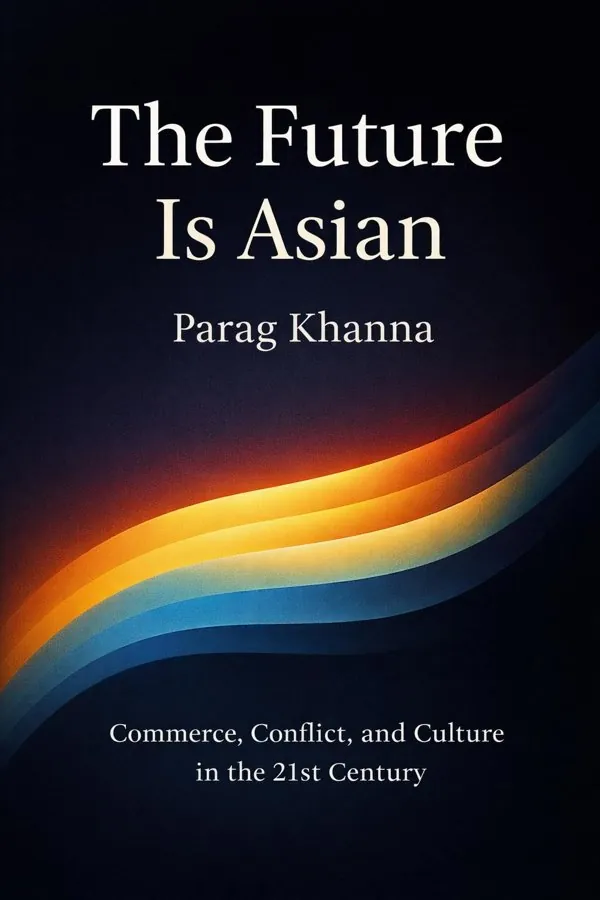
The Future Is Asian: Commerce, Conflict, and Culture in the 21st Century: Summary & Key Insights
by Parag Khanna
 10 min9 chaptersAudio available
Key Takeaways from The Future Is Asian: Commerce, Conflict, and Culture in the 21st Century
The most provocative idea in the book is that Asia’s rise is not a surprise but a return.
One of Khanna’s most important insights is that Asia should be understood less as a patchwork of rival nation-states and more as a deeply connected operating system.
Infrastructure is destiny in Khanna’s analysis.
A striking feature of Asia is that it is rising without becoming politically uniform.
Economic power does not stay confined to factories and balance sheets; eventually it reshapes culture, confidence, and identity.
What Is The Future Is Asian: Commerce, Conflict, and Culture in the 21st Century About?
The Future Is Asian: Commerce, Conflict, and Culture in the 21st Century by Parag Khanna is a future_trends book spanning 11 pages. The Future Is Asian argues that the center of gravity in the modern world is moving decisively eastward. In this sweeping geopolitical study, Parag Khanna contends that the 21st century will be shaped less by Western dominance and more by the rise, integration, and self-confidence of Asia as a vast interconnected system. Rather than focusing on a single superpower such as China or India, Khanna examines Asia as a network of economies, infrastructures, cultures, and political relationships that increasingly drive global trade, technology, urban growth, and strategic competition. The book matters because it challenges outdated assumptions about world order. It asks readers to stop seeing Asia as a collection of developing nations catching up to the West and instead recognize it as the arena where the future is already being built. Khanna brings strong authority to this argument as a political scientist, global strategist, and longtime analyst of globalization and connectivity. His synthesis of history, economics, diplomacy, and culture makes this book essential reading for anyone trying to understand where power, prosperity, and influence are headed next.
This FizzRead summary covers all 9 key chapters of The Future Is Asian: Commerce, Conflict, and Culture in the 21st Century in approximately 10 minutes, distilling the most important ideas, arguments, and takeaways from Parag Khanna's work. Also available as an audio summary and Key Quotes Podcast.
The Future Is Asian: Commerce, Conflict, and Culture in the 21st Century
The Future Is Asian argues that the center of gravity in the modern world is moving decisively eastward. In this sweeping geopolitical study, Parag Khanna contends that the 21st century will be shaped less by Western dominance and more by the rise, integration, and self-confidence of Asia as a vast interconnected system. Rather than focusing on a single superpower such as China or India, Khanna examines Asia as a network of economies, infrastructures, cultures, and political relationships that increasingly drive global trade, technology, urban growth, and strategic competition. The book matters because it challenges outdated assumptions about world order. It asks readers to stop seeing Asia as a collection of developing nations catching up to the West and instead recognize it as the arena where the future is already being built. Khanna brings strong authority to this argument as a political scientist, global strategist, and longtime analyst of globalization and connectivity. His synthesis of history, economics, diplomacy, and culture makes this book essential reading for anyone trying to understand where power, prosperity, and influence are headed next.
Who Should Read The Future Is Asian: Commerce, Conflict, and Culture in the 21st Century?
This book is perfect for anyone interested in future_trends and looking to gain actionable insights in a short read. Whether you're a student, professional, or lifelong learner, the key ideas from The Future Is Asian: Commerce, Conflict, and Culture in the 21st Century by Parag Khanna will help you think differently.
- ✓Readers who enjoy future_trends and want practical takeaways
- ✓Professionals looking to apply new ideas to their work and life
- ✓Anyone who wants the core insights of The Future Is Asian: Commerce, Conflict, and Culture in the 21st Century in just 10 minutes
Want the full summary?
Get instant access to this book summary and 100K+ more with Fizz Moment.
Get Free SummaryAvailable on App Store • Free to download
Key Chapters
The most provocative idea in the book is that Asia’s rise is not a surprise but a return. Khanna asks readers to reconsider the long arc of history: for much of human civilization, Asia was the world’s primary center of wealth, invention, trade, and cultural exchange. From the Silk Roads and Indian Ocean trade networks to Chinese manufacturing and Islamic scholarship, the continent was deeply interconnected long before Europe’s imperial age. What made the modern West seem like the natural leader of the world was not permanent superiority, but a relatively brief period of colonial extraction, industrial acceleration, and military dominance.
This historical framing matters because it changes how we interpret current events. Asia’s growth is not simply a story of emerging markets catching up. It is a civilizational rebalancing. Countries such as China, India, Indonesia, Vietnam, and others are not entering history for the first time; they are regaining agency after centuries of external domination and imposed dependency. This helps explain the confidence behind Asian infrastructure projects, regional trade agreements, and efforts to shape global institutions on their own terms.
A practical way to apply this idea is to stop using outdated mental maps. Businesses should not treat Asia as a peripheral market. Policymakers should not assume Western standards will remain universal by default. Students and professionals should study Asian history and systems not as regional specialties, but as central to understanding the modern world.
Actionable takeaway: Replace the “Asia is rising” narrative with “Asia is re-centering,” and use that lens to rethink strategy, investment, and long-term planning.
One of Khanna’s most important insights is that Asia should be understood less as a patchwork of rival nation-states and more as a deeply connected operating system. Despite extraordinary diversity in language, religion, political structure, and development level, Asian countries are bound together by trade routes, energy corridors, supply chains, migration, digital networks, and financial flows. This interdependence gives the region much of its strength.
Khanna emphasizes that Asia contains multiple subregions, from East Asia and Southeast Asia to South Asia, Central Asia, and the Gulf. These zones differ politically, but they increasingly interact through practical needs: ports, rail links, manufacturing ecosystems, tourism, labor movement, and cross-border investment. Japan finances infrastructure in Southeast Asia, Gulf capital invests across the continent, China builds transport corridors, and Indian services connect into regional markets. The point is not that Asia is unified in a European Union sense, but that it is becoming integrated through function rather than ideology.
This concept has real-world implications. A company entering Asia cannot rely on a single-country strategy. Manufacturing in Vietnam may depend on components from China, financing from Singapore, shipping through Malaysia, and end markets in India or the Gulf. Diplomats, likewise, must understand that bilateral relationships exist inside broader regional webs.
Actionable takeaway: When assessing Asia, think in terms of networks rather than borders. Build strategies around regional interdependence, not isolated national snapshots.
Infrastructure is destiny in Khanna’s analysis. He argues that roads, railways, ports, pipelines, industrial corridors, and fiber-optic networks matter as much as treaties or military alliances because they physically reorganize how economies work. The new Silk Roads are not just metaphors; they are concrete systems that bind Asia together and increase its influence over the rest of the world.
Trade and investment across Asia have accelerated through both state-led and market-led integration. China’s Belt and Road Initiative is the most famous example, but it is only one part of a larger story. Japan, South Korea, India, the Gulf states, ASEAN countries, and multilateral institutions are all investing in logistics and connectivity. The result is that goods, capital, and data increasingly move along Asian-centered routes rather than through traditional Western chokepoints.
For businesses, this means that competitive advantage often depends on understanding infrastructure geography. A city linked to major ports and digital backbones can rise quickly. A country with weak transport and energy systems can fall behind even if wages are low. For governments, infrastructure planning is now foreign policy, industrial policy, and security policy rolled into one.
Consider how supply chains have evolved: electronics, apparel, automotive parts, and renewable energy technologies often involve multiple Asian countries in a single production cycle. This complexity makes Asia resilient in some ways, but it also creates vulnerabilities when shipping lanes, border policies, or financing conditions change.
Actionable takeaway: Pay attention to corridors, not just countries. Follow where infrastructure is being built, because that is often where future economic power will concentrate.
A striking feature of Asia is that it is rising without becoming politically uniform. Khanna argues that the region’s order is not based on a single empire or uncontested superpower, but on continuous balancing among major players. China is powerful, but so are India, Japan, the ASEAN bloc, the Gulf states, South Korea, and others in different ways. This creates a fluid strategic environment in which countries hedge, cooperate, compete, and reposition constantly.
Rather than choosing permanent sides, many Asian states pursue pragmatic multi-alignment. They may trade heavily with China, rely on the United States for security, invest with Japan, import energy from the Gulf, and cultivate ties with India at the same time. This is not inconsistency; it is adaptation to a world where influence is distributed. Asia’s political logic is often transactional and flexible rather than ideological and binary.
This helps explain why predictions of a simple “new Cold War” often miss the mark. While there are serious disputes over borders, maritime claims, technology, and military presence, countries across Asia also have strong incentives to keep commerce flowing. Their prosperity depends on managing rivalry without allowing it to destroy the larger system.
For leaders and analysts, this means that conventional alliance thinking is often too rigid. Success in Asia requires reading signals carefully, understanding regional sensitivities, and accepting that countries can be partners and competitors at the same time.
Actionable takeaway: Avoid all-or-nothing geopolitical thinking. In Asia, influence comes from flexibility, credibility, and the ability to cooperate across overlapping relationships.
Economic power does not stay confined to factories and balance sheets; eventually it reshapes culture, confidence, and identity. Khanna argues that as Asia grows wealthier and more connected, it is also experiencing a cultural renaissance. Asian societies are no longer simply absorbing Western norms. They are increasingly exporting their own aesthetics, institutions, values, and aspirations to the world.
This shift appears in obvious areas such as media, food, fashion, design, education, and digital entertainment. Korean music and film, Japanese design, Indian cinema, Chinese consumer platforms, and Southeast Asian creative industries all illustrate a broader pattern: Asia is becoming not only a producer of goods but a producer of meaning. Equally important, Asian elites and middle classes are more confident in their own models of development. Western liberal modernity is no longer assumed to be the only valid template.
Khanna does not claim Asia shares one unified culture. Instead, he shows that cultural self-assurance itself is becoming regional. Countries are selectively blending tradition and modernity, nationalism and cosmopolitanism, local identity and global participation. That dynamic will influence everything from education policy to branding to political legitimacy.
For readers, the practical implication is to understand that soft power now flows in multiple directions. Companies must localize without condescension. Institutions must recognize Asian audiences as standard-setters, not secondary markets. Individuals should build cultural literacy alongside economic knowledge.
Actionable takeaway: Treat Asian culture as a source of global influence, not just local flavor. Learn how identity, values, and prestige are being redefined across the region.
The future of Asia is being built in cities before it is declared in capitals. Khanna highlights urbanization and demographic change as two of the most decisive forces shaping the region. Asia’s megacities are engines of productivity, consumption, innovation, and social transformation. From Shanghai and Shenzhen to Jakarta, Mumbai, Bangkok, Dubai, and Ho Chi Minh City, urban centers are where infrastructure, talent, and investment collide.
These cities matter because they often operate as economic worlds of their own. A well-connected metropolis can attract global capital, educate skilled workers, incubate startups, and influence national policy. At the same time, Asia’s demographic profile is highly uneven. Some societies, such as Japan and South Korea, face aging populations and labor shortages. Others, such as India, the Philippines, and parts of Southeast Asia, have youthful populations that could become huge advantages if education and employment systems keep pace.
Khanna shows that demographics are not destiny on their own. Young populations can become engines of growth or sources of instability. Aging societies can stagnate or innovate through automation, health technology, and immigration. The key variable is whether governments and markets can adapt.
For businesses, urban concentration helps identify where demand and talent will emerge first. For policymakers, it underlines the need for housing, mobility, sanitation, climate resilience, and job creation. For individuals, it suggests that cities in Asia are likely to offer some of the world’s most dynamic opportunities.
Actionable takeaway: Watch Asian cities and demographic transitions closely; they are better predictors of future growth than national headlines alone.
Khanna extends the idea of connectivity beyond roads and ports to include the digital realm. Asia’s future is not only industrial; it is increasingly technological, data-driven, and platform-based. The region is building its own digital ecosystems in e-commerce, fintech, telecommunications, artificial intelligence, logistics software, and smart-city infrastructure. This emerging digital Silk Road is helping Asia integrate faster and compete more effectively on a global scale.
In many cases, Asian markets have leapfrogged older Western models. Mobile payments in China and parts of Southeast Asia, super-app ecosystems, rapid e-commerce adoption, and advanced electronics manufacturing all show how innovation can accelerate when large populations, dense cities, and growing middle classes converge. Digital infrastructure also allows smaller firms and less-developed regions to participate in wider markets more quickly than before.
But Khanna also implies that digital integration has geopolitical consequences. Whoever controls standards, cloud systems, telecom networks, undersea cables, and data governance frameworks can shape power in the 21st century. Technology competition is therefore not just commercial; it is strategic. Debates over 5G, semiconductors, cybersecurity, and AI regulation are really debates about influence and dependency.
For organizations, the lesson is to understand Asia not merely as a user base but as a source of digital models. For governments, tech sovereignty and interoperability have become critical. For professionals, familiarity with Asian digital ecosystems is now a career advantage.
Actionable takeaway: Follow data networks with the same seriousness as shipping routes. In the next phase of globalization, digital connectivity will be as important as physical trade.
Khanna’s central thesis is not just that Asia is growing, but that globalization itself is changing character. The old version of globalization often implied Western capital, Western institutions, Western consumption patterns, and Western narratives spreading outward. The new version is increasingly shaped by Asian demand, Asian supply chains, Asian finance, Asian urbanization, and Asian standards of practical cooperation.
This does not mean the West disappears or becomes irrelevant. Rather, it means the world becomes more plural, with Asia playing the lead role in defining how commerce, diplomacy, and culture circulate. Trade agreements in Asia, manufacturing ecosystems across the region, migration flows within Asia, and educational and media exchanges all suggest that the continent is no longer merely integrated into globalization; it is redesigning it.
Khanna encourages readers to think beyond simplistic succession stories in which one superpower replaces another. The future may be less about a Chinese century or an American century than about an Asian age composed of many centers. In this world, influence comes from connectivity, adaptability, and participation in regional systems.
For companies, this means future growth may depend on being relevant inside Asian networks. For policymakers, it means global governance can no longer be designed as if Atlantic priorities are universal. For individuals, it means understanding Asia is no longer optional for anyone interested in economics, strategy, technology, or culture.
Actionable takeaway: Update your worldview from West-led globalization to Asian-shaped globalization, and make decisions accordingly in business, policy, and personal learning.
All Chapters in The Future Is Asian: Commerce, Conflict, and Culture in the 21st Century
About the Author
Parag Khanna is an Indian-American political scientist, global strategist, and bestselling author whose work focuses on geopolitics, globalization, infrastructure, and the future of world order. He has advised governments, multinational companies, and international institutions, and is known for analyzing how connectivity, trade networks, migration, and technology are reshaping power in the modern era. Khanna has written several influential books on global trends and strategic competition, often combining historical perspective with forward-looking analysis. His approach is distinctive for emphasizing systems, networks, and practical interdependence rather than viewing the world only through traditional national rivalries. In The Future Is Asian, he applies this broad strategic lens to argue that Asia’s rise is not temporary or regional, but one of the defining transformations of the 21st century.
Get This Summary in Your Preferred Format
Read or listen to the The Future Is Asian: Commerce, Conflict, and Culture in the 21st Century summary by Parag Khanna anytime, anywhere. FizzRead offers multiple formats so you can learn on your terms — all free.
Available formats: App · Audio · PDF · EPUB — All included free with FizzRead
Download The Future Is Asian: Commerce, Conflict, and Culture in the 21st Century PDF and EPUB Summary
Key Quotes from The Future Is Asian: Commerce, Conflict, and Culture in the 21st Century
“The most provocative idea in the book is that Asia’s rise is not a surprise but a return.”
“One of Khanna’s most important insights is that Asia should be understood less as a patchwork of rival nation-states and more as a deeply connected operating system.”
“Infrastructure is destiny in Khanna’s analysis.”
“A striking feature of Asia is that it is rising without becoming politically uniform.”
“Economic power does not stay confined to factories and balance sheets; eventually it reshapes culture, confidence, and identity.”
Frequently Asked Questions about The Future Is Asian: Commerce, Conflict, and Culture in the 21st Century
The Future Is Asian: Commerce, Conflict, and Culture in the 21st Century by Parag Khanna is a future_trends book that explores key ideas across 9 chapters. The Future Is Asian argues that the center of gravity in the modern world is moving decisively eastward. In this sweeping geopolitical study, Parag Khanna contends that the 21st century will be shaped less by Western dominance and more by the rise, integration, and self-confidence of Asia as a vast interconnected system. Rather than focusing on a single superpower such as China or India, Khanna examines Asia as a network of economies, infrastructures, cultures, and political relationships that increasingly drive global trade, technology, urban growth, and strategic competition. The book matters because it challenges outdated assumptions about world order. It asks readers to stop seeing Asia as a collection of developing nations catching up to the West and instead recognize it as the arena where the future is already being built. Khanna brings strong authority to this argument as a political scientist, global strategist, and longtime analyst of globalization and connectivity. His synthesis of history, economics, diplomacy, and culture makes this book essential reading for anyone trying to understand where power, prosperity, and influence are headed next.
More by Parag Khanna
You Might Also Like
Futureproof: 9 Rules for Humans in the Age of Automation
Kevin Roose
10 min
The Third Wave
Alvin Toffler
10 min
2030: How Today's Biggest Trends Will Collide and Reshape the Future of Everything
Mauro F. Guillén
10 min
A Very Human Future: Enriching Humanity in a Digitized World
Rohit Talwar, Steve Wells, Alexandra Whittington
10 min
AI 2041: Ten Visions for Our Future
Kai-Fu Lee, Chen Qiufan
10 min
Abundance: The Future Is Better Than You Think
Peter H. Diamandis, Steven Kotler
10 minBrowse by Category
Ready to read The Future Is Asian: Commerce, Conflict, and Culture in the 21st Century?
Get the full summary and 100K+ more books with Fizz Moment.