
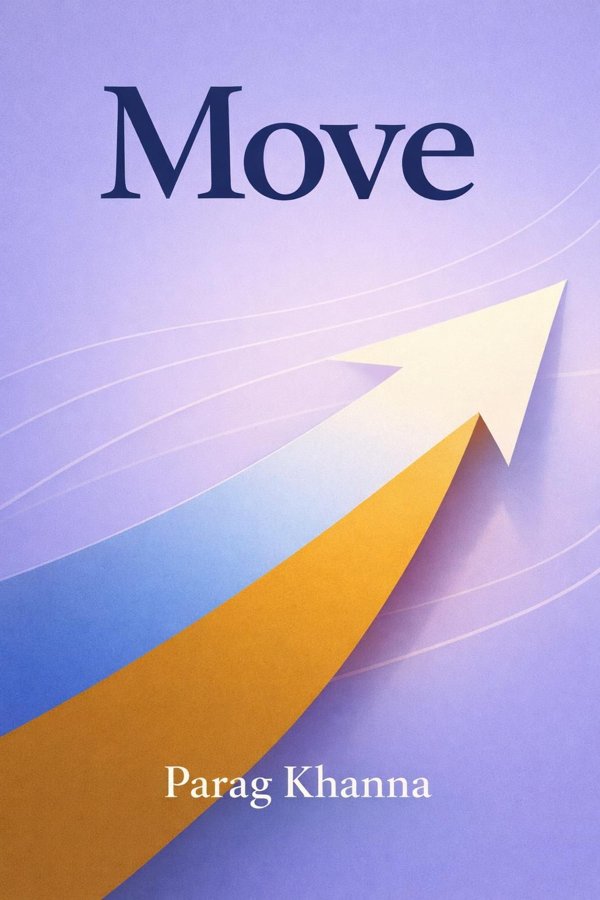
Move: Summary & Key Insights
by Parag Khanna
 10 min10 chaptersAudio available
Key Takeaways from Move
One of the book’s most powerful insights is that migration is not an exception to human history; it is the engine of it.
A disturbing but clarifying idea in Move is that climate change will not simply alter weather patterns; it will reorganize human settlement.
Khanna highlights a simple but transformative imbalance: some countries are running out of people, while others have more young people than their economies can absorb.
A striking theme in Move is that economic success increasingly belongs to places and people that can adapt through movement.
Khanna does not argue that states are disappearing.
What Is Move About?
Move by Parag Khanna is a future_trends book spanning 10 pages. In Move, global strategist Parag Khanna makes a bold claim: the defining story of the twenty-first century will not be borders, but mobility. People will move not only because they want to, but because they must. Climate disruption, aging societies, labor shortages, urbanization, conflict, and new technologies are combining to reshape where humans can live, work, and thrive. Khanna argues that migration is not a side issue in world affairs; it is the central mechanism through which civilization adapts. What makes this book especially important is its scale. Rather than treating migration as a temporary crisis or a narrow policy debate, Khanna frames it as a long-term global system involving economics, demography, infrastructure, geography, and human resilience. He combines historical perspective, data, geopolitical analysis, and case studies to show why billions of people may relocate over the coming decades. Khanna writes with unusual authority. Known for his work on globalization and geopolitics, he brings together strategic forecasting and practical policy thinking. Move matters because it challenges readers to stop asking how to prevent movement and start asking how to manage it wisely, humanely, and productively.
This FizzRead summary covers all 10 key chapters of Move in approximately 10 minutes, distilling the most important ideas, arguments, and takeaways from Parag Khanna's work. Also available as an audio summary and Key Quotes Podcast.
Move
In Move, global strategist Parag Khanna makes a bold claim: the defining story of the twenty-first century will not be borders, but mobility. People will move not only because they want to, but because they must. Climate disruption, aging societies, labor shortages, urbanization, conflict, and new technologies are combining to reshape where humans can live, work, and thrive. Khanna argues that migration is not a side issue in world affairs; it is the central mechanism through which civilization adapts.
What makes this book especially important is its scale. Rather than treating migration as a temporary crisis or a narrow policy debate, Khanna frames it as a long-term global system involving economics, demography, infrastructure, geography, and human resilience. He combines historical perspective, data, geopolitical analysis, and case studies to show why billions of people may relocate over the coming decades.
Khanna writes with unusual authority. Known for his work on globalization and geopolitics, he brings together strategic forecasting and practical policy thinking. Move matters because it challenges readers to stop asking how to prevent movement and start asking how to manage it wisely, humanely, and productively.
Who Should Read Move?
This book is perfect for anyone interested in future_trends and looking to gain actionable insights in a short read. Whether you're a student, professional, or lifelong learner, the key ideas from Move by Parag Khanna will help you think differently.
- ✓Readers who enjoy future_trends and want practical takeaways
- ✓Professionals looking to apply new ideas to their work and life
- ✓Anyone who wants the core insights of Move in just 10 minutes
Want the full summary?
Get instant access to this book summary and 100K+ more with Fizz Moment.
Get Free SummaryAvailable on App Store • Free to download
Key Chapters
One of the book’s most powerful insights is that migration is not an exception to human history; it is the engine of it. Khanna argues that we often talk about mobility as if it were a modern disruption, yet every major civilization was built through movement. From early human dispersal out of Africa to maritime trade routes, imperial expansion, frontier settlement, and modern urbanization, people have always relocated in search of safety, resources, and opportunity.
This historical framing changes how we interpret current migration debates. If movement is normal, then trying to freeze populations in place is both unrealistic and often harmful. Nations that imagine themselves as static or culturally fixed are ignoring their own past. The United States, Canada, Australia, Singapore, and many Gulf states, for example, are products of layered migrations. Even regions that appear culturally stable were shaped by centuries of conquest, trade, intermarriage, and internal displacement.
Khanna’s point is not that all migration is easy or benign. Movement can create conflict, competition, and strain. But he insists that it is also how societies renew themselves. Economies grow when labor moves to where it is needed. Ideas spread when people cross borders. Cultures evolve when newcomers contribute skills, foodways, values, and institutions.
A practical application of this idea is to rethink migration policy as nation-building policy. Schools, infrastructure, language support, housing, and labor-market integration should be treated as investments in future prosperity, not as emergency expenditures.
Actionable takeaway: Replace the fear-based question “How do we stop migration?” with the strategic question “How do we design institutions that turn movement into social and economic strength?”
A disturbing but clarifying idea in Move is that climate change will not simply alter weather patterns; it will reorganize human settlement. Khanna argues that as temperatures rise, water stress intensifies, coastlines flood, and agricultural productivity shifts, large parts of the world will become less habitable while others become more attractive. The result is not a distant environmental issue but a civilizational relocation challenge.
This means climate migration should not be understood only as dramatic refugee flows after disasters. It will also occur gradually: farmers leaving drought-prone land, families moving inland from flood zones, workers relocating from overheated cities, and entire communities seeking more stable ecosystems. Regions in the tropics and subtropics may face severe pressure, while parts of northern Europe, Russia, Canada, and other higher-latitude zones could become comparatively more livable.
Khanna pushes readers to think spatially. Where will food be grown? Which cities can handle heat? Which inland corridors have water, transport links, and jobs? Governments that ignore these questions will be caught reacting to crises. Governments that plan ahead can guide settlement, invest in resilient infrastructure, and reduce suffering.
Examples are already visible: wildfire-affected migration in North America, water stress in South Asia, sea-level threats in island nations, and heat-driven urban stress in the Middle East. Businesses, too, must rethink supply chains, insurance exposure, and labor locations.
Actionable takeaway: Whether you are a policymaker, investor, or citizen, start assessing places not just by current prosperity but by future habitability—water, heat resilience, food security, infrastructure, and long-term climate stability.
Khanna highlights a simple but transformative imbalance: some countries are running out of people, while others have more young people than their economies can absorb. This demographic divergence will be one of the strongest drivers of migration in the decades ahead. Aging societies in Europe, East Asia, and parts of North America need workers to sustain healthcare systems, pensions, construction, agriculture, logistics, and innovation. Meanwhile, youthful populations in Africa, South Asia, and parts of the Middle East are seeking jobs, education, and upward mobility.
This is not merely a humanitarian issue. It is an economic necessity. A society with too few working-age adults cannot maintain growth, support retirees, or fill essential roles. Immigration is therefore not a side solution; in many places it is a structural requirement. Khanna argues that countries will increasingly compete for migrants, especially skilled and adaptable ones.
The implication is that migration policy must be aligned with demographic reality. Nations that insist on low immigration while facing labor shortages may experience slower growth and fiscal stress. On the other hand, countries that build pathways for integration can renew their workforce and sustain public systems. Examples include healthcare worker migration into aging societies, international student pipelines that become talent channels, and regional labor mobility agreements.
For individuals, demographic awareness can guide education and career choices. Fields connected to aging populations, infrastructure expansion, and migrant integration will become more valuable. For governments, data-driven planning can identify where workers will be needed most and how migration can address those gaps.
Actionable takeaway: Treat demographic trends as destiny only if unmanaged. Study which societies are aging, which are youthful, and where labor shortages are growing—those patterns reveal the migration routes of the future.
A striking theme in Move is that economic success increasingly belongs to places and people that can adapt through movement. In earlier eras, wealth was often tied to fixed assets such as land, mines, or factories. Today, value is more fluid. Talent, capital, knowledge, and entrepreneurship travel. Khanna argues that in this world, mobility is not a symptom of instability alone; it is also a competitive advantage.
Workers move toward better wages and safer environments. Companies move operations to regions with lower risk, better regulation, and stronger infrastructure. Investors redirect capital toward climate-resilient geographies. Even families diversify risk by spreading members across cities or countries, creating transnational networks of remittances, education, and opportunity.
This perspective helps explain why migration often persists despite political resistance. Economic systems reward flexibility. A software engineer may relocate to a talent hub. A manufacturer may shift facilities to avoid climate disruption. A nurse may cross borders to fill shortages in aging societies. A family may send one member abroad to create financial resilience for everyone.
Khanna encourages readers to think of movement not just as relocation, but as portfolio strategy. Cities and nations that attract and retain talent through housing, transport, digital infrastructure, legal clarity, and social openness will outperform those that rely on exclusion or complacency.
In practical terms, organizations should map workforce mobility, remote work options, visa pathways, and exposure to climate risk. Individuals should assess where their skills are most portable and where future demand is strongest.
Actionable takeaway: Build mobility into your economic planning—personally, institutionally, and nationally. In a volatile century, the ability to move or attract movers may matter more than the ability to stand still.
Khanna does not argue that states are disappearing. Instead, he shows that the old image of the world as a set of sealed containers is no longer adequate. Borders still regulate movement, but human life is increasingly organized through networks: supply chains, digital platforms, family diasporas, transportation systems, financial flows, and knowledge communities. Migration operates through these networks, not outside them.
This matters because debates about immigration often focus only on border enforcement. Yet movement is shaped just as much by airline routes, labor recruitment systems, visa categories, social media communities, remittance channels, and educational pathways. A migrant chooses a destination not only because a border is open, but because someone they know is already there, because jobs are accessible, because credentials are recognized, or because a transit corridor exists.
Khanna’s broader geopolitical argument is that countries able to plug into global networks will have more influence than countries that merely fortify territorial lines. A city with airports, ports, universities, startup ecosystems, and migrant-friendly institutions can become a magnet regardless of national rhetoric. Conversely, a country with strict borders but weak internal networks may fail to attract the people it needs.
Examples include diaspora-driven business growth, foreign students becoming permanent contributors, and logistics corridors creating new migration routes. This framework is useful for urban planners, educators, and business leaders because it highlights the infrastructure behind human movement.
Actionable takeaway: If you want to understand migration, look beyond maps and toward systems. Ask which places are well connected by transport, jobs, digital access, legal pathways, and social trust—those are the real hubs of future mobility.
Another central insight of Move is that the political failure around migration is often not movement itself, but the refusal to prepare for it. Khanna criticizes reactive politics that treat every influx of people as an emergency, even when the larger forces behind migration are predictable. Climate stress, labor shortages, conflict, and urban pull factors do not appear overnight. Yet many governments continue to rely on short-term border theatrics instead of long-term systems design.
This creates avoidable chaos. Without planning, receiving communities face housing shortages, overwhelmed services, social tension, and political backlash. Sending communities lose talent without adequate development strategies. Migrants themselves become trapped in legal limbo, vulnerable to exploitation and misinformation. Khanna argues that mobility governance must become a normal function of the state, as essential as transportation, education, or public health.
Practical policy tools include regional migration compacts, climate relocation strategies, labor-matching systems, fast credential recognition, urban expansion plans, and integration programs focused on language, employment, and civic participation. Governments should identify likely internal and cross-border migration flows years in advance and align infrastructure accordingly.
Businesses and civil society also have roles. Employers can create ethical recruitment pipelines. Cities can design welcoming institutions. Schools can prepare for multilingual classrooms. Media can reduce fear by contextualizing migration instead of sensationalizing it.
Khanna’s key political message is that migration becomes destabilizing when unmanaged, not when acknowledged. Mature states do not deny movement; they organize it.
Actionable takeaway: Support leaders and institutions that replace symbolic anti-migration rhetoric with serious planning for housing, infrastructure, labor integration, and legal pathways.
Khanna shows that technology is transforming migration in two opposite but related ways: it makes movement easier, and in some cases it reduces the need for physical relocation. Cheap communication, digital payments, online education, telepresence, translation tools, and remote work allow people to maintain ties across borders and build livelihoods in more distributed ways. Mobility is no longer only about permanent one-way migration; it can be circular, hybrid, seasonal, digital, or multi-local.
This complicates the usual picture of migration. A person may live in one country, work for a company in another, study through a third, and support family in a fourth. Diasporas can stay deeply connected to home while integrating abroad. Remote work can delay migration for some and encourage it for others who choose lower-cost, safer, or more pleasant locations. Technology also gives migrants better access to information, though it can spread scams and false expectations as well.
Khanna suggests that states and companies must update their assumptions. Immigration systems built for factory-era labor markets may not fit a world of freelancers, digital nomads, remote teams, and platform work. Cities may attract talent not only with jobs but with quality of life, connectivity, and regulatory flexibility.
Examples include countries creating remote-work visas, migrant workers using digital remittance tools, and refugees accessing mobile banking or online education. But technology is not automatically liberating; digital exclusion can deepen inequality, and surveillance tools can also be used against mobile populations.
Actionable takeaway: Think of mobility as both physical and digital. Strengthen your digital skills, evaluate location flexibility, and support policies that modernize visas, work rules, and public services for a more networked population.
Move gains depth from its regional lens. Khanna does not present migration as a single global story with one outcome. Different regions face different pressures and opportunities based on geography, governance, infrastructure, and demographic structure. Some places will become major destinations. Others will be transit corridors. Still others will experience internal redistribution more than international immigration.
For example, Europe faces aging populations and climate adaptation pressures while struggling politically over identity and integration. North America combines strong absorptive capacity with uneven domestic consensus. The Gulf states demonstrate how large-scale labor migration can power economic growth, though often with unequal rights. Africa contains both some of the fastest-growing populations and many of the future cities where internal migration will be decisive. South and Southeast Asia are simultaneously highly vulnerable to climate stress and central to future economic dynamism.
Khanna’s comparative method helps readers avoid simplistic assumptions. A migration strategy that works for Canada may not work for India. An internal relocation challenge in China differs from refugee reception in Europe. The key is to understand local context while recognizing cross-border interdependence.
This regional perspective is useful for investors, NGOs, students, and policymakers. It encourages scenario planning: Which cities are likely to expand? Which transport corridors will matter? Which countries may liberalize migration to address labor shortages? Which regions face the biggest adaptation gaps?
Actionable takeaway: Do not think about migration in abstract terms. Study the specific region you care about—its climate risks, age structure, labor needs, governance quality, and infrastructure capacity—to understand how mobility will actually unfold there.
Although Move is ambitious in scale, one of its most important contributions is moral rather than statistical: migration is about people making difficult decisions under pressure. Khanna reminds readers that behind forecasts of billions moving are families weighing risk, dignity, belonging, and survival. This human dimension matters because policy debates often reduce migrants to numbers, threats, or labor inputs.
A family leaving a drought-hit region is not just responding to climate data; it is choosing between staying in decline or entering uncertainty. A skilled graduate emigrating from a stagnant economy is not betraying their homeland; they may be building a future that later benefits both origin and destination through remittances, investment, and knowledge transfer. A refugee is not merely a burden on a system; they are a person whose agency has been constrained by violence or collapse.
Khanna’s human-centered approach broadens the ethics of mobility. Good migration policy must protect rights, preserve dignity, and create pathways to belonging. Integration is not only about jobs; it is about recognition, legal status, education, social trust, and the ability to imagine a future.
For readers, this perspective has practical implications. Employers can hire more fairly. Communities can welcome newcomers more intentionally. Schools can support children navigating transition. Voters can evaluate migration rhetoric by asking whether it reflects reality and humanity.
Actionable takeaway: Whenever you encounter migration as a headline or statistic, ask what choices, risks, and hopes lie behind it. Policies improve when we treat mobile people as full human beings, not abstract categories.
Khanna’s overarching argument is not simply that migration will increase, but that adaptability will become the defining measure of successful societies. The winners of the future will not be those that most effectively resist change, but those that can absorb new populations, relocate vulnerable communities, redesign cities, and reconfigure economies in response to shifting geography.
This is a profound reframing. Many political systems still treat stability as the preservation of existing settlement patterns, labor structures, and cultural assumptions. Khanna argues that true stability in the coming century will come from managed flexibility. A resilient country will have dynamic cities, expandable infrastructure, portable benefits, climate-aware land use, and legal pathways for both internal and international movement.
This future orientation also applies to individuals and institutions. Schools should educate for geographic and vocational adaptability. Businesses should stress-test locations and talent strategies. Families may need to think across generations and jurisdictions. Urban planners should prepare for growth in places likely to gain population while helping vulnerable regions transition with dignity.
The practical importance of this idea is hard to overstate. Migration is not one issue among many. It intersects with food systems, housing, healthcare, labor markets, national identity, geopolitics, and climate adaptation. Khanna’s contribution is to show that all these domains must now be thought of through the lens of movement.
Actionable takeaway: Build adaptability as a core value. Whether you lead a city, a company, or your own household, plan for a future in which mobility is normal and resilience depends on the ability to respond constructively to change.
All Chapters in Move
About the Author
Parag Khanna is an Indian-American political scientist, global strategist, and bestselling author focused on geopolitics, globalization, infrastructure, and the future of human systems. He is the founder and CEO of FutureMap, a data-driven advisory firm that helps organizations understand long-term global trends. Khanna is known for connecting geography, networks, demographics, and economics in ways that challenge conventional political thinking. His previous books, including Connectography and The Future Is Asian, established him as a major voice on how the world is being reorganized by flows of people, capital, technology, and power. In Move, he extends that work by arguing that migration will be one of the central forces shaping the twenty-first century. His writing combines strategic analysis with a broad civilizational perspective.
Get This Summary in Your Preferred Format
Read or listen to the Move summary by Parag Khanna anytime, anywhere. FizzRead offers multiple formats so you can learn on your terms — all free.
Available formats: App · Audio · PDF · EPUB — All included free with FizzRead
Download Move PDF and EPUB Summary
Key Quotes from Move
“One of the book’s most powerful insights is that migration is not an exception to human history; it is the engine of it.”
“A disturbing but clarifying idea in Move is that climate change will not simply alter weather patterns; it will reorganize human settlement.”
“Khanna highlights a simple but transformative imbalance: some countries are running out of people, while others have more young people than their economies can absorb.”
“A striking theme in Move is that economic success increasingly belongs to places and people that can adapt through movement.”
“Khanna does not argue that states are disappearing.”
Frequently Asked Questions about Move
Move by Parag Khanna is a future_trends book that explores key ideas across 10 chapters. In Move, global strategist Parag Khanna makes a bold claim: the defining story of the twenty-first century will not be borders, but mobility. People will move not only because they want to, but because they must. Climate disruption, aging societies, labor shortages, urbanization, conflict, and new technologies are combining to reshape where humans can live, work, and thrive. Khanna argues that migration is not a side issue in world affairs; it is the central mechanism through which civilization adapts. What makes this book especially important is its scale. Rather than treating migration as a temporary crisis or a narrow policy debate, Khanna frames it as a long-term global system involving economics, demography, infrastructure, geography, and human resilience. He combines historical perspective, data, geopolitical analysis, and case studies to show why billions of people may relocate over the coming decades. Khanna writes with unusual authority. Known for his work on globalization and geopolitics, he brings together strategic forecasting and practical policy thinking. Move matters because it challenges readers to stop asking how to prevent movement and start asking how to manage it wisely, humanely, and productively.
More by Parag Khanna
You Might Also Like
Futureproof: 9 Rules for Humans in the Age of Automation
Kevin Roose
10 min
The Third Wave
Alvin Toffler
10 min
2030: How Today's Biggest Trends Will Collide and Reshape the Future of Everything
Mauro F. Guillén
10 min
A Very Human Future: Enriching Humanity in a Digitized World
Rohit Talwar, Steve Wells, Alexandra Whittington
10 min
AI 2041: Ten Visions for Our Future
Kai-Fu Lee, Chen Qiufan
10 min
Abundance: The Future Is Better Than You Think
Peter H. Diamandis, Steven Kotler
10 minBrowse by Category
Ready to read Move?
Get the full summary and 100K+ more books with Fizz Moment.