
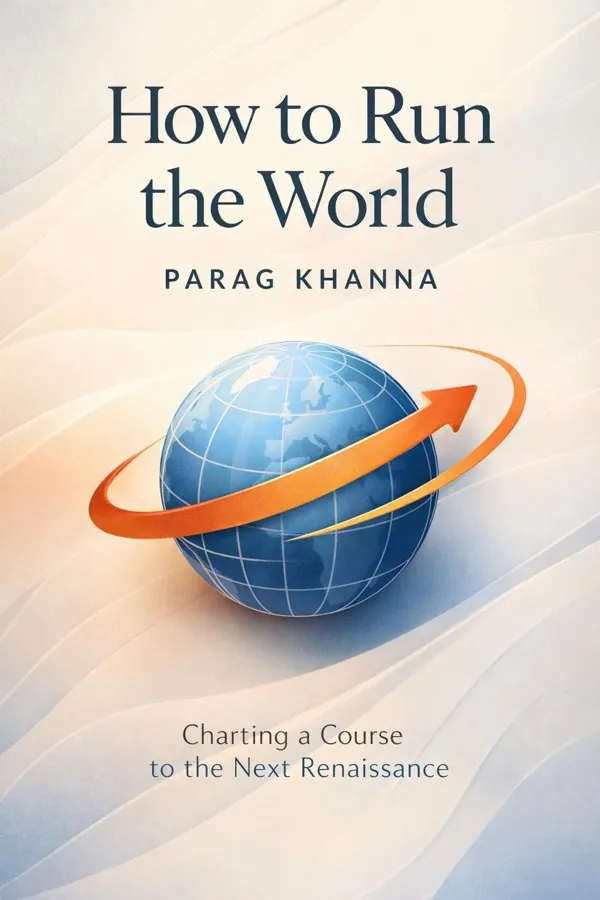
How to Run the World: Charting a Course to the Next Renaissance: Summary & Key Insights
by Parag Khanna
 10 min5 chaptersAudio available
What Is How to Run the World: Charting a Course to the Next Renaissance About?
How to Run the World: Charting a Course to the Next Renaissance by Parag Khanna is a politics book spanning 5 pages. In this book, Parag Khanna argues that the world is entering a new Renaissance driven by a mix of diplomacy, technology, and global networks. He explores how governments, corporations, and individuals can collaborate to solve global challenges in an increasingly interconnected world. The book presents a pragmatic vision for global governance beyond traditional nation-states, emphasizing innovation, cooperation, and adaptability.
This FizzRead summary covers all 5 key chapters of How to Run the World: Charting a Course to the Next Renaissance in approximately 10 minutes, distilling the most important ideas, arguments, and takeaways from Parag Khanna's work. Also available as an audio summary and Key Quotes Podcast.
How to Run the World: Charting a Course to the Next Renaissance
In this book, Parag Khanna argues that the world is entering a new Renaissance driven by a mix of diplomacy, technology, and global networks. He explores how governments, corporations, and individuals can collaborate to solve global challenges in an increasingly interconnected world. The book presents a pragmatic vision for global governance beyond traditional nation-states, emphasizing innovation, cooperation, and adaptability.
Who Should Read How to Run the World: Charting a Course to the Next Renaissance?
This book is perfect for anyone interested in politics and looking to gain actionable insights in a short read. Whether you're a student, professional, or lifelong learner, the key ideas from How to Run the World: Charting a Course to the Next Renaissance by Parag Khanna will help you think differently.
- ✓Readers who enjoy politics and want practical takeaways
- ✓Professionals looking to apply new ideas to their work and life
- ✓Anyone who wants the core insights of How to Run the World: Charting a Course to the Next Renaissance in just 10 minutes
Want the full summary?
Get instant access to this book summary and 100K+ more with Fizz Moment.
Get Free SummaryAvailable on App Store • Free to download
Key Chapters
Every Renaissance begins with disruption. To understand our current one, we must look backward—not to repeat history but to learn from its turning points. I trace previous eras of global transformation, from the Age of Exploration to the Industrial Revolution, showing how expanding networks and technologies consistently reorganized how societies governed themselves. The Venetian merchants, the British East India Company, and the innovators of the Enlightenment were all early actors in decentralized systems of trade and knowledge. Their creativity thrived not in isolation but through connection.
This historical lens offers a crucial insight: breakthroughs always occur when institutions loosen their grip and networks flourish. The medieval world was rigidly hierarchical until commerce and curiosity began to flow freely across borders. Likewise, today’s world is witnessing the erosion of old sovereignties and the rise of fluid global interdependence. What changed then through oceanic trade now changes through digital connectivity.
Learning from those periods teaches us flexibility and openness. Empires collapsed, but networks survived. Innovation never respected political boundaries. Those who embraced cross-cultural exchange shaped the world that followed. Our current transition mirrors these earlier patterns but on a vastly accelerated scale. The Renaissance spirit of interdisciplinary curiosity has become not just an intellectual luxury but a geopolitical necessity. Thus, the lessons of history guide us toward understanding that governance—and progress—today must be more collaborative than centralized.
We are witnessing a gradual yet profound shift away from the dominance of nation-states as the central unit of world organization. In *How to Run the World*, I argue that globalization and technology have chipped away at centralized power in ways that make traditional diplomacy seem almost obsolete. The internet, global capital, and transnational migration constantly bypass governments, distributing influence among non-state actors whose agility far surpasses bureaucratic institutions.
This decline is not about chaos—it’s about evolution. Governments still matter, but they no longer control the full spectrum of action required to solve global problems. Corporations manage vast supply chains across multiple jurisdictions. Humanitarian organizations intervene where states cannot or will not act. Digital activists mobilize millions beyond any formal structure. The balance of authority has shifted from the few to the many.
The challenge is that policymakers often cling to outdated assumptions about sovereignty and geopolitical competition. They mistake fragmentation for failure, when in fact it signals the emergence of new governance mechanisms. The post-Westphalian model—based on borders and hierarchy—has reached its limits. Solving climate change, securing cyberspace, or managing migration requires coalitions that cross lines of nationality and ideology. The world’s energy now lies in cooperation networks, not control structures.
For me, this transformation is liberating. It means individuals and organizations can play roles once reserved for superpowers. But it also demands maturity—a recognition that leadership today means guiding collaboration, not asserting dominance. The world is no longer run by governments alone; it’s orchestrated by thousands of actors linked through shared interests and digital connectivity.
+ 3 more chapters — available in the FizzRead app
All Chapters in How to Run the World: Charting a Course to the Next Renaissance
About the Author
Parag Khanna is an Indian-American political scientist, global strategist, and author. He is known for his work on geopolitics, globalization, and the future of world order. Khanna has advised governments and corporations worldwide and has written several influential books on global strategy and connectivity.
Get This Summary in Your Preferred Format
Read or listen to the How to Run the World: Charting a Course to the Next Renaissance summary by Parag Khanna anytime, anywhere. FizzRead offers multiple formats so you can learn on your terms — all free.
Available formats: App · Audio · PDF · EPUB — All included free with FizzRead
Download How to Run the World: Charting a Course to the Next Renaissance PDF and EPUB Summary
Key Quotes from How to Run the World: Charting a Course to the Next Renaissance
“Every Renaissance begins with disruption.”
“We are witnessing a gradual yet profound shift away from the dominance of nation-states as the central unit of world organization.”
Frequently Asked Questions about How to Run the World: Charting a Course to the Next Renaissance
How to Run the World: Charting a Course to the Next Renaissance by Parag Khanna is a politics book that explores key ideas across 5 chapters. In this book, Parag Khanna argues that the world is entering a new Renaissance driven by a mix of diplomacy, technology, and global networks. He explores how governments, corporations, and individuals can collaborate to solve global challenges in an increasingly interconnected world. The book presents a pragmatic vision for global governance beyond traditional nation-states, emphasizing innovation, cooperation, and adaptability.
More by Parag Khanna
You Might Also Like
Antifa: The Anti-Fascist Handbook
Mark Bray
10 min
Attack from Within: How Disinformation Is Sabotaging America
Barbara McQuade
10 min
Coercion, Capital, and European States, AD 990–1992
Charles Tilly
10 min
Digital Democracy: Concepts, Methodologies, Tools, and Applications
Various Authors
10 min
Fascism
Stanley G. Payne
10 min
Fire And Fury: Inside The Trump White House
Michael Wolff
10 minBrowse by Category
Ready to read How to Run the World: Charting a Course to the Next Renaissance?
Get the full summary and 100K+ more books with Fizz Moment.