
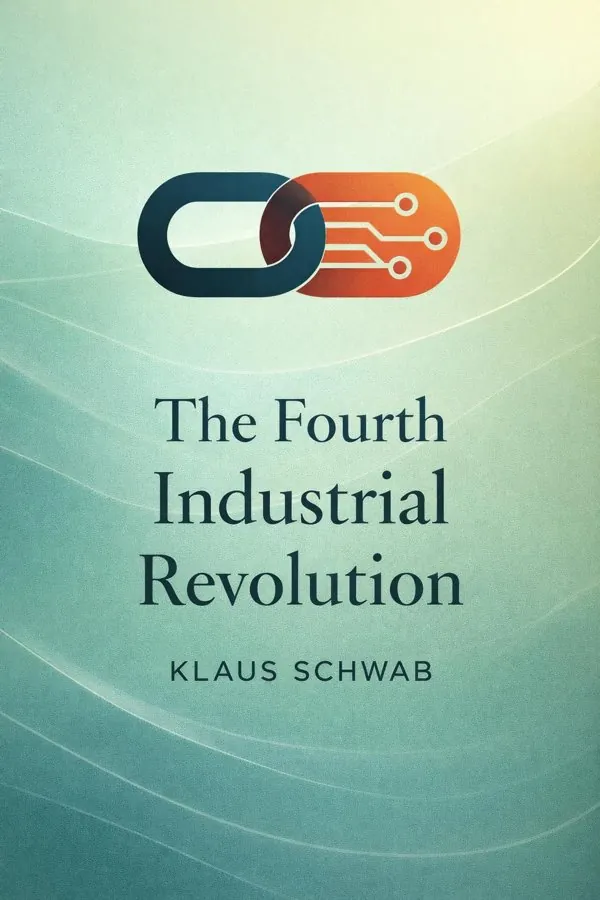
The Fourth Industrial Revolution: Summary & Key Insights
by Klaus Schwab
 10 min9 chaptersAudio available
Key Takeaways from The Fourth Industrial Revolution
Every industrial revolution changes tools, but only a few change the very logic of society.
The most important innovations today do not advance alone; they collide, combine, and multiply one another’s power.
Technology creates prosperity, but it does not distribute that prosperity fairly on its own.
The jobs of the future will not simply require more knowledge; they will require a different relationship between humans and machines.
The deepest effects of technological revolutions are often social, not technical.
What Is The Fourth Industrial Revolution About?
The Fourth Industrial Revolution by Klaus Schwab is a future_trends book spanning 13 pages. What happens when artificial intelligence, robotics, biotechnology, advanced materials, and the Internet of Things begin to evolve at the same time and reinforce one another? In The Fourth Industrial Revolution, Klaus Schwab argues that we are living through exactly that moment: a historic transformation more powerful than a simple wave of innovation and more disruptive than most governments, businesses, and individuals are prepared for. This new revolution is not defined by one breakthrough, but by the fusion of technologies across the physical, digital, and biological worlds. Schwab’s central claim is that this shift will change not only how companies operate and economies grow, but also how people work, learn, govern, consume, and relate to one another. The stakes are enormous. These technologies can improve health, productivity, inclusion, and sustainability, yet they can also widen inequality, weaken privacy, and outpace institutions built for a slower era. As founder and executive chairman of the World Economic Forum, Schwab brings a global, cross-sector perspective shaped by decades of engagement with political leaders, CEOs, academics, and civil society. The result is a big-picture guide to one of the defining forces of our time and a call for responsible leadership before technological change begins to lead us instead.
This FizzRead summary covers all 9 key chapters of The Fourth Industrial Revolution in approximately 10 minutes, distilling the most important ideas, arguments, and takeaways from Klaus Schwab's work. Also available as an audio summary and Key Quotes Podcast.
The Fourth Industrial Revolution
What happens when artificial intelligence, robotics, biotechnology, advanced materials, and the Internet of Things begin to evolve at the same time and reinforce one another? In The Fourth Industrial Revolution, Klaus Schwab argues that we are living through exactly that moment: a historic transformation more powerful than a simple wave of innovation and more disruptive than most governments, businesses, and individuals are prepared for. This new revolution is not defined by one breakthrough, but by the fusion of technologies across the physical, digital, and biological worlds.
Schwab’s central claim is that this shift will change not only how companies operate and economies grow, but also how people work, learn, govern, consume, and relate to one another. The stakes are enormous. These technologies can improve health, productivity, inclusion, and sustainability, yet they can also widen inequality, weaken privacy, and outpace institutions built for a slower era.
As founder and executive chairman of the World Economic Forum, Schwab brings a global, cross-sector perspective shaped by decades of engagement with political leaders, CEOs, academics, and civil society. The result is a big-picture guide to one of the defining forces of our time and a call for responsible leadership before technological change begins to lead us instead.
Who Should Read The Fourth Industrial Revolution?
This book is perfect for anyone interested in future_trends and looking to gain actionable insights in a short read. Whether you're a student, professional, or lifelong learner, the key ideas from The Fourth Industrial Revolution by Klaus Schwab will help you think differently.
- ✓Readers who enjoy future_trends and want practical takeaways
- ✓Professionals looking to apply new ideas to their work and life
- ✓Anyone who wants the core insights of The Fourth Industrial Revolution in just 10 minutes
Want the full summary?
Get instant access to this book summary and 100K+ more with Fizz Moment.
Get Free SummaryAvailable on App Store • Free to download
Key Chapters
Every industrial revolution changes tools, but only a few change the very logic of society. Schwab argues that the Fourth Industrial Revolution stands apart because of three defining characteristics: velocity, scope, and systemic impact. Technological change is moving faster than in previous eras, breakthroughs are spreading across multiple domains at once, and the effects are transforming entire systems rather than isolated industries.
To understand the comparison, think of the earlier revolutions. The first used steam and mechanization to reshape production. The second brought electricity, mass manufacturing, and industrial scale. The third introduced computers, electronics, and digital networks. The fourth builds on the digital revolution but goes further by merging physical machines, intelligent software, and biological science into integrated systems that can sense, decide, adapt, and act.
This is why a single innovation like AI affects more than software. It changes logistics, medicine, education, agriculture, law, media, and national security. A sensor in a factory is not just a better tool; combined with cloud computing, machine learning, and robotics, it becomes part of an intelligent production system. A wearable health monitor is not just a consumer gadget; it can alter diagnosis, insurance, preventive care, and personal behavior.
Schwab’s larger point is that leaders who treat this moment as a routine technology cycle will misread its consequences. The challenge is not simply adopting new tools, but redesigning institutions, skills, and values to match a rapidly changing reality. Actionable takeaway: assess change in terms of systems, not gadgets. When evaluating any new technology, ask how it could reshape markets, work, regulation, and human relationships at the same time.
The most important innovations today do not advance alone; they collide, combine, and multiply one another’s power. Schwab highlights a cluster of technologies driving the Fourth Industrial Revolution, including artificial intelligence, robotics, autonomous vehicles, 3D printing, nanotechnology, biotechnology, new materials, energy storage, and the Internet of Things. Their significance lies not only in what each can do independently, but in what becomes possible when they interact.
Consider healthcare. AI can analyze medical images faster, sensors can continuously monitor patients, biotechnology can enable precision therapies, and advanced manufacturing can produce custom implants. In agriculture, drones, satellite data, connected soil sensors, and machine learning can reduce waste while improving yield. In manufacturing, smart machines, digital twins, predictive maintenance, and additive manufacturing create more flexible and efficient production.
Schwab emphasizes that this convergence lowers barriers between sectors. Car companies become software firms. Banks become data platforms. Hospitals become analytics organizations. Energy systems become intelligent networks. As a result, many organizations face competition from unexpected directions. A startup with the right algorithm and cloud infrastructure can challenge a giant with physical assets but slower adaptation.
The practical lesson is that technological literacy is no longer optional for leaders, workers, or citizens. You do not need to become an engineer, but you do need to understand the direction of change. Which technologies are relevant to your industry? Which combinations create new threats or opportunities? Actionable takeaway: map the technology stack affecting your field. Instead of tracking one trend in isolation, identify how data, automation, connectivity, and biology may intersect to redefine your work or business.
Technology creates prosperity, but it does not distribute that prosperity fairly on its own. One of Schwab’s most important contributions is his balanced view of the economic implications of the Fourth Industrial Revolution. On one hand, emerging technologies can raise productivity, lower costs, improve quality, and unlock new business models. On the other hand, they can also intensify inequality, displace workers, and reward those who control platforms, data, capital, and specialized talent.
The gains are easy to see. Smart factories reduce downtime and waste. Digital platforms connect buyers and sellers at global scale. AI helps firms make better decisions from large data sets. Precision technologies can optimize everything from shipping routes to energy use. These changes can drive growth and create entirely new industries.
Yet Schwab warns that disruption often arrives before institutions are ready. Automation may replace routine jobs in manufacturing, administration, retail, transport, and even professional services. Highly skilled workers who can design, manage, and complement intelligent systems may see rising wages, while others face stagnation or instability. Market concentration can also increase when digital platforms scale rapidly and dominate networks.
This means the debate is not whether technology is good or bad, but how societies shape its outcomes. Tax policy, labor transition support, competition law, entrepreneurship ecosystems, and inclusive access to education all matter. Companies must also think beyond quarterly efficiency gains and consider social legitimacy. Actionable takeaway: focus on adaptation, not denial. Whether you are a policymaker, manager, or employee, prepare for disruption by investing in transition pathways, not just celebrating innovation’s upside.
The jobs of the future will not simply require more knowledge; they will require a different relationship between humans and machines. Schwab argues that the Fourth Industrial Revolution is transforming labor markets by automating routine tasks while increasing demand for creativity, problem-solving, emotional intelligence, collaboration, and lifelong learning. The real question is not whether jobs will disappear, but which tasks will be automated, which roles will evolve, and how quickly people can adapt.
Many occupations are already changing. Accountants use software that automates basic reconciliation, but their advisory role becomes more valuable. Doctors gain diagnostic support from AI, yet empathy, judgment, and trust remain essential. Teachers can use personalized learning platforms, but mentoring and motivation still depend on human connection. Even in blue-collar settings, workers increasingly supervise, maintain, or coordinate automated systems rather than perform every step manually.
Schwab stresses that education systems built for stable careers and standardized knowledge are poorly matched to this environment. Students and professionals alike need digital fluency, adaptability, curiosity, and the ability to learn across disciplines. Reskilling cannot be a one-time event in youth; it must become continuous. Businesses, governments, and educational institutions must collaborate to make this realistic and affordable.
For individuals, this is both unsettling and empowering. While specific technical tools may change quickly, capabilities like communication, ethics, design thinking, and resilience remain durable. People who can work with technology rather than compete directly against it will be better positioned. Actionable takeaway: build a personal reskilling habit. Regularly update one technical skill, one analytical skill, and one human-centered skill so you stay relevant in an economy where change is constant.
The deepest effects of technological revolutions are often social, not technical. Schwab argues that the Fourth Industrial Revolution is reshaping how people form identities, build relationships, consume information, and understand privacy, trust, and belonging. The same tools that create convenience and connection can also fragment attention, intensify surveillance, and weaken shared norms if left unchecked.
Digital platforms have changed communication from periodic and local to constant and global. Social media amplifies voices that were once excluded, yet it can also accelerate outrage, misinformation, and polarization. Connected devices make everyday life more efficient, but they generate data trails that can be exploited by firms or states. Biotechnology promises major advances in health, but it also raises difficult questions about enhancement, inequality, and what it means to remain fully human.
Schwab’s concern is not anti-technology. Rather, he asks whether humanity can preserve agency and dignity while embedding intelligent systems into nearly every part of life. If algorithms shape what we see, buy, and believe, then values become part of technological design. If biometric data becomes widely collected, then consent and accountability become essential civic issues.
Practical examples are everywhere: employers tracking worker performance, schools using predictive analytics, cities deploying facial recognition, and platforms optimizing engagement at the cost of well-being. These developments require more than technical standards; they require public debate about acceptable trade-offs. Actionable takeaway: evaluate technology not only for efficiency but for its effect on autonomy, relationships, and trust. In personal and professional decisions, ask not just “Can we use this?” but “What kind of society does this encourage?”
When innovation moves exponentially and regulation moves incrementally, society enters a dangerous gap. Schwab argues that one of the greatest challenges of the Fourth Industrial Revolution is governance: our legal, political, and institutional frameworks were largely built for a slower, more predictable world. As technologies spread faster across borders and sectors, traditional regulation often becomes reactive, fragmented, or obsolete.
Take autonomous vehicles. They raise questions of safety standards, liability, insurance, cybersecurity, and urban planning. Artificial intelligence raises issues around bias, transparency, accountability, and national competitiveness. Gene editing presents ethical and medical dilemmas that no single ministry or discipline can solve alone. Cryptographic systems and digital currencies challenge central banks, financial regulators, and tax authorities simultaneously.
Schwab does not argue for heavy-handed control that smothers innovation. Instead, he calls for agile governance: institutions that can learn quickly, collaborate across sectors, and create rules that are adaptive rather than rigid. Public-private cooperation becomes essential because governments rarely possess all the technical expertise, while companies cannot legitimately govern themselves on questions with broad social consequences.
International coordination is especially important because digital systems ignore national borders. Data, capital, code, and cyber threats move globally, while regulatory authority remains local. Without cooperation, countries risk either harmful races to the bottom or isolated rules that fail to address real risks. Actionable takeaway: support governance models that are experimental, transparent, and multi-stakeholder. Whether in business or public life, push for early dialogue between technologists, regulators, citizens, and ethicists before disruption hardens into crisis.
In times of deep transformation, leadership is less about prediction than about responsible navigation. Schwab argues that the Fourth Industrial Revolution demands a new kind of leadership from executives, policymakers, educators, and civic institutions. It is no longer enough to optimize existing systems. Leaders must understand technological change, anticipate second-order consequences, and align innovation with long-term human goals.
For businesses, this means moving beyond digital window dressing. Adopting a few new tools is not the same as strategic reinvention. Companies must rethink operating models, customer relationships, talent strategies, cybersecurity, and ethics. A manufacturer may need to become data-driven. A bank may need to redesign trust in an age of algorithms. A retailer may need to combine physical and digital channels seamlessly while protecting consumer data.
For governments, leadership means creating conditions for innovation without abandoning social stability. That includes investing in infrastructure, education, research, competition, and safety nets, while also engaging citizens honestly about disruption. Public trust becomes a strategic asset. If people feel technological change is imposed on them rather than guided with them, backlash is likely.
Schwab also emphasizes the importance of values. Leadership in this era cannot be purely technical or financial. Decisions about data use, automation, health technologies, and environmental systems affect dignity, fairness, and democracy. Leaders must ask not only what is efficient, but what is legitimate and beneficial over time. Actionable takeaway: lead with a dual lens. In every major decision, consider both innovation potential and human consequences, and make those trade-offs explicit rather than hidden.
The future is not something technology delivers to us; it is something society chooses through design, policy, and values. Schwab closes with a call to action: the Fourth Industrial Revolution should not be allowed to unfold as a purely market-driven or technologically deterministic process. It must be steered toward human flourishing, social inclusion, and environmental sustainability.
One reason this matters is that the same technologies causing disruption can also help solve major global problems. Smart energy systems can improve efficiency and accelerate the transition to cleaner power. Precision agriculture can reduce waste and conserve resources. Digital health tools can expand access to care. Advanced materials and circular production methods can reduce environmental impact. Better data can help cities manage congestion, pollution, water, and public services more effectively.
But none of these outcomes are automatic. If incentives favor extraction, surveillance, exclusion, or short-term profit, innovation may worsen existing problems. Schwab therefore argues for intentional stewardship. Education must prepare citizens, not just workers. Companies must be accountable not just to shareholders, but to broader stakeholders. Governments must become more capable and more collaborative. Individuals must stay informed and engaged rather than passive.
The book’s final mood is urgent but not fatalistic. Schwab believes humanity still has the power to shape this transformation, provided it acts early and collectively. The revolution’s defining question is not what technology can do, but what people decide it should do. Actionable takeaway: adopt a stewardship mindset. In your work, voting, leadership, and consumption choices, support technologies and institutions that advance inclusion, dignity, and sustainability rather than speed alone.
All Chapters in The Fourth Industrial Revolution
About the Author
Klaus Schwab is a German engineer, economist, and institutional leader best known as the founder and executive chairman of the World Economic Forum. He established the Forum in 1971 as a platform for dialogue among business, political, academic, and social leaders on the world’s most pressing challenges. Over the decades, Schwab has become a prominent voice on globalization, economic development, stakeholder capitalism, and the social impact of emerging technologies. His writing often focuses on how leaders and institutions can respond to large-scale structural change. In The Fourth Industrial Revolution, he draws on his global experience convening decision-makers across sectors to examine how technological convergence is transforming economies and societies. His perspective is especially valued for linking innovation, governance, ethics, and international cooperation into one broad strategic view.
Get This Summary in Your Preferred Format
Read or listen to the The Fourth Industrial Revolution summary by Klaus Schwab anytime, anywhere. FizzRead offers multiple formats so you can learn on your terms — all free.
Available formats: App · Audio · PDF · EPUB — All included free with FizzRead
Download The Fourth Industrial Revolution PDF and EPUB Summary
Key Quotes from The Fourth Industrial Revolution
“Every industrial revolution changes tools, but only a few change the very logic of society.”
“The most important innovations today do not advance alone; they collide, combine, and multiply one another’s power.”
“Technology creates prosperity, but it does not distribute that prosperity fairly on its own.”
“The jobs of the future will not simply require more knowledge; they will require a different relationship between humans and machines.”
“The deepest effects of technological revolutions are often social, not technical.”
Frequently Asked Questions about The Fourth Industrial Revolution
The Fourth Industrial Revolution by Klaus Schwab is a future_trends book that explores key ideas across 9 chapters. What happens when artificial intelligence, robotics, biotechnology, advanced materials, and the Internet of Things begin to evolve at the same time and reinforce one another? In The Fourth Industrial Revolution, Klaus Schwab argues that we are living through exactly that moment: a historic transformation more powerful than a simple wave of innovation and more disruptive than most governments, businesses, and individuals are prepared for. This new revolution is not defined by one breakthrough, but by the fusion of technologies across the physical, digital, and biological worlds. Schwab’s central claim is that this shift will change not only how companies operate and economies grow, but also how people work, learn, govern, consume, and relate to one another. The stakes are enormous. These technologies can improve health, productivity, inclusion, and sustainability, yet they can also widen inequality, weaken privacy, and outpace institutions built for a slower era. As founder and executive chairman of the World Economic Forum, Schwab brings a global, cross-sector perspective shaped by decades of engagement with political leaders, CEOs, academics, and civil society. The result is a big-picture guide to one of the defining forces of our time and a call for responsible leadership before technological change begins to lead us instead.
More by Klaus Schwab
You Might Also Like
Futureproof: 9 Rules for Humans in the Age of Automation
Kevin Roose
10 min
The Third Wave
Alvin Toffler
10 min
2030: How Today's Biggest Trends Will Collide and Reshape the Future of Everything
Mauro F. Guillén
10 min
A Very Human Future: Enriching Humanity in a Digitized World
Rohit Talwar, Steve Wells, Alexandra Whittington
10 min
AI 2041: Ten Visions for Our Future
Kai-Fu Lee, Chen Qiufan
10 min
Abundance: The Future Is Better Than You Think
Peter H. Diamandis, Steven Kotler
10 minBrowse by Category
Ready to read The Fourth Industrial Revolution?
Get the full summary and 100K+ more books with Fizz Moment.