
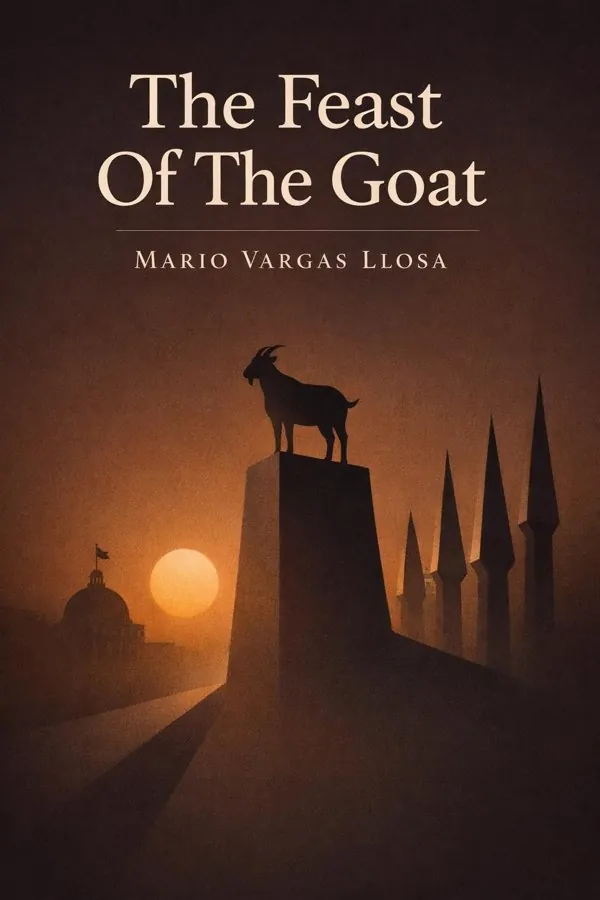
The Feast Of The Goat: Summary & Key Insights
 10 min9 chaptersAudio available
Key Takeaways from The Feast Of The Goat
Sometimes the most difficult journey is not across countries but back into memory.
Authoritarian systems do not merely punish enemies; they train loyalists to accept humiliation as normal.
Power often looks strongest at the moment it is beginning to decay.
History often remembers an assassination as a single act, but Vargas Llosa reminds us that such moments are built from years of fear, rage, compromise, and hesitation.
The collapse of a tyrant can happen in minutes, but the fear he created does not vanish with him.
What Is The Feast Of The Goat About?
The Feast Of The Goat by Mario Vargas Llosa is a bestsellers book spanning 7 pages. The Feast Of The Goat is Mario Vargas Llosa’s fierce and unforgettable historical novel about the last days of Rafael Leónidas Trujillo’s dictatorship in the Dominican Republic. Set across multiple timelines, the book interweaves the story of Urania Cabral, a successful lawyer returning to Santo Domingo after decades in self-imposed exile, with the tense preparations of the men plotting Trujillo’s assassination and the dictator’s own final hours in power. The result is not just a political thriller but a deep psychological study of fear, complicity, trauma, and moral collapse. What makes the novel so powerful is that it shows dictatorship not as an abstract political system but as something that enters homes, bodies, memories, and family relationships. Vargas Llosa, winner of the Nobel Prize in Literature, brings extraordinary authority to this material through his lifelong literary engagement with power, violence, and resistance in Latin America. The Feast Of The Goat matters because it reveals how authoritarianism survives not only through brutality, but through silence, obedience, vanity, and the corruption of ordinary people.
This FizzRead summary covers all 9 key chapters of The Feast Of The Goat in approximately 10 minutes, distilling the most important ideas, arguments, and takeaways from Mario Vargas Llosa's work. Also available as an audio summary and Key Quotes Podcast.
The Feast Of The Goat
The Feast Of The Goat is Mario Vargas Llosa’s fierce and unforgettable historical novel about the last days of Rafael Leónidas Trujillo’s dictatorship in the Dominican Republic. Set across multiple timelines, the book interweaves the story of Urania Cabral, a successful lawyer returning to Santo Domingo after decades in self-imposed exile, with the tense preparations of the men plotting Trujillo’s assassination and the dictator’s own final hours in power. The result is not just a political thriller but a deep psychological study of fear, complicity, trauma, and moral collapse. What makes the novel so powerful is that it shows dictatorship not as an abstract political system but as something that enters homes, bodies, memories, and family relationships. Vargas Llosa, winner of the Nobel Prize in Literature, brings extraordinary authority to this material through his lifelong literary engagement with power, violence, and resistance in Latin America. The Feast Of The Goat matters because it reveals how authoritarianism survives not only through brutality, but through silence, obedience, vanity, and the corruption of ordinary people.
Who Should Read The Feast Of The Goat?
This book is perfect for anyone interested in bestsellers and looking to gain actionable insights in a short read. Whether you're a student, professional, or lifelong learner, the key ideas from The Feast Of The Goat by Mario Vargas Llosa will help you think differently.
- ✓Readers who enjoy bestsellers and want practical takeaways
- ✓Professionals looking to apply new ideas to their work and life
- ✓Anyone who wants the core insights of The Feast Of The Goat in just 10 minutes
Want the full summary?
Get instant access to this book summary and 100K+ more with Fizz Moment.
Get Free SummaryAvailable on App Store • Free to download
Key Chapters
Sometimes the most difficult journey is not across countries but back into memory. Urania Cabral’s return to Santo Domingo is the emotional gateway to the novel. Now a respected professional living in New York, she comes back not out of affection for her homeland but because the past has remained unfinished. Her visit forces the reader to understand that dictatorship does not end when a ruler dies; it continues in the private wounds people carry for decades.
Urania’s homecoming is tense, restrained, and full of silence. She visits her aging father, Agustín Cabral, who can no longer speak, and the imbalance is striking: the daughter who once had no power now possesses language, distance, and clarity, while the father who once moved among the regime’s elite is reduced to helplessness. Through this encounter, Vargas Llosa shows how political systems shape intimate lives. National terror becomes family rupture.
This storyline also reveals the psychological cost of exile. Urania has built a successful life abroad, yet success has not erased humiliation or grief. Her return suggests that survival is not the same as healing. Many readers can apply this insight beyond politics: unresolved betrayal in families, workplaces, or communities often continues to govern behavior long after the original event is over.
A practical way to read Urania’s journey is as a lesson in confronting buried truth. Avoidance can preserve function, but it rarely brings freedom. Actionable takeaway: identify one unresolved experience in your life that still shapes your reactions, and take a first step toward naming it honestly.
Authoritarian systems do not merely punish enemies; they train loyalists to accept humiliation as normal. Agustín Cabral, once a trusted insider in Trujillo’s regime, embodies this grim truth. He is not a heroic resistor but a man who prospered under power, believed proximity to the dictator offered protection, and discovered too late that dictatorship consumes its own servants as easily as its opponents.
Cabral’s fall from favor exposes how fear operates inside elite circles. Under Trujillo, rank and privilege are never secure. A public official can be honored one day and discarded the next, not because of justice or competence but because arbitrary power must constantly remind everyone who rules. Cabral’s political disgrace becomes especially devastating because he has spent years internalizing the regime’s logic. He has sacrificed dignity for influence, only to learn that influence without autonomy is fragile.
The novel’s most devastating implication is that fear does not only silence people; it corrodes their moral judgment. Cabral becomes capable of choices that would once have seemed unthinkable because he is desperate to recover approval. This is how authoritarianism spreads guilt: it pressures individuals to betray others in order to save themselves. In modern terms, the pattern appears anywhere people compromise principles to keep status, access, or institutional favor.
Readers can apply this idea by examining environments where obedience is rewarded more than integrity. Whether in politics, corporations, or families, systems built on arbitrary authority invite moral collapse. Actionable takeaway: ask yourself where fear of losing approval may be distorting your judgment, and define one boundary you will not cross for acceptance.
Power often looks strongest at the moment it is beginning to decay. Vargas Llosa’s portrait of Rafael Trujillo in his final days is one of the novel’s greatest achievements. Trujillo is still terrifying, still obeyed, still surrounded by ritualized submission, yet age, bodily weakness, and political strain have begun to erode the image of total control. The novel uses these details to expose a central paradox of dictatorship: it depends on projecting invincibility precisely because it is haunted by vulnerability.
Trujillo is shown as disciplined, obsessive, and deeply invested in domination. He governs not simply through laws or institutions but through spectacle, surveillance, and personal intrusion. He must be feared in public and revered in private. Yet his physical decline matters because dictatorships often center the state on one person’s body, moods, and appetites. As the ruler weakens, the whole structure trembles.
This portrayal also reveals that absolute power deforms the ruler as much as the ruled. Trujillo cannot tolerate autonomy in others because he experiences it as a threat. He reduces people to instruments, rewards flattery, and confuses loyalty with ownership. These traits are extreme in the novel, but the underlying pattern is widely recognizable: leaders who depend on domination become unable to distinguish respect from fear.
In practical life, this chapter invites readers to evaluate leadership by how much independence it permits. Healthy authority creates stronger institutions than itself; unhealthy authority makes everyone smaller so it can appear larger. Actionable takeaway: when judging a leader, look beyond charisma or efficiency and ask whether the system they build can function ethically without their personal control.
History often remembers an assassination as a single act, but Vargas Llosa reminds us that such moments are built from years of fear, rage, compromise, and hesitation. The men who conspire to kill Trujillo are not idealized saints. They come from different backgrounds, carry personal grievances, and wrestle with guilt, hope, and uncertainty. This complexity is crucial because it shows resistance as a human process rather than a clean moral abstraction.
Each conspirator has been shaped by the regime. Some were once close to power. Some have seen relatives harmed. Some are motivated by patriotism, others by revenge, and many by both. Their plotting is therefore not just political strategy; it is a struggle to reclaim agency in a world where fear has become routine. The suspense of these chapters comes not only from whether they will succeed but from whether they can continue despite terror and doubt.
Vargas Llosa also shows that tyranny narrows the field of available choices. Under ordinary conditions, reform, dissent, and lawful opposition might exist. Under Trujillo, those channels have been destroyed, leaving violence as the desperate language of resistance. The novel does not romanticize this reality, but it forces readers to confront the moral tragedy of systems that make extreme action seem necessary.
A modern application lies in understanding how oppressive environments distort decision-making. When institutions fail, people are pushed toward riskier, harsher responses. Actionable takeaway: do not wait for a crisis to defend fair institutions; support transparent systems, free expression, and accountability early, before desperation becomes the only path left.
The collapse of a tyrant can happen in minutes, but the fear he created does not vanish with him. The assassination of Trujillo is one of the novel’s most gripping sequences, unfolding with tension, uncertainty, and brutal immediacy. Vargas Llosa captures the conspirators’ anticipation, the practical details of the ambush, and the profound risk involved in confronting a man who has seemed untouchable for decades.
What gives this episode its force is that the killing is not portrayed as simple catharsis. Yes, it is a historic rupture. Yes, it ends the life of the dictator known as the Goat. But the novel insists that removing the ruler does not instantly dismantle the machinery of repression. The habits of obedience, the networks of loyalists, and the culture of terror remain. In that sense, the assassination is both a climax and a beginning.
The scene also highlights the fragile relationship between action and consequence. The conspirators act with courage, but they cannot control what follows. Some are captured, tortured, or killed. Others discover that political change is slower and more chaotic than heroic imagination suggests. This is one of the book’s most mature insights: decisive moments matter, but they rarely resolve history neatly.
Readers can apply this lesson whenever they expect one dramatic intervention to solve a deep structural problem. In organizations, communities, or personal life, one bold move may be necessary, but rebuilding takes longer than rupture. Actionable takeaway: when facing a harmful system, plan not only for the breakthrough moment but also for the difficult work of transition that must come after it.
Some betrayals are so deep that they destroy the language around them. One of the most painful and unforgettable parts of the novel is Urania’s eventual revelation of why she fled the Dominican Republic and severed herself from her father. Her story transforms the novel from political history into an intimate reckoning with the way authoritarian power invades the body and the family.
Agustín Cabral’s guilt is not merely that he served a brutal regime. His deepest crime is personal: in a moment of political desperation and moral collapse, he sacrifices his daughter to recover favor with Trujillo. This act crystallizes the logic of dictatorship at its most monstrous. Under such systems, public corruption becomes private violation. The state does not remain outside the home; it poisons the most sacred bonds.
Urania’s narration is controlled, lucid, and devastating precisely because it rejects melodrama. She has spent years building a life of discipline and distance, but her testimony reveals how trauma can shape identity long after outward stability is achieved. The novel thereby enlarges our understanding of political violence. Its victims are not only the imprisoned and executed but also those whose trust, sexuality, and sense of self are broken in silence.
This section offers a difficult but vital lesson about complicity. Evil is sustained not only by fanatics but by respectable people who tell themselves they have no choice. Actionable takeaway: take seriously the moral cost of rationalizing small betrayals, because repeated compromise can lead ordinary people to participate in harms they once thought impossible.
A dictatorship ends officially before it ends emotionally. One of the novel’s deepest achievements is its exploration of memory as a political force. Long after Trujillo is dead, fear still organizes behavior, shapes speech, and limits intimacy. Survivors do not simply step into freedom; they carry internalized caution, shame, and fragmented recollection. In this sense, memory is not passive remembrance but an active battlefield.
Through alternating perspectives and timelines, Vargas Llosa shows how the past remains unfinished. Urania remembers what others avoid naming. Former collaborators justify themselves. Citizens adapt their stories depending on who is listening. The result is a society in which truth is unstable because terror has taught people that words can be dangerous. This is why the novel treats testimony as morally urgent. To remember accurately is already to resist erasure.
The theme has broad relevance. Families, nations, and institutions often prefer selective memory because it protects reputations and reduces discomfort. Yet suppressed history does not disappear; it returns in mistrust, denial, and repeated patterns of abuse. Healing requires more than forgetting. It requires acknowledgment, listening, and a willingness to confront shame.
For readers, this chapter suggests a practical ethic of remembrance. Whether the subject is political injustice, family harm, or organizational failure, honest memory is a condition of accountability. Actionable takeaway: if you belong to a group with a painful past, begin by asking what stories are rarely told, who has been silenced, and what truth-telling would make repair possible.
How a story is told can reveal as much as what the story says. One of the most impressive features of The Feast Of The Goat is its structure: Vargas Llosa moves among Urania’s present-day return, the conspirators’ preparations, and Trujillo’s final day. This shifting design creates suspense, but more importantly, it turns the novel into a moral investigation. Readers are asked to assemble connections between public events and private damage.
The alternation of voices and timelines mirrors the fragmented way trauma and history are experienced. No single perspective is sufficient. The dictator sees one world, the conspirators another, and Urania yet another. By forcing these perspectives into conversation, the novel shows that authoritarian rule cannot be understood through official history alone. It must be examined through memory, secrecy, bodily experience, and conflicting motives.
This structure also deepens the book’s ethical complexity. Readers are not allowed the comfort of simple categories. Victims may also be complicit. Insiders may become rebels. Personal ambition may mix with political courage. The effect is a richer understanding of responsibility. Evil is systemic, but it is enacted through many individual choices.
For anyone interested in reading more attentively, this is a useful reminder that form shapes meaning. In books, films, and even news, whose perspective is centered will influence what truth becomes visible. Actionable takeaway: when evaluating any story about power, ask whose voice is present, whose is missing, and how the structure itself guides your moral response.
All Chapters in The Feast Of The Goat
About the Author
Mario Vargas Llosa was a Peruvian novelist, essayist, journalist, and public intellectual born in 1936 in Arequipa, Peru. He became one of the defining writers of the Latin American Boom and built an international reputation through novels that explore power, violence, corruption, and individual freedom. His major works include The Time of the Hero, Conversation in the Cathedral, The War of the End of the World, and The Feast Of The Goat. In addition to fiction, he wrote extensively on politics, culture, and literature, and even ran for the presidency of Peru in 1990. In 2010, he received the Nobel Prize in Literature for his cartography of structures of power and his vivid portrayals of resistance, revolt, and defeat. He remains one of the most influential figures in modern world literature.
Get This Summary in Your Preferred Format
Read or listen to the The Feast Of The Goat summary by Mario Vargas Llosa anytime, anywhere. FizzRead offers multiple formats so you can learn on your terms — all free.
Available formats: App · Audio · PDF · EPUB — All included free with FizzRead
Download The Feast Of The Goat PDF and EPUB Summary
Key Quotes from The Feast Of The Goat
“Sometimes the most difficult journey is not across countries but back into memory.”
“Authoritarian systems do not merely punish enemies; they train loyalists to accept humiliation as normal.”
“Power often looks strongest at the moment it is beginning to decay.”
“History often remembers an assassination as a single act, but Vargas Llosa reminds us that such moments are built from years of fear, rage, compromise, and hesitation.”
“The collapse of a tyrant can happen in minutes, but the fear he created does not vanish with him.”
Frequently Asked Questions about The Feast Of The Goat
The Feast Of The Goat by Mario Vargas Llosa is a bestsellers book that explores key ideas across 9 chapters. The Feast Of The Goat is Mario Vargas Llosa’s fierce and unforgettable historical novel about the last days of Rafael Leónidas Trujillo’s dictatorship in the Dominican Republic. Set across multiple timelines, the book interweaves the story of Urania Cabral, a successful lawyer returning to Santo Domingo after decades in self-imposed exile, with the tense preparations of the men plotting Trujillo’s assassination and the dictator’s own final hours in power. The result is not just a political thriller but a deep psychological study of fear, complicity, trauma, and moral collapse. What makes the novel so powerful is that it shows dictatorship not as an abstract political system but as something that enters homes, bodies, memories, and family relationships. Vargas Llosa, winner of the Nobel Prize in Literature, brings extraordinary authority to this material through his lifelong literary engagement with power, violence, and resistance in Latin America. The Feast Of The Goat matters because it reveals how authoritarianism survives not only through brutality, but through silence, obedience, vanity, and the corruption of ordinary people.
More by Mario Vargas Llosa
You Might Also Like
The Godfather
Mario Puzo
10 min
The Handmaid's Tale
Margaret Atwood
10 min
The Hunger Games
Suzanne Collins
10 min
The Nightingale
Kristin Hannah
10 min
The Seven Husbands of Evelyn Hugo
Taylor Jenkins Reid
10 min
Backwater Justice
Fern Michaels
10 minBrowse by Category
Ready to read The Feast Of The Goat?
Get the full summary and 100K+ more books with Fizz Moment.