
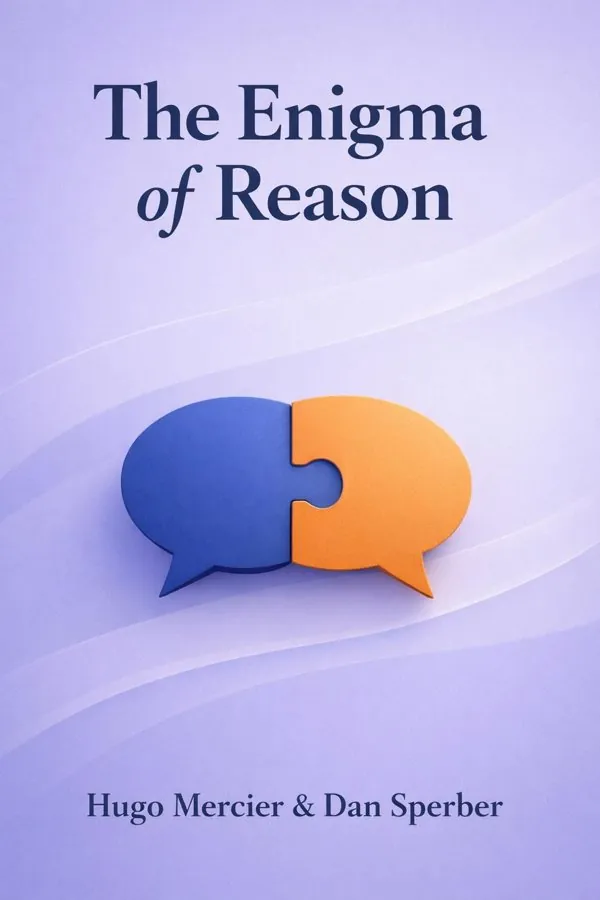
The Enigma of Reason: Summary & Key Insights
 10 min9 chaptersAudio available
Key Takeaways from The Enigma of Reason
One of the book’s most provocative claims is that we misunderstand reason when we imagine it as a solitary truth-seeking engine.
A surprising amount of evidence suggests that people are not especially good at reasoning in the abstract.
The heart of the book is the argumentative theory of reasoning: reason evolved primarily to devise and evaluate arguments.
Mercier and Sperber do not deny the phenomenon.
It is tempting to assume that adding more people to a problem simply adds more confusion.
What Is The Enigma of Reason About?
The Enigma of Reason by Hugo Mercier & Dan Sperber is a cognition book spanning 11 pages. Why are human beings so intelligent in some situations and so irrational in others? In The Enigma of Reason, cognitive scientists Hugo Mercier and Dan Sperber tackle that puzzle with a bold and deeply original answer: reason did not primarily evolve to help individuals discover truth in solitude. Instead, it evolved for social life—for persuading others, evaluating arguments, coordinating with groups, and defending ourselves in conversation. This simple shift in perspective transforms many familiar “failures” of rationality into clues about what reason is actually for. The book matters because it challenges one of the most cherished assumptions of Western thought: that reason is an inner tool designed mainly for private reflection and sound judgment. Mercier and Sperber draw on philosophy, psychology, evolutionary theory, and experimental research to show why people are often poor solitary thinkers yet surprisingly effective in debate, collaboration, and collective problem-solving. Their theory helps explain confirmation bias, political disagreement, scientific progress, and even everyday arguments at work or at home. As leading scholars in cognition, communication, and cultural evolution, the authors bring unusual authority to a question that sits at the center of human behavior: what is reason really for?
This FizzRead summary covers all 9 key chapters of The Enigma of Reason in approximately 10 minutes, distilling the most important ideas, arguments, and takeaways from Hugo Mercier & Dan Sperber's work. Also available as an audio summary and Key Quotes Podcast.
The Enigma of Reason
Why are human beings so intelligent in some situations and so irrational in others? In The Enigma of Reason, cognitive scientists Hugo Mercier and Dan Sperber tackle that puzzle with a bold and deeply original answer: reason did not primarily evolve to help individuals discover truth in solitude. Instead, it evolved for social life—for persuading others, evaluating arguments, coordinating with groups, and defending ourselves in conversation. This simple shift in perspective transforms many familiar “failures” of rationality into clues about what reason is actually for.
The book matters because it challenges one of the most cherished assumptions of Western thought: that reason is an inner tool designed mainly for private reflection and sound judgment. Mercier and Sperber draw on philosophy, psychology, evolutionary theory, and experimental research to show why people are often poor solitary thinkers yet surprisingly effective in debate, collaboration, and collective problem-solving. Their theory helps explain confirmation bias, political disagreement, scientific progress, and even everyday arguments at work or at home. As leading scholars in cognition, communication, and cultural evolution, the authors bring unusual authority to a question that sits at the center of human behavior: what is reason really for?
Who Should Read The Enigma of Reason?
This book is perfect for anyone interested in cognition and looking to gain actionable insights in a short read. Whether you're a student, professional, or lifelong learner, the key ideas from The Enigma of Reason by Hugo Mercier & Dan Sperber will help you think differently.
- ✓Readers who enjoy cognition and want practical takeaways
- ✓Professionals looking to apply new ideas to their work and life
- ✓Anyone who wants the core insights of The Enigma of Reason in just 10 minutes
Want the full summary?
Get instant access to this book summary and 100K+ more with Fizz Moment.
Get Free SummaryAvailable on App Store • Free to download
Key Chapters
One of the book’s most provocative claims is that we misunderstand reason when we imagine it as a solitary truth-seeking engine. For centuries, philosophers often treated reason as the defining faculty of the individual mind: the inner guide that helps us think clearly, overcome impulse, and arrive at justified beliefs. Mercier and Sperber do not deny that reasoning can support good judgment. But they argue that this view mistakes a secondary use for the original evolutionary function.
Their central point is that human beings evolved in intensely social environments. We had to justify our actions, convince others to cooperate, evaluate claims from allies and rivals, and coordinate around shared goals. In that context, reason was especially useful not as a neutral internal calculator, but as a social tool for producing and assessing arguments. This explains a long-standing mystery: why reasoning often performs poorly when individuals work alone, yet becomes much more effective when people exchange objections, challenge weak claims, and refine ideas together.
Think about everyday life. A person may make a poor financial decision alone, rationalizing it with flimsy logic. But in conversation with a skeptical friend, the same person is forced to confront overlooked risks. Similarly, teams often improve ideas through structured disagreement, provided members are willing to critique one another honestly.
The practical lesson is simple: do not rely on private reasoning alone for important decisions. Expose your thinking to informed criticism, ask others to challenge your assumptions, and treat disagreement as a resource rather than a threat.
A surprising amount of evidence suggests that people are not especially good at reasoning in the abstract. In experiments involving logic, probability, or evidence evaluation, participants regularly make mistakes. They ignore base rates, misunderstand conditional statements, and reach conclusions that reflect intuition more than careful analysis. If reason evolved mainly to improve private cognition, these failures are difficult to explain.
Mercier and Sperber argue that these shortcomings make more sense once we stop asking the wrong question. Instead of asking why reason fails as a perfect truth machine, we should ask whether it is optimized for something else. Their answer is yes: reasoning is better suited to producing justifications and evaluating arguments in social settings than to acting as a detached, all-purpose problem solver.
This helps explain why people are often better at spotting flaws in others’ arguments than in their own. We are lenient toward our own conclusions because our reasoning system is busy defending them. But when someone else presents a claim, we become sharper critics. In a courtroom, a political debate, or a business meeting, this division of labor can actually help a group. One person advances a case; others test it.
A practical example is decision-making at work. A manager who develops a plan alone may overlook major flaws. But if colleagues are invited to critique the proposal before implementation, weaknesses become easier to identify.
The actionable takeaway: assume your solo reasoning is limited. Build in review, dissent, and argument before making high-stakes choices.
The heart of the book is the argumentative theory of reasoning: reason evolved primarily to devise and evaluate arguments. This idea sounds narrow at first, but it has far-reaching consequences. It means that many features of human thought that appear defective under the traditional model may actually be adaptive under a social model.
In this framework, producing reasons is not mainly about achieving detached self-knowledge. It is about persuading others, defending one’s behavior, coordinating action, and policing communication. Evaluating reasons is equally important: people must decide whom to trust, which claims to accept, and whether a proposed action is justified. Reason, then, is part of a larger system of human communication and cooperation.
This perspective explains why argumentation is so central to institutions. Courts rely on opposing sides presenting reasons. Science advances through peer criticism. Democracies depend on public justification. Even families negotiate norms through argument: siblings explain, parents justify, partners contest and revise plans. In each case, reasoning is embedded in social exchange.
The theory does not imply that reasoning is useless for truth. On the contrary, it suggests that truth is often reached indirectly, through collective processes in which competing arguments are tested. A single thinker may be biased, but a well-structured community can filter those biases and converge on better conclusions.
Use this idea practically by redesigning how you think. Instead of asking only, “What do I believe?” also ask, “What are the strongest objections?” and “Who can competently challenge this?” Better reasoning often begins when argument becomes collaborative rather than combative.
It is tempting to assume that adding more people to a problem simply adds more confusion. Yet one of the book’s most optimistic insights is that groups can often reason better than individuals—if the conditions are right. Because people are skilled at finding weaknesses in others’ claims, collective discussion can outperform solo deliberation. What looks like argumentative stubbornness at the individual level can become an asset at the group level.
This does not mean all groups are wise. Poorly structured groups fall into conformity, status games, or polarization. But when members have diverse information, enough independence to disagree, and incentives to evaluate arguments seriously, discussion can improve outcomes dramatically. Each participant contributes reasons and objections; weak ideas are filtered out; stronger ones survive.
Examples are everywhere. Good scientific communities reward criticism and replication. Effective leadership teams invite dissent before committing to a strategy. Even ordinary households make better decisions when family members can challenge one another respectfully instead of deferring automatically to the loudest voice.
The authors’ point also helps explain why some educational methods work better than passive memorization. Students often deepen understanding by debating interpretations, defending answers, and responding to objections. Reasoning becomes sharper when it is used interactively.
If you want better group thinking, design for argument quality. Ask participants to justify claims with evidence, assign someone to present the strongest counterargument, and separate critique of ideas from attack on people. The actionable lesson: create settings where disagreement is informed, safe, and expected. Collective intelligence depends less on harmony than on disciplined exchange.
A major strength of The Enigma of Reason is that it moves beyond blaming individuals for irrationality and asks a deeper question: in what environments does reasoning succeed or fail? If reason is a social adaptation, then its performance should depend heavily on the quality of the social setting. A biased mind in a well-designed institution may contribute to truth; the same mind in a closed, tribal, or manipulative environment may amplify error.
Mercier and Sperber draw attention to the importance of audience, norms, and feedback. People reason more carefully when they expect their claims to be scrutinized by others. They also improve when they have access to reliable information and clear standards for what counts as a good argument. By contrast, environments that reward loyalty over evidence, speed over reflection, or identity signaling over accuracy tend to degrade reasoning.
Consider social media. It often encourages people to produce persuasive, emotionally resonant arguments for allies rather than carefully weighed judgments. The goal becomes winning attention, not refining belief. Compare that with scientific peer review or a well-run policy workshop, where claims are subjected to sustained criticism and evidential standards matter.
This insight has immediate practical value. Whether in a company, classroom, or community, better thinking comes less from telling people to “be rational” and more from structuring norms that reward accountability and open criticism.
Your takeaway: improve the setting before expecting improved reasoning. Ask what incentives, audiences, and rules are shaping how people argue, including yourself.
If reasoning is fundamentally social, then its effects will be visible not just in individual psychology but across institutions and cultures. Mercier and Sperber show that politics, science, law, and public discourse all depend on systems of argument. These systems can either exploit reason’s strengths or magnify its weaknesses.
In politics, citizens and leaders often use reason less to discover neutral truth than to justify positions, defend identities, and persuade coalitions. This helps explain why political debate can feel so resistant to evidence. Yet argument is still essential: democratic legitimacy depends on public justification, criticism, and accountability. The problem is not that politics contains argument, but that its argumentative environments are often distorted by partisanship, misinformation, and unequal incentives.
Science offers a more hopeful model. Individual scientists are not free from bias, ambition, or attachment to favored theories. But science works because it institutionalizes organized skepticism. Claims must survive criticism, replication, and peer review. In other words, science succeeds not because scientists are perfectly objective in isolation, but because the community is designed to test arguments rigorously.
Culture evolves in similar ways. Ideas spread not only because they are true, but because they are memorable, persuasive, and socially useful. Human communities selectively retain arguments, norms, and explanations that fit communicative and cooperative needs.
For readers, the lesson is clear: when evaluating public claims, do not ask only whether an argument sounds convincing. Ask whether it emerged from a setting where serious criticism was possible. Strong institutions matter because they help reason do what individuals alone often cannot.
A subtle but important message of the book is that reason should neither be worshipped nor dismissed. Traditional views often place reason on a pedestal, as if it were a flawless faculty capable of governing belief and action from above. Critics of human irrationality, in turn, sometimes swing too far in the opposite direction, treating reason as a weak after-the-fact storyteller for instincts and emotions. Mercier and Sperber offer a more balanced picture.
Reason is powerful, but its power is specialized. It is not the sole engine of cognition, and it does not operate independently of intuition, emotion, trust, memory, and social context. Many beliefs arise intuitively, and reasoning often comes later to justify or refine them. This does not make reason pointless. It makes it part of a broader cognitive ecology in which different mental tools serve different purposes.
This perspective is liberating. You do not need to expect yourself or others to become perfectly detached logicians. Instead, you can recognize where reasoning is likely to help most: when there are clear standards of evidence, opportunities for critique, and genuine engagement with opposing views. It also encourages humility. Strong reasoning habits begin with the recognition that conviction is not the same as correctness.
In daily life, this means pausing before using “logic” as a weapon or assuming an argument is sound because it feels coherent. The most rational move is often to test your view socially and empirically.
The actionable takeaway: respect reason, but use it wisely. Pair reflection with feedback, evidence, and intellectual humility.
Perhaps the most practical contribution of The Enigma of Reason is its redefinition of disagreement. Most people treat disagreement as a problem to overcome quickly or a sign that someone is ignorant, stubborn, or malicious. Mercier and Sperber suggest something more constructive: under the right conditions, disagreement is one of the main ways human beings improve thought.
If reasoning evolved for argument, then disagreement is not an unfortunate side effect of rational life. It is part of the system. Progress often occurs when different people bring different evidence, assumptions, and priorities into contact. What matters is whether disagreement is structured productively or destructively. When people attack identities, ignore evidence, or refuse to revise any position, argument hardens into conflict. But when they focus on reasons, make claims explicit, and remain open to revision, disagreement becomes intellectually productive.
This insight applies in marriages, workplaces, classrooms, and civic life. A team planning a new product should not rush to consensus if unresolved objections remain. A teacher can improve learning by asking students to defend competing interpretations. A friend group can make better decisions by inviting the least enthusiastic member to explain their concerns before acting.
The book does not promise a world without bias or conflict. Instead, it offers a realistic method for using imperfect minds well. Better reasoning is less about eliminating argument than about improving it.
Your takeaway: normalize thoughtful dissent. Ask for objections, reward people who raise inconvenient truths, and judge discussions by the quality of reasons exchanged, not by how quickly everyone agrees.
All Chapters in The Enigma of Reason
About the Authors
Hugo Mercier is a cognitive scientist at the Institut Jean Nicod in Paris whose work focuses on reasoning, communication, and social cognition. He is best known for challenging conventional views of rationality and for developing the argumentative theory of reasoning. Dan Sperber is a leading social and cognitive scientist whose research spans anthropology, psychology, communication, and cultural evolution. He has held positions at institutions including the Central European University and the Institut Jean Nicod, and is widely recognized for his influential work on relevance theory. Together, Mercier and Sperber bring an unusually interdisciplinary perspective to the study of the mind. Their collaboration in The Enigma of Reason combines experimental evidence with philosophical depth to explain why human reasoning is often biased, argumentative, and deeply social.
Get This Summary in Your Preferred Format
Read or listen to the The Enigma of Reason summary by Hugo Mercier & Dan Sperber anytime, anywhere. FizzRead offers multiple formats so you can learn on your terms — all free.
Available formats: App · Audio · PDF · EPUB — All included free with FizzRead
Download The Enigma of Reason PDF and EPUB Summary
Key Quotes from The Enigma of Reason
“One of the book’s most provocative claims is that we misunderstand reason when we imagine it as a solitary truth-seeking engine.”
“A surprising amount of evidence suggests that people are not especially good at reasoning in the abstract.”
“The heart of the book is the argumentative theory of reasoning: reason evolved primarily to devise and evaluate arguments.”
“Confirmation bias is usually presented as one of the mind’s most embarrassing flaws: we seek evidence that supports what we already believe and neglect evidence that contradicts it.”
“It is tempting to assume that adding more people to a problem simply adds more confusion.”
Frequently Asked Questions about The Enigma of Reason
The Enigma of Reason by Hugo Mercier & Dan Sperber is a cognition book that explores key ideas across 9 chapters. Why are human beings so intelligent in some situations and so irrational in others? In The Enigma of Reason, cognitive scientists Hugo Mercier and Dan Sperber tackle that puzzle with a bold and deeply original answer: reason did not primarily evolve to help individuals discover truth in solitude. Instead, it evolved for social life—for persuading others, evaluating arguments, coordinating with groups, and defending ourselves in conversation. This simple shift in perspective transforms many familiar “failures” of rationality into clues about what reason is actually for. The book matters because it challenges one of the most cherished assumptions of Western thought: that reason is an inner tool designed mainly for private reflection and sound judgment. Mercier and Sperber draw on philosophy, psychology, evolutionary theory, and experimental research to show why people are often poor solitary thinkers yet surprisingly effective in debate, collaboration, and collective problem-solving. Their theory helps explain confirmation bias, political disagreement, scientific progress, and even everyday arguments at work or at home. As leading scholars in cognition, communication, and cultural evolution, the authors bring unusual authority to a question that sits at the center of human behavior: what is reason really for?
You Might Also Like
A Field Guide to Lies: Critical Thinking in the Information Age
Daniel J. Levitin
10 min
A Theory of Cognitive Dissonance
Leon Festinger
10 min
Black-And-White Thinking: The Burden of a Binary Brain in a Complex World
Kevin Dutton
10 min
Born Liars: Why We Can’t Live Without Deceit
Ian Leslie
10 min
Collective Illusions: Conformity, Complicity, and the Science of Why We Make Bad Decisions
Todd Rose
10 min
Concrete Mathematics: A Foundation for Computer Science
Ronald L. Graham, Donald E. Knuth, Oren Patashnik
10 minBrowse by Category
Ready to read The Enigma of Reason?
Get the full summary and 100K+ more books with Fizz Moment.