
Dan Sperber Books
Dan Sperber is a social and cognitive scientist, known for his work on relevance theory and cultural evolution, and is a researcher at the Central European University and the Institut Jean Nicod.
Known for: The Enigma of Reason
Books by Dan Sperber
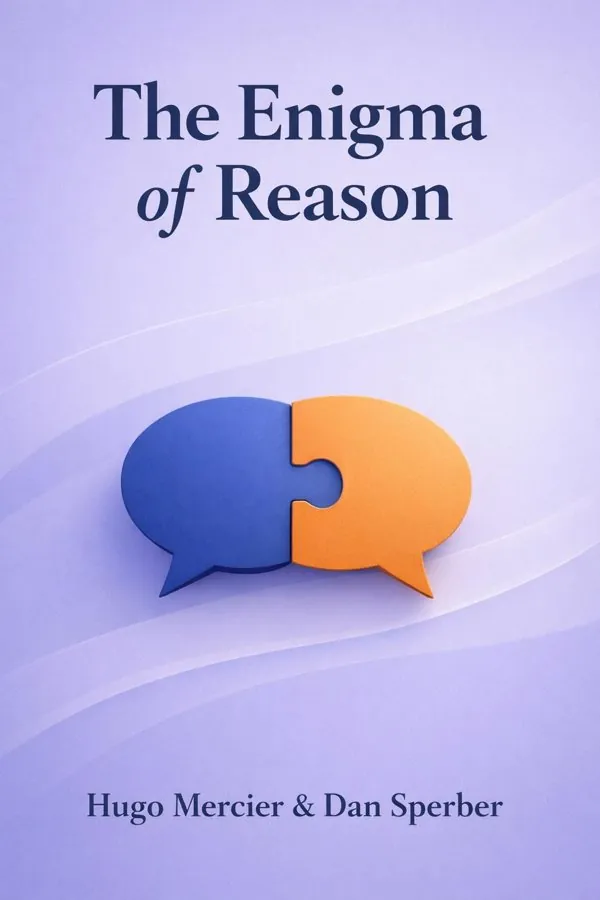
The Enigma of Reason
Why are human beings so intelligent in some situations and so irrational in others? In The Enigma of Reason, cognitive scientists Hugo Mercier and Dan Sperber tackle that puzzle with a bold and deeply original answer: reason did not primarily evolve to help individuals discover truth in solitude. Instead, it evolved for social life—for persuading others, evaluating arguments, coordinating with groups, and defending ourselves in conversation. This simple shift in perspective transforms many familiar “failures” of rationality into clues about what reason is actually for. The book matters because it challenges one of the most cherished assumptions of Western thought: that reason is an inner tool designed mainly for private reflection and sound judgment. Mercier and Sperber draw on philosophy, psychology, evolutionary theory, and experimental research to show why people are often poor solitary thinkers yet surprisingly effective in debate, collaboration, and collective problem-solving. Their theory helps explain confirmation bias, political disagreement, scientific progress, and even everyday arguments at work or at home. As leading scholars in cognition, communication, and cultural evolution, the authors bring unusual authority to a question that sits at the center of human behavior: what is reason really for?
Read SummaryKey Insights from Dan Sperber
Reason Was Never Purely Private
One of the book’s most provocative claims is that we misunderstand reason when we imagine it as a solitary truth-seeking engine. For centuries, philosophers often treated reason as the defining faculty of the individual mind: the inner guide that helps us think clearly, overcome impulse, and arrive ...
From The Enigma of Reason
Why Individual Reasoning Often Misfires
A surprising amount of evidence suggests that people are not especially good at reasoning in the abstract. In experiments involving logic, probability, or evidence evaluation, participants regularly make mistakes. They ignore base rates, misunderstand conditional statements, and reach conclusions th...
From The Enigma of Reason
The Argumentative Theory Changes Everything
The heart of the book is the argumentative theory of reasoning: reason evolved primarily to devise and evaluate arguments. This idea sounds narrow at first, but it has far-reaching consequences. It means that many features of human thought that appear defective under the traditional model may actual...
From The Enigma of Reason
Confirmation Bias Has a Social Logic
Confirmation bias is usually presented as one of the mind’s most embarrassing flaws: we seek evidence that supports what we already believe and neglect evidence that contradicts it. Mercier and Sperber do not deny the phenomenon. What they challenge is the assumption that it is simply a malfunction....
From The Enigma of Reason
Groups Can Think Better Than Individuals
It is tempting to assume that adding more people to a problem simply adds more confusion. Yet one of the book’s most optimistic insights is that groups can often reason better than individuals—if the conditions are right. Because people are skilled at finding weaknesses in others’ claims, collective...
From The Enigma of Reason
Good Reasoning Depends on the Environment
A major strength of The Enigma of Reason is that it moves beyond blaming individuals for irrationality and asks a deeper question: in what environments does reasoning succeed or fail? If reason is a social adaptation, then its performance should depend heavily on the quality of the social setting. A...
From The Enigma of Reason
About Dan Sperber
Dan Sperber is a social and cognitive scientist, known for his work on relevance theory and cultural evolution, and is a researcher at the Central European University and the Institut Jean Nicod.


Frequently Asked Questions
Dan Sperber is a social and cognitive scientist, known for his work on relevance theory and cultural evolution, and is a researcher at the Central European University and the Institut Jean Nicod.
Read Dan Sperber's books in 15 minutes
Get AI-powered summaries with key insights from 1 book by Dan Sperber.