
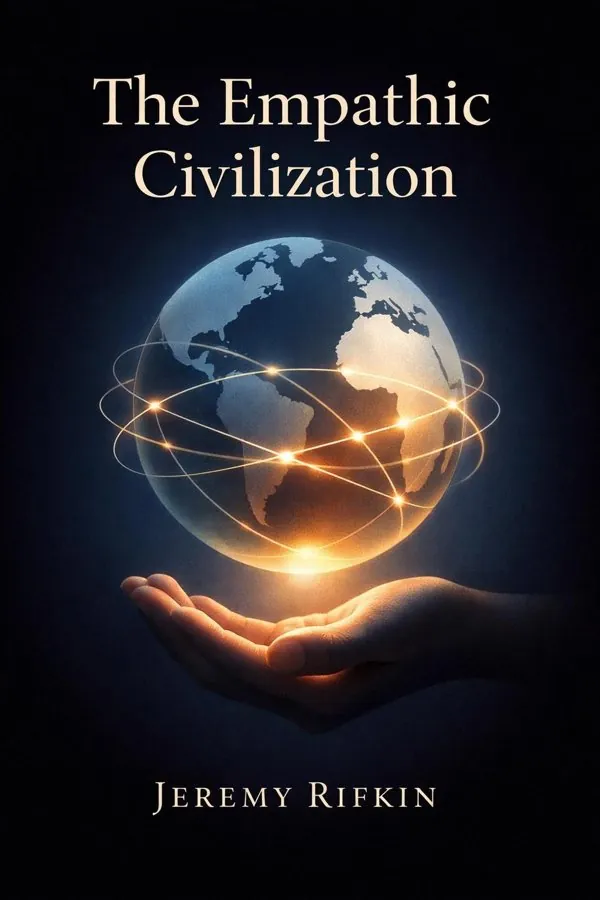
The Empathic Civilization: The Race to Global Consciousness in a World in Crisis: Summary & Key Insights
 10 min12 chaptersAudio available
What Is The Empathic Civilization: The Race to Global Consciousness in a World in Crisis About?
The Empathic Civilization: The Race to Global Consciousness in a World in Crisis by Jeremy Rifkin is a civilization book spanning 12 pages. In this sweeping work, Jeremy Rifkin explores the evolution of empathy and its role in shaping human civilization. He traces the development of empathic awareness from early tribal societies through theological and ideological civilizations to the modern global age. Rifkin argues that humanity is entering a new stage of consciousness—an empathic civilization—where interconnectedness and compassion are essential for addressing global crises such as climate change, economic inequality, and technological disruption.
This FizzRead summary covers all 12 key chapters of The Empathic Civilization: The Race to Global Consciousness in a World in Crisis in approximately 10 minutes, distilling the most important ideas, arguments, and takeaways from Jeremy Rifkin's work. Also available as an audio summary and Key Quotes Podcast.
The Empathic Civilization: The Race to Global Consciousness in a World in Crisis
In this sweeping work, Jeremy Rifkin explores the evolution of empathy and its role in shaping human civilization. He traces the development of empathic awareness from early tribal societies through theological and ideological civilizations to the modern global age. Rifkin argues that humanity is entering a new stage of consciousness—an empathic civilization—where interconnectedness and compassion are essential for addressing global crises such as climate change, economic inequality, and technological disruption.
Who Should Read The Empathic Civilization: The Race to Global Consciousness in a World in Crisis?
This book is perfect for anyone interested in civilization and looking to gain actionable insights in a short read. Whether you're a student, professional, or lifelong learner, the key ideas from The Empathic Civilization: The Race to Global Consciousness in a World in Crisis by Jeremy Rifkin will help you think differently.
- ✓Readers who enjoy civilization and want practical takeaways
- ✓Professionals looking to apply new ideas to their work and life
- ✓Anyone who wants the core insights of The Empathic Civilization: The Race to Global Consciousness in a World in Crisis in just 10 minutes
Want the full summary?
Get instant access to this book summary and 100K+ more with Fizz Moment.
Get Free SummaryAvailable on App Store • Free to download
Key Chapters
Empathy begins not as an abstract moral ideal but as an evolutionary capacity encoded in our neural architecture. In the late twentieth century, neuroscience uncovered the existence of mirror neurons—cells that fire not only when we perform an action, but also when we observe someone else performing it. This discovery provided an astonishing biological confirmation of what philosophers and humanists had long intuited: we are wired for connection.
From this neural foundation emerges emotional attunement, the very capacity to resonate with another’s feelings. Evolutionary psychology reveals that such attunement is not accidental—it conferred survival advantage. Early humans who could sense distress or cooperation in others were better equipped to build alliances, raise offspring, and navigate complex social environments. Self-awareness itself evolved through relationship; the distinction between self and other arose from the mirroring process.
Through this lens, empathy becomes the pivot of consciousness. It transforms primitive sensory responses into complex moral and social emotions. It is how cognition and emotion fuse to create social intelligence. Every civilization rests upon that bedrock. Biology teaches us that empathy is energy-efficient: cooperation minimizes conflict and maximizes resource distribution. As long as our empathic circuits remain active and extended, societies thrive; when they close down, civilizations falter into alienation and violence.
Thus, to understand humanity’s future, we must return to its neural origins. Empathy is the biological grammar of civilization. The marvel of our species lies not merely in intellect but in the ability to inhabit another’s world. This natural predisposition to empathy is the seed from which all moral advancement has grown. The task before us now is to extend that innate biology to global consciousness—without losing the intimacy that birthed it.
When we turn our eyes to prehistory, we find empathy woven into the daily rhythms of hunter-gatherer life. In small, kin-based tribes, survival depended less on domination and more on coordination. Every meal shared, every child protected, every elder cared for reinforced the emotional bonds that held the community together. Reciprocity—the mutual care of others—was embedded in ritual, song, and story.
These early societies embodied what I call empathic engagement. While limited in scale, their consciousness rested upon direct emotional interaction. There was little separation between self and group, between private interest and communal welfare. Empathy arose through touch, through visibility, through constant interdependence. The tribal economy was not built on markets but on mutuality—the understanding that one’s well-being depended on the group’s resilience.
Yet this intimacy had its boundaries. Empathy was confined within the tribe. Outsiders were often viewed with suspicion, their difference a potential threat. As population increased and settlements expanded, human empathy had to stretch beyond face-to-face relations. The emergence of agriculture introduced new complexities: hierarchy, property, and territorial identity. To hold societies together across these divides, symbolic systems evolved—language, myth, and nascent moral codes—all of which translated emotional empathy into cultural norms.
Thus began the long dialectic of civilization: each new social expansion required extending empathy to strangers, and each new form of organization risked narrowing it again. The evolution of empathy, as I trace it, is the history of our expanding moral circles, always challenged by the limits of our ecological and social capacity.
+ 10 more chapters — available in the FizzRead app
All Chapters in The Empathic Civilization: The Race to Global Consciousness in a World in Crisis
About the Author
Jeremy Rifkin is an American economic and social theorist, writer, public speaker, political advisor, and activist. He is known for his influential works on the impact of scientific and technological changes on the economy, society, and the environment. Rifkin has authored numerous books on the future of energy, the economy, and human consciousness.
Get This Summary in Your Preferred Format
Read or listen to the The Empathic Civilization: The Race to Global Consciousness in a World in Crisis summary by Jeremy Rifkin anytime, anywhere. FizzRead offers multiple formats so you can learn on your terms — all free.
Available formats: App · Audio · PDF · EPUB — All included free with FizzRead
Download The Empathic Civilization: The Race to Global Consciousness in a World in Crisis PDF and EPUB Summary
Key Quotes from The Empathic Civilization: The Race to Global Consciousness in a World in Crisis
“Empathy begins not as an abstract moral ideal but as an evolutionary capacity encoded in our neural architecture.”
“When we turn our eyes to prehistory, we find empathy woven into the daily rhythms of hunter-gatherer life.”
Frequently Asked Questions about The Empathic Civilization: The Race to Global Consciousness in a World in Crisis
The Empathic Civilization: The Race to Global Consciousness in a World in Crisis by Jeremy Rifkin is a civilization book that explores key ideas across 12 chapters. In this sweeping work, Jeremy Rifkin explores the evolution of empathy and its role in shaping human civilization. He traces the development of empathic awareness from early tribal societies through theological and ideological civilizations to the modern global age. Rifkin argues that humanity is entering a new stage of consciousness—an empathic civilization—where interconnectedness and compassion are essential for addressing global crises such as climate change, economic inequality, and technological disruption.
More by Jeremy Rifkin
The Third Industrial Revolution: How Lateral Power Is Transforming Energy, the Economy, and the World
Jeremy Rifkin
10 min
The End of Work: The Decline of the Global Labor Force and the Dawn of the Post-Market Era
Jeremy Rifkin
10 min
The Zero Marginal Cost Society: The Internet of Things, the Collaborative Commons, and the Eclipse of Capitalism
Jeremy Rifkin
10 minYou Might Also Like
The Structure of Scientific Revolutions
Thomas S. Kuhn
10 min
Genius
Harold Bloom
10 min
A Cultural History of the Medieval Age
Various Editors
10 min
A History of God: The 4,000-Year Quest of Judaism, Christianity and Islam
Karen Armstrong
10 min
A History of the World in 10½ Chapters
Julian Barnes
10 min
A Short History of Progress
Ronald Wright
10 minBrowse by Category
Ready to read The Empathic Civilization: The Race to Global Consciousness in a World in Crisis?
Get the full summary and 100K+ more books with Fizz Moment.