
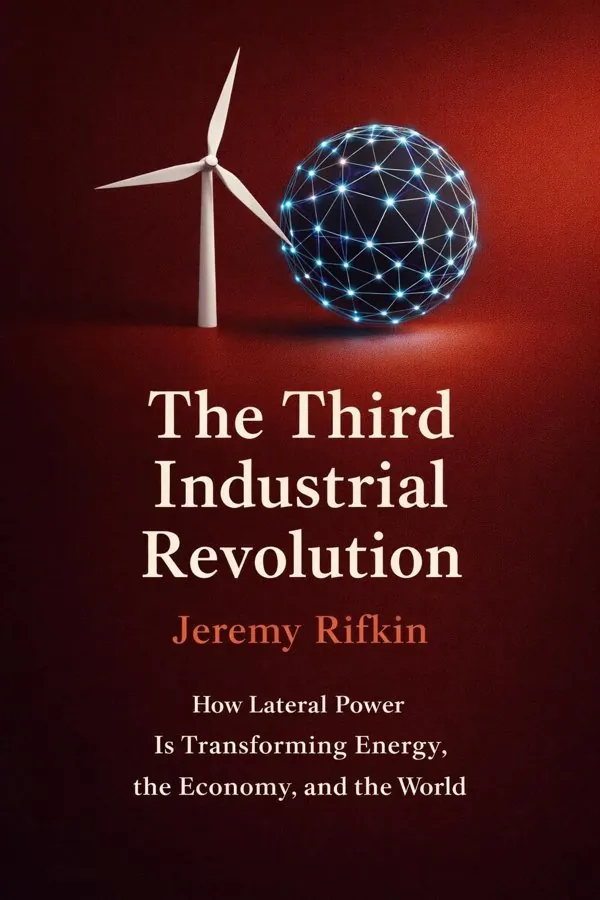
The Third Industrial Revolution: How Lateral Power Is Transforming Energy, the Economy, and the World: Summary & Key Insights
 10 min8 chaptersAudio available
What Is The Third Industrial Revolution: How Lateral Power Is Transforming Energy, the Economy, and the World About?
The Third Industrial Revolution: How Lateral Power Is Transforming Energy, the Economy, and the World by Jeremy Rifkin is a economics book spanning 8 pages. In this influential work, Jeremy Rifkin explores how the convergence of new communication technologies and renewable energy systems is ushering in a transformative economic era. He argues that the shift from centralized fossil fuel-based industries to distributed renewable networks will redefine power structures, employment, and global relations, leading to a more collaborative and sustainable future.
This FizzRead summary covers all 8 key chapters of The Third Industrial Revolution: How Lateral Power Is Transforming Energy, the Economy, and the World in approximately 10 minutes, distilling the most important ideas, arguments, and takeaways from Jeremy Rifkin's work. Also available as an audio summary and Key Quotes Podcast.
The Third Industrial Revolution: How Lateral Power Is Transforming Energy, the Economy, and the World
In this influential work, Jeremy Rifkin explores how the convergence of new communication technologies and renewable energy systems is ushering in a transformative economic era. He argues that the shift from centralized fossil fuel-based industries to distributed renewable networks will redefine power structures, employment, and global relations, leading to a more collaborative and sustainable future.
Who Should Read The Third Industrial Revolution: How Lateral Power Is Transforming Energy, the Economy, and the World?
This book is perfect for anyone interested in economics and looking to gain actionable insights in a short read. Whether you're a student, professional, or lifelong learner, the key ideas from The Third Industrial Revolution: How Lateral Power Is Transforming Energy, the Economy, and the World by Jeremy Rifkin will help you think differently.
- ✓Readers who enjoy economics and want practical takeaways
- ✓Professionals looking to apply new ideas to their work and life
- ✓Anyone who wants the core insights of The Third Industrial Revolution: How Lateral Power Is Transforming Energy, the Economy, and the World in just 10 minutes
Want the full summary?
Get instant access to this book summary and 100K+ more with Fizz Moment.
Get Free SummaryAvailable on App Store • Free to download
Key Chapters
To appreciate the third wave of transformation, we must first look backward. The First Industrial Revolution, beginning in 18th-century Britain, was fueled by coal and enabled by steam power. It linked with print and postal services to create the world’s first modern communication-energy infrastructure. Coal powered factories, locomotives, and ships, while newspapers and pamphlets spread information to a literate public eager for economic participation. Together, these forces built the foundation of industrial capitalism and the modern nation-state.
The Second Industrial Revolution arrived in the late 19th and early 20th centuries, pairing the internal combustion engine and oil-based energy with electricity and centralized telecommunication systems—telegraph, telephone, radio, and television. This second wave was hierarchical in design: large corporations controlled production, governments regulated national economies, and communication moved in one direction—from a few broadcasters to millions of listeners. This vertically integrated structure mirrored the centralization of power in political, economic, and social life.
Yet, beneath its impressive productivity, the Second Industrial Revolution also embedded dependencies—on finite resources and on centralized authorities that limited self-sufficiency. Industrial growth filled the atmosphere with carbon emissions, and the centralized nature of power amplified inequalities. As we reached the end of the 20th century, oil prices soared, infrastructures aged, and climate warnings grew louder. The old energy-communication system was breaking down under its own contradictions.
Now, as the digital age unfolds, we find ourselves poised for a systemic transformation comparable to the leaps of the 18th and 19th centuries. The Internet revolutionized communication; renewable energy technologies revolutionize power. When they converge, they generate the conditions for the Third Industrial Revolution—a decentralized, intelligent infrastructure that can redefine production and distribution for a connected world.
Every revolution rests on a distinct infrastructure. For the Third Industrial Revolution, I define five interconnected pillars. First, we must transition to renewable energy sources—solar, wind, geothermal, biomass, and other clean technologies. These forms of energy reclaim our partnership with the planet, turning sunlight and wind into infinite inputs for human progress.
Second, buildings themselves must become power plants. No longer passive consumers of electricity, homes, offices, and factories will collect and generate their own energy through rooftop solar panels, small wind turbines, and geothermal systems. The architecture of cities will thus transform into nodes of microgeneration.
Third, hydrogen offers a crucial storage medium, solving the intermittent nature of renewable sources. Just as batteries store electricity, hydrogen can hold excess energy and release it when needed, ensuring continuous power across networks.
Fourth, we need smart grids—intelligent systems that distribute electricity exactly when and where it’s required. They operate much like the Internet, balancing supply and demand through digital sensors and instant feedback loops.
Finally, transport must be electrified and integrated into this new grid. Electric vehicles, powered by clean energy and capable of feeding energy back into the system when idle, complete the circular flow of the new infrastructure.
These five pillars are not isolated innovations but interdependent ones. Together, they form the skeleton of a distributed economic ecosystem—the same way rail, telegraph, and coal once formed the core of the First Industrial Revolution. As each pillar develops, the other four advance with it, generating exponential change and enabling communities to reduce emissions, democratize energy, and stimulate new industries.
+ 6 more chapters — available in the FizzRead app
All Chapters in The Third Industrial Revolution: How Lateral Power Is Transforming Energy, the Economy, and the World
About the Author
Jeremy Rifkin is an American economic and social theorist, writer, public speaker, and activist. He is known for his work on the impact of scientific and technological changes on the economy, the environment, and society. Rifkin has advised governments and corporations on sustainable development and energy transition strategies.
Get This Summary in Your Preferred Format
Read or listen to the The Third Industrial Revolution: How Lateral Power Is Transforming Energy, the Economy, and the World summary by Jeremy Rifkin anytime, anywhere. FizzRead offers multiple formats so you can learn on your terms — all free.
Available formats: App · Audio · PDF · EPUB — All included free with FizzRead
Download The Third Industrial Revolution: How Lateral Power Is Transforming Energy, the Economy, and the World PDF and EPUB Summary
Key Quotes from The Third Industrial Revolution: How Lateral Power Is Transforming Energy, the Economy, and the World
“To appreciate the third wave of transformation, we must first look backward.”
“Every revolution rests on a distinct infrastructure.”
Frequently Asked Questions about The Third Industrial Revolution: How Lateral Power Is Transforming Energy, the Economy, and the World
The Third Industrial Revolution: How Lateral Power Is Transforming Energy, the Economy, and the World by Jeremy Rifkin is a economics book that explores key ideas across 8 chapters. In this influential work, Jeremy Rifkin explores how the convergence of new communication technologies and renewable energy systems is ushering in a transformative economic era. He argues that the shift from centralized fossil fuel-based industries to distributed renewable networks will redefine power structures, employment, and global relations, leading to a more collaborative and sustainable future.
More by Jeremy Rifkin

The Empathic Civilization: The Race to Global Consciousness in a World in Crisis
Jeremy Rifkin
10 min
The End of Work: The Decline of the Global Labor Force and the Dawn of the Post-Market Era
Jeremy Rifkin
10 min
The Zero Marginal Cost Society: The Internet of Things, the Collaborative Commons, and the Eclipse of Capitalism
Jeremy Rifkin
10 minYou Might Also Like

Business Adventures
John Brooks
10 min
Nudge
Richard H. Thaler, Cass R. Sunstein
10 min
The Hitchhiker"s Guide to the Galaxy
Douglas Adams
10 minThe Muqaddimah
Ibn Khaldun
10 minThe Outsiders
William N. Thorndike
10 min
A Little History of Economics
Niall Kishtainy
10 minBrowse by Category
Ready to read The Third Industrial Revolution: How Lateral Power Is Transforming Energy, the Economy, and the World?
Get the full summary and 100K+ more books with Fizz Moment.