
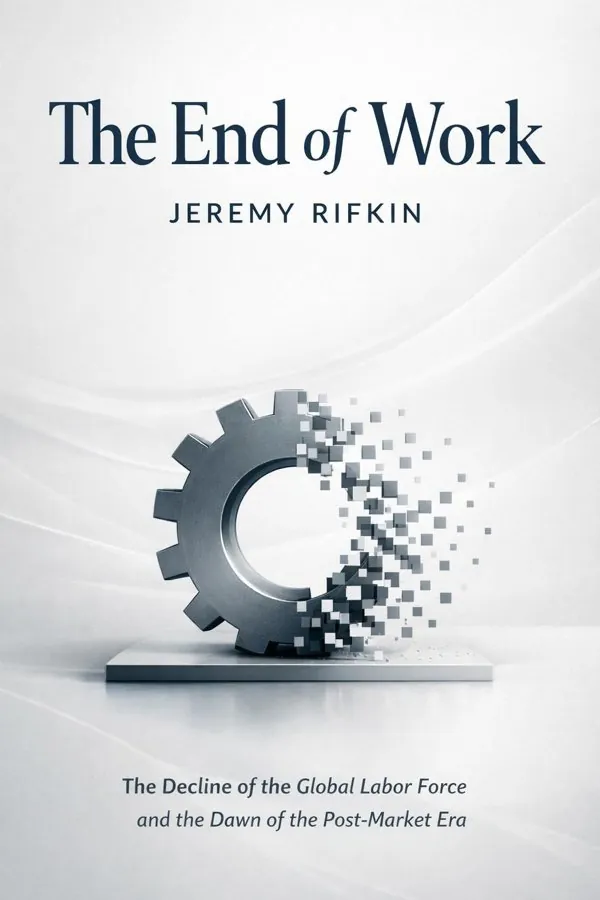
The End of Work: The Decline of the Global Labor Force and the Dawn of the Post-Market Era: Summary & Key Insights
 10 min5 chaptersAudio available
What Is The End of Work: The Decline of the Global Labor Force and the Dawn of the Post-Market Era About?
The End of Work: The Decline of the Global Labor Force and the Dawn of the Post-Market Era by Jeremy Rifkin is a economics book spanning 5 pages. In this influential work, Jeremy Rifkin explores how technological innovation and automation are transforming the global economy, leading to a decline in traditional employment. He argues that the world is entering a post-market era where productivity gains no longer translate into job growth, urging societies to rethink the meaning of work and the structure of economic life.
This FizzRead summary covers all 5 key chapters of The End of Work: The Decline of the Global Labor Force and the Dawn of the Post-Market Era in approximately 10 minutes, distilling the most important ideas, arguments, and takeaways from Jeremy Rifkin's work. Also available as an audio summary and Key Quotes Podcast.
The End of Work: The Decline of the Global Labor Force and the Dawn of the Post-Market Era
In this influential work, Jeremy Rifkin explores how technological innovation and automation are transforming the global economy, leading to a decline in traditional employment. He argues that the world is entering a post-market era where productivity gains no longer translate into job growth, urging societies to rethink the meaning of work and the structure of economic life.
Who Should Read The End of Work: The Decline of the Global Labor Force and the Dawn of the Post-Market Era?
This book is perfect for anyone interested in economics and looking to gain actionable insights in a short read. Whether you're a student, professional, or lifelong learner, the key ideas from The End of Work: The Decline of the Global Labor Force and the Dawn of the Post-Market Era by Jeremy Rifkin will help you think differently.
- ✓Readers who enjoy economics and want practical takeaways
- ✓Professionals looking to apply new ideas to their work and life
- ✓Anyone who wants the core insights of The End of Work: The Decline of the Global Labor Force and the Dawn of the Post-Market Era in just 10 minutes
Want the full summary?
Get instant access to this book summary and 100K+ more with Fizz Moment.
Get Free SummaryAvailable on App Store • Free to download
Key Chapters
To understand where we are headed, we must first look at where we have been. Human history has already witnessed two great industrial revolutions. The first, driven by steam power in the late eighteenth century, mechanized agriculture and manufacturing. Millions left the land for the factories, and in doing so they redefined the very idea of labor. The second, beginning in the late nineteenth century and propelled by electricity and the internal combustion engine, created massive urban industries and the familiar rhythms of the modern working day.
Each of these transformations shared a common pattern: productivity soared, old forms of work vanished, and new forms appeared. The textile worker, the locomotive engineer, the assembly-line operator — each represented a new class of worker born from the technological landscape of their time. During those periods, governments and social institutions managed, with varying degrees of success, to absorb displaced workers into emerging sectors. Education systems evolved to prepare citizens for industrial life; unions and welfare states arose to ensure a measure of equity.
But now, as we move through the twilight of the second Industrial Age and into a third, the old mechanisms for adjustment are faltering. Unlike earlier mechanizations that still relied heavily on human coordination and supervision, the current technological revolution replaces entire categories of human decision-making. We are no longer just automating labor — we are automating thinking. This shift, more profound than any previous one, means that new job creation can no longer keep pace with job elimination.
The historical analogy, then, is misleading if we assume that today’s dislocations will be followed by the same recovery of employment experienced in the past. We are moving into uncharted territory, where work itself must be reinvented rather than merely redistributed.
I refer to our current transformation as the Third Industrial Revolution — an epoch defined by the merger of digital, telecommunication, and biotechnology systems. This revolution is not confined to factories; it penetrates offices, hospitals, farms, and even our homes. Computers, networks, and intelligent machines are reshaping not only how we work but the very notion of what human labor is for.
Where earlier industrial revolutions mechanized muscle, this one automates the mind. Microprocessors execute decisions once reserved for managers, clerks, and professionals. Artificial intelligence systems analyze financial markets, design products, and diagnose illnesses more rapidly and accurately than people. Even creative fields, once thought immune, are being encroached upon by software that composes music, writes text, and generates art.
In this digital economy, the marginal cost of production — the cost of producing one additional unit once infrastructure is built — approaches zero. A single program can perform limitless transactions without fatigue or wages. As a result, wealth accumulates in the hands of those who control the means of information — the code, networks, and intellectual property. The vast majority of workers, however, find themselves displaced from the production process, seeking scarce service jobs that offer neither security nor dignity.
I argue that this revolution forces us to reconsider fundamental economic assumptions. If productive activity no longer requires human labor on a mass scale, then the market logic that ties income to employment collapses. We face a future where technological abundance coexists with human redundancy — unless we consciously design a new social contract.
+ 3 more chapters — available in the FizzRead app
All Chapters in The End of Work: The Decline of the Global Labor Force and the Dawn of the Post-Market Era
About the Author
Jeremy Rifkin is an American economic and social theorist, writer, public speaker, political advisor, and activist. He is known for his work on the impact of scientific and technological changes on the economy, the workforce, society, and the environment.
Get This Summary in Your Preferred Format
Read or listen to the The End of Work: The Decline of the Global Labor Force and the Dawn of the Post-Market Era summary by Jeremy Rifkin anytime, anywhere. FizzRead offers multiple formats so you can learn on your terms — all free.
Available formats: App · Audio · PDF · EPUB — All included free with FizzRead
Download The End of Work: The Decline of the Global Labor Force and the Dawn of the Post-Market Era PDF and EPUB Summary
Key Quotes from The End of Work: The Decline of the Global Labor Force and the Dawn of the Post-Market Era
“To understand where we are headed, we must first look at where we have been.”
“I refer to our current transformation as the Third Industrial Revolution — an epoch defined by the merger of digital, telecommunication, and biotechnology systems.”
Frequently Asked Questions about The End of Work: The Decline of the Global Labor Force and the Dawn of the Post-Market Era
The End of Work: The Decline of the Global Labor Force and the Dawn of the Post-Market Era by Jeremy Rifkin is a economics book that explores key ideas across 5 chapters. In this influential work, Jeremy Rifkin explores how technological innovation and automation are transforming the global economy, leading to a decline in traditional employment. He argues that the world is entering a post-market era where productivity gains no longer translate into job growth, urging societies to rethink the meaning of work and the structure of economic life.
More by Jeremy Rifkin

The Empathic Civilization: The Race to Global Consciousness in a World in Crisis
Jeremy Rifkin
10 min
The Third Industrial Revolution: How Lateral Power Is Transforming Energy, the Economy, and the World
Jeremy Rifkin
10 min
The Zero Marginal Cost Society: The Internet of Things, the Collaborative Commons, and the Eclipse of Capitalism
Jeremy Rifkin
10 minYou Might Also Like
Business Adventures
John Brooks
10 min
Nudge
Richard H. Thaler, Cass R. Sunstein
10 min
The Hitchhiker"s Guide to the Galaxy
Douglas Adams
10 minThe Muqaddimah
Ibn Khaldun
10 minThe Outsiders
William N. Thorndike
10 min
A Little History of Economics
Niall Kishtainy
10 minBrowse by Category
Ready to read The End of Work: The Decline of the Global Labor Force and the Dawn of the Post-Market Era?
Get the full summary and 100K+ more books with Fizz Moment.