
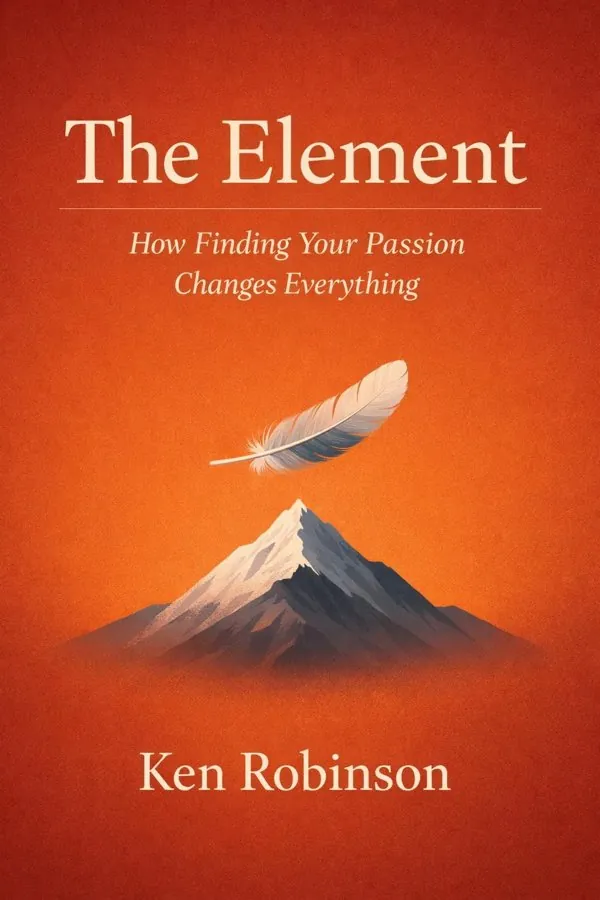
The Element: How Finding Your Passion Changes Everything: Summary & Key Insights
by Ken Robinson
 10 min9 chaptersAudio available
Key Takeaways from The Element: How Finding Your Passion Changes Everything
Many people spend years trying to become competent at things they were never meant to love.
A life without inner connection often looks successful from the outside and empty from the inside.
What keeps people from finding their Element is often not a lack of talent, but a lifetime of limiting assumptions.
Potential is fragile when no one knows how to see it.
Two people can have similar talent and radically different outcomes because attitude shapes what talent becomes.
What Is The Element: How Finding Your Passion Changes Everything About?
The Element: How Finding Your Passion Changes Everything by Ken Robinson is a education book spanning 12 pages. What if the difference between merely making a living and truly feeling alive comes down to discovering the work, activity, or calling that fits you best? In The Element, Ken Robinson argues that the most fulfilled and effective people are those who find the point where natural ability meets deep personal passion. He calls this point “the Element,” and he believes it has the power to transform not only individual lives but also schools, workplaces, and entire communities. Through stories of dancers, entrepreneurs, musicians, athletes, scientists, and people who bloomed later in life, Robinson shows that talent is rarely enough on its own. People thrive when skill is matched by enthusiasm, curiosity, and a supportive environment. The book matters because so many people have been taught to value security, conformity, and test-based achievement over creativity, purpose, and human potential. Robinson writes with unusual authority: he was one of the world’s best-known thinkers on creativity and education, advising governments, institutions, and companies while challenging outdated ideas about intelligence and success.
This FizzRead summary covers all 9 key chapters of The Element: How Finding Your Passion Changes Everything in approximately 10 minutes, distilling the most important ideas, arguments, and takeaways from Ken Robinson's work. Also available as an audio summary and Key Quotes Podcast.
The Element: How Finding Your Passion Changes Everything
What if the difference between merely making a living and truly feeling alive comes down to discovering the work, activity, or calling that fits you best? In The Element, Ken Robinson argues that the most fulfilled and effective people are those who find the point where natural ability meets deep personal passion. He calls this point “the Element,” and he believes it has the power to transform not only individual lives but also schools, workplaces, and entire communities. Through stories of dancers, entrepreneurs, musicians, athletes, scientists, and people who bloomed later in life, Robinson shows that talent is rarely enough on its own. People thrive when skill is matched by enthusiasm, curiosity, and a supportive environment. The book matters because so many people have been taught to value security, conformity, and test-based achievement over creativity, purpose, and human potential. Robinson writes with unusual authority: he was one of the world’s best-known thinkers on creativity and education, advising governments, institutions, and companies while challenging outdated ideas about intelligence and success.
Who Should Read The Element: How Finding Your Passion Changes Everything?
This book is perfect for anyone interested in education and looking to gain actionable insights in a short read. Whether you're a student, professional, or lifelong learner, the key ideas from The Element: How Finding Your Passion Changes Everything by Ken Robinson will help you think differently.
- ✓Readers who enjoy education and want practical takeaways
- ✓Professionals looking to apply new ideas to their work and life
- ✓Anyone who wants the core insights of The Element: How Finding Your Passion Changes Everything in just 10 minutes
Want the full summary?
Get instant access to this book summary and 100K+ more with Fizz Moment.
Get Free SummaryAvailable on App Store • Free to download
Key Chapters
Many people spend years trying to become competent at things they were never meant to love. Robinson’s central idea is that the Element is the place where natural aptitude and personal passion come together. Aptitude is not just what you can do reasonably well after effort; it is what seems to fit your mind, body, and instincts unusually naturally. Passion is the emotional energy that makes you want to keep going, even when the work is demanding. When these two forces meet, effort feels different. You still work hard, but the work becomes energizing instead of draining.
Robinson emphasizes that this intersection is different for everyone. One person may find it in mathematics, another in choreography, another in teaching, cooking, carpentry, product design, or community organizing. The point is not that everyone must become an artist or public visionary. The point is that everyone has the capacity to find an activity or path that feels deeply aligned with who they are.
This idea challenges conventional success models. Schools and workplaces often reward standardization, but the Element depends on individuality. A student who struggles in one environment may flourish in another. An employee who looks average on paper may become extraordinary when moved into a role better suited to their strengths.
A practical way to apply this idea is to ask two questions together, not separately: What am I naturally good at, and what gives me energy? List moments when you felt both effective and fully engaged. Patterns in those moments may point directly toward your Element. Your actionable takeaway: identify three activities that make you lose track of time and three skills others consistently praise in you, then look for where they overlap.
A life without inner connection often looks successful from the outside and empty from the inside. Robinson argues that people who find their Element experience a fundamental shift in how they relate to work, learning, and themselves. They are more likely to feel alive, resilient, and purposeful because their effort is rooted in genuine interest rather than obligation alone. Instead of constantly needing external motivation, they generate motivation from within.
This matters because passion changes the quality of persistence. When people care deeply about what they are doing, they recover more quickly from setbacks, seek feedback more willingly, and continue practicing long after others quit. This is true in creative fields, but also in business, research, sports, health care, and public service. Robinson’s examples show that people often endure years of confusion or frustration before discovering the context in which they truly thrive.
Finding the Element does not guarantee fame or a problem-free life. Robinson is careful to show that fulfillment is not the same as glamour. What changes is the relationship between effort and identity. Work begins to feel like a meaningful expression of self rather than a role you perform to survive. That shift influences confidence, relationships, and well-being.
In practical terms, this means reevaluating how you define achievement. Instead of asking only, “What pays well?” or “What looks impressive?” ask, “What kind of work makes me feel more like myself?” You may not be able to redesign your life overnight, but you can start with small experiments: side projects, volunteer work, classes, collaborations, or informational conversations. Your actionable takeaway: choose one neglected interest that still excites you and give it two dedicated hours this week to test whether it still sparks energy.
Potential is fragile when no one knows how to see it. Robinson explains that aptitude is not always obvious, especially in systems designed to measure only a narrow range of abilities. Some talents reveal themselves early, but many appear gradually or under the right conditions. A person may have natural skill in mentoring, spatial reasoning, storytelling, movement, strategy, or improvisation and yet go unnoticed because those qualities are not tested or valued in conventional ways.
Robinson also makes an important distinction between raw ability and cultivated mastery. Being naturally inclined toward something is only the beginning. The people who come alive in their Element usually work hard to deepen their craft. Talent opens the door; discipline helps you walk through it. This means the Element is not a magical state where everything is effortless. Rather, it is a place where effort feels meaningful because your abilities are being stretched in a direction that suits you.
This has major implications for parenting, teaching, and leadership. Instead of asking only who performs best on standard measures, we should ask where different kinds of intelligence are already showing themselves. A student who builds intricate worlds in games may have design talent. An employee who mediates team conflict may have leadership aptitude. Once recognized, these strengths can be developed through coaching, practice, and opportunity.
A useful exercise is to study your learning history. What skills did you acquire unusually fast? Where did improvement feel rewarding rather than exhausting? Ask others what strengths they have seen in you over time. Your actionable takeaway: choose one ability that has come naturally to you and create a 30-day plan to deliberately improve it through daily practice, feedback, or structured learning.
Two people can have similar talent and radically different outcomes because attitude shapes what talent becomes. Robinson argues that passion is not a decorative extra; it is a central force in creativity, perseverance, and personal growth. But passion alone is not enough. It needs to be supported by attitudes such as curiosity, openness, confidence, and willingness to experiment. The Element is sustained by an inner climate that invites risk and learning.
Robinson highlights that people in their Element are not fearless. They simply care enough to keep moving despite uncertainty. They are more willing to tolerate imperfection, try again after mistakes, and remain interested long enough to improve. This mindset helps explain why some people with modest early promise eventually surpass those with stronger initial advantages. Their relationship to learning is healthier and more adaptive.
Attitude also affects how people interpret setbacks. A rejection, poor grade, failed audition, or weak first attempt can either become proof of inadequacy or information for growth. People who stay connected to their Element tend to choose the second interpretation. They see obstacles as part of the path, not as a final verdict on identity.
In everyday life, you can strengthen this inner climate by noticing where your energy rises and falls, reframing mistakes as data, and surrounding yourself with people who encourage exploration instead of ridicule. Reflect on activities that make you feel mentally awake, emotionally invested, and eager to improve. Your actionable takeaway: the next time you face a setback in something that matters to you, write down what it taught you and one concrete adjustment you will make instead of treating it as a sign to quit.
Even extraordinary ability can remain dormant without access, support, and context. Robinson stresses that finding the Element is not only a personal journey; it is also deeply influenced by opportunity. Family encouragement, good teachers, mentors, financial stability, cultural permission, and exposure to possibilities all matter. Many people do not fail to find their Element because they lack gifts, but because they never encounter the environments where those gifts can surface.
This is why Robinson resists simplistic self-help narratives. He does not claim that everyone can flourish through willpower alone. Structural conditions matter. A child may have musical brilliance but no instruments. A young adult may have entrepreneurial instincts but no network or capital. A mid-career professional may have leadership potential but work in a culture that punishes initiative. Recognizing the role of environment makes the argument more humane and realistic.
At the same time, Robinson encourages people to become active seekers of opportunity rather than passive victims of circumstance. If your current setting does not nourish your strengths, part of the task is to find or create better conditions. This may mean joining a community, taking classes, finding online mentors, moving roles within an organization, or building a portfolio outside your main job.
Leaders and educators can apply this idea by designing environments where diverse talents are visible and valued. Individuals can apply it by asking not only “What am I capable of?” but also “What conditions help me do my best work?” Your actionable takeaway: identify one environmental factor that improves your performance—such as autonomy, collaboration, coaching, or quiet time—and make one deliberate change this week to increase it.
One of Robinson’s most influential arguments is that traditional education systems are poorly designed for the full range of human intelligence. Built largely for the needs of industrial society, schools often emphasize standardization, obedience, and academic ranking at the expense of creativity, movement, curiosity, and individualized learning. As a result, many students conclude that they are incapable when in fact they are simply mismatched with the system.
Robinson does not reject education; he calls for its transformation. He believes the purpose of education should be to help people understand the world and discover themselves within it. That requires broader definitions of ability, more varied teaching methods, and greater respect for artistic, vocational, interpersonal, and practical forms of intelligence. A healthy education system would not sort people into fixed categories of smart and not smart. It would cultivate many pathways to excellence.
This insight is especially important for parents, teachers, and anyone who has internalized school-based judgments. A poor grade in one subject, or even many subjects, does not define a person’s potential. Some of the most innovative people struggle in rigid classrooms because their way of thinking is nonlinear, embodied, collaborative, or experimental.
In practical terms, this means paying closer attention to how people learn, not just what they score. It means creating space for projects, performance, making, dialogue, and real-world problem solving. It also means helping young people explore identity rather than forcing premature conformity. Your actionable takeaway: if you support a learner, ask what activities make them most engaged, confident, and expressive, then help them spend more time developing those strengths alongside essential basics.
We do not discover ourselves in isolation as often as we imagine. Robinson introduces the idea of finding your “tribe,” the communities of people who share your interests, values, language, and standards. A tribe does more than offer companionship. It validates unusual ambitions, raises expectations, introduces role models, and creates a sense of belonging. Many people only recognize their own potential after encountering others who live in similar ways.
This matters because social context can either suppress or awaken identity. If you grow up surrounded by people who dismiss your interests, you may treat them as trivial or unrealistic. But when you meet others who take those same interests seriously, your perspective changes. Suddenly what felt eccentric becomes legitimate. Your passion gains vocabulary, structure, and momentum.
Tribes also help people improve. They expose you to better questions, stronger examples, and honest feedback. An aspiring writer grows through other writers. A scientist grows through scientific communities. A founder grows through other builders. A teacher grows through educators who care deeply about learning. The tribe can be local or global, physical or digital, formal or informal.
This idea applies strongly in organizations too. Teams become more innovative when people with different strengths can connect around meaningful work. Culture either releases talent or restricts it.
To apply this concept, think about where people who care about your interests already gather: professional groups, online forums, workshops, conferences, local meetups, clubs, volunteer projects, or collaborative spaces. Your actionable takeaway: join or re-engage with one community related to a serious interest of yours and contribute in a visible way within the next seven days.
When institutions ignore the Element, they waste talent on a massive scale. Robinson extends his argument beyond individuals to organizations and society. Businesses, schools, and public institutions often underperform not because people are unmotivated, but because systems are built around hierarchy, control, and narrow job definitions. When people are placed in roles that do not suit their strengths, engagement declines and creativity withers. When leaders make room for individuality, collaboration, and experimentation, performance improves.
Robinson’s broader contribution is to connect personal fulfillment with social change. Helping people find their Element is not merely a private luxury; it is an economic, educational, and cultural necessity. The modern world rewards adaptability, imagination, and innovation, yet many institutions still operate as if efficiency depends on uniformity. Robinson argues the opposite: the future belongs to systems that can recognize and cultivate human diversity.
For organizations, this means hiring and developing people for more than credentials, redesigning roles around strengths where possible, encouraging cross-functional thinking, and creating cultures where initiative is safe. For societies, it means valuing the arts, vocational pathways, entrepreneurship, and nontraditional careers alongside academic achievement.
For individuals, the message is hopeful and demanding at once. You may not control every external constraint, but you can participate in reshaping the systems around you by mentoring others, advocating for broader measures of success, and building environments where people can thrive.
Your actionable takeaway: whether you lead a team, a classroom, a family, or just yourself, identify one way your current system rewards conformity over contribution, and make one concrete change that gives people more room to use their real strengths.
All Chapters in The Element: How Finding Your Passion Changes Everything
About the Author
Sir Ken Robinson (1950–2020) was a British author, educator, and global thought leader on creativity, innovation, and education reform. Trained in English and drama, he became one of the most influential critics of conventional schooling, arguing that education systems often suppress the very imagination and originality modern societies need. Robinson advised governments, schools, nonprofits, and major corporations on how to cultivate creativity and human potential. He became internationally famous for his TED Talk “Do Schools Kill Creativity?”, which introduced millions of people to his ideas about intelligence, talent, and learning. Through books such as The Element, Out of Our Minds, and Creative Schools, Robinson urged individuals and institutions to recognize diverse abilities and create environments where people can discover what they do best.
Get This Summary in Your Preferred Format
Read or listen to the The Element: How Finding Your Passion Changes Everything summary by Ken Robinson anytime, anywhere. FizzRead offers multiple formats so you can learn on your terms — all free.
Available formats: App · Audio · PDF · EPUB — All included free with FizzRead
Download The Element: How Finding Your Passion Changes Everything PDF and EPUB Summary
Key Quotes from The Element: How Finding Your Passion Changes Everything
“Many people spend years trying to become competent at things they were never meant to love.”
“A life without inner connection often looks successful from the outside and empty from the inside.”
“What keeps people from finding their Element is often not a lack of talent, but a lifetime of limiting assumptions.”
“Potential is fragile when no one knows how to see it.”
“Two people can have similar talent and radically different outcomes because attitude shapes what talent becomes.”
Frequently Asked Questions about The Element: How Finding Your Passion Changes Everything
The Element: How Finding Your Passion Changes Everything by Ken Robinson is a education book that explores key ideas across 9 chapters. What if the difference between merely making a living and truly feeling alive comes down to discovering the work, activity, or calling that fits you best? In The Element, Ken Robinson argues that the most fulfilled and effective people are those who find the point where natural ability meets deep personal passion. He calls this point “the Element,” and he believes it has the power to transform not only individual lives but also schools, workplaces, and entire communities. Through stories of dancers, entrepreneurs, musicians, athletes, scientists, and people who bloomed later in life, Robinson shows that talent is rarely enough on its own. People thrive when skill is matched by enthusiasm, curiosity, and a supportive environment. The book matters because so many people have been taught to value security, conformity, and test-based achievement over creativity, purpose, and human potential. Robinson writes with unusual authority: he was one of the world’s best-known thinkers on creativity and education, advising governments, institutions, and companies while challenging outdated ideas about intelligence and success.
More by Ken Robinson

You Might Also Like

Bedtime Biography: Florence Nightingale
Isabel Thomas
10 min
Introduction To Museum Studies
Howard H. Hoyt
10 min
A Mind for Numbers: How to Excel at Math and Science (Even If You Flunked Algebra)
Barbara Oakley
10 min
AI for Educators: Learning Strategies, Teacher Empowerment, and the Future of Education
Matt Miller
10 min
Animation For Beginners
Morr Meroz
10 min
Artificial Intelligence for Learning
Donald Clark
10 minBrowse by Category
Ready to read The Element: How Finding Your Passion Changes Everything?
Get the full summary and 100K+ more books with Fizz Moment.