
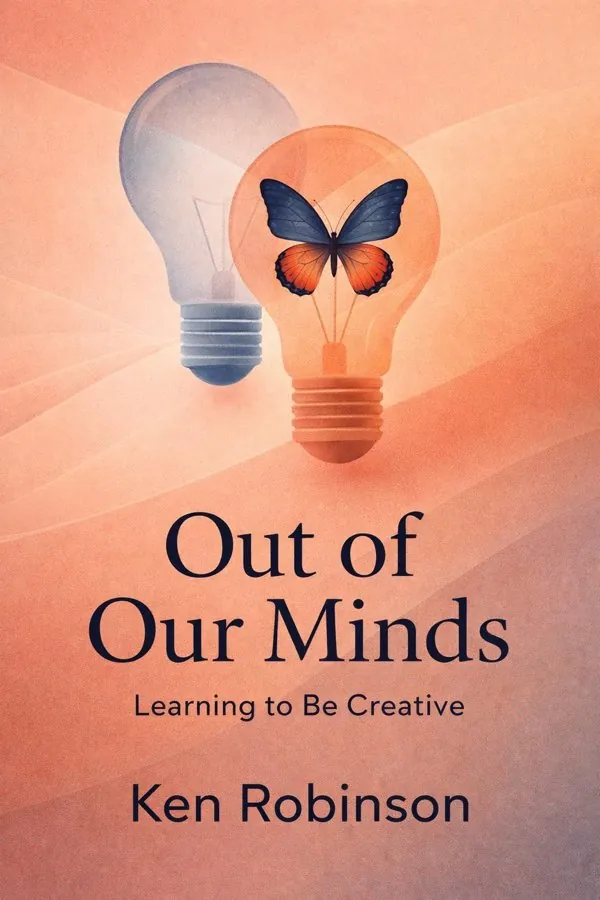
Out of Our Minds: Learning to Be Creative: Summary & Key Insights
by Ken Robinson
 10 min10 chaptersAudio available
Key Takeaways from Out of Our Minds: Learning to Be Creative
Robinson describes a “crisis of human resources” to capture this problem.
Creativity is often treated as mysterious, but Robinson makes it more concrete: imagination allows us to conceive what is not present, and creativity puts that imagination to work.
If creativity is so important, why do so many institutions suppress it?
A central error in modern culture is the belief that intelligence is singular, fixed, and easily measured.
Few institutions shape creativity more deeply than schools, and few do more to limit it when poorly designed.
What Is Out of Our Minds: Learning to Be Creative About?
Out of Our Minds: Learning to Be Creative by Ken Robinson is a creativity book spanning 10 pages. Out of Our Minds: Learning to Be Creative is Ken Robinson’s powerful argument that creativity is not a luxury, a personality trait for a gifted few, or an optional extra for artists. It is a fundamental human capacity and one of the most important resources any person, school, or organization can develop. Robinson shows that while modern societies claim to value innovation, many of their core systems—especially education—still reward standardization, narrow academic success, and compliance over imagination, experimentation, and original thinking. The result is not just frustration for individuals, but a costly waste of human potential. What makes this book so compelling is Robinson’s ability to connect big cultural shifts—globalization, technological change, economic uncertainty—to everyday experiences in classrooms, workplaces, and families. He explains why old models of intelligence and achievement no longer fit a rapidly changing world, and why creativity must be treated with the same seriousness as literacy. Drawing on his work as a leading education thinker and international advisor, Robinson offers both a critique of outdated systems and an inspiring vision of how people can rediscover their talents and build environments where creativity can flourish.
This FizzRead summary covers all 10 key chapters of Out of Our Minds: Learning to Be Creative in approximately 10 minutes, distilling the most important ideas, arguments, and takeaways from Ken Robinson's work. Also available as an audio summary and Key Quotes Podcast.
Out of Our Minds: Learning to Be Creative
Out of Our Minds: Learning to Be Creative is Ken Robinson’s powerful argument that creativity is not a luxury, a personality trait for a gifted few, or an optional extra for artists. It is a fundamental human capacity and one of the most important resources any person, school, or organization can develop. Robinson shows that while modern societies claim to value innovation, many of their core systems—especially education—still reward standardization, narrow academic success, and compliance over imagination, experimentation, and original thinking. The result is not just frustration for individuals, but a costly waste of human potential.
What makes this book so compelling is Robinson’s ability to connect big cultural shifts—globalization, technological change, economic uncertainty—to everyday experiences in classrooms, workplaces, and families. He explains why old models of intelligence and achievement no longer fit a rapidly changing world, and why creativity must be treated with the same seriousness as literacy. Drawing on his work as a leading education thinker and international advisor, Robinson offers both a critique of outdated systems and an inspiring vision of how people can rediscover their talents and build environments where creativity can flourish.
Who Should Read Out of Our Minds: Learning to Be Creative?
This book is perfect for anyone interested in creativity and looking to gain actionable insights in a short read. Whether you're a student, professional, or lifelong learner, the key ideas from Out of Our Minds: Learning to Be Creative by Ken Robinson will help you think differently.
- ✓Readers who enjoy creativity and want practical takeaways
- ✓Professionals looking to apply new ideas to their work and life
- ✓Anyone who wants the core insights of Out of Our Minds: Learning to Be Creative in just 10 minutes
Want the full summary?
Get instant access to this book summary and 100K+ more with Fizz Moment.
Get Free SummaryAvailable on App Store • Free to download
Key Chapters
One of the most damaging forms of waste is not material waste but human waste: the loss of talent, originality, and possibility when people are never given the chance to discover what they can do. Robinson describes a “crisis of human resources” to capture this problem. Across schools, companies, and institutions, vast numbers of people are trained to fit existing systems rather than encouraged to develop their full capabilities. We measure a narrow band of abilities, then mistakenly treat those measures as a complete picture of human potential.
The roots of this crisis lie in systems built for another era. Industrial-age education was designed to create order, standardization, and efficiency. It favored hierarchy, routine, and uniform outcomes. That model made sense in economies that needed predictable workers, but it is increasingly destructive in a world that rewards adaptability, problem-solving, collaboration, and innovation. When schools rank subjects in rigid hierarchies and organizations value compliance more than initiative, many people conclude that their real strengths do not matter.
This has practical consequences. A child who thinks visually may be labeled distracted. An employee who asks unconventional questions may be seen as difficult. A team full of intelligent people may still produce stale results if they are punished for risk-taking. In each case, talent exists but remains underused.
Robinson’s point is not simply that people are different; it is that systems must be redesigned around that reality. Human abilities are diverse, dynamic, and often revealed in context. We flourish when environments help us uncover and apply them.
Actionable takeaway: Audit one area of your life—school, work, or home—and ask: where are we rewarding conformity over capability, and what small change could better reveal people’s real strengths?
Creativity is often treated as mysterious, but Robinson makes it more concrete: imagination allows us to conceive what is not present, and creativity puts that imagination to work. In other words, imagination is the spark; creativity is the process of turning that spark into something meaningful. This distinction matters because it shows that creativity is not random inspiration. It involves action, judgment, refinement, and purpose.
Many people mistakenly think creativity belongs only to painters, musicians, or writers. Robinson challenges this view. A scientist designing a new experiment, a teacher rethinking a lesson, an entrepreneur solving a customer problem, or a parent inventing a better family routine are all engaging creatively. What defines creativity is not the field but the combination of original thinking and valuable outcomes.
This broader definition makes creativity both more democratic and more demanding. Everyone has imaginative capacity, but creativity grows through use. It requires knowledge, skill, experimentation, and the willingness to make mistakes. Great ideas rarely arrive fully formed; they emerge through cycles of trying, adjusting, combining influences, and seeing patterns others miss.
A practical example is brainstorming a new product feature. Imagination generates possibilities; creativity tests them against user needs, technical limits, and strategic goals until one idea becomes workable. Likewise, a student writing an essay uses imagination to form a unique angle and creativity to structure arguments clearly.
Robinson encourages us to treat creativity as a habit of mind and a mode of practice, not a rare gift. The more often we ask “What else is possible?” and then act on the answer, the stronger this capacity becomes.
Actionable takeaway: Choose one current problem and generate three unconventional solutions before selecting the most useful one. Train imagination first, then apply disciplined creativity.
If creativity is so important, why do so many institutions suppress it? Robinson’s answer is historical. Our modern ideas about education, intelligence, and success did not emerge naturally; they were shaped by economic and cultural needs of the past. Schools were largely designed during the Industrial Revolution and expanded in ways that mirrored factory logic: age-based groups, standardized curricula, bells, separate subjects, and external authority determining what counts as achievement.
This system also absorbed the influence of academic culture, which ranked disciplines according to their perceived usefulness and prestige. At the top sat mathematics, science, and language; below them often came the arts, movement, crafts, and practical forms of intelligence. The result was a narrow cultural script about what it means to be smart. Many people grew up internalizing the message that if they were not strong in approved academic areas, they were somehow less capable.
Robinson argues that this inherited structure is now badly mismatched to contemporary life. The modern world is volatile, interconnected, and innovation-driven. Yet schools and workplaces often continue to operate as though certainty, obedience, and uniformity are the highest goals. This creates tension: organizations say they want originality, but their systems still punish deviation.
You can see this in hiring practices that overvalue credentials while missing unconventional talent, or in classrooms where students memorize information but have little time to explore, make, debate, or design. The problem is not a lack of intelligence in people; it is outdated assumptions in the systems around them.
Understanding these roots is liberating. It means many feelings of inadequacy are not personal failures but signs of a poor fit between human diversity and inherited structures.
Actionable takeaway: Challenge one inherited assumption you rarely question—such as what counts as a “serious” subject, a “real” job, or a “smart” person—and replace it with a wider, evidence-based definition.
A central error in modern culture is the belief that intelligence is singular, fixed, and easily measured. Robinson rejects this model and presents intelligence as diverse, dynamic, and highly contextual. People think in different ways: verbally, mathematically, visually, physically, musically, socially, emotionally, and practically. These capacities often interact rather than operate in isolation. Creativity thrives precisely because human intelligence is not linear.
This idea has enormous implications. If intelligence comes in many forms, then traditional testing captures only part of the picture. A student who struggles with written exams may excel in design, movement, storytelling, leadership, or spatial reasoning. An employee who appears average in formal meetings may be brilliant at connecting people, sensing patterns, or improvising solutions in real time. When institutions recognize only narrow abilities, they misjudge people and reduce collective potential.
Robinson also emphasizes that intelligence is dynamic. We do not merely retrieve information; we make connections, reinterpret experience, and generate new possibilities. A choreographer thinks through movement. A mechanic thinks through systems and feel. A composer thinks through sound. A founder may think through patterns of need and opportunity. None of these forms of thinking are secondary. They are expressions of intelligence in action.
In practical terms, this means better teaching, leadership, and self-understanding require multiple entry points. In a classroom, students might demonstrate understanding through writing, performance, presentation, prototyping, or discussion. At work, managers can build teams with complementary strengths rather than clone one “ideal” profile.
When people discover the forms of intelligence that come naturally to them, confidence and contribution often rise together. The goal is not to rank human abilities but to recognize and develop them.
Actionable takeaway: Identify your three strongest modes of thinking and redesign one task this week so you can use them more fully instead of forcing yourself into a less natural style.
Few institutions shape creativity more deeply than schools, and few do more to limit it when poorly designed. Robinson’s critique of education is not that schools lack good intentions, but that their structure often privileges standard answers over original questions. Students quickly learn that being correct, efficient, and compliant is safer than being exploratory, experimental, or unusual. Over time, many stop taking intellectual risks altogether.
This suppression happens in subtle ways. Subjects are separated into rigid categories, even though real problems cut across disciplines. Assessment rewards recall and procedure more than insight. Mistakes are framed as failures instead of part of learning. The arts are treated as enrichment rather than central ways of knowing and expressing. Students who learn differently may be diagnosed as deficient when the deeper problem is a narrow model of teaching.
Robinson argues that education should help people discover their talents, not merely sort them. A strong system would cultivate curiosity, confidence, collaboration, and the ability to connect knowledge across fields. It would give equal dignity to academic, artistic, technical, and vocational pathways. It would prepare students not just to pass tests, but to navigate uncertainty and contribute creatively to society.
Examples already exist: project-based learning, interdisciplinary courses, maker spaces, drama in language learning, music in pattern recognition, and classrooms where students solve real-world problems instead of only memorizing established answers. These approaches do not lower standards; they broaden them.
The larger lesson is that creativity in education depends on culture, not slogans. You cannot encourage originality while punishing deviation from a script.
Actionable takeaway: If you teach, parent, or mentor, replace one task focused only on the right answer with an open-ended challenge that invites multiple methods, interpretations, or solutions.
Periods of rapid change do not simply create new opportunities; they expose the weaknesses of old assumptions. Robinson argues that technology and globalization have transformed the context in which education, work, and creativity operate. Information is abundant, industries evolve quickly, jobs disappear or mutate, and people now compete and collaborate across borders. In such an environment, the ability to repeat established routines matters less than the ability to adapt, learn, communicate, and invent.
Technology has democratized tools for creation. A teenager can compose music, edit video, build a business, publish writing, or learn complex skills online. Yet access to tools alone is not enough. Without creative confidence and judgment, people may consume endlessly without producing anything meaningful. The challenge is to pair technological access with imaginative capacity and critical thinking.
Globalization increases this pressure. Organizations are no longer operating in isolated markets with predictable local competitors. They face diverse customers, cultural complexity, and constant disruption. This means innovation cannot remain the job of a single department. Creative thinking must become a wider organizational capability.
For individuals, the message is equally clear: a career can no longer be built solely on static expertise. People need to keep learning, combining skills, and responding to new conditions. For schools, the implication is profound. Education cannot simply prepare students for specific existing jobs; many future roles do not yet exist. It must prepare them to navigate ambiguity with resilience and originality.
Robinson’s point is not that change is inherently good, but that resisting it through outdated systems is dangerous. Creativity is now a survival skill as much as a cultural value.
Actionable takeaway: Pick one new technology or global trend affecting your field and ask how it changes what people must now be able to imagine, make, or solve.
Many organizations say they want innovation while structuring work in ways that suffocate it. Robinson highlights a common contradiction: companies celebrate creativity in mission statements but rely on rigid hierarchies, risk aversion, excessive control, and short-term metrics that discourage experimentation. Creativity cannot thrive where people fear embarrassment, punishment, or irrelevance for suggesting something new.
A creative organization is not chaotic or undisciplined. It is one that understands how new ideas actually emerge. They often arise through collaboration, diversity of perspective, time for reflection, and iterative testing rather than through command-and-control planning. This means organizations need systems that support conversation across silos, tolerate intelligent failure, and recognize contributions beyond formal rank.
Consider product teams that include engineers, designers, marketers, and customer support staff from the beginning. Their varied perspectives can surface insights no single function would generate alone. Or think of companies that give employees protected time for experimentation, internal showcases for unfinished ideas, or after-action reviews focused on learning rather than blame. These practices communicate that exploration is part of the work, not a distraction from it.
Robinson also stresses the importance of aligning structures with stated values. If promotions depend only on efficiency and error avoidance, no one will truly prioritize innovation. If meetings are dominated by the loudest voices, quieter but insightful contributors will disengage. Culture is built through daily signals.
Ultimately, organizations become more creative when they see people not as replaceable units but as sources of judgment, initiative, and possibility. The task of management is not to extract obedience but to release capability.
Actionable takeaway: Examine one team process—meetings, feedback, planning, or evaluation—and redesign it to increase psychological safety, cross-functional input, and room for experimentation.
Creative breakthroughs rarely result from pressure alone; they emerge when leaders build environments where people can think, question, and contribute fully. Robinson distinguishes leadership from control. In creative settings, the leader’s role is not to dictate every move but to set direction, clarify purpose, assemble diverse talent, and cultivate a climate in which original work becomes possible.
This begins with trust. People are more imaginative when they feel their ideas will be heard rather than dismissed. It also requires high expectations. Supporting creativity does not mean accepting anything without scrutiny. Strong leaders encourage experimentation and then help teams refine ideas through challenge, evidence, and iteration. Creativity needs both freedom and discipline.
Robinson points out that many leaders unintentionally block innovation by overmanaging uncertainty. They demand detailed certainty too early, punish failed attempts, or rely too heavily on precedent. Yet new ideas are often fragile at first. They need room to develop before they can be judged fairly. Leadership involves protecting that early-stage possibility without losing sight of standards and outcomes.
Practical leadership behaviors include asking better questions, rewarding initiative, inviting dissent, and making time for reflection. In a school, this may mean giving teachers autonomy to experiment with instruction. In a company, it may mean funding prototypes before requiring complete business cases. In any setting, it means recognizing that people do their most inventive work when they feel both challenged and supported.
Robinson’s broader lesson is that creativity is social. Even highly original individuals depend on cultures that notice, encourage, and develop their capacities. Leadership therefore shapes not just results but the very range of ideas that can appear.
Actionable takeaway: In your next leadership conversation, ask one open question that invites possibility—“What are we not seeing yet?”—and respond with curiosity before evaluation.
Creativity is not only a policy issue or an organizational strategy; it is also a personal practice. Robinson argues that living creatively means more than producing artistic work. It means becoming more fully yourself by identifying your strengths, following your interests, developing your capacities, and being willing to move beyond conventions that no longer fit. For many people, this requires unlearning years of self-doubt shaped by systems that valued only certain kinds of success.
A creative life often begins with paying attention. What activities absorb you? What kinds of problems energize you? When do you feel most capable and alive? Robinson suggests that talent reveals itself not only through competence but through vitality. We tend to flourish when aptitude and passion meet. Yet many people ignore these signals because they seem impractical or because they fear judgment.
Personal creativity also demands resilience. Original work involves uncertainty, false starts, criticism, and revision. The difference between blocked people and developing creators is not that one group avoids failure; it is that they relate to failure differently. They treat it as information, not identity.
In practical terms, a creative life might mean starting a side project, changing careers, bringing humor into teaching, redesigning how you solve problems at work, or finally taking seriously a long-neglected interest. It does not require dramatic rebellion. Often it starts with reclaiming time, attention, and permission.
Robinson’s message is hopeful: creativity is not something you wait to feel. It grows through engagement. The more you make, test, reflect, and share, the more clearly your capacities emerge.
Actionable takeaway: Start a small weekly creative practice—writing, sketching, prototyping, composing, designing, or problem journaling—and commit to consistency over perfection for one month.
The future is not a destination we passively enter; it is something we help create through the ideas we cultivate and the systems we choose to redesign. Robinson ends on a larger social vision: if we want more humane, adaptable, and innovative societies, we must rethink how we understand talent, intelligence, education, and work. Creativity is not a side issue in that project. It is the engine of renewal.
This reimagining begins with a shift in values. Instead of assuming that standardization guarantees quality, we need to recognize that diversity is a source of strength. Instead of treating the arts as peripheral, we should see them as vital forms of perception, expression, and meaning-making. Instead of educating people mainly for economic utility, we should help them become capable, fulfilled, and socially engaged human beings.
At a policy level, this means schools designed around breadth as well as depth, assessment systems that capture more than memorization, and public cultures that honor multiple forms of excellence. At an organizational level, it means workplaces that invest in curiosity, collaboration, and continuous learning. At a personal level, it means taking responsibility for discovering and contributing our own gifts.
Robinson does not promise a utopia. Creativity will not eliminate conflict, inequality, or uncertainty. But it gives individuals and communities a better way to respond. It helps us generate alternatives where others see dead ends. It allows us to shape institutions that fit human nature more closely instead of forcing people into narrow molds.
The real choice is whether we continue wasting talent or build cultures that awaken it. Robinson makes clear which future is worth choosing.
Actionable takeaway: Identify one system you influence—your classroom, team, family, or community—and make a concrete plan to expand choice, expression, and experimentation within it.
All Chapters in Out of Our Minds: Learning to Be Creative
About the Author
Sir Ken Robinson (1950–2020) was a British author, educator, and internationally influential advisor on creativity, education, and human development. He became widely known for challenging conventional schooling and arguing that education systems too often suppress imagination and undervalue diverse forms of intelligence. Robinson worked with governments, nonprofits, schools, and major organizations around the world, helping them think differently about learning, innovation, and talent. He was especially respected for making complex ideas accessible, practical, and deeply human. His TED Talk, Do Schools Kill Creativity?, became one of the most viewed talks in TED history and introduced millions to his core message: creativity is as important as literacy and deserves equal status. Through books such as Out of Our Minds and The Element, Robinson helped reshape global conversations about how people learn, work, and thrive.
Get This Summary in Your Preferred Format
Read or listen to the Out of Our Minds: Learning to Be Creative summary by Ken Robinson anytime, anywhere. FizzRead offers multiple formats so you can learn on your terms — all free.
Available formats: App · Audio · PDF · EPUB — All included free with FizzRead
Download Out of Our Minds: Learning to Be Creative PDF and EPUB Summary
Key Quotes from Out of Our Minds: Learning to Be Creative
“One of the most damaging forms of waste is not material waste but human waste: the loss of talent, originality, and possibility when people are never given the chance to discover what they can do.”
“Creativity is often treated as mysterious, but Robinson makes it more concrete: imagination allows us to conceive what is not present, and creativity puts that imagination to work.”
“If creativity is so important, why do so many institutions suppress it?”
“A central error in modern culture is the belief that intelligence is singular, fixed, and easily measured.”
“Few institutions shape creativity more deeply than schools, and few do more to limit it when poorly designed.”
Frequently Asked Questions about Out of Our Minds: Learning to Be Creative
Out of Our Minds: Learning to Be Creative by Ken Robinson is a creativity book that explores key ideas across 10 chapters. Out of Our Minds: Learning to Be Creative is Ken Robinson’s powerful argument that creativity is not a luxury, a personality trait for a gifted few, or an optional extra for artists. It is a fundamental human capacity and one of the most important resources any person, school, or organization can develop. Robinson shows that while modern societies claim to value innovation, many of their core systems—especially education—still reward standardization, narrow academic success, and compliance over imagination, experimentation, and original thinking. The result is not just frustration for individuals, but a costly waste of human potential. What makes this book so compelling is Robinson’s ability to connect big cultural shifts—globalization, technological change, economic uncertainty—to everyday experiences in classrooms, workplaces, and families. He explains why old models of intelligence and achievement no longer fit a rapidly changing world, and why creativity must be treated with the same seriousness as literacy. Drawing on his work as a leading education thinker and international advisor, Robinson offers both a critique of outdated systems and an inspiring vision of how people can rediscover their talents and build environments where creativity can flourish.
More by Ken Robinson
The Element: How Finding Your Passion Changes Everything
Ken Robinson
10 min
Finding Your Element: How to Discover Your Talents and Passions and Transform Your Life
Ken Robinson
10 min
Creative Schools: The Grassroots Revolution That's Transforming Education
Ken Robinson
10 minYou Might Also Like
Dimensions Of Creativity
Margaret A. Boden
10 min
How to Fly a Horse: The Secret History of Creation, Invention, and Discovery
Kevin Ashton
10 min
Imagine: How Creativity Works
Jonah Lehrer
10 min
The Accidental Creative: How to Be Brilliant at a Moment's Notice
Todd Henry
10 min
The Origins of Creativity
Edward O. Wilson
10 min
Wired to Create: Unraveling the Mysteries of the Creative Mind
Scott Barry Kaufman, Carolyn Gregoire
10 minBrowse by Category
Ready to read Out of Our Minds: Learning to Be Creative?
Get the full summary and 100K+ more books with Fizz Moment.