
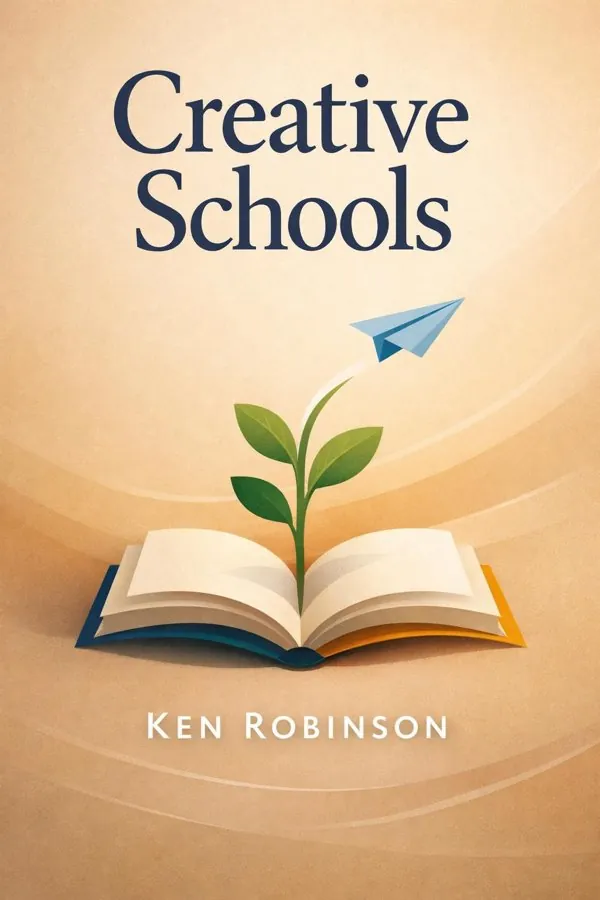
Creative Schools: The Grassroots Revolution That's Transforming Education: Summary & Key Insights
by Ken Robinson
 10 min10 chaptersAudio available
What Is Creative Schools: The Grassroots Revolution That's Transforming Education About?
Creative Schools: The Grassroots Revolution That's Transforming Education by Ken Robinson is a education book spanning 10 pages. Creative Schools explores how education systems around the world can be transformed to nurture creativity and innovation rather than conformity. Ken Robinson argues for a radical shift from standardized testing and rigid curricula toward personalized learning that values imagination, curiosity, and diverse talents. Drawing on inspiring examples from schools and educators globally, the book presents a vision for an education revolution that empowers students to thrive in a rapidly changing world.
This FizzRead summary covers all 10 key chapters of Creative Schools: The Grassroots Revolution That's Transforming Education in approximately 10 minutes, distilling the most important ideas, arguments, and takeaways from Ken Robinson's work. Also available as an audio summary and Key Quotes Podcast.
Creative Schools: The Grassroots Revolution That's Transforming Education
Creative Schools explores how education systems around the world can be transformed to nurture creativity and innovation rather than conformity. Ken Robinson argues for a radical shift from standardized testing and rigid curricula toward personalized learning that values imagination, curiosity, and diverse talents. Drawing on inspiring examples from schools and educators globally, the book presents a vision for an education revolution that empowers students to thrive in a rapidly changing world.
Who Should Read Creative Schools: The Grassroots Revolution That's Transforming Education?
This book is perfect for anyone interested in education and looking to gain actionable insights in a short read. Whether you're a student, professional, or lifelong learner, the key ideas from Creative Schools: The Grassroots Revolution That's Transforming Education by Ken Robinson will help you think differently.
- ✓Readers who enjoy education and want practical takeaways
- ✓Professionals looking to apply new ideas to their work and life
- ✓Anyone who wants the core insights of Creative Schools: The Grassroots Revolution That's Transforming Education in just 10 minutes
Want the full summary?
Get instant access to this book summary and 100K+ more with Fizz Moment.
Get Free SummaryAvailable on App Store • Free to download
Key Chapters
Everywhere I go, people tell me that education is not working as it should. Students feel disengaged, teachers feel undervalued, and policymakers seem obsessed with measurements rather than meaning. To understand the urgency of change, we have to acknowledge the roots of the current system — an industrial-age model built to produce a workforce for predictable, routine labor. Standardization was once its strength; today, it is its Achilles’ heel.
We live in a world of unprecedented complexity, where careers evolve faster than curricula can adapt, and creativity and adaptability are not luxuries but survival skills. Yet our education systems continue to reward conformity and penalize originality. The need for change is not about improving test scores or introducing new gadgets into classrooms. It’s about transforming the very purposes of education — from sorting and selecting to inspiring and equipping.
I often compare schools to farms. A successful farm doesn’t produce crops by force or uniformity; it creates the conditions in which plants can flourish naturally. Education should operate in the same way — cultivating environments where every young person can grow into their unique strengths. The challenge is systemic, not individual. It isn’t that teachers don’t care; it’s that they’re constrained by systems designed for an age long past. The time has come to replace the mechanistic paradigm with an organic one that reflects how people actually learn and live.
One of the fundamental errors in education is the narrow view of intelligence. We’ve been conditioned to see intelligence as an academic hierarchy with mathematics and language at the top, and the arts somewhere near the bottom. But intelligence is wonderfully diverse. People think visually, aurally, kinesthetically; they solve problems through design, movement, collaboration, or storytelling. When we value only certain kinds of intellect, we waste the rest.
In my work, I’ve met countless people who were written off by school but went on to achieve extraordinary things once they discovered their true strengths. Dancers, engineers, chefs, scientists — each with distinct talents that flourished outside the traditional academic mold. The tragedy is not that schools fail to teach content, but that they fail to recognize human potential in all its forms.
To understand human potential, we must understand creativity itself. Creativity isn’t a mysterious gift bestowed on a few geniuses; it’s a natural capacity in everyone, the process of having original ideas that bring value. Children display it effortlessly when they play, explore, and question. Our responsibility as educators is not to teach creativity but to sustain it — to nurture curiosity rather than compliance. By doing so, we turn education from an exercise in memorization into a journey of discovery.
+ 8 more chapters — available in the FizzRead app
All Chapters in Creative Schools: The Grassroots Revolution That's Transforming Education
About the Author
Sir Ken Robinson (1950–2020) was a British author, speaker, and international advisor on education in the arts. He was known for his influential work on creativity and innovation in education, including his TED Talk 'Do Schools Kill Creativity?', one of the most viewed talks of all time. Robinson was knighted in 2003 for his services to the arts and education.
Get This Summary in Your Preferred Format
Read or listen to the Creative Schools: The Grassroots Revolution That's Transforming Education summary by Ken Robinson anytime, anywhere. FizzRead offers multiple formats so you can learn on your terms — all free.
Available formats: App · Audio · PDF · EPUB — All included free with FizzRead
Download Creative Schools: The Grassroots Revolution That's Transforming Education PDF and EPUB Summary
Key Quotes from Creative Schools: The Grassroots Revolution That's Transforming Education
“Everywhere I go, people tell me that education is not working as it should.”
“One of the fundamental errors in education is the narrow view of intelligence.”
Frequently Asked Questions about Creative Schools: The Grassroots Revolution That's Transforming Education
Creative Schools: The Grassroots Revolution That's Transforming Education by Ken Robinson is a education book that explores key ideas across 10 chapters. Creative Schools explores how education systems around the world can be transformed to nurture creativity and innovation rather than conformity. Ken Robinson argues for a radical shift from standardized testing and rigid curricula toward personalized learning that values imagination, curiosity, and diverse talents. Drawing on inspiring examples from schools and educators globally, the book presents a vision for an education revolution that empowers students to thrive in a rapidly changing world.
More by Ken Robinson

You Might Also Like
Bedtime Biography: Florence Nightingale
Isabel Thomas
10 min
Introduction To Museum Studies
Howard H. Hoyt
10 min
A Mind for Numbers: How to Excel at Math and Science (Even If You Flunked Algebra)
Barbara Oakley
10 min
AI for Educators: Learning Strategies, Teacher Empowerment, and the Future of Education
Matt Miller
10 min
Animation For Beginners
Morr Meroz
10 min
Artificial Intelligence for Learning
Donald Clark
10 minBrowse by Category
Ready to read Creative Schools: The Grassroots Revolution That's Transforming Education?
Get the full summary and 100K+ more books with Fizz Moment.