
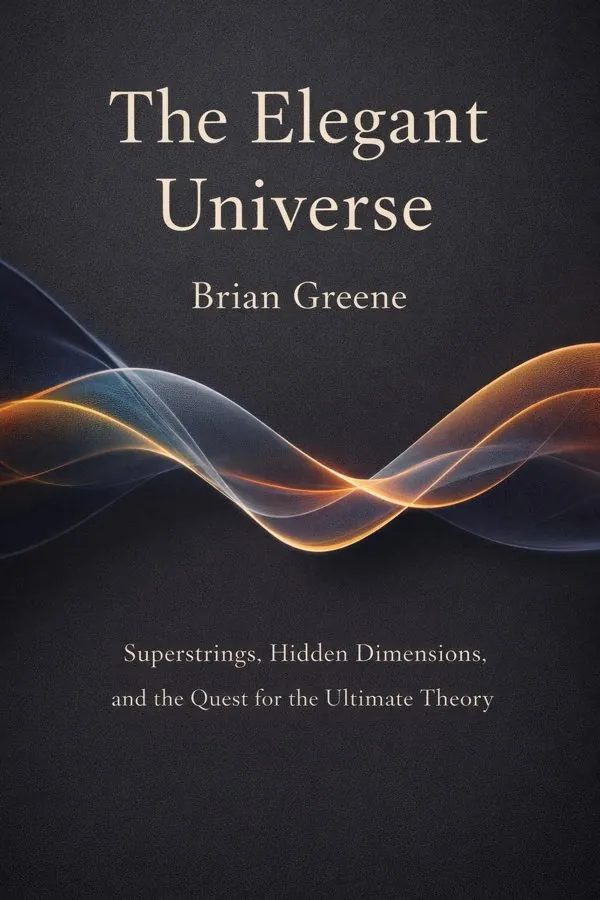
The Elegant Universe: Superstrings, Hidden Dimensions, and the Quest for the Ultimate Theory: Summary & Key Insights
by Brian Greene
 10 min10 chaptersAudio available
Key Takeaways from The Elegant Universe: Superstrings, Hidden Dimensions, and the Quest for the Ultimate Theory
A revolutionary idea often begins by changing what we think space itself is.
The deeper we look into matter, the less the universe behaves like common sense expects.
A map with two masterpieces is still incomplete if the pieces cannot connect.
Sometimes the solution to a major problem begins by shrinking our assumptions to an almost unimaginable scale.
One of the most compelling features of string theory is that gravity is not awkwardly inserted into the theory—it appears naturally.
What Is The Elegant Universe: Superstrings, Hidden Dimensions, and the Quest for the Ultimate Theory About?
The Elegant Universe: Superstrings, Hidden Dimensions, and the Quest for the Ultimate Theory by Brian Greene is a space_physics book spanning 10 pages. What if everything in the universe—matter, energy, space, time, and gravity—could be explained by a single elegant framework? In The Elegant Universe, Brian Greene takes readers into one of modern physics’ most ambitious intellectual adventures: the search for a “theory of everything.” At the heart of that quest is string theory, the idea that the fundamental ingredients of reality are not point-like particles but unimaginably tiny vibrating strings whose different patterns of motion give rise to the particles and forces we observe. Greene’s achievement is not merely explaining difficult science; it is making readers feel why these ideas matter. He guides us from Einstein’s warped spacetime to the strange laws of quantum mechanics, then shows why these two pillars of physics clash at the deepest levels. From there, he introduces extra dimensions, supersymmetry, black holes, and M-theory with clarity, imagination, and intellectual honesty. As a leading theoretical physicist and professor deeply involved in string theory research, Greene writes with rare authority. This book matters because it turns an abstract scientific quest into a gripping human story about our desire to uncover the hidden order of the cosmos.
This FizzRead summary covers all 10 key chapters of The Elegant Universe: Superstrings, Hidden Dimensions, and the Quest for the Ultimate Theory in approximately 10 minutes, distilling the most important ideas, arguments, and takeaways from Brian Greene's work. Also available as an audio summary and Key Quotes Podcast.
The Elegant Universe: Superstrings, Hidden Dimensions, and the Quest for the Ultimate Theory
What if everything in the universe—matter, energy, space, time, and gravity—could be explained by a single elegant framework? In The Elegant Universe, Brian Greene takes readers into one of modern physics’ most ambitious intellectual adventures: the search for a “theory of everything.” At the heart of that quest is string theory, the idea that the fundamental ingredients of reality are not point-like particles but unimaginably tiny vibrating strings whose different patterns of motion give rise to the particles and forces we observe.
Greene’s achievement is not merely explaining difficult science; it is making readers feel why these ideas matter. He guides us from Einstein’s warped spacetime to the strange laws of quantum mechanics, then shows why these two pillars of physics clash at the deepest levels. From there, he introduces extra dimensions, supersymmetry, black holes, and M-theory with clarity, imagination, and intellectual honesty. As a leading theoretical physicist and professor deeply involved in string theory research, Greene writes with rare authority. This book matters because it turns an abstract scientific quest into a gripping human story about our desire to uncover the hidden order of the cosmos.
Who Should Read The Elegant Universe: Superstrings, Hidden Dimensions, and the Quest for the Ultimate Theory?
This book is perfect for anyone interested in space_physics and looking to gain actionable insights in a short read. Whether you're a student, professional, or lifelong learner, the key ideas from The Elegant Universe: Superstrings, Hidden Dimensions, and the Quest for the Ultimate Theory by Brian Greene will help you think differently.
- ✓Readers who enjoy space_physics and want practical takeaways
- ✓Professionals looking to apply new ideas to their work and life
- ✓Anyone who wants the core insights of The Elegant Universe: Superstrings, Hidden Dimensions, and the Quest for the Ultimate Theory in just 10 minutes
Want the full summary?
Get instant access to this book summary and 100K+ more with Fizz Moment.
Get Free SummaryAvailable on App Store • Free to download
Key Chapters
A revolutionary idea often begins by changing what we think space itself is. Before Einstein, gravity was commonly understood as an invisible force acting across empty space, much as Newton described it. Einstein transformed that picture. In general relativity, space and time are woven into a single fabric—spacetime—and massive objects like stars and planets bend that fabric. Gravity is not a pull in the old sense; it is the curvature of spacetime guiding motion.
Greene shows why this was such a monumental breakthrough. It explained planetary orbits more deeply, predicted the bending of light around stars, and made sense of phenomena that Newton’s framework could not fully capture. In Einstein’s universe, the cosmos is not a rigid stage where events merely happen. The stage itself flexes, stretches, and responds. This insight changed cosmology, enabling modern ideas about black holes, the expanding universe, and gravitational waves.
A practical way to understand this is to imagine a trampoline with a heavy bowling ball in the center. Smaller balls rolling nearby follow curved paths not because the bowling ball reaches out and grabs them, but because the surface itself is distorted. The analogy is imperfect, but it captures the heart of Einstein’s vision.
Greene uses this triumph to set up a larger question: if one theory can so radically redefine reality, could there be an even deeper theory uniting all of nature’s forces? Actionable takeaway: when approaching complex ideas, start by identifying the hidden assumption being challenged—in this case, the belief that space is passive rather than dynamic.
The deeper we look into matter, the less the universe behaves like common sense expects. Quantum mechanics emerged when physicists realized that atoms, electrons, and light do not obey the smooth, predictable rules of classical physics. Instead, the microscopic world is governed by probabilities, discrete energy levels, uncertainty, and wave-particle duality.
Greene explains that quantum theory did not arise from philosophical speculation but from stubborn experiments. Light behaved as both wave and particle. Electrons could occupy only certain energy states. Empty space itself turned out not to be truly empty, but alive with temporary fluctuations. The quantum world is a place where asking for exact position and exact velocity at the same time is not merely difficult; it is fundamentally impossible.
This theory has practical consequences everywhere. Semiconductors, lasers, MRI machines, and modern computing all depend on quantum principles. Your smartphone is evidence that nature’s strangest rules can be harnessed with precision. Yet the success of quantum mechanics also creates a puzzle. It describes three of the four fundamental forces beautifully, but it seems to resist any straightforward merger with gravity.
Greene helps readers see that quantum mechanics is not just weirdness for its own sake. It is a tested, mathematically powerful description of reality at small scales. Its oddness is the price of accuracy.
The key lesson is that reality does not owe us intuitive behavior. Actionable takeaway: when a topic feels paradoxical, separate intuition from evidence—many breakthroughs begin when we trust what experiments show rather than what everyday experience suggests.
A map with two masterpieces is still incomplete if the pieces cannot connect. That is the central frustration Greene explores in the relationship between general relativity and quantum mechanics. Each theory is astonishingly successful in its own domain: relativity explains the large-scale structure of stars, galaxies, and gravity, while quantum mechanics governs atoms, particles, and the other fundamental forces. But when physicists try to use both together in extreme environments—such as inside black holes or at the birth of the universe—the mathematics breaks down.
This is more than a technical inconvenience. It suggests that our understanding of nature is split between two incompatible languages. Relativity treats spacetime as smooth and geometric. Quantum theory treats physical processes as fluctuating, probabilistic, and often discontinuous at tiny scales. Try to quantize gravity using ordinary methods, and infinities appear that cannot be sensibly removed.
Greene frames this conflict as one of the greatest scientific tensions of the twentieth century. If the universe is truly one coherent whole, its laws should not fracture when we look at the most extreme conditions. A child can ask, “What happened at the beginning of time?” or “What is inside a black hole?” but the current split in physics has long prevented complete answers.
In everyday terms, it is like having one brilliant theory for highways and another for city streets, but no way to explain how traffic works at an interchange where both meet. The missing connection is exactly where the deepest truths may lie.
Actionable takeaway: pay attention to contradictions between successful ideas. In science and in life, the most important progress often comes not from what already fits, but from the stubborn places where our best explanations collide.
Sometimes the solution to a major problem begins by shrinking our assumptions to an almost unimaginable scale. String theory proposes that the basic constituents of reality are not zero-dimensional point particles, but tiny one-dimensional strings. These strings are so small that no current instrument can directly see them, yet their different vibrational patterns may generate the particles we detect—electrons, quarks, photons, and more.
Greene explains why this idea is so powerful. In conventional particle theories, point-like particles create severe mathematical problems when gravity is included. But if the basic ingredients are tiny extended objects, some of those infinities soften. Just as a violin string can produce different musical notes depending on how it vibrates, a fundamental string can manifest as different particle types depending on its mode of vibration. Matter and force are no longer entirely separate categories; they become expressions of the same underlying entity.
This shift is conceptually elegant because it replaces a zoo of distinct particles with a single unifying principle. The universe starts to look less like a box of unrelated parts and more like a symphony built from one instrument playing different tones. Greene’s talent lies in making this leap feel both audacious and oddly natural.
The practical application is not that we use string theory in engineering today, but that it offers a framework for solving deep conceptual problems in high-energy physics and cosmology. It changes the questions researchers ask and the mathematical tools they develop.
Actionable takeaway: when faced with complexity, look for whether many apparent differences could be variations of one deeper pattern. That instinct toward unification often reveals more than cataloging surface details.
One of the most compelling features of string theory is that gravity is not awkwardly inserted into the theory—it appears naturally. This is a crucial reason the theory attracted so much attention. In the mathematical description of vibrating strings, one of the vibration modes has exactly the properties expected of the graviton, the hypothetical quantum particle that would carry the force of gravity.
Greene emphasizes the significance of this result. Physicists had spent decades struggling to quantize gravity using the standard toolkit of particle physics, only to encounter destructive infinities. String theory suggested something extraordinary: perhaps gravity was never the outsider; perhaps our old assumption that particles are point-like was the real mistake. Once the fundamental entities are strings, gravity enters as part of the package.
This matters because a quantum theory of gravity is essential for understanding regions where immense mass is compressed into tiny spaces, such as black holes, and epochs when the whole universe was compressed shortly after the Big Bang. In such extremes, neither relativity alone nor quantum theory alone is enough.
A useful analogy is architecture. If a building constantly develops cracks under stress, perhaps patching the walls is not the answer; perhaps the blueprint itself needs revision. String theory proposes a new blueprint in which gravity fits structurally rather than cosmetically.
Greene does not claim final victory. The theory remains mathematically rich and experimentally difficult to test. Still, the natural emergence of gravity is one of its strongest conceptual triumphs.
Actionable takeaway: if a solution feels forced, reconsider the underlying model. Elegant explanations often stand out because they make the difficult piece arise naturally rather than by patchwork.
Nature often appears lopsided, but deep laws may hide elegant symmetries beneath that imbalance. Supersymmetry is one such proposed symmetry. Greene explains it as a theoretical relationship between two broad classes of particles: fermions, which make up matter, and bosons, which carry forces. In a supersymmetric world, every known particle would have a heavier partner with related properties.
Why introduce such a bold idea? Partly because it helps string theory work consistently, but also because it may solve important problems in particle physics. Supersymmetry can stabilize certain equations, improve the unification of forces at high energies, and potentially provide candidates for dark matter. It is an example of how a mathematically motivated concept can also illuminate puzzles in the observed universe.
Greene carefully presents supersymmetry not as an established fact but as a compelling possibility. So far, particle accelerators have not confirmed supersymmetric partners, which means either the symmetry is broken at energies beyond current reach or nature chose a different path. Yet the concept remains influential because of the order it brings to theory.
A practical analogy is language translation. Two languages may seem unrelated until you discover a shared grammar underneath. Supersymmetry suggests that matter and force, which seem different, may be linked by a deeper rule set.
For readers, the broader value is learning how theoretical physics operates: not by guessing wildly, but by searching for structures that make the equations more coherent and predictive.
Actionable takeaway: when evaluating bold ideas, ask what problems they solve. A good theory is not just imaginative; it earns attention by reducing disorder and connecting previously separate phenomena.
One of the strangest twists in the story is that the search for unity briefly produced more variety than expected. By the 1980s and early 1990s, physicists had developed five distinct versions of string theory. That seemed disappointing: a theory meant to unify nature had itself fractured into multiple candidates. Greene explains how this apparent setback turned into a deeper insight.
Through a network of mathematical relationships called dualities, physicists realized that the five string theories might not be competitors at all. They could be different limits, perspectives, or approximations of a single underlying framework. This larger picture became known as M-theory. Although not fully understood, M-theory suggested that strings were only part of the story; higher-dimensional objects called branes also play fundamental roles.
This development is important because it changed what counts as progress in theoretical physics. Instead of choosing one model and discarding the rest, researchers learned that different descriptions can be equivalent under certain conditions. What looks like contradiction from one angle may be complementarity from another.
A practical comparison is maps. A subway map, a road map, and a topographic map all depict the same city while emphasizing different features. None is the whole city, but each is valid within its purpose. M-theory hints that our theories may work similarly.
Greene presents this evolution as both humbling and exciting. It shows that the road to understanding may require stepping beyond familiar categories and accepting that ultimate theories might appear in fragments before their full structure is visible.
Actionable takeaway: when multiple explanations seem to compete, consider whether they might be partial views of a larger truth rather than mutually exclusive opposites.
A theory earns lasting significance when it reaches beyond abstraction and speaks to the universe’s most extreme phenomena. Greene explores how string theory may illuminate black holes, the early universe, and the deep structure of spacetime. Black holes are especially important because they force relativity and quantum mechanics into direct confrontation. They compress enormous mass into tiny regions, making them natural laboratories for quantum gravity.
String theory contributed powerful ideas here, including microscopic accounts of black hole entropy in certain cases. That achievement suggested the theory was not merely mathematically decorative but capable of explaining real physical properties. Greene also discusses cosmology: if string theory is correct, it may reshape how we understand the Big Bang, cosmic evolution, and perhaps even the origin of the universe’s constants.
Yet Greene is candid about the central challenge: evidence. Because the relevant scales are so tiny and energies so high, direct tests are difficult. Researchers therefore look for indirect clues, such as signatures in cosmology, particle physics, or mathematical consistency with known phenomena. This tension between conceptual beauty and empirical verification is one of the book’s most honest and valuable themes.
For readers, this offers a realistic picture of science in progress. Frontier theories are not neat collections of proven facts; they are evolving structures judged by elegance, explanatory power, internal consistency, and eventually testability.
Actionable takeaway: admire bold theories, but always ask what observations could support or challenge them. Intellectual excitement is strongest when paired with disciplined skepticism.
The search for a final theory is not only a scientific project; it is also a deeply human expression of curiosity. Greene’s book closes on a theme larger than equations: why people care so intensely about unification at all. The desire to understand the universe at its deepest level reflects something fundamental about the human mind. We seek patterns, coherence, and stories that reveal how the parts fit into a whole.
Greene portrays physics not as a cold collection of formulas, but as an ongoing conversation about existence. What is space? Is time fundamental? Why do the laws of nature have the form they do? These questions matter even to readers who never solve an equation, because they shape our picture of reality and our place within it. The quest for unification is therefore both intellectual and existential.
There is also a practical lesson in the scientific attitude Greene models. Great discoveries require patience, creativity, rigor, and comfort with uncertainty. String theory may or may not become the final answer, but the pursuit itself has already expanded mathematics, inspired new frameworks, and deepened our understanding of what a fundamental theory must explain.
In everyday life, we often treat uncertainty as failure. Greene suggests the opposite. Not knowing can be the beginning of disciplined wonder. The most profound questions are not always quickly solvable, but they can still guide meaningful exploration.
Actionable takeaway: cultivate curiosity about first principles. Whether in science, work, or personal decisions, asking “what deeper pattern explains this?” can lead to more thoughtful, integrated understanding.
All Chapters in The Elegant Universe: Superstrings, Hidden Dimensions, and the Quest for the Ultimate Theory
About the Author
Brian Greene is an American theoretical physicist, mathematician, and professor at Columbia University, widely known for both his research and his gift for public science communication. He has made important contributions to string theory, particularly in areas involving mirror symmetry and the geometry of extra dimensions. Beyond academia, Greene has become one of the most recognizable interpreters of modern physics for general audiences through bestselling books, documentaries, and television appearances. His writing combines technical authority with unusual clarity, allowing non-specialists to engage with some of the most abstract ideas in science. Through works such as The Elegant Universe, he has helped bring discussions of spacetime, quantum theory, and the search for a unified theory into mainstream culture, inspiring readers to think more deeply about the structure of reality.
Get This Summary in Your Preferred Format
Read or listen to the The Elegant Universe: Superstrings, Hidden Dimensions, and the Quest for the Ultimate Theory summary by Brian Greene anytime, anywhere. FizzRead offers multiple formats so you can learn on your terms — all free.
Available formats: App · Audio · PDF · EPUB — All included free with FizzRead
Download The Elegant Universe: Superstrings, Hidden Dimensions, and the Quest for the Ultimate Theory PDF and EPUB Summary
Key Quotes from The Elegant Universe: Superstrings, Hidden Dimensions, and the Quest for the Ultimate Theory
“A revolutionary idea often begins by changing what we think space itself is.”
“The deeper we look into matter, the less the universe behaves like common sense expects.”
“A map with two masterpieces is still incomplete if the pieces cannot connect.”
“Sometimes the solution to a major problem begins by shrinking our assumptions to an almost unimaginable scale.”
“One of the most compelling features of string theory is that gravity is not awkwardly inserted into the theory—it appears naturally.”
Frequently Asked Questions about The Elegant Universe: Superstrings, Hidden Dimensions, and the Quest for the Ultimate Theory
The Elegant Universe: Superstrings, Hidden Dimensions, and the Quest for the Ultimate Theory by Brian Greene is a space_physics book that explores key ideas across 10 chapters. What if everything in the universe—matter, energy, space, time, and gravity—could be explained by a single elegant framework? In The Elegant Universe, Brian Greene takes readers into one of modern physics’ most ambitious intellectual adventures: the search for a “theory of everything.” At the heart of that quest is string theory, the idea that the fundamental ingredients of reality are not point-like particles but unimaginably tiny vibrating strings whose different patterns of motion give rise to the particles and forces we observe. Greene’s achievement is not merely explaining difficult science; it is making readers feel why these ideas matter. He guides us from Einstein’s warped spacetime to the strange laws of quantum mechanics, then shows why these two pillars of physics clash at the deepest levels. From there, he introduces extra dimensions, supersymmetry, black holes, and M-theory with clarity, imagination, and intellectual honesty. As a leading theoretical physicist and professor deeply involved in string theory research, Greene writes with rare authority. This book matters because it turns an abstract scientific quest into a gripping human story about our desire to uncover the hidden order of the cosmos.
Compare The Elegant Universe: Superstrings, Hidden Dimensions, and the Quest for the Ultimate Theory
More by Brian Greene
Until the End of Time: Mind, Matter, and Our Search for Meaning in an Evolving Universe
Brian Greene
10 min
The Fabric of the Cosmos: Space, Time, and the Texture of Reality
Brian Greene
10 min
The Hidden Reality: Parallel Universes and the Deep Laws of the Cosmos
Brian Greene
10 minYou Might Also Like
The Means Of Prediction
Mark P. Silverman
10 min
AstroTech
Various Authors
10 min
Black Holes and Time Warps: Einstein’s Outrageous Legacy
Kip S. Thorne
10 min
Dark Matter and the Dinosaurs: The Astounding Interconnectedness of the Universe
Lisa Randall
10 min
Helgoland
Carlo Rovelli
10 min
Hyperspace: A Scientific Odyssey Through Parallel Universes, Time Warps, and the 10th Dimension
Michio Kaku
10 minBrowse by Category
Ready to read The Elegant Universe: Superstrings, Hidden Dimensions, and the Quest for the Ultimate Theory?
Get the full summary and 100K+ more books with Fizz Moment.